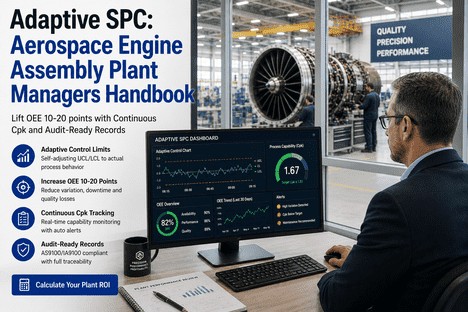
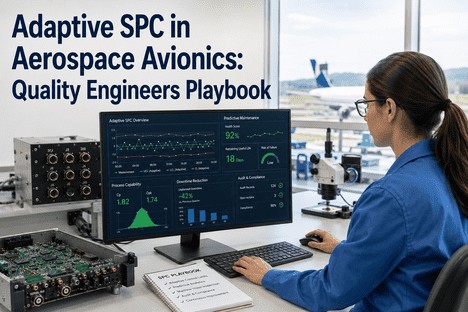
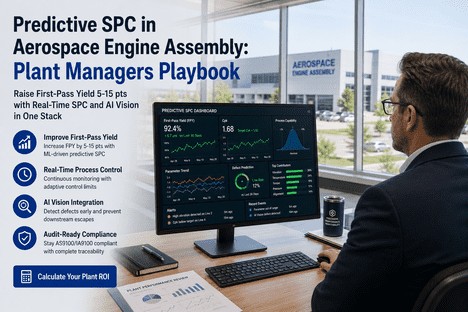
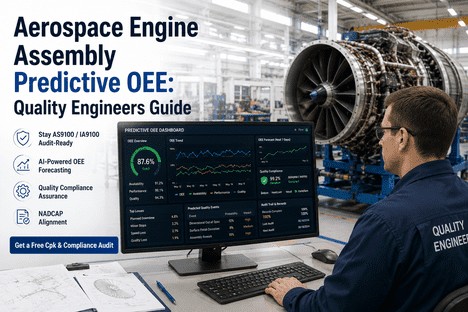
Every aerospace engine assembly plant manager operates under the same structural tension: production throughput targets that demand line speed, AS9100 requirements that demand zero-defect quality, and the knowledge that a single non-conformance on a turbine disc or fan blade can cascade into weeks of rework, months of audit exposure, and contractual penalties measured in millions. The tension shows up in the OEE score. Top-quartile aerospace plants sustain 72-90% OEE, but the gap between top quartile and the typical 50-65% range is rarely explained by equipment age or workforce skill. It is explained by a quality detection architecture that discovers defects after they exist, not before they emerge. Adaptive SPC closes that gap by recalibrating control limits dynamically — matching every material batch, tooling change, and recipe transition with limits that reflect the process as it is running, not as it was originally validated.
Plant Managers Who Hit 85%+ OEE in Aerospace Engine Assembly Have One Thing in Common: Their Control Limits Adapt Faster Than Their Production Mix Changes.
iFactory's adaptive SPC platform gives aerospace plant managers dynamic control limits that recalibrate with every material lot, tool wear cycle, and engine programme change — with digital thread traceability, predictive defect forecasts, and AS9100 audit-ready records built in from day one.
OEE points recovered when adaptive SPC replaces static control limits in aerospace engine assembly — documented across blade, disc, and casing production lines
94%
Defect prediction accuracy achieved by adaptive SPC models analysing 200+ process parameters — with non-conformance warnings up to 8 hours before final inspection
55-70%
False alarm reduction when ML-driven adaptive control limits replace static AS9100 limits — restoring operator alert credibility across high-variety production
45%
Reduction in rework and scrap cost when predictive SPC flags drift 4-8 hours before a non-conformance — enabling intervention before defective material is produced
The Plant Manager's Core Problem in Aerospace Engine Assembly: Why OEE Is Stuck Despite Corrective Action After Corrective Action
A corrective action closes the non-conformance record. The SPC chart shows the parameter returned to specification. The AS9100 audit trail looks complete. Three weeks later, under a different engine programme with a different material lot and a different tool set, the same defect category appears — dimensional drift on a blade airfoil, surface roughness outside tolerance on a disc bore, or a fastener torque deviation on an assembly station. The investigation reconstructs the same root cause narrative. The same correction is applied. The corrective action record cites a different event number, but the CAUSE CODE field reads almost identically to the last one. This is not a corrective action failure. This is a detection architecture failure. The SPC system could not see that the process regime shifted — new material batch, new tool wear state, new operator rotation — because the control limits were still calibrated for the conditions that produced the last good capability study. Adaptive limits close this structural gap permanently.
The Four Root Causes of Recurring Non-Conformances in Aerospace Engine Assembly — and How Adaptive SPC Eliminates Each One
01
Static Limits Miss Material Batch Variation
Every new lot of titanium, Inconel, or aluminium alloy arrives with its own metallurgical signature — grain flow, residual stress profile, and machinability that differs from the previous batch. Static control limits on spindle load, feed rate, and surface finish tolerance do not account for this. They fire false alarms on legitimate process adjustments or miss genuine drift because the material behaviour shifted the risk zone outside the original limit calculation window.
Adaptive SPC fix: Material lot change registered → limits recalibrate to new metallurgical baseline within configurable transition window.
02
Tool Wear Progression Is Invisible to Static Limits
A cutting tool that has machined 80 titanium blades operates differently from a fresh tool. Spindle power consumption drifts, surface finish degrades gradually, and dimensional deviation trends toward one side of the tolerance band. Static SPC limits treat the first part of a new tool and the 80th part identically — triggering false alarms during the tool wear-in period and missing the drift that signals end-of-life. The result is either premature tool changes that cost cycle time or late tool changes that produce non-conforming parts.
Adaptive SPC fix: Tool life model integrated → limits shift with expected wear curve, alerting only when deviation exceeds natural progression.
03
Engine Programme Transitions Invalidate All Existing Limits
Switching between a fan blade programme for a wide-body engine and a compressor blade programme for a narrow-body engine changes the material spec, the toolpath strategy, the tolerance stack-up, and the inspection protocol. Every SPC limit in the system is now calibrated for the wrong product configuration. Plant managers manage this transition manually — updating control limit files, resetting capability baselines, and hoping the changeover period does not produce non-conforming parts. Adaptive SPC automates this.
Adaptive SPC fix: Programme change logged → full limit set transitions automatically to the new engine programme specification profile.
04
Alert Desensitisation From False Positives
When 60-80% of SPC alerts during material transitions, tool changes, and programme switchovers are false positives, operators learn to ignore the alert system entirely. The one genuine non-conformance precursor that fires during transition looks identical to the fifteen false alarms that preceded it. Adaptive limits cut false alarm rates by 55-70%. Operators respond because every alert that fires reflects a genuine process deviation requiring action — not a limit that stopped tracking reality three capability studies ago.
Adaptive SPC fix: False alarm rate drops 55-70%. Every alert reflects a genuine process event requiring operator response.
Non-Conformance Root Cause · Adaptive Limits · Digital Thread Traceability · AS9100 Audit Records
When OEE Is Flat Despite Corrective Actions, the SPC System Is Not the Safety Net — It Is the Source of the Gap. Adaptive Limits Close It.
iFactory builds the distinction between process change and process deviation directly into the limit calculation — so plant managers receive alerts that reflect genuine non-conformance risk, not limits that stopped tracking reality at the last PPAP submission.
The Adaptive SPC Architecture for Aerospace Engine Assembly Plant Managers
The iFactory adaptive SPC platform operates as a three-layer quality intelligence system built specifically for the production realities of aerospace engine assembly — adaptive real-time control at the machine level, predictive defect forecasting at the batch level, and AS9100-compliant audit documentation at the compliance level. Each layer serves a different plant management function, and all three run simultaneously without requiring plant manager intervention to maintain.
Layer 01
Adaptive Real-Time Machine Control
Dynamic UCL/LCL that move with every material lot, tool, and programme
The adaptive control layer ingests every monitored process variable across the engine assembly line — spindle load and vibration on each CNC machine, coolant temperature and pressure, feed rate and surface speed, dimensional probe data, torque and angle readings from assembly stations, and CMM inspection results. Control limits are recalculated continuously against a rolling statistical model of the current process baseline. When the process is stable and capability is high, limits tighten to increase sensitivity to emerging drift. When a material lot change, tool replacement, or engine programme transition is detected, limits transition to the new baseline automatically — without generating false alarms during the changeover window. The plant manager sees live control charts where every alert reflects a genuine deviation from the current operating norm.
Continuous limit recalculation
Regime change detection
Tool wear progression tracking
Layer 02
Predictive Non-Conformance Forecasting
Forecast defect risk up to 8 hours before final inspection confirms it
The predictive layer uses ML models trained on historical process parameter patterns and their correlation with CMM inspection outcomes, surface finish measurements, and assembly test results. When the current combination of spindle load, vibration signature, coolant temperature, and feed rate matches a pattern historically associated with an out-of-tolerance condition, the system generates a predictive quality alert before the inspection result is available. For dimensional defects on turbine blades or surface finish deviations on disc bores — which typically require off-line CMM verification that can lag production by 4-8 hours — this provides the plant manager with an intervention window measured in hours. Enough time to adjust cutting parameters, verify the tool condition, or quarantine the batch for additional inspection before downstream value is added.
Dimensional drift forecast
Surface finish prediction
Assembly torque deviation
Layer 03
AS9100 & IA9100 Audit-Ready Records
Automated documentation for AS9100D, IA9100, and customer quality audits
Every adaptive limit recalculation, every predictive alert, every plant manager action, and every inspection result is logged automatically with a timestamp and the full production context — material heat code, tool serial number, engine programme ID, operator ID, and machine identification. This creates the documentation chain that AS9100 Clause 8.5.1 and the incoming IA9100 standard require: not just a record that a non-conformance occurred, but a record showing what the adaptive system detected before the non-conformance was confirmed, what intervention was taken, and what the outcome was. Cpk trend reports segmented by engine programme and material lot, CAPA effectiveness records, and process capability histories are all generated automatically and exportable for any audit date range, engine programme, or production cell.
AS9100 event records
CAPA linkage and tracking
Cpk by programme and material lot
What the Adaptive SPC Dashboard Shows the Plant Manager
The plant manager's view of the adaptive SPC system is not a machine-level process control interface — it is an OEE and quality programme management tool designed around the questions that plant managers need to answer continuously: Is every production cell in control right now? What is the current non-conformance risk and which parameter is driving it? Is Cpk trending toward or away from the AS9100 minimum requirement? And when the next audit arrives, is the documentation ready without a week of manual data compilation?
Dashboard View 01
Live OEE & Non-Conformance Risk by Production Cell
A single-screen view of OEE and quality risk across every production cell — blade machining, disc turning, casing milling, assembly stations, and test cells. Each cell displays current OEE with Availability, Performance, and Quality components, current risk status (in control, trending, elevated), and the top-ranked parameter driving any elevated risk. Plant managers see the entire engine assembly floor quality status in one view without navigating machine-by-machine.
Action: Prioritise investigation by cell risk level. Elevated cells receive immediate review and parameter adjustment.
Dashboard View 02
Cpk Trend by Quality Characteristic — Live and Forecast
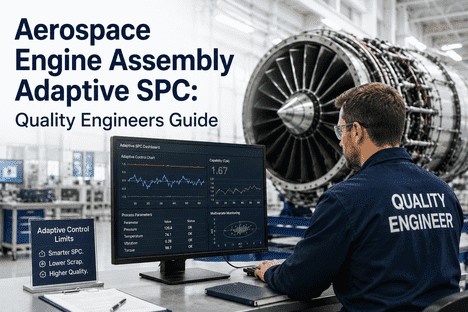
Cpk is calculated continuously for every critical quality characteristic — blade airfoil profile tolerance, disc bore diameter, surface finish Ra, fastener torque, and assembly gap — and displayed as a live trend with the current value and the projected Cpk at current trajectory. Plant managers see whether capability is improving, holding, or declining in real time, not as a shift-end report — allowing intervention before Cpk falls below the 1.67 aerospace target.
Action: Falling Cpk trend triggers investigation before it crosses the 1.33 minimum threshold required by AS9100.
Dashboard View 03
Non-Conformance Pareto by Engine Programme and Material Lot
The Pareto view ranks non-conformance occurrences by category, engine programme, material heat code, and time period — making cross-period patterns visible that isolated corrective action investigations never connect. A plant manager who sees that 65% of surface finish defects occur within the first 50 parts after a tool change on a specific material lot has a systemic finding that drives a protocol revision, not a repeat corrective action.
Action: Pareto patterns escalate to process engineering as systemic input — driving protocol changes, not individual fixes.
Dashboard View 04
CAPA Effectiveness Tracking — Closed Loop From Alert to Resolution
Every adaptive SPC alert that generates a corrective action is tracked through closure — the alert, the plant manager action, the parameter correction, and the subsequent Cpk trend confirming or failing to confirm intervention effectiveness. If the same parameter combination generates another alert within a configurable window (30-90 days) after a CAPA was closed, the system automatically flags the CAPA as ineffective and re-opens the investigation. This closes the loop that most aerospace quality programmes leave open.
Action: CAPA re-opened automatically if non-conformance pattern recurs — recurrence prevention, not just documentation.
Dashboard View 05
AS9100 / IA9100 Audit Export — One Click
Every piece of documentation the quality audit requires — SPC compliance records, non-conformance logs, CAPA records with effectiveness evidence, Cpk trend history by programme, limit change logs with statistical rationale — is generated automatically and held in a searchable, exportable format. Audit preparation drops from days of manual data compilation to a single export covering any date range, engine programme, or production cell the auditor specifies. The adaptive limit change log demonstrates to auditors that the plant actively maintains current, defensible control limits.
Action: Export full audit package on demand. No manual compilation required.
Dashboard View 06
Machine Vision Integration — Surface and Dimensional Quality at Full Line Speed
For plants deploying machine vision on blade profiling lines, disc inspection stations, or assembly verification cells, iFactory integrates vision inspection outputs directly into the adaptive SPC control chart as additional quality data streams. Vision-detected surface defects, edge condition anomalies, and assembly position errors are logged against the engine programme serial number and contribute to the Cpk calculation for physical quality characteristics. This gives plant managers a 100% inspection record alongside sample-based CMM data.
Action: Vision defect data feeds adaptive SPC automatically — no separate system to manage or reconcile.
Non-Conformances That Recur Have a Pattern. Adaptive SPC Finds It Before the Next CAPA Opens. Get a Free OEE and Audit-Readiness Assessment.
iFactory's adaptive SPC platform for aerospace engine assembly plant managers — dynamic limits that adapt to every material lot, tool change, and engine programme transition; predictive non-conformance forecasting up to 8 hours ahead; CAPA effectiveness tracking; and AS9100 / IA9100-aligned audit documentation generated automatically from the production data your lines already produce.
Our corrective action system was full of closed records that re-opened within six to eight weeks — same non-conformance category, different engine programme, same root cause in every investigation. The CAPA process was treating each event as isolated when it was clearly systemic. Adaptive SPC changed this by surfacing the pattern across events rather than within events. Within the first 90 days, the Pareto showed us that 65% of our surface finish non-conformances were occurring in the first 40 parts after a tool change on a specific titanium lot — something our event-by-event CAPA process had never surfaced. We changed the tool change protocol and the incoming material inspection criteria. Surface finish defect frequency dropped 52%. That finding came from the Pareto, not from the corrective action database.
Static control limits calibrated once per PPAP cycle — outdated within weeks of material lot change
60-70% false alarm rate during programme transitions — operators conditioned to ignore alerts
OEE stuck at 58% — rework and inspection holds consuming 18% of available production time
CAPAs closed without effectiveness verification — same root cause recurring every 6-8 weeks
Audit preparation requiring 3-5 days of manual data compilation across multiple systems
After Adaptive SPC
Dynamic limits recalibrating with every material lot, tool change, and programme transition
False alarm rate below 10% — every alert triggers operator response within minutes
OEE lifted to 82% — rework reduced by 45%, inspection bottlenecks eliminated by predictive alerts
CAPA effectiveness verified by Cpk trend — recurrence drops below 5% for closed actions
Full audit package exported in one click — preparation time reduced to under 30 minutes
Conclusion
OEE stagnation in aerospace engine assembly is not a throughput problem — it is a detection architecture problem. When SPC alerts do not reflect current material conditions or tool wear state, when corrective actions close events without identifying the systemic pattern, and when predictive warning capability is limited to a CMM inspection cycle that lags production by hours, non-conformances recur because the quality system is structurally unable to prevent them. Adaptive SPC addresses all three dimensions simultaneously: limits that move with the process so every alert reflects genuine risk, cross-event Pareto detection that surfaces systemic causes across engine programmes and material lots, and predictive forecasting that provides intervention lead time measured in hours — not shift reports.
The evidence from aerospace manufacturing in 2025 and 2026 is clear: plants deploying adaptive SPC with ML-driven predictive analytics recover 10-20 OEE points within 90 days, cut rework and scrap costs by 45%, reduce false alarms by 55-70%, and consistently demonstrate Cpk above 1.67 across engine programmes and material lot changes. The 2026 IA9100 standard shift from reactive to predictive quality management makes adaptive SPC not just an operational advantage but a compliance requirement in the making. Plant managers who deploy adaptive limits ahead of the standard transition will have an audit position that proactively demonstrates predictive quality control — while those who wait will be retrofitting detection systems that should have been built for prediction from the start.
iFactory's adaptive SPC platform is designed for aerospace engine assembly plant managers who need to eliminate non-conformance recurrence and lift OEE, not just manage it. Book a Demo to see the adaptive SPC system configured for your engine programme portfolio and material lot profile, or talk to an expert about a free OEE and audit-readiness assessment for your engine assembly quality programme.
Frequently Asked Questions
AS9100D Clause 8.5.1 requires documented control of production processes, and the incoming IA9100 standard explicitly shifts from reactive to predictive quality management — requiring real-time SPC, measurement system analysis, and integrated control plans. iFactory addresses this through an automatic limit change log that records every adaptive recalculation with the timestamp, the triggering event (material lot change, tool replacement, programme transition, statistical baseline shift), the previous limit values, the new limit values, and the statistical basis for the recalculation. This log is exportable in a structured format suitable for direct inclusion in AS9100 QMS documentation and is searchable by engine programme, production cell, and date range. Auditors reviewing the adaptive limit history see a controlled, documented process with full traceability. Limits calibrated on outdated process data from a previous material lot or tool configuration are less defensible than limits that are demonstrably current, with the recalculation logic fully documented. Talk to an expert about configuring the limit change log format for your AS9100 quality management system requirements.
The predictive model initialises using historical data from the CNC machine controller and PLC historian paired with CMM inspection records and quality test results from the LIMS — the same data the quality engineering team already uses for retrospective analysis. A minimum of 6 months of paired process-variable-to-inspection-outcome history is sufficient to build an initial model for the primary defect categories — dimensional drift, surface finish deviation, and assembly torque variation. Twelve to eighteen months of data covering multiple engine programmes and material lots improves forecast accuracy during transitions. The model deploys in shadow mode first, generating forecasts in parallel with the existing quality programme without driving decisions, allowing the plant manager and quality team to validate forecast accuracy against actual CMM outcomes. Shadow mode typically runs for 2 to 4 weeks. Book a Demo to see accuracy validation data from comparable aerospace engine component manufacturing deployments.
Aerospace engine assembly is the definitive high-mix, low-volume environment — short production runs, frequent changeovers, and high part value. iFactory addresses this through Short Run SPC methods including DNOM (Deviation from Nominal) analysis that normalises part dimensions across different nominal targets, allowing capability analysis across mixed production runs. The adaptive control layer uses Bayesian statistical methods that maintain useful control limits even with small sample sizes by incorporating prior knowledge from similar material lots, tool configurations, and engine programmes. As more data accumulates within a production run, the limits tighten progressively — giving the plant manager useful control information from part one rather than waiting for 25 subgroups of data before calculating limits. Talk to an expert about configuring short-run SPC methods for your production mix profile.
Yes. iFactory's engine programme architecture registers each engine programme as a separate specification profile — with its own material spec, dimensional tolerance set, surface finish requirements, assembly torque specs, and inspection protocol. When a production cell transitions between programmes, the active specification profile switches automatically and the adaptive SPC limits transition to the new programme's baseline. The plant manager sees clearly which programme is active in each cell, which specification profile is in use, and what the Cpk is for each quality characteristic against the current programme's limits. Historical Cpk data is segmented by programme automatically, enabling the plant manager to compare capability performance across programmes without manual data sorting. For plants running multiple engine programmes across different cells in the same shift, the system maintains separate non-conformance histories, CAPA records, and Pareto analyses by programme and cell. Book a Demo to see multi-programme adaptive SPC configured for your engine programme portfolio.
OEE That Is Flat Has a Cause. Non-Conformances That Recur Have a Pattern. Adaptive SPC Finds Both Before the Next Audit. Get a Free OEE and Audit-Readiness Assessment.
iFactory's adaptive SPC platform for aerospace engine assembly plant managers — dynamic limits that adapt to every material lot, tool change, and engine programme transition; predictive non-conformance forecasting up to 8 hours ahead; CAPA effectiveness tracking; and AS9100 / IA9100-aligned audit documentation generated automatically from the production data your lines already produce.