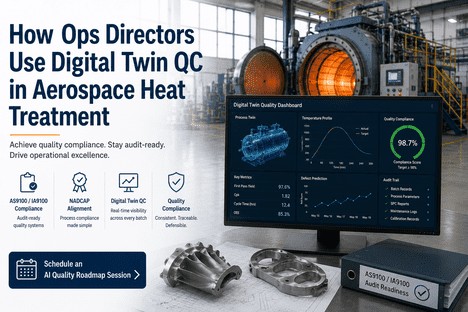
How Ops Directors Use Digital Twin QC in Aerospace Heat Treatment
By Grace on June 17, 2026
An operations director managing aerospace heat treatment under AS9100 and NADCAP faces a structural contradiction: every furnace cycle is certified, every recipe is approved, every thermocouple is calibrated — yet non-conformances still appear, corrective actions still recur, and every NADCAP audit still requires days of manual data compilation across disconnected systems. The furnace runs the certified cycle. The cycle matches the recipe. The thermocouples read within tolerance. The part fails hardness anyway. The investigation finds that the zone temperature distribution shifted after the last maintenance event, the quench medium degraded beyond specification, or the load configuration created a thermal shadow that the single control thermocouple never detected. The certified cycle was correct. The real furnace was not the same system the certification was performed on. This gap between the furnace as it was when certified and the furnace as it is when the cycle runs is the single largest unaddressed source of quality risk in aerospace heat treatment — and no amount of post-cycle documentation or corrective action management can close it, because the documentation captures the event after the fact while the corrective action addresses the symptom rather than the structural condition that produced it. Digital Twin Quality closes this gap by maintaining a continuous virtual replica of the furnace — its current thermal behaviour, its actual zone uniformity, its real quench performance — and simulating every cycle against this live model before the physical cycle begins. For operations directors, this is the difference between managing heat treatment by recipe certification and managing it by current furnace reality. The certification says the furnace was capable on a specific date. The digital twin says whether the furnace is capable right now, for the specific load and recipe queued for the next cycle.
85%
Reduction in audit preparation time when digital twin cycle records replace manual data compilation across multiple furnace control and LIMS systems
60-80%
Of heat treatment non-conformances traced to furnace condition drift between certification events — drift that digital twin simulation detects before the cycle runs
3-5x
Faster root cause identification when digital twin replay enables investigators to rerun the exact cycle conditions that produced a non-conformance
100%
Of production cycles paired with a digital twin quality record — every load documented with simulated vs actual performance for full compliance traceability
Digital Twin Quality Turns Every Furnace Cycle Into a Documented, Predictable, Audit-Ready Event. See It on Your Data.
iFactory's Digital Twin Quality platform for aerospace heat treatment gives operations directors a live virtual replica of every furnace — simulating cycles before they run and generating AS9100/NADCAP-compliant records automatically.
Digital Twin Quality vs Traditional Heat Treat QC — The Difference Is Simulation Before Material Commitment
Traditional heat treatment quality control operates on a verify-after-cycle model: run the certified recipe, collect the furnace data, test the part, document the outcome. If the part passes, the cycle was good. If it fails, the investigation reconstructs what happened from the recorded data. Digital Twin Quality inverts this sequence: simulate the cycle against the current digital twin of the furnace before the physical load enters, validate that the simulated outcome meets specification, and only then commit the material. The difference is not in the documentation — both approaches produce records. The difference is that one approach knows the outcome before the cycle starts and the other discovers it after the cycle ends. The practical consequence of this inversion is far-reaching. In the verify-after-cycle model, every non-conformance consumes material that has already been through upstream machining, every investigation relies on reconstructing furnace behaviour from limited logged data, and every corrective action closes an event without necessarily addressing the furnace condition that caused it. In the simulate-before-cycle model, non-conformances from predictable furnace condition drift are eliminated because the twin detects them before material is committed, investigations are replaced by simulation review because the predicted outcome is already documented, and corrective actions focus on furnace condition restoration rather than event documentation.
Traditional QC — Verify After Cycle
1
Load certified recipe into furnace controller
2
Run cycle with data logging
3
Test mechanical properties and microstructure
4
Document outcome — pass or non-conformance
Non-conformance discovered after material is committed. Scrap or rework already incurred.
Digital Twin QC — Simulate Before Cycle
1
Digital twin simulates cycle against current furnace state
2
Predicted quality outcome validated against specification
3
Material committed only if simulation confirms specification
4
Actual cycle data compared with simulation for continuous twin fidelity
Non-conformance prevented before material enters furnace. Zero scrap from predictable deviations.
How the Digital Twin Quality Cycle Works — A Four-Stage Pipeline
The iFactory Digital Twin Quality platform operates as a continuous four-stage cycle that mirrors every physical furnace with a live virtual model. The cycle runs continuously — each completed physical cycle feeds back into the digital twin, and the next simulation starts from an incrementally more accurate representation of the furnace's current thermal behaviour.
01
Twin Calibration
TC
Every furnace in the fleet is modelled as a digital twin calibrated to its current physical state — zone temperature response curves, thermal mass, quench heat transfer coefficient, atmosphere dynamics. The twin updates continuously from real-time thermocouple, controller, and SCADA data streams.
Live calibration from furnace telemetry
02
Cycle Simulation
CS
Before any production load enters the furnace, the selected recipe is run through the digital twin simulating the full thermal profile — ramp, soak, quench — using the furnace's current calibrated state. The simulation predicts the resulting hardness profile, case depth, microstructure evolution, and dimensional change across the load configuration.
Pre-cycle quality prediction
03
Production Validation
PV
As the physical cycle runs, the digital twin runs in parallel — comparing actual zone temperatures, ramp rates, and quench performance against the pre-cycle simulation. Deviations between the twin prediction and the physical execution are flagged in real time. If the deviation exceeds a configurable threshold, the operations director receives an alert with the projected impact on final quality.
Real-time twin-to-physical comparison
04
Compliance Record
CR
Every cycle generates an AS9100-compliant quality record automatically: the pre-cycle simulation prediction, the as-run thermal profile, the twin-to-physical deviation log, the final quality test result, and a reconciliation analysis explaining any difference between the simulated and actual outcome. The record is structured for NADCAP heat treat audit checklists and exportable for any date range, furnace, or alloy grade.
AS9100-NADCAP auto-documentation
Why Digital Twin Quality Matters for NADCAP and AS9100 Compliance
NADCAP heat treat accreditation requires documented evidence that every production cycle was performed on a furnace operating within its certified parameters. The audit standard does not require that the certification was performed yesterday — it requires that the furnace was within specification when the cycle ran. These are different statements, and the gap between them is where non-conformances are born. A furnace certified six months ago with a uniformity survey may have experienced thermocouple drift, heating element degradation, or quench contamination in the intervening period. The certification document says the furnace was good on the date of certification. The digital twin says whether the furnace is good right now. For the operations director preparing for a NADCAP audit, the digital twin calibration log — showing continuous model validation against actual cycle data — provides demonstrably stronger evidence of current furnace capability than a certification report from the previous quarter. AS9100 Clause 8.5.1 requires that production processes be carried out under controlled conditions, including the availability of documented information defining the characteristics of the product and the results to be achieved. A digital twin that simulates the outcome before the cycle runs and compares the prediction with the actual result after completion satisfies this requirement with evidence that traditional post-cycle documentation alone cannot match. The implications for audit defence are significant. An auditor reviewing a traditional quality record sees a certificate date, a cycle log, and a test result with no direct link between furnace condition at the time of the cycle and the quality outcome. An auditor reviewing a digital twin quality record sees the furnace calibration state immediately before the cycle, the pre-cycle simulation prediction, the as-run data compared to the prediction, and the final test result with a reconciliation analysis. The digital twin record demonstrates that the quality system actively verified furnace capability before committing material — transforming the audit from a document verification exercise into a process capability demonstration.
NADCAP heat treat checklist alignment — what the digital twin record satisfies automatically:
Furnace certification current and traceable to each load
Thermocouple accuracy verification records per AMS2750
Cycle profile compliance with certified recipe parameters
Quench medium temperature and agitation verification
Load configuration and zone uniformity correlation
Deviation investigation with root cause documentation
Your NADCAP Audit Package Is Only as Strong as the Furnace Evidence It Contains. Digital Twin Records Prove Current Capability, Not Just Historical Certification.
iFactory generates AS9100 and NADCAP-aligned cycle documentation automatically — with the digital twin calibration log, pre-cycle simulation, as-run data, and deviation analysis in a single export.
What the Digital Twin Quality Dashboard Shows the Operations Director
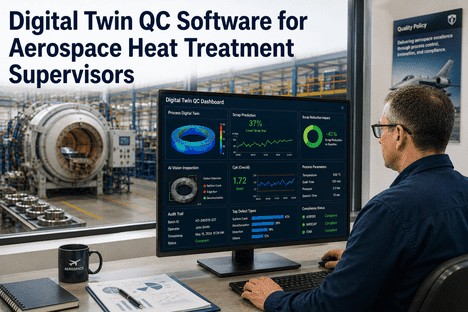
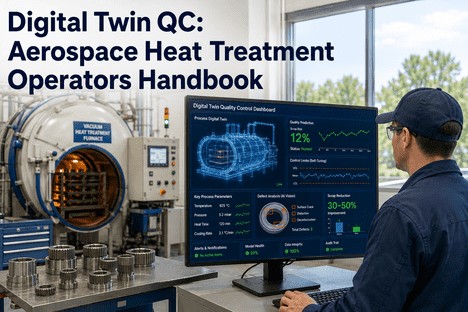
The Digital Twin Quality dashboard is designed around the decisions an operations director makes about heat treatment production every shift — not the data a process engineer monitors every minute. Each view is structured to answer one question clearly, with the supporting detail available one click deeper. The dashboard does not require the operations director to interpret furnace telemetry, analyse thermal profiles, or review calibration statistics. It surfaces the actionable output of those analyses: which furnaces are ready for production, which cycles carry risk, whether the digital twin accurately represents the physical furnace, and whether the audit record is complete. The operations director who opens the dashboard at the start of a shift should know within 30 seconds whether heat treatment is running to plan and where attention is needed.
01
Dashboard View
Furnace Fleet Status — Twin Health and Cycle Readiness
Every furnace displays its current digital twin calibration status — calibrated and production-ready, recalibrating after maintenance, or requiring manual verification before next cycle. The view also shows the number of active, queued, and completed cycles with the twin-predicted quality outcome vs the specification target. A furnace whose digital twin indicates degraded zone uniformity after a recent thermocouple replacement is flagged for recalibration before the next load, preventing a cycle that would run on a furnace the certification no longer represents.
Operations director action: Approve or queue cycles based on twin calibration status, not calendar-based certification schedules.
02
Dashboard View
Simulation Results and Cycle Risk Assessment
Every cycle appears in the queue with its pre-simulation outcome — predicted hardness range, case depth, and microstructure classification — displayed against the specification limits. Cycles where the simulation predicts an outcome fully within specification are marked for production. Cycles where the simulation shows marginal or out-of-spec results are flagged with the specific parameter driving the deviation and a recommended corrective action before re-simulation. The operations director approves or holds cycles based on simulation evidence, not batch-release checklists.
Operations director action: Hold any cycle where simulation predicts marginal quality — investigate before material is committed.
03
Dashboard View
Twin Fidelity Trend — How Accurately the Twin Mirrors the Furnace
The digital twin is only useful if it accurately represents the physical furnace. The fidelity trend tracks the deviation between twin-predicted and actual thermal performance for every completed cycle — zone temperature error, ramp rate accuracy, quench curve match. When fidelity degrades beyond a configurable threshold (indicating the twin no longer accurately reflects the furnace), the system alerts the operations director that recalibration is required. This prevents the most dangerous failure mode of any digital twin system: using a twin that has silently diverged from the physical asset and generating confident but incorrect predictions.
Operations director action: Trigger twin recalibration when fidelity trend crosses the warning threshold — re-certify the model, not just the furnace.
04
Dashboard View
Audit Export — Complete Cycle Record With Simulation Evidence
Every component of the audit record — furnace certification history, digital twin calibration log, pre-cycle simulation report, as-run cycle data with deviation analysis, quality test results, and twin-to-physical reconciliation — is generated automatically and linked to the specific load, recipe, and furnace. The export covers any date range, furnace, alloy grade, or customer program with a single query. The digital twin calibration log is the record that demonstrates the quality system used a current, validated model of the furnace for every production decision — not a certification performed six months ago on a furnace that has since changed.
Operations director action: Export full audit package with twin calibration history — no manual data assembly across systems.
"
The NADCAP audit used to consume five days of our quality manager's time — pulling furnace records from three different systems, cross-referencing cycle data against certification dates, and manually compiling the traceability matrix. The digital twin changed this fundamentally. The auditor asked for the compliance record for a specific vacuum furnace run from four months earlier. I opened the dashboard, entered the date range and furnace ID, and exported the complete record — pre-cycle simulation, as-run profile, deviation analysis, and test results — in under two minutes. The auditor spent the rest of the time reviewing the digital twin calibration log, which showed every recalibration event and the statistical fidelity score. That single record demonstrated the quality system was actively maintaining current furnace models. Audit pass rate improved. Preparation time dropped from days to minutes.
The Measurable Impact — What Operations Directors Report After Deploying Digital Twin Quality
The transition from certification-based quality to digital twin quality produces measurable outcomes across every dimension of heat treatment operations. The pattern is consistent across vacuum furnace, atmosphere furnace, and fluidised bed operations processing aerospace alloys from aluminium to titanium to nickel-based superalloys.
40-65%
Reduction in heat treatment non-conformances within six months of deploying pre-cycle simulation — driven by detection of furnace condition issues before material is committed
75-90%
Reduction in audit preparation time when digital twin cycle records replace manual data compilation across furnace SCADA, LIMS, and certification databases
3-4x
Faster root cause resolution when investigators replay non-conformance cycles against the digital twin that was current at the time of the event
The data shown above represents first-year outcomes from operations that deployed digital twin quality across their full furnace fleet. Facilities that deployed initially on a single high-criticality furnace or a single alloy grade line report proportionally similar improvements on the deployed scope, with the benefit compounding as additional furnaces and grades are added to the digital twin model. The pattern is consistent regardless of facility size: the magnitude of non-conformance reduction correlates with the proportion of cycles that pass through pre-cycle simulation, and the audit time reduction correlates with the completeness of the digital twin record coverage across the furnace fleet.
Beyond the direct quality and compliance metrics, operations directors report secondary effects that compound over time. The digital twin creates a continuous furnace health record that makes maintenance prioritisation data-driven rather than schedule-driven — furnaces with degrading twin fidelity are serviced before they produce non-conformances, not after. The simulation sandbox enables process engineers to validate new recipes in a fraction of the time previously required for physical trial cycles, accelerating alloy qualification programmes without consuming production furnace capacity. And the twin-to-physical deviation log provides investigators with a precise record of exactly how the furnace behaviour differed from the model at any point in time — eliminating the reconstruction uncertainty that plagues traditional non-conformance investigations where the furnace has already been re-certified or modified before the investigation begins.
The operations directors reporting the highest impact are those who configure the digital twin to automatically block cycles when the simulation predicts an out-of-spec outcome — creating a quality gate that prevents non-conforming production from starting rather than detecting it after completion. This configuration shifts the quality model from verify-and-correct to simulate-and-prevent, and it is the single intervention that produces the most significant non-conformance reduction.
The Data That Proves Digital Twin Quality Works Is Already in Your Furnace Controllers and Quality Records. We Just Make It Visible Before the Cycle, Not After.
Schedule an AI Quality Roadmap Session to see the Digital Twin Quality platform configured for your furnace fleet, alloy grade portfolio, and compliance requirements.
Quality compliance in aerospace heat treatment is not a documentation problem — it is a model accuracy problem. When the quality system operates on recipe certifications that were performed on a furnace in a previous state — before thermocouple drift, before zone degradation, before quench medium contamination — every cycle runs on the assumption that the furnace is identical to the one that was certified. It is not. The physical furnace changes continuously. The certification is a point-in-time validation that becomes less representative with every cycle, every maintenance event, and every hour of operation. Digital Twin Quality closes this gap by maintaining a live model of the furnace that reflects its current state and simulating every cycle against that model before material is committed.
The distinction between a certified furnace and a current furnace is not a semantic one — it is the structural root cause of heat treatment non-conformances that recur despite corrective actions. Every corrective action closes an event, but if the furnace condition that caused the non-conformance has not been detected and corrected by the time the next cycle runs, the same failure mode will produce the same outcome under a different event number. The digital twin closes this loop by making furnace condition visible continuously, not just at certification intervals. When the twin detects that zone uniformity has degraded since the last certification, it flags the condition before the next cycle is queued — not after the next non-conformance is confirmed.
The outcomes from aerospace heat treat operations that have deployed digital twin quality with live furnace calibration are consistent: 40 to 65 percent non-conformance reduction driven by pre-cycle detection of furnace condition issues, 75 to 90 percent reduction in audit preparation time through auto-generated twin-calibrated cycle records, and 3 to 4 times faster root cause identification through cycle replay against the furnace model that was current at the time of the event. The operations directors achieving these outcomes are the ones who moved from a verify-after-cycle quality model to a simulate-before-commit quality model — and who use the digital twin as the continuous validation layer between recipe certification and furnace reality.
iFactory's Digital Twin Quality platform is designed for operations directors in aerospace heat treatment who need to maintain AS9100 and NADCAP compliance while reducing non-conformance rates and audit preparation time. Book a Demo to see the Digital Twin Quality dashboard configured for your furnace fleet and alloy grade portfolio, or talk to an expert about a free digital twin readiness assessment for your heat treatment operation.
Frequently Asked Questions
The initial digital twin is calibrated using three data sources: furnace design specifications (zone configuration, heating element power ratings, quench system design, thermocouple locations), historical cycle data from the furnace controller or SCADA system (temperature profiles from at least 50 recent cycles covering the operating range), and furnace certification records (AMS2750 uniformity survey results, thermocouple accuracy verification logs, calibration schedules). The platform uses these data sources to construct a thermal model of the furnace that predicts zone temperatures, ramp rates, soak uniformity, and quench cooling curves as functions of the load configuration and setpoint profile. The initial calibration typically takes two to four weeks depending on data availability and furnace complexity. Once deployed, the twin updates continuously from live telemetry and self-corrects as each cycle completes, with the model accuracy improving progressively over the first 20 to 30 production cycles. Talk to an expert about data requirements for your specific furnace types and controller configurations.
Every maintenance event that affects furnace thermal behaviour — thermocouple replacement, heating element change, zone calibration, insulation repair, quench system service — is registered in the platform and triggers a digital twin recalibration process. During recalibration, the twin enters a transition state where simulation predictions include a reduced confidence indicator reflecting the uncertainty introduced by the physical change. The twin collects data from the first five to ten post-maintenance cycles and compares its predictions against actual as-run profiles, progressively restoring full confidence as the new calibration is validated against real cycle data. The operations director sees which furnaces are in full-calibration state, which are in post-maintenance transition, and what confidence level applies to each twin's predictions. For NADCAP audit purposes, the recalibration log — showing the maintenance event, the recalibration parameter adjustments, and the confidence recovery trajectory — provides documented evidence that the digital twin quality system maintains current furnace models. Book a Demo to see how the platform manages maintenance transitions in the digital twin lifecycle.
Yes. The digital twin platform includes a simulation sandbox where operations directors, process engineers, and metallurgists can run what-if cycles using the digital twin of any production furnace without affecting the physical asset. A new alloy grade with different thermal conductivity and transformation kinetics can be simulated against the current furnace state to determine whether the existing certified recipe will achieve the required hardness and microstructure, or whether a modified profile is needed. A proposed furnace configuration change — different load arrangement, modified quench pressure, alternative thermocouple placement — can be evaluated for its predicted quality impact before any physical modification is made. The sandbox maintains a separate simulation log that documents every what-if analysis, the parameters tested, the predicted outcome, and whether the simulation was used to inform a production decision. This log provides additional audit evidence that the quality system validates recipe and configuration changes systematically before committing production material. Book a Demo to see the what-if simulation sandbox configured for your alloy grade and recipe portfolio.
The platform connects to existing furnace infrastructure through read-only integration with furnace controllers, SCADA systems, PLCs, and process historians using standard industrial protocols — OPC-UA, Modbus TCP, MTConnect, and Siemens S7. No modification to the control loop, the certified cycle program, or the furnace instrumentation is required. The data flow is unidirectional from the physical system to the digital twin: the twin receives process data but never transmits commands to the furnace. This architecture eliminates the need for cycle re-certification or NADCAP audit concern related to control system modification. For quality data — hardness test results, microstructure analysis, case depth measurements — the platform integrates with existing LIMS databases or accepts manual entry through standardised templates. The digital twin operates as a quality intelligence layer above the existing control and quality systems, not as a replacement for them. Talk to an expert about mapping your current SCADA, furnace controller, and LIMS integration points for a digital twin deployment.
A typical deployment for a facility with 4 to 12 furnaces — including vacuum, atmosphere, and fluidised bed types — follows a phased timeline. Phase one (weeks one to three) covers data connectivity: establishing read-only integration with furnace controllers, SCADA systems, and LIMS databases for the highest-criticality furnaces. Phase two (weeks three to six) covers digital twin calibration: building the initial thermal models for each furnace using historical cycle data and certification records, running the twin in shadow mode alongside production cycles to validate prediction accuracy. Phase three (weeks six to eight) covers dashboard configuration and operations director training: setting up the fleet status view, the simulation results panel, the twin fidelity trend, and the audit export format to match the facility's specific compliance requirements and reporting preferences. Full deployment across an entire furnace fleet is typically complete within eight to ten weeks. For facilities with existing SCADA infrastructure and clean historical data access, the timeline can compress to four to six weeks. Book a Demo to see a typical deployment timeline mapped to your facility's furnace fleet size and SCADA infrastructure.
Yes. The platform supports multi-site deployment with a unified enterprise dashboard that consolidates digital twin data from every connected facility. Each facility maintains its own furnace fleet, digital twin models, recipe libraries, and compliance records — but the operations director or quality leader at the enterprise level can view all sites on a single screen, filter by facility, furnace type, alloy grade, or customer program, and compare performance metrics across sites using standardised KPIs. The enterprise view shows each facility's furnace fleet calibration status, active cycle risk levels, non-conformance trends, and audit readiness status. For organisations with multiple heat treatment facilities serving different aerospace OEMs or programs, the platform maintains separate compliance record sets for each facility while enabling cross-site benchmarking and best practice transfer. Site-level data segregation meets the requirements of multi-plant AS9100 certification scopes where each facility maintains its own quality management system under the corporate umbrella. Book a Demo to see the multi-site Digital Twin Quality dashboard configured for an enterprise heat treatment operation.
Your Furnace Changed Since the Last Certification. The Digital Twin Knows How. Simulate Your Next Cycle Before You Commit the Material. Get a Free Digital Twin Readiness Assessment.
iFactory's Digital Twin Quality platform for aerospace heat treatment — live furnace models calibrated to current physical state, pre-cycle simulation for every load, real-time deviation monitoring during production, and AS9100/NADCAP-aligned cycle records generated automatically from the twin-to-physical comparison.