Adaptive SPC for Aerospace Heat Treatment – Less Downtime
By Grace on June 16, 2026
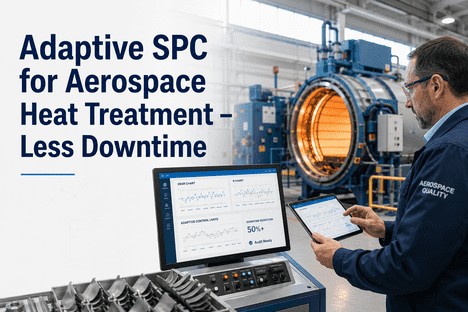
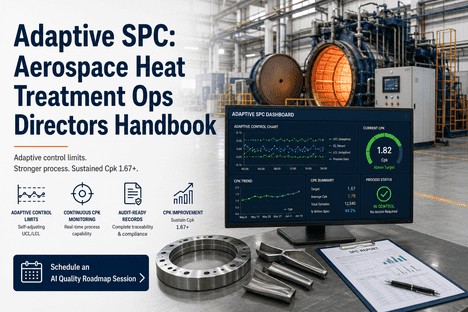
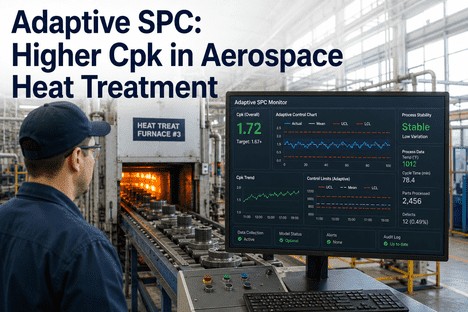
Every plant manager in aerospace heat treatment knows the cycle time tension. The furnace is capable of a 6-hour soak on this aluminium alloy. The AMS specification allows it. The quality engineer confirmed it. But the production schedule shows 7.5 hours per load because the last three capability studies were run on a different alloy batch with different quench response, and the control limits on the SPC chart have not been updated since the study from eight months ago. The plant manager is running the process 25% slower than it could run — not because the metallurgy requires it, but because the control limits do not reflect current process capability. Every load carries 90 minutes of unnecessary cycle time that compounds across three shifts, five furnaces, and thirty loads per week. That is not a metallurgy problem. That is a control limit problem. Adaptive control limits eliminate this penalty by recalculating UCL and LCL dynamically against the current process baseline — so every furnace runs at its real capable speed, not the speed dictated by a study conducted on a different material, on a different day, with different furnace conditions.
10-20%
Cycle time reduction when adaptive limits eliminate the cushion that static limits force into every load across every furnace
60-70%
False alarm reduction when adaptive limits stop firing alerts against outdated baselines — restoring operator attention to genuine process deviations
50%+
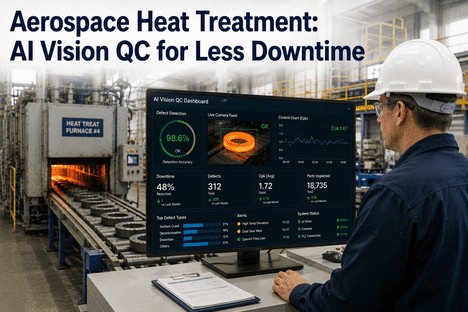
Reduction in inspection-linked downtime when AI vision detects defects at the moment of occurrence rather than at post-process inspection
10-20
OEE points recovered within 90 days of deploying adaptive control limits across furnace fleets in documented aerospace heat treat operations
Adaptive UCL/LCL + Predictive Alerts + AI Vision
Every Hour of Unplanned Downtime Costs More Than the Hardware. See How Adaptive Limits Recover 10-20 OEE Points.
iFactory's adaptive control limit platform is already recovering cycle time and reducing downtime at leading aerospace heat treat operations. Schedule a live walkthrough configured for your furnace types, alloy profile, and AMS 2750 class.
The Three Hidden Downtime Drivers That Static Control Limits Create
Static control limits do not just generate false alarms. They generate downtime through three distinct mechanisms that compound across every furnace, every shift, and every load. Understanding each mechanism is the first step toward recovering the 10 to 20 percent of cycle time that adaptive limits restore to production.
01
Forced Cycle Time Padding
When control limits were last calculated, the furnace was running a different alloy, with a different quench medium batch, under different ambient conditions. Those limits are still in the system. To avoid triggering false alarms against outdated limits, supervisors build safety margin into every cycle — extending soak time, adding temperature hold buffers, running longer than the specification requires. A 6-hour soak becomes 7.5 hours. Across five furnaces, three shifts, and thirty loads per week, that 90 minutes per load compounds into 45 hours of unnecessary cycle time every week. The plant manager sees utilisation data that looks acceptable and does not realise that 20 percent of it is structural waste imposed by static limits.
02
False Alarm Investigation Time
Every false alarm that fires during an alloy transition, a quench media change, or a specification switch triggers an investigation. The operator stops production, reviews the chart, checks the furnace parameters, and determines that the alert was a false positive. The investigation consumes 15 to 30 minutes per incident. When 60 to 70 percent of all alerts during transition periods are false, the accumulated investigation time across a month of production represents hours of lost furnace productivity. Worse, the investigation habit itself becomes a source of downtime — operators learn to stop and check every alert, including the ones that are real, and the delay between the alert and the corrective action lengthens. Adaptive limits eliminate the false alarm surge during transitions, so operators investigate only the alerts that matter.
03
Post-Inspection Discovery Delays
When static limits miss a genuine drift because the signal is buried within the outdated control band, the nonconformance is not detected until post-process inspection — typically 4 to 8 hours after the load completed its cycle. The discovery triggers a line stoppage, material segregation, root cause investigation, and re-inspection of every load produced since the last known good result. A single post-inspection discovery event can consume an entire shift of production time. In aerospace heat treatment, where hardness, case depth, and distortion are confirmed by destructive or time-consuming tests, the lag between production and detection means that a drift that started at 9 AM may not be discovered until 5 PM. By then, six to ten loads may be affected. Adaptive limits detect the drift trajectory during the cycle, not after inspection, eliminating the downtime that post-inspection discovery causes.
45 hrs/wk
Cycle time padding waste from static limits on a 5-furnace fleet
60-70%
Of all SPC alerts during transitions are false — each consuming 15-30 min of investigation
4-8 hrs
Detection lag between defect occurrence and post-inspection discovery
How Adaptive Control Limits Recover Downtime: The Four-Stage Cycle
Adaptive control limits operate through a continuous four-stage cycle that recalibrates with every furnace load. Each stage runs automatically on iFactory's edge processing unit, ingesting furnace PLC data and updating control limits before the next cycle begins. The plant manager sees the result — not the calculation — on a dashboard designed around downtime recovery.
1
Ingest and Baseline
Every furnace cycle streams soak temperature per zone, ramp rate, quench temperature and agitation, atmosphere composition, and cycle duration into the adaptive engine. The system maintains a rolling statistical baseline of the last N cycles for the current alloy-specification combination. When an alloy change is registered or a new specification is loaded, the baseline resets to the new regime — so limits never compare current data against an irrelevant historical window.
Downtime impact: Eliminates cycle time padding by ensuring limits match the current process, not last quarter's capability study.
2
Classify and Adapt
The adaptive engine classifies every detected shift by pattern. A step change coinciding with a material batch that stabilises at the new level is classified as common-cause — limits recalculate, no alarm. A progressive drift across consecutive loads is classified as assignable-cause — the alarm fires even if no single point has breached the limit. A transient spike that self-corrects is classified as noise — no alarm, no limit change. This classification eliminates the false alarm problem that fixed limits cannot solve.
Downtime impact: Eliminates false alarm investigation time by silencing noise and firing alerts only for genuine process events.
3
Predict and Alert
When the current combination of furnace parameters matches a pattern historically associated with an off-spec outcome, the system generates a predictive quality alert before the test result is available. For hardness failures that emerge after quench and temper, this provides an intervention window measured in hours — enough time to isolate the affected load, adjust the tempering cycle for the next batch, or authorise a hold before additional product is committed. The alert includes the specific parameter driving the risk and the recommended corrective action.
Downtime impact: Eliminates post-inspection discovery delays by catching nonconformances during the cycle, not 4-8 hours later at inspection.
4
Log and Document
Every adaptive limit change, every predictive alert, every corrective action, and every test result is logged automatically with the alloy code, AMS specification reference, furnace ID, and operator ID. The limit change log records the previous UCL and LCL, the new values, the triggering event, and the statistical rationale. Every SPC chart is tagged with the AS9100 or NADCAP clause it supports. The audit package is generated automatically — no manual compilation, no pre-audit scramble.
Downtime impact: Eliminates weeks of audit preparation downtime by generating complete, clause-mapped evidence with every load.
What the Plant Manager's Downtime Dashboard Shows
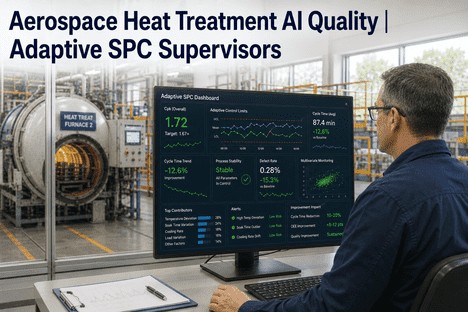
The plant manager's view of the adaptive control limit system is designed around one question: Where is production time being lost, and what is recovering it? The dashboard surfaces the four categories of downtime that static limits create and tracks the recovery that adaptive limits deliver — in hours recovered, OEE points gained, and loads released faster.
Downtime View 01
Cycle Time Recovery by Furnace and Alloy
Each furnace displays the actual cycle time versus the specification-allowed minimum, with the gap attributed to static limit padding. Plant managers see exactly how many hours per week are being recovered as adaptive limits tighten. A furnace running 4130 steel at 4.5 hours instead of 5.8 shows 1.3 hours recovered per load, tracked cumulatively across the shift, week, and month.
Action: Prioritise furnace-alloy combinations with the largest cycle time gap for adaptive limit deployment.
Downtime View 02
False Alarm Volume Trend by Transition Type
The false alarm trend chart shows the volume of alerts per shift, segmented by transition type — alloy change, quench media change, specification switch. As adaptive limits calibrate to each transition, the false alarm rate drops. Plant managers see the trend line decline from baseline to the 60-70 percent reduction target, with the cumulative investigation time recovered displayed in hours.
Action: Validate that adaptive calibration windows are correctly configured for each transition type.
Downtime View 03
Predictive Alert Lead Time by Nonconformance Type
Every predictive alert is tracked with its lead time — the interval between the alert and the inspection confirmation. Plant managers see the average lead time by nonconformance type: hardness deviations, case depth shortfalls, distortion exceedances. A system that consistently generates alerts 2 to 6 hours before inspection gives the plant manager a measurable intervention window that directly reduces inspection-linked downtime.
Action: Review lead time distribution and adjust predictive model thresholds to maximise early detection without increasing false positives.
Downtime View 04
OEE Trend — Availability, Performance, Quality by Furnace
OEE is calculated continuously for each furnace, with the three components — availability, performance, quality — displayed as stacked trend lines. As adaptive limits recover cycle time, the performance component rises. As false alarms decline, availability improves. As predictive alerts catch nonconformances early, quality stabilises. Plant managers see the composite OEE trend line and the contribution of each adaptive control capability to the overall gain.
Action: Track OEE recovery by furnace and allocate adaptive tuning effort to underperforming units.
OEE Recovery + AS9100 Compliance
Your Furnaces Are Running Slower Than They Need To. Adaptive Limits Recover the Lost Time Automatically.
iFactory's adaptive control limit platform recalculates UCL and LCL against a rolling baseline of current furnace data — so every load runs at the cycle time the current process actually needs, not the cycle time the last capability study prescribed.
We knew our furnaces could run faster. The capability studies said so. But the control charts kept showing points near the upper limit, and nobody wanted to approve a cycle time reduction against limits that were set during a different alloy run on a different furnace condition. The adaptive limits broke the logjam. Within the first month, we recovered 11 percent cycle time across our five vacuum furnaces without a single quality event. The operators saw the limits moving with the process and stopped padding the cycles. The false alarm rate dropped so dramatically that the investigation time we recovered was equivalent to adding a sixth furnace shift per week. Our OEE went from 62 percent to 78 percent in 90 days. The IA9100 transition audit is next quarter, and for the first time, our evidence package is building itself.
Downtime in aerospace heat treatment is rarely a single dramatic event. It accumulates across every load — 90 minutes of forced cycle time padding here, 20 minutes of false alarm investigation there, 4 hours of post-inspection discovery delay on the next shift. Static control limits create all three forms of waste simultaneously, and conventional monitoring systems cannot distinguish between them because they use the same outdated baseline to measure every load. Adaptive control limits break this cycle by recalibrating UCL and LCL dynamically — tightening when the process is stable, transitioning smoothly when conditions change, and generating predictive alerts before nonconformances reach inspection.
The evidence from aerospace heat treatment operations that have made this transition is consistent and measurable: 10 to 20 percent cycle time reduction, 60 to 70 percent fewer false alarms, 50 percent or greater reduction in inspection-linked downtime, and 10 to 20 OEE points recovered within 90 days. The incoming IA9100 revision, which mandates real-time SPC and predictive quality management as expected practices, makes adaptive control limits not just a downtime reduction strategy but a certification requirement in the making. Plant managers who deploy adaptive limits ahead of the standard transition will enter the audit with documented evidence of continuous process control that exceeds the new baseline.
iFactory's adaptive control limit platform is designed for plant managers in aerospace heat treatment who need to recover cycle time, reduce false alarms, and eliminate post-inspection discovery delays. Book a Demo to see adaptive limits configured for your furnace types, alloy portfolio, and certification baseline, or talk to an expert about a free OEE and downtime assessment for your heat treat operation.
Frequently Asked Questions
Deployment does not require furnace controller modifications or production interruptions. iFactory's edge processing unit connects to the existing furnace PLC data stream — typically through a read-only network tap that requires no changes to the control system configuration or safety. The initial installation for a pilot furnace takes 2 to 3 days, including connectivity verification and data stream validation. The adaptive model runs in parallel with the existing SPC system during a 2-week shadow mode period, generating dynamic control limits alongside static limits without affecting production decisions. After the shadow mode period, the quality team reviews the comparison data, validates that adaptive limits detect drift earlier and generate fewer false alarms, and authorises the transition to primary operation. Full fleet rollout follows at 3 to 5 furnaces per week. From project kickoff to full fleet live, the typical timeline is 6 to 10 weeks. Book a Demo to see a deployment plan for your specific furnace types and control system configuration.
The incoming IA9100 revision, expected in late 2026, mandates real-time statistical process control and predictive quality management as expected practices. Every adaptive limit change is automatically logged with the timestamp, alloy code, AMS specification, furnace ID, previous UCL and LCL values, new values, and the statistical rationale for the recalculation — the data window used and the algorithm applied. This log is searchable by alloy, furnace, and date range, and exportable in a format ready for direct inclusion in QMS documentation. The IA9100 gap analysis report maps every adaptive SPC capability to the corresponding standard clause, showing the auditor which requirements are addressed and how. Talk to an expert about configuring the IA9100 readiness report for your certification timeline.
Yes. iFactory's adaptive control limit platform is furnace-type agnostic and connects to any furnace control system that exposes process data through standard industrial communication protocols — OPC-UA, Modbus TCP, Siemens S7, Rockwell CIP, or Ethernet/IP. Vacuum furnaces with multiple zone control, atmosphere furnaces with carbon potential and endothermic gas control, and salt bath furnaces with molten salt temperature and agitation monitoring are all supported. The adaptive model maintains separate dynamic limits for each critical parameter type — for vacuum furnaces, zone temperature uniformity and vacuum level; for atmosphere furnaces, carbon potential and dew point; for salt baths, molten salt temperature gradients and agitation rate. The deployment configuration for each furnace type takes approximately one day of parameter mapping. Book a Demo to see the adaptive control limit system configured for your specific furnace types and AMS 2750 classification.
Every Load Carries Hidden Downtime. Adaptive Limits Recover It. Get a Free OEE and Downtime Assessment.
iFactory's adaptive control limit platform for aerospace heat treatment plant managers — dynamic UCL and LCL that eliminate cycle time padding, false alarm investigation waste, and post-inspection discovery delays, with AS9100 and IA9100-compliant audit documentation generated automatically from every furnace cycle.