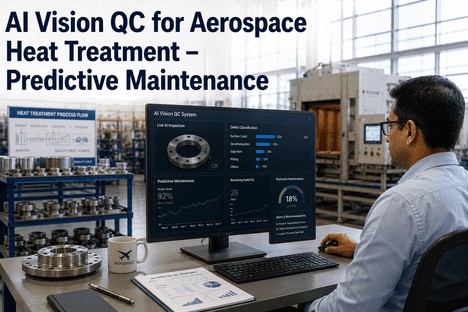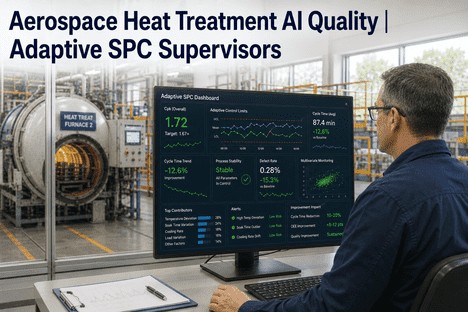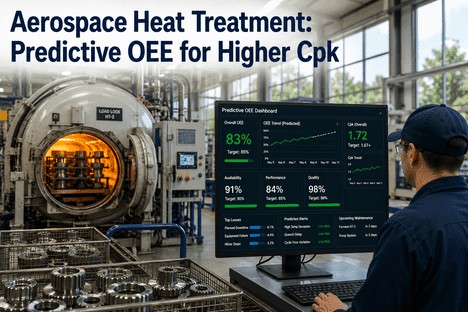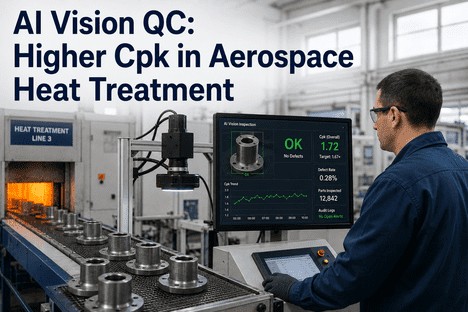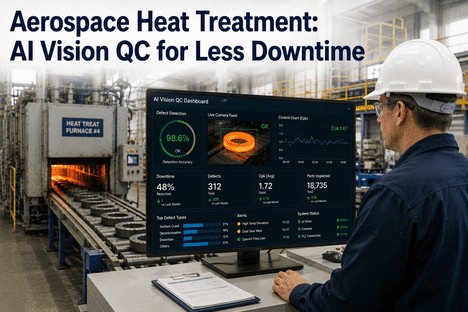
The shift supervisor's board at handover shows three furnaces running, two loads in quench, and a hardness tester with a queue of six parts waiting for disposition. Every load looks normal on the control screen. Temperatures are within range. Cycle times are nominal. But the supervisor knows that normal is not the same as good. Last month, a load of 17-4 PH stainless came out of the furnace with a surface discoloration pattern that the visual inspector caught only because the part was held at a specific angle under the shop light. The load was separated. Four parts failed hardness. The production delay from containment, retesting, and re-scheduling consumed six hours of furnace time that the production plan did not have. The heat treat cycle itself ran correctly. The defect was not in the process — it was in the detection. That six-hour downtime event was invisible to every monitoring system the plant had, because no system was watching the parts the way a supervisor would if they could be at every station simultaneously. AI vision inspection is that system.
Three Types of Downtime That AI Vision Eliminates
Downtime in aerospace heat treatment is rarely a single dramatic event. It accumulates across three recurring sources that traditional monitoring systems never measure because they do not inspect the parts themselves. AI vision addresses each one differently, and the combination is what produces the documented 50%+ reduction in inspection-linked downtime.
How AI Vision Inspection Works on the Heat Treat Floor
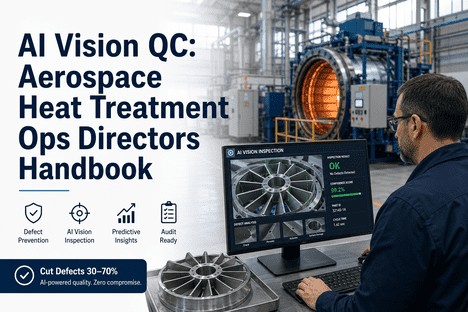
AI vision inspection does not replace the existing quality process. It compresses it. The deep learning models are trained on aerospace-specific defect categories — quench cracking, surface discoloration, oxidation patterns, distortion indicators, and dimensional edge deviation — and deployed on cameras positioned at the natural inspection points in the heat treat workflow. Every part is inspected in milliseconds as it passes through the station, and every result feeds the supervisor's dashboard and the AS9100 record simultaneously.
What Changes on the Supervisor's Board
The supervisor's role is defined by the information available at decision time. Without AI vision, the supervisor approves load releases based on process parameters alone — temperatures were good, soak time was correct, the furnace log looks clean. With AI vision, the supervisor sees the actual quality state of every part before it moves to the next operation. The decision shifts from trusting the process to verifying the outcome.
Before AI vision, I would walk the floor every two hours and visually check the parts coming out of quench. I caught maybe 60% of the surface defects that way, and always after they had already been through temper. The containment decision was always reactive — pull the load, test everything, lose half a shift. The AI vision system caught a quench crack pattern on the first load of a new binder batch within 90 seconds of the parts exiting the quench tank. I isolated that load, adjusted the quench parameters for the remaining loads, and the subsequent four loads passed without issue. The total production interruption was 15 minutes. The same event before AI vision would have cost me six hours and possibly a full load scrap. The system paid for itself in that one intervention.
— Shift Supervisor, Aerospace Heat Treatment — Vacuum and Atmosphere Furnaces, NADCAP-Accredited FacilityHow Defect Patterns Become Predictive Maintenance Signals
The most powerful capability of AI vision inspection is not what it detects on the part. It is what the defect pattern reveals about the equipment that produced it. When a surface crack, discoloration pattern, or distortion indicator is correlated with the furnace and quench parameters that were active at the time of detection, the defect becomes a diagnostic signal for equipment health. A vision-detected quench crack pattern that correlates with a quench media temperature rise and agitation rate drop is not just a quality event. It is a predictive maintenance signal that allows the supervisor to schedule quench media replacement before the condition produces a full nonconformance event across multiple loads. This is the closed loop that traditional quality systems cannot provide: the inspection system that catches the defect also identifies the equipment root cause and predicts the next failure.
The AS9100 Documentation That AI Vision Generates Automatically
Every AI vision inspection event — every defect detected, every clean pass recorded, every alert generated — is logged with the part serial number, furnace load ID, recipe version, image timestamp, defect classification and severity, and the operator or supervisor action taken. This creates the documentation chain that AS9100 Clause 8.5.1 and NADCAP heat treat accreditation require: evidence that every part was inspected, that defects were detected at the point of occurrence, and that corrective actions were taken before nonconforming product progressed to the next operation. The inspection record, defect image library, trend analysis, and corrective action log are exportable in a single audit package — replacing the manual inspection documentation that typically consumes hours of supervisor time before every NADCAP or customer audit.
Conclusion
AI vision inspection transforms the supervisor's ability to manage quality proactively. Instead of relying on process parameter logs and post-process inspection results, the supervisor sees every defect at the moment it occurs — on every part, at every station, without adding a single minute to the production cycle. The industry evidence across aerospace heat treatment and adjacent special-process operations is consistent: supervisors using AI vision with deep learning defect detection achieve 50% or greater reduction in inspection-linked downtime, catch 93-98% of surface defects that manual inspection would miss or discover later, and convert individual defect events into predictive maintenance signals that prevent equipment-related failures before they occur.
The supervisor who sees the quench crack alert on the dashboard 90 seconds after the parts exit the tank and isolates the affected load before it reaches the temper furnace is not just saving six hours of production delay. They are building a quality record that the NADCAP auditor will review — a record showing a process where defects are detected at the point of occurrence, contained with precision, and analyzed for systemic patterns rather than addressed as isolated events. That is the difference between a heat treat operation that manages downtime reactively and one that has eliminated the gap between defect creation and defect detection.
iFactory's AI vision QC platform is built for heat treat supervisors and quality leaders who need to eliminate inspection-linked downtime, move defect detection from post-process to real-time, and convert every defect into a signal that protects the next load. Book a Demo to see AI vision configured for your heat treat stations, defect categories, and furnace types, or talk to an expert about a free downtime reduction assessment for your heat treatment operation.