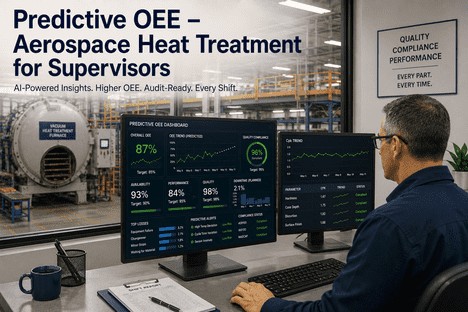
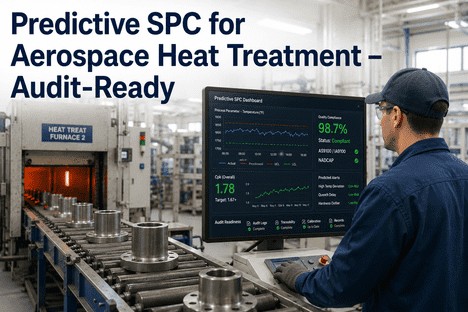
Aerospace Heat Treatment: Predictive OEE for Higher Cpk
By Grace on June 16, 2026
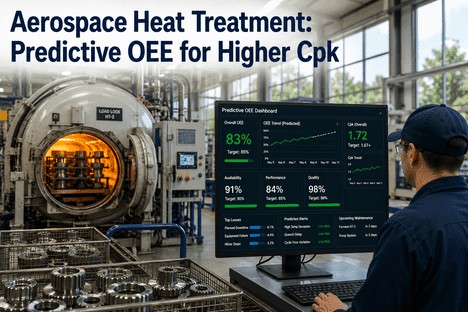
Every aerospace heat treatment operator knows the rhythm of a standard shift. You load the furnace, set the soak temperature, start the cycle, and wait for the pyrometry report to confirm uniformity. The parts come out, you check hardness, you sign off the lot. This routine works well until the day it does not — when a furnace zone drifts three degrees past the AMS 2750 tolerance, when a quench medium ages past its effective range, when the Cpk on a key characteristic slides from 1.67 to 1.21 between two consecutive loads. The operator did nothing different. The process changed without asking permission. Traditional OEE tracks whether the furnace was running. Predictive OEE tracks whether it was running capably — and it is the single most important capability an operator can have when every load carries an AS9100 audit trail.
Predictive OEE for Aerospace Heat Treatment
When Cpk Drops Below 1.33, the Furnace Was Still Running. Only Predictive OEE Tells You Which Load Will Fail Before the Quench.
iFactory's AI-native SPC platform gives heat treat operators live Cpk tracking, adaptive control limits, and multivariate defect forecasts — so every load that enters the furnace has a measurable probability of meeting specification before the first heating element fires.
Why Heat Treatment Cpk Is the Operator's Real OEE Metric
Overall Equipment Effectiveness in heat treatment is traditionally measured as availability multiplied by performance multiplied by quality. The quality factor is almost always calculated from post-process inspection results — hardness tests, case depth measurements, metallurgical review. This means OEE is reported after the fact, often hours after the load has completed its cycle. Predictive OEE replaces this lagging calculation with a leading one: the probability that the current load will meet specification, computed from live process parameters against the Cpk target for each key characteristic. For the operator, this shifts the question from "did this load pass inspection?" to "will this load pass inspection?" — and that four-hour advance warning is the difference between a process adjustment and a scrap event.
1.67+
Cpk target for safety-critical aerospace heat treat characteristics per AS9100 customer requirements
4-8 hrs
Advance warning Predictive OEE gives operators before a nonconformance is confirmed by post-process inspection
3
Heat treat variables that account for 80%+ of Cpk variation: soak time, zone uniformity, quench rate
The Three Variables That Control Every Heat Treat Cpk
Every heat treatment cycle — whether vacuum, atmosphere, or salt bath — reduces to three process variables that determine whether the load meets specification. When any one of these drifts outside its adaptive control window, Cpk follows. Predictive OEE monitors all three simultaneously and alerts the operator the moment the multivariate pattern diverges from the capable envelope.
Soak Time Consistency
Soak time deviation is the most common source of case depth variation in carburizing and hardening cycles. A 5-minute drift at temperature changes diffusion depth by measurable margins. The operator's control panel shows target versus actual soak time in real time, with a Cpk contribution score that quantifies how much this single variable is affecting the overall process capability.
Predictive OEE tracks: Soak time Cpk per load, drift rate from recipe target, trend direction across consecutive cycles
Zone Temperature Uniformity
AMS 2750 requires TUS compliance per furnace class, but between scheduled surveys, individual zone controllers can drift independently. A furnace that passed its last TUS may have a single zone running six degrees hot under certain load configurations. Adaptive SPC on each zone thermocouple detects inter-zone divergence patterns that a single furnace controller cannot see because it only regulates setpoint.
Predictive OEE tracks: Per-zone temperature Cpk, zone-to-zone spread, trend relative to last TUS survey
Quench Rate Precision
Quench rate is the most consequential variable for final hardness and distortion. Insufficient quench severity produces soft spots. Excessive severity causes cracking or excess distortion. Quench media age, agitation variation, and load geometry all affect the effective cooling rate. Predictive OEE captures the full cooling curve at high frequency and compares it against the approved process window for each alloy specification.
Predictive OEE tracks: Cooling curve Cpk, quench rate by media age, distortion prediction per load configuration
The Heat Treat Operator Who Catches Zone Drift Before the TUS Has Already Saved the Next Four Loads. Predictive OEE Makes That Operator Every Operator.
iFactory's predictive OEE platform monitors soak time, zone uniformity, and quench rate simultaneously — with adaptive control limits that recalibrate to every alloy change, furnace cycle type, and load configuration — giving heat treat operators live Cpk visibility and defect forecasts up to 8 hours before post-process inspection.
Why Static SPC Limits Fail the Heat Treat Operator
Standard SPC systems calculate control limits from a fixed historical baseline — typically the last 25 to 100 subgroups. These limits stay in place until the quality engineer manually recalculates them. In heat treatment, this static approach creates a structural blind spot. Furnace components age. Thermocouples drift. Quench media accumulates contaminants. A new alloy enters production with a different hardenability curve. Static limits cannot distinguish between a furnace that is operating differently but still capably and a furnace that is approaching a nonconformance event. The result is a control chart that either fires false alarms on legitimate process variation or misses genuine drift because the limits were set on a process that no longer exists.
Static SPC vs Predictive OEE — What the Operator Sees
Static SPC
Limits calculated from a 90-day baseline. Operator sees an out-of-control alert. Investigation reveals the furnace setpoint changed for a new alloy last week. The alert was a false positive — the process was operating correctly against the new recipe, but the limits were calibrated on the old one. Three real drifts are missed because the limits are too wide for the current material.
Predictive OEE with Adaptive Limits
Limits recalibrate automatically when the recipe changes. The operator sees that zone 3 thermocouple is trending toward a 4-degree offset from zone 2 with a projected crossing time of 3 cycles. The system generates a predictive Cpk alert before any single zone exceeds its specification limit. The operator schedules a furnace check during the next planned downtime.
False alarm rate
50-70%
of static SPC alerts in heat treat are false positives caused by limits calibrated on a different process regime
Alert credibility
Restored
Operators respond to adaptive alerts because they fire only when the multivariate pattern signals genuine Cpk risk
How Predictive OEE Changes the Operator's Workflow
The operator's daily routine shifts from inspecting outcomes to managing probabilities. Instead of loading the furnace, running the cycle, and waiting for the metallurgy lab to confirm the result, Predictive OEE gives the operator a live quality forecast for every load before the cycle completes. The workflow becomes a continuous four-step loop.
1
Monitor
Adaptive SPC tracks soak time, zone temperatures, and quench rate against Cpk targets continuously
2
Predict
ML model forecasts defect probability per load from the multivariate parameter pattern
3
Act
Operator adjusts quench parameters, flags load for priority inspection, or schedules furnace maintenance
4
Verify
Cpk trend confirms or flags corrective action effectiveness, auto-documenting the AS9100 record
Before predictive OEE, I would not know a load had a quench issue until the hardness report came back from the lab the next morning. By that point, that load and possibly the next two were already processed with the same marginal quench media. Now the system flags the cooling curve deviation during the quench cycle itself. I caught a quench oil degradation event three loads before it would have produced a nonconformance. The first load was flagged with a 67% probability of edge hardness below specification. I separated it, adjusted the quench agitation for the remaining loads, and the Cpk stayed above 1.67. The scrap avoidance paid for the system in that single event.
— Heat Treat Lead Operator, Aerospace Gears and Critical Components, NADCAP-accredited Facility
What Changes on the Operator's Dashboard
The operator's interface is designed around the decisions that need to be made during a shift, not the data history that quality engineering reviews at month end. Every screen element serves one purpose: telling the operator whether the current and next loads are on track to meet Cpk target.
Operator View 01
Live Load Cpk Forecast
Every active load in the furnace displays a projected Cpk based on current process parameters. Green indicates Cpk above 1.67. Yellow indicates Cpk trending between 1.33 and 1.67. Red indicates Cpk below 1.33 with a predicted nonconformance probability. The operator sees at a glance which loads need attention.
Operator View 02
Parameter Contribution Score
For loads with elevated risk, the dashboard ranks which parameter is driving the Cpk decline. A load showing a quench rate contribution score of 0.64 tells the operator exactly where to intervene — and the system suggests the adjustment range based on historical correction effectiveness.
Operator View 03
Furnace Health Trend
A trend line for each furnace shows the Cpk trajectory across the last 50 loads. Operators see whether furnace performance is improving or declining independently of the individual load forecast — catching drift that accumulates across cycles before it manifests in any single load.
The AS9100 Documentation That Predictive OEE Generates Automatically
Every predictive alert, every operator action, every Cpk trend shift, and every limit change is logged with a timestamp, the furnace ID, the recipe version, and the load identifier. This creates the documentation chain that AS9100 Clause 8.5.1 and NADCAP heat treat accreditation require: evidence that the special process was monitored continuously, that deviations were detected and addressed before they produced nonconforming product, and that corrective actions were verified for effectiveness. The Cpk history, limit change log, and predictive alert record are exportable in a single package for any audit — replacing the manual documentation compilation that typically consumes days of operator and quality engineer time before every NADCAP or customer audit.
Conclusion
Predictive OEE transforms the heat treat operator's role from a process monitor to a process manager. Instead of loading furnaces and waiting for inspection results, the operator receives live Cpk forecasts, adaptive alerts that reflect genuine risk, and multivariate analytics that pinpoint the exact parameter driving a capability decline. The industry evidence across aerospace heat treatment and adjacent special-process operations is consistent: operators using adaptive SPC with predictive defect forecasting catch 80 to 90% of potential nonconformances before they are confirmed by post-process inspection — with documented Cpk improvements of 0.3 to 0.6 within three months of deployment.
The operator who sees a zone temperature divergence at 10:00 AM and adjusts before the next load enters the furnace is not just preventing a single nonconformance. They are building a Cpk trend that the AS9100 auditor will review at the next surveillance visit — and that trend will show a process that is statistically controlled, proactively managed, and documented continuously rather than reconstructed retrospectively.
iFactory's predictive OEE platform is designed for heat treat operators and quality leaders who need to sustain Cpk 1.67+ across every alloy, every furnace, and every cycle — not as a periodic target, but as a continuous operating reality. Book a Demo to see predictive OEE configured for your furnace types and alloy portfolio, or talk to an expert about a free Cpk and NADCAP audit-readiness assessment for your heat treatment operation.
Frequently Asked Questions
The predictive model initializes from three data sources: furnace controller logs (temperature per zone, soak time, cycle phase timestamps), quench monitoring data (cooling curve, quench media temperature, agitation rate), and quality test results from your metallurgy lab (hardness, case depth, microstructure). Most heat treat operations already collect all three — they just exist in separate systems. iFactory connects to the furnace PLC via OPC-UA or Modbus, to the quench monitoring system, and to the LIMS for quality results. A minimum of 6 months of paired process-to-quality data is sufficient to train the initial Cpk forecast model for the primary alloy groups. The model deploys in parallel with your existing quality workflow for 2 to 3 weeks of shadow-mode validation before it becomes a primary decision input. Book a Demo to see a typical heat treat furnace connector setup and validation timeline.
iFactory's recipe architecture registers each alloy-grade combination as a distinct specification profile with its own target Cpk, temperature range, soak time, quench rate window, and hardness acceptance criteria. When the operator selects a recipe at the furnace control panel, the active specification profile switches automatically and the adaptive control limits transition to the new baseline. The operator dashboard displays the current alloy and recipe alongside the live Cpk forecast. Historical Cpk data is segmented by alloy automatically, so the operator can compare performance on 4130 versus 4340 or IN718 versus Waspaloy without manual data sorting. For NADCAP audits covering multiple alloy families, the system exports Cpk history per specification profile on demand. Book a Demo to see multi-alloy predictive OEE configured for your heat treat portfolio.
Every predictive alert, operator action, and Cpk trend shift is logged with furnace ID, recipe version, load identifier, and timestamp. For NADCAP audits, the system generates a heat treat process control report that includes: the adaptive limit change log with statistical rationale for every adjustment, the Cpk trend for each monitored characteristic across the audit period, the predictive alert record showing every forecast of potential nonconformance, and the operator action log demonstrating that alerts were reviewed and addressed. For AS9100 Clause 10.2 corrective action requirements, every alert that generates a corrective action is linked to the subsequent Cpk trend. If the same parameter combination generates a recurrence within the effectiveness window, the CAPA is automatically flagged as ineffective and re-opened — providing the documented evidence of corrective action effectiveness evaluation that AS9100 and NADCAP auditors require. Talk to an expert about configuring the audit report format for your NADCAP and AS9100 documentation requirements.
Cpk 1.67 Is Not a Target. It Is a Continuous Operating Requirement. Predictive OEE Makes It Sustainable.
iFactory's predictive OEE platform for aerospace heat treatment — live Cpk per load, adaptive control limits that follow every recipe change, multivariate defect forecasting up to 8 hours ahead, and automatic AS9100 and NADCAP audit documentation from the data your furnaces already produce. Book a Demo for a live walkthrough configured for your furnace types and alloy portfolio.