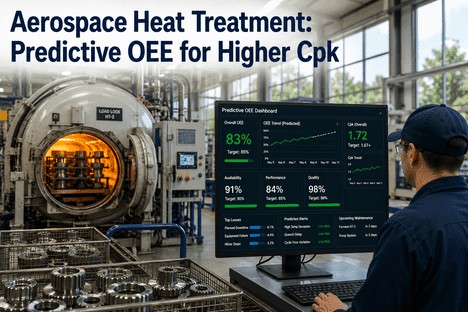
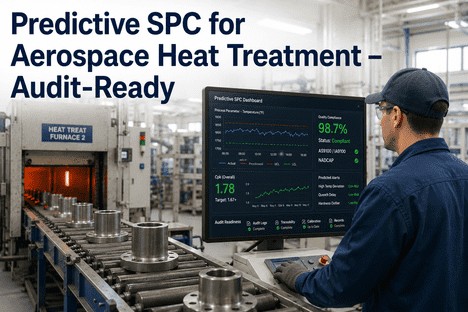
Predictive OEE – Aerospace Heat Treatment for Supervisors
By Grace on June 16, 2026
The NADCAP heat treat audit is scheduled for 10 weeks from today. The supervisor knows what the auditor will ask for: the last 90 days of temperature uniformity survey records, the SPC charts for every active alloy group, the corrective action history for every nonconformance logged in the previous audit cycle, and the documented evidence that every process parameter stayed within its control limits for every load produced since the last surveillance visit. In most heat treat operations, assembling that evidence package consumes two to three weeks of manual effort — pulling paper logs, cross-referencing batch records against SPC charts, reconstructing the documentation trail that should have been generated automatically during production. The supervisor also knows that when the auditor finds the gaps — the missing TUS report from furnace 4, the control limit recalculation that was never documented, the corrective action that was closed without an effectiveness check — the finding goes on the NADCAP nonconformance report and the accreditation status moves closer to probation. Predictive OEE eliminates this cycle by generating AS9100 and NADCAP compliance evidence automatically from the same data the furnaces produce during every cycle, so the supervisor arrives at the audit with a complete, clause-mapped evidence package that required zero manual assembly.
Predictive OEE for Aerospace Heat Treatment
The NADCAP Auditor Is Coming in 10 Weeks. With Predictive OEE, the Evidence Package Is Already Complete — Generated Automatically From Every Furnace Cycle.
iFactory's predictive OEE platform for aerospace heat treatment gives supervisors automated AS9100 and NADCAP compliance evidence, real-time quality monitoring, and closed-loop corrective action tracking — generated from the furnace data your process already produces.
The Three Compliance Pressures That Every Heat Treat Supervisor Faces
Quality compliance in aerospace heat treatment is not a single requirement. It is three concurrent pressure sources that the supervisor must satisfy simultaneously — and the OEE quality factor is the metric that suffers when any one of them is managed reactively.
AS9100 / IA9100
Real-Time SPC and Process Control Evidence
AS9100 Rev D clause 8.3 requires documented process control for key characteristics. The incoming IA9100 revision elevates this further by mandating real-time statistical process control, measurement system analysis, and comprehensive control plans integrated into operational workflows. For the heat treat supervisor, this means every load must have SPC evidence that is current, complete, and clause-mapped — not reconstructed from paper logs when the auditor arrives. The transition to IA9100 in late 2026 shifts the compliance baseline from periodic evidence snapshots to continuous process control demonstration.
Compliance gap: Manual SPC records cannot meet IA9100's real-time process control requirements.
NADCAP AC7102
Pyrometry, Furnace Control, and Audit Documentation
NADCAP AC7102 is the baseline checklist for heat treat accreditation. It covers pyrometry compliance (AMS 2750 — TUS and SAT schedules), furnace control records, process parameter logging, thermocouple management, personnel qualification, and nonconformance handling. The auditor reviews actual production cycle records, not summary reports. Every temperature excursion, every control limit adjustment, every corrective action must have a documented evidence trail. A single missing TUS report or an undocumented limit change generates a nonconformance report that triggers a formal corrective action response and puts accreditation status at risk.
Compliance gap: Manual documentation assembly cannot keep pace with NADCAP's evidence granularity.
CUSTOMER
Customer Quality Flow-Down Requirements
Boeing D1-4426, Lockheed Martin QCS-001, and other prime OEM quality specifications flow down NADCAP accreditation and AS9100 compliance as contractual requirements. They also add customer-specific requirements: Cpk targets above 1.67 on designated key characteristics, serial-level traceability for critical parts, and documented evidence of corrective action effectiveness within defined timeframes. The supervisor must satisfy not just the baseline standards but the layered requirements from every customer whose parts are in the furnace — and each customer has the right to audit those records on demand.
Compliance gap: Multiple customer standards cannot be managed manually across every load and furnace.
How Predictive OEE Generates Compliance Evidence From Every Furnace Cycle
Predictive OEE does not add a compliance documentation step to the production process. It replaces the manual reconstruction cycle with automated evidence generation that runs during every furnace cycle. The six capabilities below are the mechanism through which predictive OEE closes the gap between process data and audit-ready records.
01
Automated SPC With Dynamic Control Limits
Every process variable from every furnace cycle feeds a live SPC engine that generates control charts with dynamically calculated UCL and LCL. The charts are not created after the cycle — they update in real time during the soak phase, the ramp phase, and the quench phase. For the NADCAP auditor, this means every load has a complete SPC record with control limits that are demonstrably current, not limits that were calculated from a study six months ago. The AS9100 clause mapping is applied automatically: each chart is tagged with the standard clause it supports.
AS9100 evidence: Clause 8.3 process control + Clause 7.5 documented information
02
Live Cpk Tracking by Alloy and Recipe
Process capability is calculated continuously for every key quality characteristic — hardness range, case depth, quench rate uniformity — segmented by alloy, recipe, and furnace. The Cpk trend is available for any date range the auditor specifies. If Cpk drops below the 1.67 target during a production run, the system flags it immediately and links the event to the corrective action workflow. The quality leader and supervisor see the same live Cpk data, eliminating the disconnect between production and quality that produces audit findings.
Every nonconformance event detected by the predictive OEE system — whether from a control limit breach, a Cpk decline, or a post-inspection result — initiates a corrective action record that tracks through investigation, containment, correction, and effectiveness verification. The system monitors the same parameter combination after the corrective action closes. If the pattern recurs within the effectiveness window, the CAPA is flagged as ineffective and re-opened automatically. The NADCAP auditor sees a documented closed-loop corrective action system, not a list of tickets that were closed without recurrence verification.
TUS and SAT schedules are tracked automatically against the furnace class designation and calibration interval. When a survey is approaching its due date, the system notifies the supervisor before the compliance gap occurs. Temperature uniformity is monitored continuously between surveys using live zone thermocouple readings — detecting element degradation and refractory changes weeks before they would appear as a TUS failure. The pyrometry compliance record includes every SAT result, TUS report, thermocouple calibration certificate, and instrument calibration log, linked to the furnace and date range.
NADCAP evidence: AC7102/8 pyrometry + AMS 2750 compliance records
05
Serial-Level Traceability Across Every Load
Every furnace cycle generates a complete traceability record: furnace ID, recipe version, alloy code, load identifier, operator ID, cycle timestamp, and every process parameter logged at second-level frequency. The record links to the upstream material lot from the receiving inspection and to the downstream quality test results from the metallurgy lab. For customer audits requiring serial-level traceability on critical parts, the system produces the full genealogy from raw material to final release in a single search — eliminating the manual cross-referencing that consumes hours per audit request.
AS9100 evidence: Clause 8.3.2 identification and traceability
06
One-Click Audit Export With Clause Mapping
Every piece of evidence the auditor requires — SPC charts, Cpk trends, corrective action records, pyrometry compliance logs, traceability reports, personnel qualification records — is stored in a searchable, clause-mapped data model. When the auditor requests evidence, the supervisor selects the date range and standard (AS9100, NADCAP AC7102, customer-specific), and the system generates a structured export with each document already mapped to the applicable clause or checklist item. Audit preparation time drops from two to three weeks of manual assembly to under one hour of export generation.
Real-Time SPC · Live Cpk · Closed-Loop CAPA · Pyrometry Compliance · Serial Traceability · One-Click Audit Export
The Difference Between an Audit That Takes Two Weeks to Prepare For and an Audit That Is Already Complete Is Predictive OEE.
iFactory's predictive OEE platform generates AS9100 and NADCAP compliance evidence automatically from every furnace cycle — eliminating manual documentation assembly and giving supervisors audit-ready records that are current, complete, and clause-mapped.
The Compliance Evidence That Predictive OEE Generates — Mapped to Real Audit Requirements
The table below maps the specific evidence that the predictive OEE platform generates automatically to the corresponding audit requirements that heat treat supervisors face during NADCAP, AS9100, and customer audits.
Audit Requirement
Predictive OEE Evidence Generated
Manual Alternative
NADCAP AC7102 — Furnace control records for every production cycle
Complete cycle record with all temperature zones, soak time, ramp rate, quench profile, and control limit compliance — generated per load
Paper chart recorder logs manually filed — auditor must cross-reference against batch records
Automatic TUS/SAT schedule tracking with due-date alerts; continuous zone uniformity monitoring between surveys; calibration certificate storage linked to furnace
Manual calendar tracking for survey due dates; paper TUS reports filed in binders — gaps discovered during audit
AS9100 Clause 8.3 — Process control evidence for key characteristics
Live SPC charts with dynamic control limits; Cpk trend by alloy and recipe; control limit change log with statistical rationale
Manual SPC charts updated per batch; control limits recalculated only during process studies — stale limits used between studies
AS9100 Clause 10.2 — Nonconformity and corrective action effectiveness
Closed-loop CAPA records from detection through effectiveness verification; automatic recurrence monitoring within configured effectiveness window
CAPA tickets closed when correction is applied; no systematic recurrence monitoring — same defect recategorised as new event
AS9100 Clause 8.3.2 — Identification and traceability
Full genealogy from raw material lot through furnace cycle to quality test results — searchable by load, serial number, or date range
Manual cross-referencing of receiving records, furnace logs, and lab reports — hours per audit request
IA9100 2026 — Real-time SPC and predictive quality management
Continuous real-time SPC with adaptive limits; predictive alerts before nonconformance; data integrity and audit trail for all records
Periodic SPC updates — not real-time; manual data entry with transcription risk; no systematic predictive capability
What Changes for the Supervisor: The Predictive OEE Compliance Dashboard
The supervisor's compliance dashboard with predictive OEE is designed around audit readiness as a continuous state rather than a periodic event. Instead of a compliance calendar that shows when the next audit is due, the dashboard shows the real-time compliance status of every furnace, every active corrective action, and every pending pyrometry survey — with the evidence package ready for export at any time.
COMPLIANCE
Furnace Compliance Status — Live by Furnace and Standard
Every furnace displays its current compliance status against AS9100, NADCAP AC7102, and AMS 2750 — with the TUS and SAT due dates, the number of loads processed since the last survey, and the current zone uniformity index. Green indicates full compliance. Yellow indicates a pyrometry survey approaching due within the warning window. Red indicates a compliance gap requiring immediate action.
COMPLIANCE
Open CAPA Register — With Effectiveness Status
Every open corrective action is listed with the initiating event, the furnace and load involved, the root cause category, the corrective action plan, the due date, and the effectiveness monitoring status. CAPAs that are within the effectiveness window display a recurrence monitoring counter. CAPAs where the same defect pattern has recurred are flagged automatically for re-opening.
COMPLIANCE
Audit Export Center — One-Click Package Generation
The audit export center generates a complete evidence package for any standard, date range, furnace, or product group. The supervisor selects the audit type (NADCAP AC7102, AS9100 surveillance, IA9100 transition, customer-specific), the date range, and the scope, and the system generates a structured export with each document mapped to the applicable clause or checklist item.
Our NADCAP surveillance audit used to require two full weeks of documentation preparation. Two people pulling paper logs from four furnaces, cross-referencing SPC charts against batch records, verifying TUS dates, reconstructing the corrective action history. Every audit cycle, we found gaps — a TUS that was overdue by two weeks on furnace 2, a corrective action that had been closed without documenting the effectiveness check. The findings went on the NCR and the auditor tracked them as repeat issues. After we deployed predictive OEE with automated evidence generation, the next audit preparation took 45 minutes. I selected the date range, selected the standard, and the system generated the evidence package with every record already mapped to the AC7102 checklist. The auditor reviewed the package and asked two follow-up questions. Zero nonconformances. The time we saved on documentation preparation is now spent on process improvement projects that actually reduce defect rates.
Quality compliance in aerospace heat treatment is not a documentation problem — it is a detection and evidence architecture problem. When SPC charts are generated manually, updated periodically, and reconstructed from paper logs when the auditor arrives, the compliance evidence is always playing catch-up with the production process. The IA9100 transition in 2026 makes this gap explicit by requiring real-time statistical process control, predictive quality management, and documented corrective action effectiveness — requirements that manual documentation systems cannot satisfy at the scale and granularity that aerospace heat treat operations demand.
Predictive OEE addresses all three dimensions of compliance pressure simultaneously. SPC evidence is generated in real time with dynamic control limits that reflect current process conditions, not the conditions that existed during a study conducted months ago. Corrective actions are tracked through to effectiveness verification with automatic recurrence monitoring that closes the loop that manual CAPA systems leave open. Pyrometry compliance is managed proactively with automatic TUS and SAT scheduling and continuous zone uniformity monitoring between surveys. And the entire evidence package is available for any standard, date range, or scope with a single export — reducing audit preparation time from weeks to under one hour.
iFactory's predictive OEE platform for aerospace heat treatment is built for supervisors and quality leaders who need to maintain AS9100, NADCAP, and IA9100 compliance as a continuous state rather than a periodic event — combining real-time SPC with dynamic control limits, closed-loop corrective action tracking, automated AMS 2750 pyrometry compliance, serial-level traceability, and one-click audit export in a single platform that connects directly to your furnace control system. Book a Demo to see predictive OEE compliance evidence generated from your furnace data, or talk to an expert about a free audit-readiness assessment for your heat treatment operation.
Frequently Asked Questions
IA9100, expected in late 2026, elevates the AS9100 requirement for process control by mandating real-time statistical process control and predictive quality management as expected practices rather than aspirational goals. The standard specifically references SPC with real-time monitoring, Measurement Systems Analysis, Design of Experiments, and comprehensive control plans integrated into operational workflows. iFactory's predictive OEE platform addresses these requirements through several integrated capabilities. Real-time SPC with dynamic control limits generates control charts that update continuously during every furnace cycle — not periodic charts that are reviewed after the fact. The predictive ML model analyses current process parameters against historical patterns and generates alerts when a multivariate combination signals an impending nonconformance, satisfying the predictive quality management expectation. Every data point, alert, corrective action, and control limit adjustment is logged with full audit trail and data integrity controls. For the IA9100 transition audit, the system generates a gap analysis report showing how each new requirement is addressed by the existing predictive OEE deployment — providing the auditor with documented evidence of compliance with the updated standard before the formal transition deadline. Book a Demo to see the IA9100 evidence generation configured for your furnace types and standard revision status.
The platform digitises and automates pyrometry record management but does not replace the physical pyrometry activities. TUS and SAT surveys are still performed by qualified personnel at the intervals specified by AMS 2750 for the furnace class. What predictive OEE changes is how those records are captured, stored, and linked to audit evidence. The system tracks every furnace's TUS and SAT schedule against its class designation and sends automated alerts when a survey is approaching its due date. Survey results are entered digitally and stored with the furnace record, linked to the applicable AC7102/8 pyrometry checklist items. Thermocouple inventory and calibration status are tracked with automatic calibration due-date alerts and chain-of-custody logging for each thermocouple from receipt through installation to retirement. The continuous zone uniformity monitoring feature supplements the periodic TUS by tracking live zone-to-zone temperature deltas between surveys — detecting element degradation and refractory changes that would appear as TUS failures weeks before the scheduled survey. For the NADCAP auditor, the pyrometry compliance record shows both the periodic survey compliance and the continuous monitoring data that demonstrates proactive management between surveys. Talk to an expert about configuring the pyrometry compliance module for your furnace fleet and AMS 2750 class designations.
The compliance module supports customer-specific audit requirements through a configurable requirements framework. Each customer programme — Boeing D1-4426, Lockheed Martin QCS-001, or any prime OEM quality specification — is registered as a separate compliance profile with its own set of mapped requirements, evidence criteria, and audit checklist items. The supervisor selects the active customer programme for each load or furnace, and the system generates evidence packages that address the specific requirements of that programme in addition to the baseline AS9100 and NADCAP standards. For example, a programme requiring Cpk above 1.67 on designated key characteristics with serial-level traceability triggers automatic Cpk tracking on those characteristics, serial number registration at load entry, and evidence generation that maps directly to the customer's quality clause. When the customer's quality engineer requests evidence, the supervisor generates an export filtered to that programme's requirements without manually sorting which records belong to which customer. The system also tracks customer-specific corrective action timelines — some customers require CAPA closure within 30 days, others allow 90 — and escalates overdue items to the supervisor automatically. Book a Demo to see the customer-specific compliance configuration for your prime OEM programme requirements.
Yes. The OEE quality factor is calculated from the actual quality outcome of every load, not from a projected or estimated defect rate. When a corrective action is re-opened because the same defect pattern recurs within the effectiveness window, the affected loads are linked to both the original and the re-opened CAPA record — creating a visible recurrence chain in the quality factor calculation. The OEE dashboard displays the quality factor as a live metric that reflects the actual defect rate including recurring events. The system also provides a CAPA recurrence impact analysis that shows the supervisor how much OEE quality factor is attributable to recurring versus first-time defect events. This analysis is important for the IA9100 effectiveness evaluation requirement: the quality leader can demonstrate that the corrective action system is not just closing tickets but actually reducing the recurrence rate, and the OEE quality factor trend provides the quantitative evidence. If the recurrence rate is improving, the OEE quality factor trend confirms it. If the recurrence rate is flat or increasing despite a high CAPA closure rate, the system flags the pattern as a systemic quality management issue requiring leadership review — providing the documented evidence that IA9100 clause 10.2 requires for corrective action effectiveness evaluation. Talk to an expert about configuring the OEE quality factor recurrence tracking for your defect category mix and CAPA effectiveness windows.
The IA9100 Transition Is Coming. Predictive OEE Makes Compliance a Continuous State Instead of a Pre-Audit Crisis. Get a Free Audit-Readiness Assessment.
iFactory's predictive OEE platform for aerospace heat treatment supervisors — real-time SPC with dynamic control limits, closed-loop corrective action tracking with automatic recurrence monitoring, AMS 2750 pyrometry compliance automation, serial-level traceability, and one-click audit export mapped to AS9100, NADCAP AC7102, and IA9100 requirements.