Predictive SPC for Aerospace Heat Treatment – Audit-Ready
By Grace on June 16, 2026
Every heat treatment operator in aerospace knows the scenario: the furnace thermocouple logged a stable temperature through the soak cycle, the quench delay was within the specified window, and the hardness test came back within the AMS requirement range — yet the NADCAP auditor flags a nonconformance because the manual SPC chart was not updated within the required shift interval. The part was good. The process was in control. The documentation trail was not. For shop-floor operators and line technicians managing aerospace heat treat operations — vacuum furnaces, solution treat and age lines, carburizing and nitriding cells — the gap between producing conforming parts and proving compliance through SPC documentation is where audit findings live. Predictive SPC closes this gap by automating the documentation that operators already generate through their process data, converting every furnace cycle into an audit-ready quality record without requiring operators to maintain parallel manual charting systems alongside their primary process control responsibilities.
Operators Who Run Compliant Heat Treat Cycles Already Produce the Data. Predictive SPC Turns Every Cycle Into an Audit-Ready Record Automatically.
iFactory's predictive SPC platform for aerospace heat treatment gives operators adaptive control charts, predictive quality alerts, and automated AS9100 and NADCAP documentation — without adding manual charting or data entry to the shift.
Reduction in audit preparation time achieved by aerospace heat treat operations using AI-driven SPC systems that auto-generate AS9100-compliant documentation from cycle data
85–92%
Predictive accuracy for heat treat deviation detection achieved when AI models analyse multiple furnace parameters — temperature uniformity, quench rate, atmosphere composition — in combination
32%
Average reduction in recurring nonconformances reported by aerospace heat treat programmes after deploying predictive quality monitoring linked to CAPA systems
60%
Of NADCAP heat treat audit findings relate to documentation and record-keeping gaps — not process failures — making automated SPC record generation a direct compliance intervention
The Operator's 6-Step Workflow for Audit-Ready Heat Treatment With Predictive SPC
The iFactory predictive SPC platform is designed to match the operator's existing heat treatment workflow — not replace it. Each step below shows how the system supports the operator through the cycle while building the AS9100 and NADCAP documentation trail automatically. The operator runs the process. The platform records the evidence. The auditor sees both.
01
Material Receipt & Certification Verification
AMS spec match · heat trace log · incoming test data
The operator scans the incoming material certificate or enters the heat number and alloy grade. Predictive SPC reads the AMS specification requirements — hardness range, case depth target, tensile strength minimum — and pre-populates the control chart limits for the upcoming cycle. If the material certificate data falls outside the expected range for the selected recipe, the system generates a pre-cycle alert: the part can proceed, but the operator knows before the furnace door closes that the SPC limits are adjusted to the actual material condition. The receipt record, certificate scan, and spec-check result are logged to the batch file automatically — no clipboard required.
Audit-ready output: Material receipt log with certificate attachment, AMS spec match confirmation, pre-cycle SPC baseline
AMS2750 pyrometry · TUS report check · recipe limits
The operator selects the heat treat recipe — solution treat temperature, soak duration, quench medium, ageing profile — and the platform automatically cross-references the recipe requirements against the furnace's current NADCAP accreditation status, the most recent AMS2750 pyrometry survey date, and the temperature uniformity survey (TUS) results. If the furnace is due for a pyrometry check within the next seven days, the system flags it without blocking production — the operator knows the documentation gap window and can plan accordingly. The selected recipe loads the adaptive SPC limits for the cycle: temperature upper and lower control limits per zone, quench rate tolerance band, atmosphere dew point range where applicable. Every limit is calibrated to the specific recipe, not to a generic furnace range.
During the heat treat cycle, the predictive SPC engine ingests temperature readings from each furnace zone, quench pressure and flow data, atmosphere composition where monitored, and load position data at configurable intervals — typically every 30 to 60 seconds for vacuum furnaces, every 2 to 5 minutes for large batch furnaces. The adaptive control chart displays live. Upper and lower control limits adjust dynamically if a zone thermocouple reading shifts within a statistically valid pattern — not every random spike triggers a limit change, but a sustained 10-degree drift in zone 3 over a 15-minute period that correlates with similar drift patterns across previous loads generates a predictive alert before the drift reaches the AMS-specified tolerance band. The operator sees the alert with a recommended action: verify zone 3 thermocouple placement, reduce setpoint by 5 degrees, or prepare for a potential load evaluation after cycle completion. The system learns from operator responses: if the operator overrides the alert and subsequent hardness testing confirms the part is conforming, the model adjusts its threshold for that furnace-zone-recipe combination on future runs.
Audit-ready output: Continuous SPC chart with time-stamped limit adjustments, predictive alert log, operator action record with outcome
04
Quench & Cool Rate Verification
Quench delay · cooling curve · transfer time log
Quench delay and cooling rate are among the most frequently documented parameters in NADCAP heat treat audits because they directly affect metallurgical properties that cannot be fully verified through post-process hardness testing alone — a delayed quench that cools the load below the solution temperature before the quench begins can alter precipitate formation without affecting hardness. The predictive SPC platform logs furnace door open time, load transfer time, and quench initiation time automatically from furnace PLC data. The quench cooling curve is plotted against the recipe's acceptable cooling rate envelope defined in the AMS specification. If the cooling rate falls outside the envelope — even if the final hardness passes — the system generates a predictive quality note attached to the batch record: the part is conforming to the acceptance test, but the cooling rate deviation should be evaluated for potential effects on fatigue performance or stress corrosion resistance in the end-use application. This note becomes part of the batch documentation, giving the quality engineer and the customer's receiving inspection the full process picture.
Audit-ready output: Quench delay log, cooling curve record with envelope compliance, transfer time documentation with furnace ID
When the operator enters hardness test results — Rockwell C or Brinell values from the load coupons or the production parts — the predictive SPC system compares the test outcome against the prediction it generated during the cycle. A passing hardness result that matches the prediction confirms the model's accuracy for the furnace-recipe-alloy combination. A passing result that contradicts a predictive alert triggers a model review: did the alert over-predict, or did the operator's intervention prevent the deviation? The system records the outcome and updates the Cpk calculation for the furnace-zone-alloy-recipe combination. If the same combination consistently shows a wider gap between predicted and actual results, the quality engineer is notified that the model may need recalibration or that an unmeasured variable — load density, fixture mass, atmospheric condition — is influencing the result. The operator's test entry is the final confirmation step that closes the loop between predictive SPC and actual quality outcomes.
Audit-ready output: Hardness test record linked to prediction, Cpk update by furnace-zone-alloy, model accuracy trend log
06
Batch Documentation & Cert Generation
One-click export · AS9100 format · NADCAP ready
At cycle completion, the operator reviews the batch record in the platform — a single-screen view that assembles every piece of documentation generated across steps 1 through 5 into a structured, searchable file. Material receipt certificate, recipe selection record with furnace qualification cross-reference, continuous SPC chart with adaptive limit change log, predictive alert record with operator actions and outcomes, quench delay and cooling curve data, hardness test results with prediction comparison, and the Cpk trend for the furnace-zone-alloy combination. The documentation is format-ready for AS9100 Clause 8.5 production and service provision records and NADACP AC7102 heat treat audit criteria. The operator clicks export and the batch file generates in the format specified by the quality management system — PDF for customer certs, structured data for QMS import, or both. The documentation that previously required shift-end manual compilation, spreadsheet cross-referencing, and supervisory review before cert release is complete at the moment the test results are entered.
Every Heat Treat Operator Has Run a Perfect Cycle That Survived the Test but Failed the Audit. Predictive SPC Automates the Documentation So the Operator Can Focus on the Process.
iFactory's predictive SPC platform is purpose-built for aerospace heat treatment operators who need to maintain AS9100 and NADCAP compliance without sacrificing shift productivity to documentation demands.
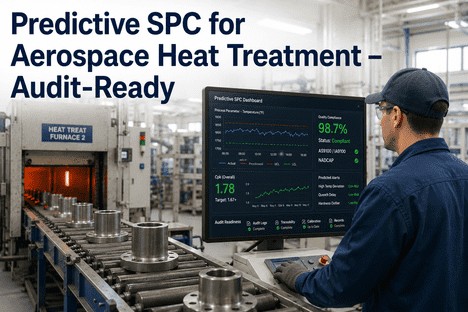
What the Predictive SPC Operator Dashboard Shows During a Heat Treat Shift
The operator does not need to navigate through quality reports or compliance menus to see the audit status. The dashboard presents four views that correspond to what operators need to know across every active cycle: is my process in control? Is my documentation building correctly? Is there a risk I need to act on? And if the auditor walked in right now, is my batch evidence complete?
Operator View 01
Live Cycle Status With Adaptive Control Chart
Every active furnace displays its current cycle phase — pre-heat, solution soak, quench, age — with the live temperature reading per zone plotted against dynamic SPC limits. The adaptive limits are visible as an envelope that widens or tightens based on the current process regime. A green band shows the AMS specification tolerance zone. As long as the process trace stays within both the adaptive limits and the AMS band, the operator sees a single status indicator: in control. A drift approaching the AMS band triggers a visual alert on the specific furnace card, and the operator can expand the card to see which zone and parameter is driving the drift without leaving the main screen.
Operator action: One-screen view of all active cycles. Alert expansion shows zone-level detail. No menu navigation required.
Operator View 02
Documentation Completion Indicator
Each batch in the system displays a documentation completion bar — material receipt checked, recipe selected and cross-referenced, SPC chart active with time-stamped limit adjustments, quench parameters logged, test results entered. The bar fills automatically as each step completes. An auditor walk-through at any point in the cycle shows exactly what documentation exists and what is still pending. The operator can see at a glance which batches are fully documented and ready for cert generation, and which still need test results or a quench delay entry. No batch goes to cert generation with missing records because the system will not produce a compliant export until the documentation bar is fully complete.
Operator action: Documentation bar shows real-time completion status. Export is locked until all required records are present.
Operator View 03
Predictive Alert Feed by Priority
Alerts are ranked by severity and displayed in a chronological feed that the operator can filter by furnace, recipe, or alloy. Predictive alerts — those fired before a parameter reaches the AMS tolerance limit — are displayed with a forecast window showing the estimated time to limit breach if current drift continues. The operator sees not just what is happening now but what the model expects to happen in the next 15, 30, or 60 minutes based on the current rate of change across correlated parameters. A zone 2 temperature drift of 8 degrees over 20 minutes with a forecast to reach the AMS limit in 40 minutes gives the operator time to respond before the cycle is affected. The feed also shows confirmed deviations — parameters that crossed the limit before a correction was applied — and model accuracy notifications that log when a predicted event did not materialise, strengthening the operator's trust in the alert system over time.
Operator action: Priority-ranked feed with forecast windows. Respond before limits are breached, not after.
Operator View 04
Audit Snapshot — Current Compliance Status
A single compliance gauge on the dashboard shows the operator the current audit-readiness score for the shift's active and completed batches combined — a percentage based on documentation completeness, SPC limit compliance rate, and open predictive alert status. A score of 95% or higher means the shift is audit-ready at the current moment. A score below 85% highlights the specific gaps — a batch missing quench delay documentation, a cycle where the SPC chart has a gap exceeding the configured data logging interval, a test result still pending for a completed cycle. The operator can address the gaps immediately rather than discovering them during a pre-audit review. The audit snapshot also displays the number of days since the last NADCAP pyrometry survey for each active furnace, the number of cycles since the last TUS, and the current calibration status of the hardness test equipment used for that shift.
Operator action: Real-time compliance percentage with gap indicators. Address missing records before the audit request arrives.
"
The shift before we deployed predictive SPC, I had two operators spending the last 45 minutes of every shift manually transcribing furnace temperatures into SPC charts and filling out documentation logs. They were good operators running good cycles, but the documentation system treated the process data and the quality record as separate workflows. After deployment, the same furnace data that was already flowing through the PLC started populating the SPC charts, the documentation logs, and the batch records simultaneously. My operators stopped spending the end of shift on paperwork and started reviewing the next day's load plan. The auditor noticed the difference before we did — the documentation was complete, time-stamped, and internally consistent across every batch. That consistency is what AS9100 and NADCAP auditors are looking for: not perfect processes, but documented evidence that the process was controlled.
Aerospace heat treatment compliance is not solely a metallurgical challenge — it is a documentation challenge with metallurgical consequences. The operator who runs a NADCAP-compliant cycle but cannot produce the AS9100-required SPC documentation for that cycle has produced a part that the quality system cannot release. Predictive SPC resolves this structural tension by treating documentation as a byproduct of process control rather than a separate operator responsibility.
The six-step workflow — material receipt verification through batch cert generation — maps to the operator's existing process sequence while building the audit trail that AS9100 Clause 8.5 and NADCAP AC7102 require. Adaptive control limits that move with the process regime, predictive alerts that give operators a 15 to 60 minute intervention window before a parameter reaches the AMS-specified tolerance, and automated documentation that assembles the batch record from process data the operator already generates — these capabilities close the gap between running a compliant cycle and proving that the cycle was compliant.
iFactory's predictive SPC platform is designed specifically for aerospace heat treatment operators and the quality leaders who support them. Book a Demo to see the platform configured for your furnace lineup and AMS specification portfolio, or talk to an expert about a free documentation-readiness assessment for your heat treat operation.
Frequently Asked Questions
No. Predictive SPC does not replace physical testing requirements specified in AMS standards, NADCAP AC7102 audit criteria, or customer purchase order requirements. Hardness testing, tensile testing, metallographic examination, and other destructive or non-destructive evaluation methods remain the definitive quality acceptance criteria. Predictive SPC adds a process-level monitoring layer that operates between test events — providing real-time visibility into whether the process is trending toward or away from the conditions known to produce conforming test results. The predictive model is validated against actual test outcomes, but the test result is always the primary quality record. The advantage for operators is that predictive alerts reduce the number of surprises at test time: if the model indicates the cycle is in control, the operator can be confident the test result will confirm it. If the model signals a deviation risk, the operator can adjust before the test event rather than discovering the deviation after the fact. Talk to an expert about how predictive SPC integrates with your existing hardness testing and metallurgical evaluation workflow.
AMS2750 requires that pyrometry surveys — thermocouple accuracy checks, temperature uniformity surveys (TUS), and system accuracy tests (SAT) — be conducted at specified intervals and that the results be documented and traceable to each production load. iFactory's predictive SPC platform maintains a furnace equipment calendar that tracks the date of the most recent pyrometry survey for each furnace zone, the TUS results and the approved temperature range, and the SAT schedule. When an operator selects a recipe for a furnace zone, the platform cross-references the recipe's required temperature range against the zone's current TUS-approved range. If the recipe temperature falls outside the approved TUS range, the operator receives a pre-cycle alert that the furnace is not currently qualified for that recipe. The TUS record, SAT verification, and pyrometry log are attached to every production batch documentation file automatically, so the auditor sees the furnace qualification evidence alongside the batch SPC records without requiring the operator to locate separate pyrometry files. Book a Demo to see the AMS2750 integration configured for your furnace pyrometry schedule.
Yes. Every predictive alert in the iFactory platform includes the operator response as part of the permanent batch record. If the operator evaluates the alert and determines that no action is required — based on their knowledge of the furnace behaviour, the specific alloy response characteristics, or the load configuration — the operator can dismiss the alert with a brief rationale selected from a predefined list or entered as free text in the operator notes field. The system logs the alert timestamp, the parameter values that triggered the alert, the operator's dismissal decision, the rationale, and the operator ID. This record is part of the batch documentation. If the subsequent hardness test result confirms the operator's judgement, the model learns from the override: the same parameter combination in a similar context is less likely to generate an alert on the next occurrence. If the test result reveals a deviation that the operator dismissed, the alert record with the override rationale becomes the evidence for the quality investigation — showing that the operator made an informed decision based on available information, and that the model's prediction was more accurate than the operator's assessment. Both outcomes strengthen the overall quality system by capturing the decision logic at the point of action. Talk to an expert about configuring operator alert response options for your heat treat workflow.
Yes. iFactory's equipment architecture registers each furnace cell as a separate equipment asset with its own process parameter set, recipe library, AMS specification associations, pyrometry schedule, and NADCAP accreditation scope. An operator logged into the platform sees all active cycles across their assigned furnace cells on a single dashboard — regardless of whether those cells include vacuum furnaces running AMS2759/1, atmosphere carburising furnaces running AMS2759/7, or salt bath tempering lines running AMS2759/2. Each furnace type has its own SPC limit configuration: vacuum furnaces monitor zone temperature, partial pressure, and quench pressure; atmosphere furnaces monitor carbon potential, dew point, and atmosphere circulation; salt baths monitor molten salt temperature uniformity and chemical composition. The operator does not need to switch between different systems or log into separate process control interfaces for each furnace type. The predictive SPC model is trained on the specific parameter combinations relevant to each furnace-AMS specification-alloy combination, so an alert on a vacuum furnace means something different from an alert on a salt bath line, and the platform communicates that difference through the alert context rather than making the operator interpret generic alarms. Book a Demo to see multi-fleet predictive SPC configured for your equipment portfolio.
The Operator Runs the Cycle. Predictive SPC Completes the Record. Get a Free Documentation-Readiness Assessment for Your Heat Treat Line.
iFactory's predictive SPC platform for aerospace heat treatment — adaptive control charts, predictive quality alerts, automated AS9100 and NADCAP documentation, and an operator dashboard designed for multi-furnace, multi-AMS specification production environments.