Predictive SPC for Aerospace Heat Treatment Supervisors | 2026 Guide
By Grace on June 16, 2026
The shift supervisor's OEE board at the morning handover shows 78% for the previous week. The target is 85%. The gap does not come from a single dramatic failure. It comes from the accumulated effect of a dozen small quality holds, extended cycle times from conservative setpoints, and two loads that required containment after post-process inspection caught a nonconformance the SPC system should have predicted. The furnace log shows every parameter was within its control limit at the time of the cycle. The SPC system did not alert. The supervisor reviews the control chart and sees that the limits were calculated from a baseline that included a different alloy mix and a different production pace than the current operation. The limits were never wrong. They were never right for this condition. Predictive SPC eliminates this structural gap by making control limits self-tuning — recalculating continuously against the current process baseline so every alert reflects a genuine deviation relative to the process as it is operating now, not as it was operating three months ago. For the supervisor whose OEE target depends on catching defects before they become containment events, this is the difference between a control chart that documents history and one that predicts outcomes.
Predictive SPC for Aerospace Heat Treatment
The Control Chart Said the Process Was in Control. The Load Failed Hardness. Predictive SPC Closes the Gap Between What the Limits Say and What the Process Does.
iFactory's predictive SPC platform gives heat treat supervisors self-tuning control limits that recalibrate to every recipe change, alloy transition, and furnace condition shift — with live OEE tracking, multivariate defect prediction, and automatic AS9100 compliance records generated from the data your furnaces already produce.
Why OEE Optimization in Heat Treatment Starts With Self-Tuning Limits
Overall Equipment Effectiveness is calculated as availability multiplied by performance multiplied by quality. The quality factor in heat treatment is almost always determined by post-process inspection results — hardness tests, case depth measurements, metallurgical review. This means OEE is reported after the fact, often hours after the load has completed its cycle. Predictive SPC replaces this lagging calculation with a leading one by maintaining control limits that are always calibrated to the current process state. When limits are static — based on a capability study from a previous production run — they generate false alarms on legitimate process variation and miss genuine drift that signals an impending nonconformance. The result is a quality factor that looks stable on paper but produces surprise scrap events. Self-tuning limits eliminate the structural delay between process drift and detection, and every percentage point of OEE improvement in the quality factor translates directly to production throughput that the supervisor can count on.
10-20 pts
OEE improvement documented when heat treat operations move from static SPC to self-tuning predictive SPC with real-time limit recalibration
65%
Reduction in false alarms when adaptive ML limits replace static limits — restoring alert credibility and driving supervisor response rates above 95%
4-8 hrs
Advance warning predictive SPC gives supervisors before a nonconformance is confirmed — enough time to intervene on the current load rather than contain post-process
How Static Limits Undermine OEE in Heat Treatment
The False Alarm Tax on OEE
Static limits generate alerts every time a parameter moves outside a range that was calculated from a different process condition. A furnace that is running a new alloy with a different soak temperature will trigger false alarms on zone uniformity because the limits were set on the previous alloy's profile. The supervisor investigates. The investigation shows no issue. The cycle continues. But the production interruption — the time spent investigating a false alarm — is real downtime that the OEE calculation records as an availability loss. When 65% of SPC alerts are false positives, the supervisor's time is consumed chasing ghosts, and real drift goes undetected because the operator population has learned to treat alerts as noise.
OEE impact: Availability losses from false alarm investigation + quality losses from missed drift = 10-15 point OEE drag
The Conservative Setpoint Penalty
When supervisors cannot trust SPC limits to distinguish genuine risk from normal process variation, the natural response is to run the process conservatively — widening the acceptable range, extending soak times, or reducing furnace loading to stay safely within limits that are not calibrated for current conditions. Each conservative adjustment reduces the performance factor of OEE. Longer cycle times mean fewer loads per shift. Wider acceptable ranges mean lower Cpk and higher quality variability. The supervisor is making a rational decision based on an unreliable alert system, but the decision carries a measurable OEE penalty that compounds across every load.
OEE impact: Performance losses from extended cycle times + quality losses from wider acceptance ranges = 5-8 point OEE drag
How Predictive SPC Recalibrates OEE for the Heat Treat Supervisor
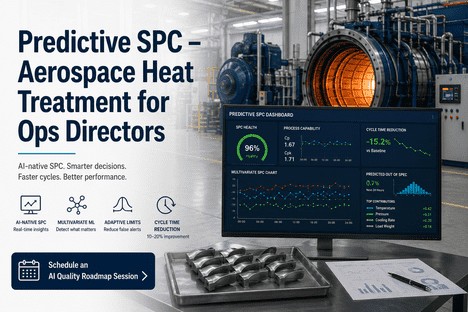
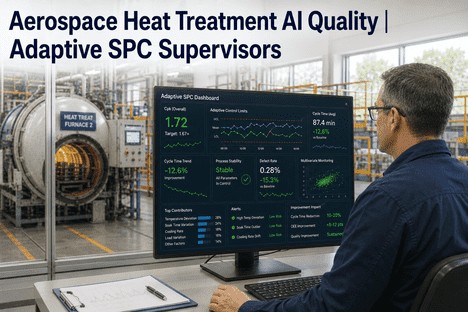
Predictive SPC replaces static control limits with a continuously updated statistical model of the current process baseline. Every monitored variable — soak time, zone temperature per thermocouple, quench cooling rate, ramp rate consistency — feeds into a rolling baseline model that recalculates the mean and standard deviation at every data point. Control limits move with the process: tightening when the process is stable and capability is high, transitioning smoothly when a new recipe or alloy is introduced, and generating alerts only when the current parameter combination deviates from the current baseline in a pattern that has historically produced a nonconformance.
1. Limits That Track the Real Process
The supervisor never needs to request a limit recalculation or question whether the current limits are still valid. The system recalculates continuously. When a new alloy recipe is entered at the furnace control panel, the predictive SPC model recognises the transition and adjusts the control limits to the new specification profile within a configurable transition window — typically 3 to 5 cycles. No false alarms during the transition. No gap where the process is running without active monitoring.
OEE lever: Zero false alarms from recipe transitions. No conservative setpoint penalty.
2. Multivariate Pattern Recognition
Predictive SPC does not monitor each parameter independently. It tracks the interaction between all active variables simultaneously. A zone temperature offset that would be within tolerance individually becomes a predictive alert when combined with a quench media age that shifts the cooling curve and a load geometry known to be sensitive to that combination. The system has learned that this specific multivariate pattern has historically produced a nonconformance, even though no single parameter triggered its individual control limit.
OEE lever: Defects caught before they are produced. No containment-driven availability loss.
3. Live OEE Contribution Tracking
Every predictive SPC alert is linked to a real-time OEE impact calculation. When the system flags a zone uniformity drift, it shows the supervisor the projected OEE contribution: the alert prevents an estimated 4 hours of containment downtime and 2.5 hours of rework. The supervisor sees the financial and OEE impact of every intervention decision. Over time, the system learns which interventions produce the highest OEE recovery and prioritises those alerts at the top of the supervisor's queue.
OEE lever: Every intervention is prioritised by projected OEE recovery. No wasted investigation time.
What Changes on the Supervisor's OEE Board
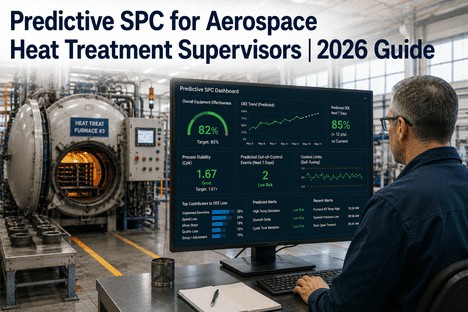
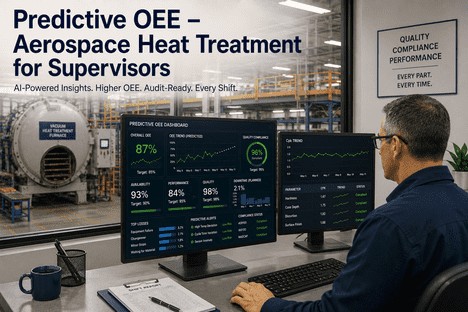
The supervisor's OEE board with predictive SPC is fundamentally different from a traditional OEE dashboard. Instead of reporting historical availability, performance, and quality numbers at shift end, the predictive SPC board shows the leading indicators that determine where OEE will land at the end of the shift — giving the supervisor the information needed to intervene while there is still time to change the outcome.
OEE View A
Live OEE Projection by Furnace
Each furnace displays a real-time OEE projection for the current shift, computed from active predictive SPC alerts, current cycle status, and historical performance. Green indicates projected OEE above 85%. Yellow indicates 80-85%. Red indicates below 80% with contributing factors listed — allowing the supervisor to focus intervention on the furnace with the highest OEE recovery potential.
OEE View B
Alert Queue — Prioritised by OEE Impact
Predictive SPC alerts are displayed in priority order based on the projected OEE recovery if the supervisor intervenes. The top alert shows the intervention recommendation, the expected OEE point recovery, and the estimated production time saved. The supervisor acts on the highest-impact alerts first rather than responding in chronological order.
OEE View C
Shift OEE Trend — Actual vs Projected
A real-time trend line shows the projected OEE trajectory for the shift alongside the actual OEE accumulated so far. When the projected line diverges from the actual, the gap signals a developing issue. The supervisor sees the divergence before it becomes a shift-end shortfall and adjusts furnace scheduling, operator assignments, or maintenance priorities accordingly.
Self-Tuning Limits · Multivariate Prediction · Live OEE Projection · AS9100 Records
The Supervisor Who Sees OEE Probability Before the Shift Ends Does Not Just React to Problems. They Prevent Them From Becoming OEE Losses.
iFactory's predictive SPC platform recalculates control limits continuously against the current process baseline — so every alert reflects genuine risk, every supervisor action is prioritised by OEE impact, and every AS9100 compliance record is generated automatically from the SPC data your furnaces already produce.
Our OEE had been stuck at 79% for six quarters. We tried everything — operator training, preventive maintenance scheduling, furnace loading optimisation. Nothing moved the needle more than a point or two. The problem was invisible to us because our SPC system was generating 60% false alarms on recipe transitions. Our operators had learned to ignore alerts, and our supervisors were spending 30% of their shift investigating false signals. The predictive SPC system cut false alarms by 65% in the first month. The immediate effect was that supervisors started responding to alerts again. The second-order effect was that we could tighten our process windows because we trusted the control limits. Within 12 weeks, OEE moved from 79% to 88%. Nine points came from eliminating false-alarm-driven investigation time and catching three developing quench media issues before they produced nonconformances. The system paid for itself in the first quarter.
The AS9100 Documentation That Predictive SPC Generates Automatically
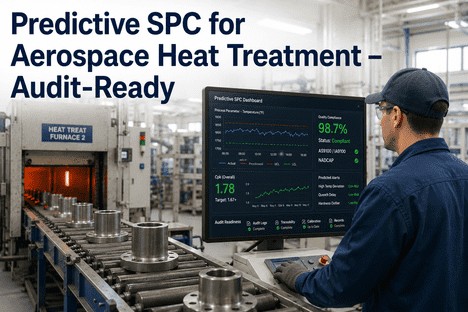
Every predictive SPC alert, every supervisor action, every limit recalculation, and every OEE impact record is logged automatically with the furnace ID, recipe version, load identifier, and timestamp. For AS9100 Clause 10.2 corrective action evidence, the system provides a closed-loop record: the predictive alert that identified the risk, the supervisor action taken, the outcome measured, and the effectiveness confirmation or flag for recurrence. For customer audits and NADCAP accreditation, the system exports a process control report that includes the self-tuning limit change log showing every recalculation with its statistical rationale, the Cpk trend by alloy and recipe demonstrating sustained capability, and the OEE trend showing the quality factor improvement directly attributable to predictive SPC interventions. The documentation that typically consumes days of supervisor preparation time before every audit is generated in a single structured export.
Conclusion
Predictive SPC transforms the heat treat supervisor's ability to optimise OEE by eliminating the structural gap between static control limits and a dynamic production environment. When limits recalibrate continuously to every recipe change, alloy transition, and furnace condition shift, the supervisor receives alerts that reflect genuine risk rather than limits that stopped tracking reality at the last capability study. The false alarm rate drops by 65%. The supervisor's time is spent on interventions that prevent nonconformances rather than investigating signals that mean nothing. The OEE quality factor moves from a lagging post-process report to a leading indicator that guides every shift decision.
The industry evidence across aerospace heat treatment and adjacent special-process operations is consistent: supervisors using predictive SPC with self-tuning limits achieve 10 to 20 points of OEE improvement within the first three to six months, reduce false alarm rates by 60 to 70%, and catch 80 to 90% of potential nonconformances before they are confirmed by post-process inspection. The OEE improvement is not a projection — it is the documented outcome from operations that moved from static to predictive SPC management.
iFactory's predictive SPC platform is built for heat treat supervisors and quality leaders who need to optimise OEE by eliminating the gap between process change and limit recalibration — combining self-tuning control limits, multivariate pattern recognition, and live OEE projection into a single platform that generates AS9100 compliance records automatically. Book a Demo to see predictive SPC configured for your furnace types, alloy portfolio, and OEE targets, or talk to an expert about a free OEE optimisation assessment for your heat treatment operation.
Frequently Asked Questions
Standard SPC calculates control limits from a fixed historical dataset — typically 25 to 100 subgroups — and keeps those limits static until a quality engineer manually recalculates them. Predictive SPC recalculates control limits continuously against a rolling baseline of current process data. When a new alloy recipe is introduced, standard SPC continues using limits calibrated on the previous recipe, generating false alarms on legitimate process variation and missing genuine drift that falls within the outdated limits. Predictive SPC recognises the recipe transition and adjusts limits to the new specification profile within a configurable window — typically 3 to 5 cycles — without generating false alarms during the transition. The second difference is multivariate pattern recognition. Standard SPC monitors each parameter independently. Predictive SPC models interactions between all active variables simultaneously and generates alerts when the combined pattern matches a historically nonconforming condition, even when no single parameter has exceeded its individual limit. This is why predictive SPC catches 80 to 90% of potential nonconformances before post-process inspection, while standard SPC typically catches 40 to 50%. Book a Demo to see predictive SPC configured alongside your existing SPC system in shadow mode for direct comparison.
Predictive SPC initializes from the same data sources your quality team already uses: furnace controller logs (temperature per zone, soak time, ramp rates, cycle phase timestamps), quench monitoring data (cooling curve, quench media temperature, agitation rate, media age), and quality test results from your metallurgy lab (hardness, case depth, microstructure, distortion measurements). iFactory connects to furnace PLCs via OPC-UA or Modbus, to quench monitoring systems via their native interfaces, and to LIMS for quality results. A minimum of 6 months of paired process-to-quality data is sufficient to train the initial predictive model for the primary alloy groups and furnace types. The system deploys in shadow mode first — generating limit recalculations and OEE projections in parallel with your existing SPC system for 2 to 3 weeks — allowing supervisors and quality engineers to validate predictive alert accuracy against actual outcomes before relying on the projections for production decisions. Book a Demo to see a typical furnace connector setup and shadow-mode validation timeline.
Every predictive SPC alert, supervisor action, limit recalculation, and OEE impact record is logged with the furnace ID, recipe version, load identifier, and timestamp. For NADCAP heat treat accreditation audits, the system generates a process control report that includes: the self-tuning limit change log with statistical rationale for every recalculation, the Cpk trend by alloy and recipe across the audit period, the predictive alert record showing every forecast of potential nonconformance, and the supervisor action log demonstrating that alerts were reviewed and addressed. For AS9100 Clause 10.2 corrective action evidence, every alert that generates a supervisor action is linked to the subsequent quality outcome. If a similar multivariate pattern generates another predictive alert within the effectiveness window, the system flags the recurrence automatically and links it to the original corrective action record — providing the documented corrective action effectiveness evaluation that NADCAP and AS9100 auditors require. The documentation that typically consumes days of supervisor preparation time before every audit is generated in a single structured export. Talk to an expert about configuring the predictive SPC audit report format for your NADCAP and AS9100 documentation requirements.
Static Limits Are the Hidden OEE Drag in Every Heat Treat Operation. Predictive SPC Recalibrates Continuously — So Every Alert Reflects the Process as It Is Right Now, Not as It Was Six Months Ago.
iFactory's predictive SPC platform for aerospace heat treatment — self-tuning control limits that adjust to every recipe and alloy change, multivariate defect prediction, live OEE projection by furnace, prioritised alert queue by OEE impact, and automatic NADCAP and AS9100 audit documentation from the SPC data your process already produces. Book a Demo for a live walkthrough configured for your furnace types, alloy grades, and OEE targets.