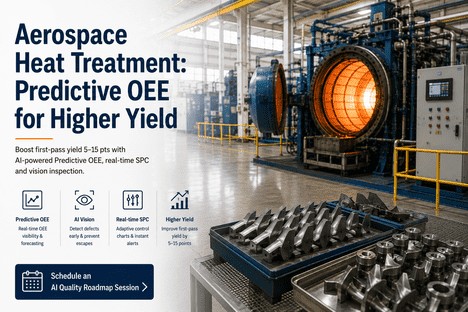
Aerospace Heat Treatment: Predictive OEE for Higher Yield
By Grace on June 17, 2026
A turbine disc that spends 12 hours in a vacuum furnace at 1,050 degrees Celsius has one chance to emerge with the correct microstructure. If the soak time drifts by seven minutes, if the quench rate falls four degrees below the certified profile, if a thermocouple reports a false temperature that masks a cold zone — the disc passes every in-process check and fails final hardness testing three shifts later. The non-conformance is documented. The furnace is re-qualified. A corrective action is written. Five weeks later, with a different alloy batch and a different operator crew, the same defect category appears again. The investigation finds the same root cause. The corrective action number has changed. The outcome has not. This is not a heat treatment execution failure. It is a detection architecture failure — and it is the problem that Predictive OEE is designed to solve. For operations directors managing aerospace heat treatment operations under AS9100 and NADCAP requirements, the ability to predict yield issues before the furnace door opens separates quality programmes that manage risk from those that merely document its consequences.
Predictive OEE Turns Heat Treatment From a Cost Center Into a Yield Driver. See How on Your Furnace Data.
iFactory's Predictive OEE platform gives operations directors real-time visibility into heat treatment yield, with AI-powered defect forecasting that flags non-conformance risk before the cycle completes.
First pass yield improvement documented in aerospace heat treat operations after deploying AI-powered predictive OEE with real-time furnace monitoring and adaptive SPC
40-60%
Reduction
Reduction in heat treatment non-conformances when predictive models flag off-spec conditions 4-8 hours before hardness and microstructure test results confirm the defect
8-12
OEE Points
Overall Equipment Effectiveness improvement reported by aerospace heat treat facilities combining real-time OEE tracking with predictive quality analytics in a single platform
The Three Levers of Heat Treatment OEE — Where Yield Leaks and How to Plug Them
Every point of OEE lost in heat treatment traces to one of three levers: Availability (furnace downtime when production waits), Performance (cycles that run slower or longer than the standard), and Quality (parts that fail first-pass inspection). In aerospace heat treatment, the Quality lever dominates the loss profile — a single non-conforming furnace load can scrap hundreds of thousands of dollars in machined components. Yet most OEE programmes invest disproportionate effort on Availability and Performance because those losses are visible in real time. The Quality loss does not appear until the hardness tester or the metallurgical lab confirms it hours or shifts after the furnace cycle completed. Predictive OEE closes this visibility gap by making quality losses as visible — and as predictable — as equipment downtime.
Availability Lever
Furnace Downtime and Thermal Cycles
Heat treatment furnaces lose availability to planned maintenance (thermocouple replacement, zone calibration, vacuum pump service) and unplanned events (burner failure, quench system fault, atmosphere leak). Predictive OEE models capture furnace utilisation across all cycles — including idle time between loads, cooldown and heat-up transitions, and extended soak holds that eat into the production window. The system distinguishes between planned thermal cycles and unplanned delays automatically, so the operations director sees true availability loss without manual log interpretation.
Thermal transition tracking
Predictive maintenance alerts
Performance Lever
Cycle Time Adherence and Rate Efficiency
Performance loss in heat treatment is measured as the gap between the certified cycle time and the actual cycle duration. Extended ramp-up phases, temperature overshoot that triggers additional stabilisation holds, operator-added soak margin beyond specification, and delayed quench initiation all degrade performance without necessarily producing non-conforming parts. The performance metric answers the question: given the furnace cycle started at the correct time, did it complete within the efficiency target? Predictive OEE tracks every phase of the thermal profile against the certified standard and flags deviations before they compound.
Phase-by-phase cycle tracking
Thermal profile compliance
Quality Lever
First Pass Yield and Defect Prevention
The quality lever is where aerospace heat treatment operations face the highest financial exposure. A single furnace load that fails to meet hardness specification, case depth requirement, or microstructure acceptance criteria can scrap weeks of upstream machining value. Predictive OEE addresses this by correlating in-process thermal data — zone temperatures, quench medium temperature and flow, atmosphere carbon potential, vacuum level — with historical quality outcomes. When the current cycle profile matches a pattern that previously produced a non-conformance, the system generates a predictive alert before the cycle completes, giving the operations director the lead time to quarantine the load for additional inspection or adjust the downstream process.
Pre-cycle defect forecast
Real-time quality correlation
How Predictive OEE Transforms Heat Treatment — A Three-Stage Architecture
The iFactory Predictive OEE platform for aerospace heat treatment operates as a three-stage intelligence pipeline. Stage one captures what the furnace is doing in real time. Stage two compares it against what the certified cycle requires and what historical quality data says the outcome will be. Stage three delivers actionable information to the operations director — not as raw data, but as risk-ranked decisions with documented rationale for AS9100 audit compliance.
Stage 01
Real-Time Furnace Telemetry
Every production furnace is connected to the platform through existing thermocouple, controller, and SCADA outputs — no additional sensors required unless the operations director chooses to add zone-specific monitoring for high-criticality loads. The system ingests zone temperatures, ramp rates, soak durations, quench medium temperature and flow, atmosphere composition, and vacuum pressure at intervals configurable from one second to one minute. Each data point is time-stamped and tagged with the furnace ID, load number, alloy grade, and cycle recipe version.
Data sources: thermocouples, SCADA, PLC, furnace controllers, quench instrumentation
Stage 02
Predictive Quality Correlation Engine
The correlation engine matches the live thermal profile against a model trained on the facility's historical pairing of furnace data with quality test results — hardness, case depth, microstructure, tensile strength, and dimensional measurements. When the current cycle profile falls within a region of the model that historically produced non-conforming outcomes, the engine calculates a defect probability score and a forecast confidence interval. The model improves with every completed cycle: the actual quality result feeds back into the training set, and the next prediction for the same alloy-recipe combination is incrementally more accurate.
Training data: 12-18 months of paired furnace telemetry and quality test outcomes
Stage 03
Operations Director Action Dashboard
The predictive output is delivered to the operations director through a single-screen dashboard organised around the questions that matter for heat treat production management: what is the current defect risk by furnace and alloy grade, which active cycles require attention before completion, and what is the first-pass yield trend for each certified recipe. Every alert includes the defect probability, the primary parameter driving the risk, and a link to the cycle data that generated the prediction. The dashboard also surfaces the OEE score for each furnace, calculated automatically from the combined availability, performance, and quality data streams.
Output: risk-ranked alerts, OEE scores, FPY trends, audit-ready cycle records
What the Operations Director's Dashboard Shows
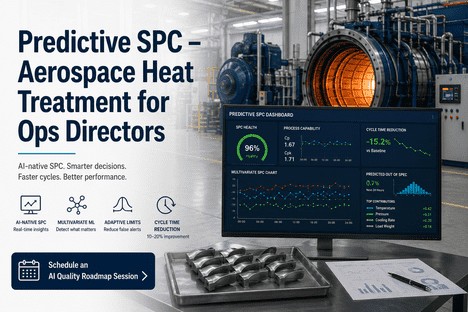
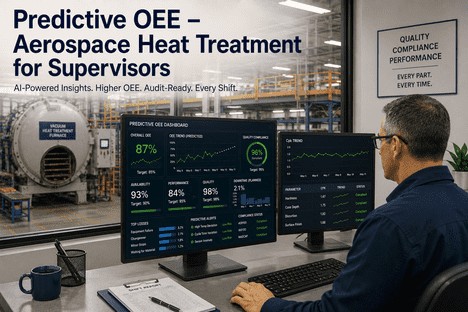
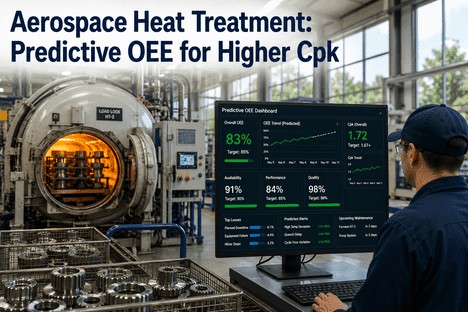
The Predictive OEE dashboard is not a process control interface — it is a production and quality management tool designed for the operations director who needs to know, in under 30 seconds, whether heat treatment is running to plan, where risk is accumulating, and what action is needed before the end of the shift. Every view is configurable by furnace group, alloy grade, recipe, and time horizon.
View 01
Live OEE by Furnace With Quality-Adjusted Scoring
Each furnace displays its real-time OEE score with the three component breakdown — availability, performance, and quality. The quality component is adjusted dynamically by the predictive engine: a furnace with a high-probability defect forecast in an active cycle shows a reduced quality score immediately, not after the hardness test confirms the failure. This gives the operations director a true forward-looking OEE that reflects the most likely outcome of cycles in progress, not just the confirmed result of completed cycles.
Forward-looking OEE with predictive quality adjustment
View 02
Cycle Risk Register — Active and Queued Loads
Every active and queued furnace cycle is listed with its defect probability score, alloy grade, recipe version, and estimated completion time. Cycles with probability above the user-configurable threshold are highlighted for attention with the specific risk driver identified — zone temperature deviation, ramp rate anomaly, quench condition variance, or atmosphere composition drift. The operations director can drill into any flagged cycle to see the real-time thermal profile overlaid with the certified recipe envelope and the historical failure zone.
Flagged cycles show risk driver, probability score, and root parameter
View 03
First Pass Yield Trend by Alloy and Recipe
FPY is calculated continuously for each alloy grade and recipe combination and displayed as a trend line with the current value, the 30-day moving average, and the projected FPY at the current trajectory. When FPY declines below the configured threshold for any alloy-recipe pair, the dashboard surfaces the change automatically with the primary contributing parameter shift. This enables the operations director to detect yield drift that emerges gradually over multiple cycles — the kind of trend that individual cycle inspections never flag because no single load fails badly enough to trigger investigation.
FPY trend with automatic drift detection and parameter attribution
View 04
Audit-Ready Compliance Record for Every Cycle
Every furnace cycle generates a compliance record automatically: the recipe certification, the as-run thermal profile with zone-by-zone temperature trace, the quench record, the atmosphere log, the predictive quality assessment generated during the cycle, and the final quality test result when confirmed. The record is structured to satisfy AS9100 Clause 8.5 production and service provision documentation requirements, NADCAP heat treat audit checklists, and customer quality record requests. Audit preparation shifts from manual data assembly across multiple systems to a single export filtered by date range, furnace, alloy, or customer program.
AS9100 and NADCAP compliant cycle documentation — auto-generated
"
Before Predictive OEE, our heat treat quality review was always after the fact. The hardness test told us we had a problem four hours after the quench completed. By then, the next load was already in the furnace with the same recipe. We were producing non-conforming parts for an entire shift before we knew we had a problem. The predictive engine changed this — now we see a defect probability alert during the soak phase, not after the test. In the first quarter, we reduced heat treat non-conformances by 43% and recovered 9 OEE points on our vacuum furnaces. The cycle compliance record alone cut our NADCAP audit prep time from five days to one export.
The Furnace Cycle Produces the Part. The Predictive Model Produces the Warning Before the Defect Becomes Scrap.
iFactory's Predictive OEE for aerospace heat treatment gives operations directors the lead time they need to intervene before yield is lost — with audit-ready records generated automatically from every cycle.
First pass yield improvement in aerospace heat treatment is not a quality sampling problem — it is a prediction timing problem. When the quality system waits for the hardness test, the microstructure report, or the dimensional inspection to confirm a defect, the furnace has already completed the cycle, the load is already non-conforming, and the production window is already lost. Predictive OEE addresses this structural gap by making the quality outcome visible before the cycle ends — not as a certainty, but as a risk-ranked probability with the specific parameter driver identified and the historical evidence base attached. The operations director who sees a defect probability alert during the soak phase has an intervention option. The operations director who waits for the test result has a corrective action to write.
The documented outcomes from aerospace heat treat operations that have deployed predictive OEE with real-time furnace telemetry and AI-driven quality correlation are consistent across facility types and alloy portfolios: 5 to 15 percentage point improvement in first pass yield, 40 to 60 percent reduction in heat treatment non-conformances, and 8 to 12 OEE points recovered on the furnace fleet that was previously running blind between cycle start and quality confirmation. The operations directors achieving the upper end of these ranges are the ones who integrated furnace telemetry into a single platform that captures availability, performance, and quality data simultaneously — and who use the predictive quality engine as a real-time decision input, not a retrospective analysis tool.
iFactory's Predictive OEE platform is designed for operations directors in aerospace heat treatment who need to raise first pass yield, reduce non-conformance recurrence, and maintain AS9100 and NADCAP audit readiness without adding manual documentation overhead. Book a Demo to see the Predictive OEE dashboard configured for your furnace portfolio and alloy grade mix, or talk to an expert about a free heat treat OEE and audit-readiness assessment for your facility.
Frequently Asked Questions
The platform connects to furnace controllers, SCADA systems, and PLCs through standard industrial communication protocols — OPC-UA, Modbus TCP, MTConnect, and Siemens S7 — without any modification to the control loop or the certified cycle program. Data is read-only from the controller's perspective: the platform receives process variable transmissions but never sends commands to the furnace. This architecture means the Predictive OEE system can be deployed on active production furnaces without requiring cycle re-certification or creating a NADCAP audit concern. For facilities where IT security policy prohibits direct control network connections, the platform supports a DMZ deployment architecture with one-way data diodes or historian bridge connectors that extract data from the OT network without exposing it. Talk to an expert about your furnace connectivity profile and we will map the integration architecture for your specific controller types.
The predictive model requires paired furnace telemetry and quality test result data covering the defect categories the operations director wants to forecast — hardness deviation, case depth non-conformance, microstructure rejection, and dimensional distortion. A minimum of six months of paired data per alloy-recipe combination is sufficient to train an initial model with useful forecast accuracy. Twelve to eighteen months covering multiple alloy batches, furnace maintenance cycles, and seasonal ambient temperature variations produces higher confidence during transition periods. The platform can ingest historical data from existing process historians, furnace chart recorders, and LIMS databases. During the initial deployment, the model runs in shadow mode — generating forecasts without triggering alerts — so the operations director team can validate accuracy against actual quality outcomes before relying on predictions for production decisions. Book a Demo to see accuracy validation data from comparable aerospace heat treatment deployments.
Yes. The platform registers each furnace as an individual asset with its own equipment profile, certified recipe library, zone configuration, and process parameter set. A vacuum furnace with six heating zones, a quench gas system, and cooling rate specification is managed alongside an atmosphere carburising furnace with carbon potential control and oil quench on the same unified dashboard. Each furnace type has its own predictive model calibrated to the relevant process variables and defect categories. The operations director sees all furnaces on a single screen with the ability to filter by furnace type, alloy grade, customer program, or any combination. OEE scores are calculated using the same methodology across furnace types, making the comparison between vacuum and atmosphere furnace efficiency meaningful despite the different process physics. Book a Demo to see multi-furnace Predictive OEE configured for a mixed vacuum-and-atmosphere heat treatment facility.
When a furnace is re-certified — following thermocouple replacement, zone calibration, or major maintenance — the platform registers the certification event and begins collecting a new process baseline. The predictive model for that furnace enters a transition state where predictions are flagged with reduced confidence until sufficient cycles are completed under the new certification to rebuild the statistical baseline. Similarly, when a new recipe version or a new alloy grade is introduced, the model for that alloy-recipe combination starts with a conservative prediction threshold and tightens as cycle data accumulates. The operations director sees which predictions are based on the established model versus the transition model, so the decision to act on a prediction can be calibrated to the confidence level. After approximately 20 to 30 cycles under the new certification or recipe, the model achieves equivalent confidence to the established baseline. Book a Demo to see how the platform manages certification transitions in the predictive model.
Your Furnace Data Already Contains the Pattern of Every Defect It Will Produce. Predictive OEE Reads It Before the Hardness Test Confirms It. Get a Free Heat Treat OEE Assessment.
iFactory's Predictive OEE platform for aerospace heat treatment — real-time furnace telemetry integration, AI-powered defect forecasting up to 8 hours ahead, first pass yield trend analytics, and AS9100/NADCAP-aligned cycle documentation generated automatically from the process data your furnaces already produce.