Digital Twin QC for Aerospace Engine Assembly Supervisors | 2026 Guide
By Grace on June 12, 2026
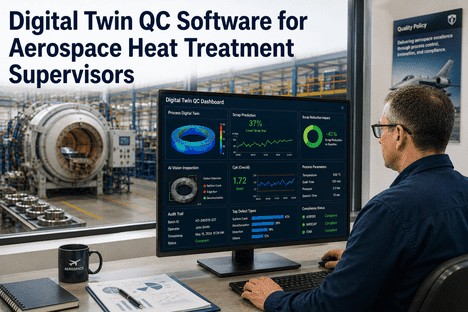
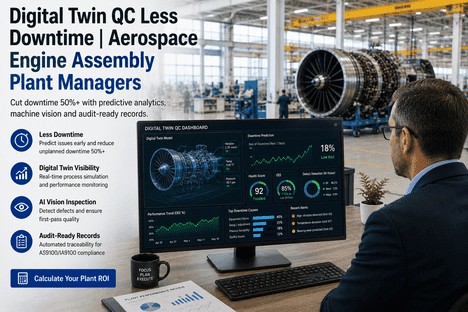
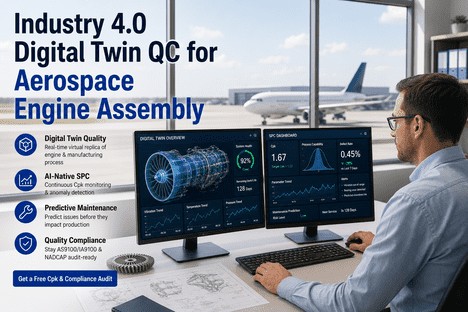
Every engine assembly supervisor knows the gap between design intent and as-built quality. The drawing calls for a coaxiality tolerance of 0.02 mm between the turbine disc and the shaft. The CMM report at the end of the line shows 0.035 mm. The part is reworked. The schedule slips. The investigation reconstructs the root cause from shift logs, operator notes, and tooling records — data that existed in isolation before the part was assembled but was never correlated until after the escape was confirmed. Digital Twin Quality closes this gap by maintaining a continuously synchronised virtual model of every engine assembly in production — updated in real time by torque tool readings, clearance measurements, fastener run-down data, and leak test results — so the supervisor sees not just what the process is doing, but where the current trajectory will land against every critical characteristic before the next assembly cycle begins. The twin does not replace the CMM. It replaces the delay between producing a deviation and discovering it.
Every Engine Assembly Exists Twice — Once as a Digital Twin Updated in Real Time and Once as a Physical Part. The Supervisor's Job Is to Keep Them Identical.
iFactory's Digital Twin QC platform gives engine assembly supervisors a live virtual model of every assembly in production — synchronised with every torque cycle, clearance check, and leak test — delivering Cpk visibility at the part level and what-if simulation for every process decision.
Design intent is archived when assembly begins. The physical process proceeds without synchronisation. Quality deviations are detected at end-of-line CMM — hours or days after root cause. Rework costs escalate. The gap between digital model and physical outcome is quantified only after the escape is confirmed.
With Digital Twin QC
Design intent remains alive throughout production. Every torque cycle, clearance measurement, and leak test updates the twin in real time. Quality deviations are detected at the cycle they occur — not at end-of-line. Cpk is calculated continuously against as-built data, not against archived design models.
Cpk 1.67+
Sustained capability achieved when supervisors use digital twin QC to detect drift at the point of occurrence — not at end-of-line inspection
5-15s
Time to run a what-if simulation on the digital twin — the supervisor asks what happens to Cpk if a parameter changes and gets the answer in seconds, not days
87%
Reduction in defect discovery time when quality deviations are detected by the twin at cycle level — compared to end-of-line inspection in engine assembly
24%
Improvement in first-time assembly yield documented when digital twin-driven quality control replaces traditional end-of-line inspection in engine manufacturing
What a Process Digital Twin Actually Does for Quality in Engine Assembly
The term digital twin is widely used and rarely defined. In aerospace engine assembly, a process digital twin is not a 3D visualisation of the engine on a screen. It is a continuously synchronised virtual model that ingests data from every sensor, tool, and inspection station on the line and mirrors the evolving quality state of every assembly in real time. The twin tracks torque curves from every fastener driver, clearance measurements from every feeler gauge or laser check, compression force from every seal installation, leak test pressure decay from every fuel or oil system test, and coaxiality data from every rotor stack measurement. As each data point arrives, the twin updates the virtual assembly state and recalculates the projected Cpk for every critical characteristic. The supervisor does not wait for the end-of-line CMM to confirm whether the assembly meets specification. The twin already knows.
Twin Function 01
Real-Time Cpk per Characteristic
Every critical characteristic — fastener torque, coaxiality, clearance gap, seal compression — has a live Cpk that updates with every measurement. The supervisor sees the capability trajectory for each characteristic at any point in the assembly cycle. When Cpk on a turbine disc coaxiality measurement drops from 1.72 to 1.58 after three consecutive rotor stacks, the twin flags it immediately, not after the CMM report at shift end.
Twin Function 02
What-If Simulation
The supervisor asks a question — "What happens to final coaxiality Cpk if I increase the stack preload by 5%?" — and the twin answers in 5 to 15 seconds. The simulation runs the forward model using current as-built data, applies the proposed parameter change, and returns the predicted impact on every downstream characteristic. The supervisor decides based on simulation output, not intuition.
Twin Function 03
Automated Part Record with Full Traceability
Every assembly serial number generates a complete quality record automatically — all torque curves, clearance measurements, leak test results, operator interventions, and the Cpk trajectory at each stage. The record is linked to programme version, tool lots, material batches, and shift data. This is the AS9100 Clause 8.5.2 traceability record, generated in real time without manual compilation.
The Four Quality Dimensions the Twin Monitors in Engine Assembly
Engine assembly quality is defined by four independent characteristic groups, each with its own sensor inputs, measurement methods, and capability targets. The digital twin maintains a separate model for each dimension and aggregates them into a composite Cpk that reflects the overall quality state of each assembly at every stage of production.
1
Torque and Fastener Integrity
Every fastener driver on the line streams torque curves to the twin — peak torque, angle at peak, run-down time, and torque-rate slope. The twin classifies each curve against the expected profile for that fastener type and application. A torque curve that deviates from the learned profile by more than the configured threshold is flagged immediately. The supervisor sees not just that a torque value was out of range, but that the torque-rate slope suggests thread galling or insufficient lubrication before the fastener reaches full torque.
2
Clearance and Coaxiality
Rotor-stator clearance measurements, bearing journal alignment, and coaxiality checks across multi-stage stacks are recorded by laser or feeler gauge and ingested by the twin. The twin maintains a stack-up model that accumulates each measurement into the evolving assembly state. When a clearance measurement at stage 3 shifts the projected final coaxiality from 0.018 mm to 0.026 mm — still within spec but trending toward the limit — the twin alerts the supervisor. The corrective action is taken before the next stage is assembled, not after the final CMM.
3
Seal and Leak Integrity
Seal compression force during installation and leak test pressure decay after assembly are critical quality indicators for fuel, oil, and air systems. The twin tracks the seal compression curve for each gasket and O-ring installation — comparing the force-deflection profile against the design-specified range. Leak test results are correlated with the seal installation data for the same serial number, creating a closed-loop quality record that links installation parameters to final test outcomes.
4
Process Parameter Correlation
The twin correlates quality outcomes with process parameters that are not themselves quality measurements — tool lot, spindle cycle count, programme version, operator ID, shift, and ambient temperature. When a pattern emerges across multiple assemblies — for example, clearance drift that correlates with a specific tool lot number across three different part numbers — the twin surfaces the correlation. The supervisor investigates a root cause that would be invisible in a single-part Cpk review.
How the Supervisor Uses the Digital Twin on Every Shift
The digital twin changes the supervisor's relationship with quality data. Instead of receiving quality information at discrete inspection points — end of stage, end of line, end of shift — the supervisor has continuous visibility into the evolving quality state of every assembly on the floor. The daily workflow is organised around three recurring actions.
1
Cpk Review at Shift Start
The supervisor opens the digital twin dashboard at shift start. Every active assembly is displayed with its current Cpk for each characteristic group. Assemblies with Cpk above 1.67 are green. Assemblies between 1.33 and 1.67 are amber. Assemblies below 1.33 are red. The supervisor scans the dashboard in under 60 seconds and knows exactly which assemblies need attention, which characteristics are driving any amber or red status, and which station generated the measurement that changed the status.
2
What-If Simulation for Process Decisions
When a parameter change is being considered — whether to adjust seal compression force, change a fastener torque specification, or modify rotor stack preload — the supervisor runs a what-if simulation on the twin before making the change. The simulation takes 5 to 15 seconds and returns the predicted impact on every downstream characteristic and the projected final Cpk. The supervisor makes parameter decisions based on simulation output, not guesswork.
3
Alert Response and Disposition
When the twin detects a Cpk decline or a deviation pattern, the supervisor receives an alert with the specific characteristic, the current and previous values, the Cpk trajectory, and the recommended root-cause investigation path. The supervisor assigns the alert, reviews the operator investigation, and closes the disposition. Every alert, action, and outcome is logged against the assembly serial number for audit traceability.
4
End-of-Shift Quality Record Export
At shift end, the digital twin has already generated the complete quality record for every assembly worked during the shift. The supervisor reviews the Cpk summary, checks that all alerts have been dispositioned, and confirms that the traceability chain is complete. Exporting the shift's quality documentation takes one click. No manual compilation from machine logs, paper records, or CMM printouts.
The Digital Twin Dashboard — What the Supervisor Sees
The supervisor dashboard is the operational interface where twin intelligence becomes production decisions. It is organised around the four questions a shift supervisor needs answered continuously: which assemblies are at risk, which characteristics are driving that risk, what happens if I change a parameter, and is the documentation ready for the next audit.
Twin View 01
Assembly Quality Heat Map
Every active assembly displayed as a tile with Cpk status for each characteristic group. Assemblies are colour-coded: green for all characteristics above 1.67, amber for any characteristic between 1.33 and 1.67, red for any characteristic below 1.33. The supervisor scans the heat map and knows which assemblies require immediate attention, which are trending, and which are stable.
Twin View 02
Cpk Trend Per Characteristic
Each critical characteristic displays a Cpk trend line showing the current value, the trajectory over the last 50 parts, and the projected Cpk at current drift rate. When the projection crosses the 1.67 threshold, the characteristic is flagged for review. When it crosses 1.33, an alert fires. The supervisor sees not just where capability is now, but where it will be at the current trajectory.
Twin View 03
What-If Simulation Panel
The supervisor selects a characteristic and a parameter to simulate. The twin displays the current value, the proposed change, and the predicted impact on every downstream characteristic. The simulation returns within 15 seconds. The supervisor can compare multiple scenarios side by side and select the optimal parameter setting before committing the change on the physical line.
Twin View 04
Traceability Chain Viewer
Every assembly serial number links to its complete quality record. The supervisor or auditor can open any serial number and see the torque curve for every fastener installed, every clearance measurement, every leak test result, the Cpk trend at each stage, and every operator intervention logged against that assembly. The traceability chain is complete, synchronised, and exportable in one click.
Twin View 05
Correlation Engine
The correlation engine analyses quality outcomes against process parameters — tool lot, operator, shift, machine, programme version — and surfaces patterns that isolated characteristic reviews would miss. A clearance drift that correlates with a specific tool lot across 12 assemblies is surfaced as a correlation pattern. The supervisor has a systemic root-cause lead instead of a single-part investigation.
Twin View 06
AS9100 Compliance Dashboard
A single-screen view of the quality programme's compliance status — Cpk compliance per characteristic, defect prevention log, open and closed corrective actions, and audit documentation completeness. The compliance dashboard is the view the supervisor uses to confirm audit readiness before the auditor arrives. Every record required for AS9100 Clause 8.5.2 traceability and Clause 10.2 corrective action evidence is generated automatically.
The first time I used the digital twin, I ran a what-if simulation on a rotor stack preload adjustment that I had been making by feel for eight years. The simulation showed that my intuition was wrong — the adjustment I was making was actually reducing the final coaxiality Cpk, not improving it. I changed the parameter based on the simulation. The next three assemblies cleared end-of-line CMM with Cpk above 1.67. That was the moment I stopped trusting my experience and started trusting the twin. In the first six months, the twin detected 22 deviation patterns that our end-of-line inspection never caught because the individual measurements were within spec — it was the cumulative effect across stages that the twin identified. Our Cpk across all characteristics went from 1.42 to 1.71.
— Assembly Supervisor, Compressor Module Line — AS9100 Rev D Certified, Tier 1 Aerospace Supplier
Conclusion
Quality in engine assembly has always been constrained by the gap between when a deviation occurs and when it is detected. End-of-line CMM, batch inspection, and shift-end reports create a detection lag measured in hours or days — during which additional assemblies are built with the same underlying drift pattern. The cost of this lag is measured in rework hours, scrap parts, and schedule overruns that accumulate far beyond the individual quality event.
Digital Twin Quality closes this gap by making the detection lag negligible. Every torque cycle, clearance measurement, seal installation, and leak test updates the twin in real time. Cpk is calculated continuously from as-built data, not from archived design intent. What-if simulation replaces trial-and-error parameter changes with verified outcomes. The traceability record is generated automatically as part of the production process, not reconstructed after the fact for audit preparation. The supervisor's role shifts from waiting for quality data to acting on quality intelligence — from managing the gap between design intent and as-built quality to ensuring they remain identical.
iFactory's Digital Twin QC platform is built for aerospace engine assembly supervisors who need continuous Cpk visibility, real-time deviation detection, and what-if simulation capability on every assembly. Book a Demo to see the digital twin configured for your engine assembly line, or talk to an expert about a free Cpk assessment and digital twin readiness review for your operation.
Frequently Asked Questions
No. A CAD model is a static representation of design intent — it shows what the engine should look like when built correctly. A process digital twin is a live, data-driven model that is synchronised with the physical assembly as it is produced. The twin receives real-time data from torque tools, clearance measurement devices, leak testers, and other inspection equipment, and it updates the virtual assembly state with every measurement. Where a CAD model answers the question "what was the design?" the digital twin answers "what is the evolving quality state of this specific serial-numbered assembly right now, and where is it heading?" The CAD model is a reference. The digital twin is a live quality mirror. Talk to an expert about how iFactory's digital twin integrates with your existing CAD and PLM infrastructure.
The digital twin connects to the data sources already present on the engine assembly line: torque controllers from every fastener driver (peak torque, angle, torque-rate slope, run-down time), clearance measurement devices (laser micrometers, feeler gauge systems, or coordinate measurement arms), leak test equipment (pressure decay rate, test pressure, test duration), seal compression monitoring tools (force-deflection sensors), and the MES or ERP system for part serial numbers, programme versions, and operator assignments. No additional sensors are required for initial deployment. The twin ingests data through standard industrial protocols and does not require changes to the existing tooling or inspection equipment. During the configuration phase, the iFactory team maps each data source to the corresponding characteristic in the twin model. Book a Demo to see a sample data source map for an engine assembly line.
The what-if simulation uses a physics-informed ML model trained on the historical relationship between process parameters and quality outcomes for each characteristic type — torque parameters vs. fastener integrity, clearance measurements vs. coaxiality, seal compression force vs. leak test results. When the supervisor enters a proposed parameter change, the simulation model applies that change to the current as-built state of the specific assembly and propagates the effect through the virtual assembly model. The simulation returns the predicted Cpk for each downstream characteristic. During initial deployment, the simulation runs in advisory mode for 2 to 4 weeks — the supervisor can compare simulation predictions against actual CMM outcomes to build documented accuracy confidence. After validation, simulation accuracy typically exceeds 90% for well-characterised parameter-to-quality relationships. Talk to an expert about simulation validation data from comparable engine assembly deployments.
No, it supplements them. The digital twin uses data from the same sources that feed the SPC programme and the CMM inspection — it does not replace either. The SPC programme continues to run control charts, evaluate Western Electric rules, and calculate Cpk from the same data streams. The CMM continues to provide the authoritative final measurement for every critical characteristic. What the digital twin adds is a real-time synchronisation layer that connects the data streams to a virtual assembly model, enabling continuous Cpk visibility, what-if simulation, and automated traceability generation. The SPC programme provides the statistical process control evidence. The CMM provides the final verification. The digital twin provides the real-time quality intelligence that helps the supervisor prevent defects before they reach either. For AS9100 auditors, the twin's automated traceability record and defect prevention log provide evidence of proactive quality management that strengthens the compliance position. Book a Demo to see how the digital twin integrates with your existing SPC and CMM processes.
The Gap Between Design Intent and As-Built Quality Is Where Defects Form. Digital Twin QC Closes That Gap. Get a Free Cpk Assessment and Digital Twin Readiness Review.
iFactory's Digital Twin QC platform for aerospace engine assembly supervisors — real-time Cpk per characteristic, what-if simulation for every process decision, automated AS9100 traceability records, and correlation-driven root cause detection — deployed in 60 days without adding sensors or replacing existing tools.