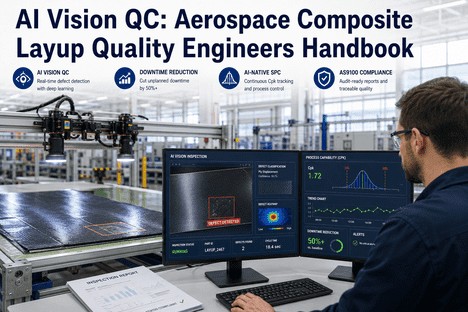
Every minute a part spends waiting in the CMM queue is a minute the next operation stays idle, the workcentre accumulates WIP, and the shift's OEE target moves further out of reach. In aerospace engine assembly, where a single high-pressure turbine blade can carry 14 critical characteristics requiring dimensional verification, the inspection queue routinely stretches to 45 minutes per part while the CNC cycle finishes in 14. That gap between production speed and inspection speed is where OEE leaks — and where AI vision inspection redefines what a capable assembly line can deliver. Operations directors deploying deep learning-based visual inspection are closing that gap entirely, moving quality detection from end-of-line sampling to real-time, every-part verification at the machine, without adding a second to cycle time or a line item to the inspection labour budget.
Deep Learning Defect Detection · Self-Tuning SPC · Real-Time Cpk · AS9100 Audit Ready
Operations Directors Closing the Inspection Gap Are Running AI Vision QC at the Machine — Not Sampling Parts at the CMM.
iFactory's AI vision inspection platform gives aerospace engine assembly operations directors deep learning defect detection at production speed, self-tuning SPC with live Cpk tracking, and automatically generated AS9100 traceability records — all running from a single quality intelligence layer that deploys without replacing existing CNC or CMM infrastructure.
10-20
OEE points recovered when AI vision inspection replaces end-of-line CMM sampling with real-time, every-part quality verification at the machine
98%+
Surface defect detection accuracy achieved by transformer-based deep learning models on turbine blade and engine component inspection benchmarks
100ms
Per-frame inference latency of production-grade AI vision models — defect detection at machine speed without adding cycle time
75%
Reduction in inspection labour cost achieved by operations that move from CMM-dependent sampling to automated AI vision inspection at every station
Where OEE Leaks in Aerospace Engine Assembly — and What AI Vision Inspection Recovers
The OEE formula is straightforward: Availability multiplied by Performance multiplied by Quality. In aerospace engine assembly, every component of this equation is constrained by the same structural bottleneck — the speed gap between production and inspection. A CNC machine produces a turbine disc in 14 minutes. The CMM queue behind it holds 45 minutes of inspection backlog. The machine waits for the CMM to clear before the next operation can release. Availability settles at 82% not because the machine cannot run, but because the inspection system cannot keep up. Performance drops because the production schedule must account for inspection delays. Quality suffers because defects detected three operations downstream carry rework costs that multiply with every additional assembly step.
Operations directors managing this gap with additional CMM capacity, overtime inspection shifts, and buffer inventory are treating the symptom rather than the architecture. The architecture problem is this: quality verification is separated from the production process in both time and location. AI vision inspection eliminates that separation by placing detection at the point of production — inspecting every surface, every feature, every edge on every part as it exits the machine, at machine speed, with machine-level reliability. The inspection queue disappears. The machine releases the next operation immediately. OEE recovers across all three components simultaneously.
How AI Vision Inspection Resets Each OEE Component in Aerospace Engine Assembly
Availability: From 82% to 94%+
The machine does not wait for quality clearance. AI vision inspects every part as it exits the spindle — no CMM queue, no inspector backlog, no hold-for-inspection delays. Planned downtime drops because maintenance alerts arrive from the defect pattern itself: when a vision system detects a recurring surface anomaly, the correlated machine parameter trend points to the worn component before it fails. Unplanned downtime from defect escapes that trigger production stops also declines, because the defect is caught at the machine rather than three operations downstream.
Impact: Machine utilisation recovers 10-15% from inspection-queue elimination alone.
Performance: From Target Rate to Sustained Peak
Production scheduling no longer pads cycle times to account for inspection variability. The AI vision pipeline operates at inference speeds under 100 milliseconds per frame — detection keeps pace with the fastest CNC cycle without creating a secondary bottleneck. Performance losses from micro-stops caused by inspection-related material flow interruptions are eliminated. The line runs at its designed speed because quality is no longer a pacing constraint.
Impact: Production rate stabilises at target throughput with zero inspection-related slow-downs.
Quality: From 95% to 99.5%+ First-Pass Yield
Every part is inspected for surface cracks, tool mark anomalies, burr formation, discolouration, and dimensional edge deviation. The deep learning model classifies each detected anomaly by type and severity — achieving above 98% accuracy on production benchmarks. Defects are flagged at the moment they occur, when the machine parameters that produced them are still active. The operator corrects the condition — tool offset, coolant flow, feed rate — before the next part enters the spindle. First-pass yield moves from 95% (post-process sampling) to 99.5%+ (real-time every-part correction).
Impact: Scrap and rework reduced 30-70% through real-time defect detection at the point of production.
Why Deep Learning Vision Outperforms Traditional Machine Vision in Engine Assembly
Traditional machine vision systems rely on rule-based algorithms — fixed thresholds for contrast, edge detection parameters, and geometric matching templates. These systems perform well in controlled lighting environments inspecting uniform parts with known defect geometries. Aerospace engine assembly presents exactly the conditions that defeat them: variable lighting across different workcells, reflective superalloy surfaces, complex blade geometries with airfoil curves and cooling hole patterns, and defect types that range from microscopic crack initiation at the crystal grain level to thermal barrier coating spallation spanning several millimetres. A rule-based system calibrated for one defect type will miss the next, and generating false alarms on surface features that fall outside its static threshold model.
Deep learning vision replaces the fixed rule set with a neural network trained on thousands of labelled production images covering the full range of defect types relevant to engine assembly. The model learns to distinguish genuine defects from acceptable surface variation — tool marks within specification, normal anodised finish variation, casting witness lines — and classifies each detected anomaly by type, severity, and location. Published benchmarks on aero-engine surface defect detection show that deep learning models achieve 93-98% precision and 81-98% recall depending on the architecture and defect class, with inference speeds exceeding 135 frames per second. The model continues to improve through active learning: when the operator confirms or corrects a classification, that feedback is incorporated into the next update cycle — so the system gets smarter with every shift.
Defect Categories AI Vision Detects in Aerospace Engine Assembly
C
Surface Cracks
Detection of crack initiation sites as small as 0.1mm on blade airfoils, disc bores, and casing surfaces. Correlated with spindle load and vibration data to determine root cause.
T
Tool Mark Anomalies
Irregular tool path patterns, chatter marks, and feed rate signatures indicating tool wear or incorrect cutting parameters that precede dimensional drift.
B
Burr Formation
Edge burrs and raised material on machined features that affect assembly fit and can break loose during engine operation. Flagged for immediate deburr disposition.
D
Discolouration & Thermal Damage
Heat-induced surface discolouration from grinding burn, coolant failure, or excessive cutting temperatures. Leading indicator of potential microstructural damage.
E
Dimensional Edge Deviation
Visual edge profile variation that correlates with dimensional drift measured by post-process CMM. The vision model predicts dimensional outcome from visual surface signature.
F
Foreign Object Debris
Metal chips, abrasive particles, and process debris embedded in assembled components. Detected at assembly stations before close-out operations seal the component.
C
Coating Defects
Thermal barrier coating delamination, spallation, and thickness variation detected through AI segmentation on blade surfaces. Critical for turbine section components.
S
Splice & Joint Anomalies
Weld seam irregularities, fastener installation defects, and sealant bead continuity issues in engine case assembly stations. Verified against CAD-derived requirements.
Self-Tuning SPC: The Architecture That Keeps Cpk Stable Through Every Process Shift
Aerospace engine assembly is not a steady-state process. Tool wear progresses across every production run. Coolant temperature varies with ambient conditions and machine duty cycle. Material batch hardness fluctuates within the allowable range. Each of these variables shifts what normal looks like on the production floor — and each renders static SPC control limits progressively less relevant from the moment they are calculated. An operations director reviewing a weekly Cpk report sees data that reflects the average of the week. The Cpk for characteristic 12 bore diameter might report 1.67. What the average hides is that Cpk crossed below 1.33 on Thursday afternoon when the tool was at 80% of its expected life and coolant temperature peaked at 42 degrees. That gap — between the weekly average and the real-time condition — is where escapes originate.
Self-tuning SPC eliminates the gap by recalculating control limits continuously against the current process baseline. The model detects regime shifts — tool wear progression, thermal drift, material variation — and transitions the limits to the new baseline within a configurable window. False alarms from static limits that no longer reflect the real process are eliminated. Genuine scrap-risk events stand out against a current, accurate baseline. The operations director sees alerts that fire before the condition produces an escape — based on trend data, not after-the-fact CMM confirmation. Every limit recalculation is automatically logged with timestamp, triggering condition, prior and new limit values, and statistical basis, producing a complete AS9100 audit documentation trail with zero manual effort.
Static SPC vs. Self-Tuning Adaptive SPC — What Changes for Operations Directors
Static SPC
Control limits set during process capability study — usually quarterly. Every tool wear cycle, coolant temperature shift, and material batch variation between studies operates against limits that no longer reflect current conditions.
Tool wear progression generates high false-alarm rates as the process shifts within its normal operating range — operators learn to ignore alerts, and genuine escapes are missed because they are buried in noise.
No mechanism to distinguish common-cause process drift from assignable-cause defect risk — every deviation gets the same treatment regardless of whether it signals an imminent quality failure.
Limit change documentation is manual, inconsistent, and creates AS9100 audit risk when the rationale behind threshold adjustments cannot be reconstructed from the record.
Self-Tuning Adaptive SPC (iFactory)
Limits recalibrate continuously against a rolling model of the current process — every tool wear stage, temperature shift, and material variation is absorbed into the current norm automatically.
Regime transitions are detected and managed. The system holds alert generation during the transition window to eliminate false alarms, then resets to the new baseline before resuming full sensitivity.
Genuine scrap-risk deviations produce alerts that stand out against a current, accurate baseline — not against thresholds calibrated for conditions that no longer apply. The operations director acts on signals that matter.
Every limit recalculation is automatically logged with timestamp, triggering condition, prior and new values, and statistical basis — producing the AS9100 audit trail without manual documentation.
The AI Vision Platform: What Operations Directors See and Act On
The iFactory platform delivers AI vision inspection across three operational layers — real-time machine vision, adaptive SPC with predictive alerts, and executive programme visibility — each designed for a different decision type and time horizon. All three run simultaneously and feed into a single quality record that is AS9100 audit-ready from the first day of deployment.
Real Time
Machine Vision Inspection
Every part, every feature, every surface — inspected at machine speed
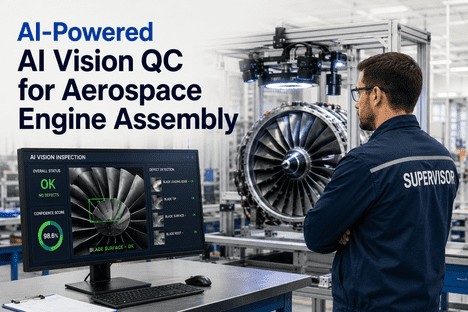
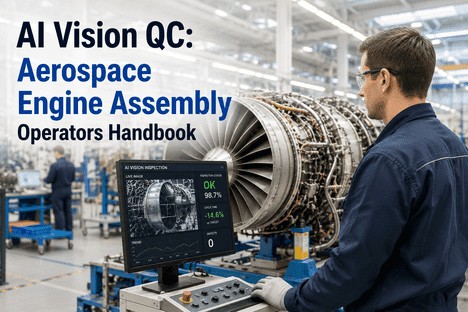
High-resolution cameras positioned at each workcentre capture part images as the machine cycle completes. The deep learning model classifies every image region in real time — detecting surface cracks, tool mark anomalies, burrs, discolouration, and dimensional edge deviation across the full range of engine component geometries. Detection latency is under 100 milliseconds per frame. Every detection is logged with part serial number, timestamp, defect classification and severity score, and the machine parameters active at the time of detection — spindle load, feed rate, coolant temperature, tool wear state. The supervisor sees a live station view with colour-coded part status for every active workcentre.
100% part coverage
8 defect classifications
Machine parameter correlation
Adaptive
SPC & Predictive Alerts
Cpk trends live, alerts before escapes, root cause identified
Every vision detection event streams to the adaptive SPC engine, which cross-correlates the visual defect with machine parameters. The system recalculates running Cpk for every monitored characteristic continuously. When a characteristic trends below the configured threshold, the engine identifies the primary driver from tool wear progression, thermal drift, or material variation, assigns a confidence score to each potential cause, and generates a ranked corrective action. The operations director sees a single alert: characteristic 12 bore diameter Cpk trending to 1.28, primary driver tool wear at 82% of expected life on insert 3, recommended action advance tool change by 8 parts and apply -0.00015-inch offset.
Real-time Cpk tracking
Ranked root cause alerts
Corrective action guidance
Executive
Programme Visibility
OEE, COPQ, Cpk, and audit export on demand
The executive dashboard aggregates OEE, Cpk trends, defect frequency, and COPQ impact across all active workcentres into a single management view. Scrap rate trends are displayed against baseline and target, segmented by part type, workcentre, and shift. CAPA effectiveness tracking links every corrective action to the alert that generated it and monitors the subsequent defect rate to confirm whether the intervention prevented recurrence. AS9100 audit documentation — control limit histories, defect event logs, CAPA records, and Cpk trend exports — is generated automatically and available for any date range at a single export click.
OEE & COPQ dashboard
CAPA closed-loop tracking
One-click AS9100 export
The COPQ Reality in Aerospace Engine Assembly: What Inspection Bottlenecks Actually Cost
Operations directors managing engine assembly lines track scrap rate, rework hours, and inspection labour as separate line items. The Cost of Poor Quality framework reveals that these categories are not independent — they compound. A defect detected at final assembly costs 10 times what the same defect would have cost at the machine. An inspection queue that holds parts for 45 minutes after a 14-minute cycle is not just an availability loss — it is a COPQ multiplier that touches every downstream operation. When the CMM confirms a dimensional deviation on a part that was machined three hours earlier, the machine has already produced 12 more parts with the same tool wear condition. Each of those parts carries the same defect risk. The COPQ of that single detection delay multiplies across every part produced between the defect event and the CMM confirmation.
Internal Failure
Scrap titanium and superalloy components, rework labour, re-inspection costs, and production hold expenses incurred before the part leaves the plant. AI vision inspection reduces these by detecting defects at the machine — when rework is a spindle adjustment away rather than a disassembly operation.
External Failure
Customer rejections, concession requests, delivery penalty clauses, and in-service failure liability. External failure costs in aerospace typically exceed internal failure costs by 5-10x, making escape prevention the highest-value application for AI vision detection.
Appraisal Costs
CMM inspection labour, first article inspection overhead, quality audit preparation, and supplier inspection costs. Vision-based automated inspection converts appraisal cost from variable labour to fixed automation, with higher detection reliability and a 100% inspection record.
Prevention Costs
SPC programme administration, capability study cycles, quality system maintenance, and training. Adaptive SPC with automated documentation reduces the administrative burden of the prevention programme, making prevention more efficient and more effective simultaneously.
"
We were running OEE at 67% across our engine component workcentres and attributing the loss to a mix of tooling issues and operator variability. What the weekly Cpk reports could not show us was that the same surface crack pattern was appearing on turbine blade tenon roots across three different machines, every one of which was traced to a coolant concentration drift that started six weeks earlier. The crack was visible to a camera at the machine. It was invisible to the weekly sampling schedule. After deploying AI vision with self-tuning SPC, we identified the coolant concentration signature as the leading indicator of that defect class. We corrected the coolant parameter. The crack pattern disappeared from every machine within two production cycles. Our OEE settled at 84% in the following quarter — a 17-point recovery that the platform paid for in the first three months.
— Operations Director, Tier-1 Aerospace Engine Component Manufacturing Facility, 12 CNC Workcentres, 6 Mtpa Throughput
What Deployment Looks Like — From First Camera to Production-Grade AI Vision
Operations directors evaluating AI vision inspection for engine assembly consistently ask the same question: how long before the system is generating defect detections the line can act on? The answer depends on part variety and historical data availability, but the implementation pathway follows a consistent structure regardless of facility size or engine programme.
PHASE 1 — WEEKS 1-3
Camera Commissioning and Model Training
Vision camera installation with machine-specific lighting configuration, image capture pipeline setup, and deep learning model training on the facility's defect library. Minimum 1,000 labelled production images per defect class is sufficient for initial detection capability. Integration with CNC controller for automatic part identification and parameter correlation.
Deliverable: Vision system live with trained defect model and machine parameter integration.
PHASE 2 — WEEKS 4-6
Shadow Mode Validation
The AI vision system runs in parallel with the existing CMM inspection programme. Every vision detection is compared against CMM results and inspector findings over a 2-4 week validation period. The documented accuracy data from shadow mode provides the evidence needed to authorise transition of vision output to primary quality decision input status.
Deliverable: Site-specific accuracy report validated against production CMM data.
PHASE 3 — WEEK 7+
Live Deployment and OEE Tracking
AI vision becomes the primary inspection method for the deployed workcentres. CMM transitions to targeted verification of flagged parts and periodic validation sampling. OEE and COPQ tracking activates — availability, performance, quality, scrap rate, and defect frequency are tracked against pre-deployment baselines continuously. The executive dashboard goes live with full AS9100 documentation capability.
Deliverable: Live OEE dashboard with automated quality record generation active.
Conclusion
Aerospace engine assembly produces the industry's most demanding quality conditions — micron-level tolerances, zero-defect requirements for flight-critical components, and process variables that shift across every production run. The inspection systems designed to verify quality under these conditions have historically been separated from the production process by architecture: quality confirmed at the CMM, not at the machine; control limits set quarterly, not updated continuously; defect escapes detected three operations downstream, not flagged in real time. AI vision inspection closes that separation at every level simultaneously — deep learning models that detect 8 defect classes at production speed across 100% of parts, self-tuning SPC that keeps Cpk stable through every tool wear cycle and material transition, and executive visibility that converts quality data into OEE recovery measured in points, not percentages.
The documented outcomes across aerospace engine component facilities making this transition are consistent: OEE recovery of 10-20 points, scrap and rework reduction of 30-70%, inspection labour cost reduction up to 75%, and AS9100 audit records that document every part, every detection, and every corrective action without manual data entry. Operations directors who have deployed AI vision inspection in their engine assembly workcentres consistently report the same finding: the defect signals were present in the data the entire time. The platform made them readable, actionable, and correctable at machine speed, before the next operation compounded the error.
iFactory's AI vision inspection platform is built for aerospace engine assembly operations where defect elimination, not defect management, is the operating standard. Book a Demo to see the platform configured for your engine programme and component range, or talk to an expert about a free OEE impact assessment for your assembly operation.
Frequently Asked Questions
Your Engine Assembly Line Already Contains Tomorrow's OEE Recovery. Calculate What Finding Defects at Machine Speed Is Worth to Your Operation.
iFactory's AI vision inspection platform for aerospace engine assembly — deep learning defect detection, self-tuning adaptive SPC, real-time Cpk tracking, and AS9100 audit documentation, all running from a single quality intelligence layer that deploys without replacing your existing CNC or CMM infrastructure.