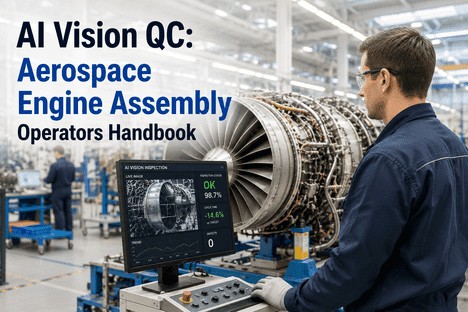
AI Vision QC: Aerospace Engine Assembly Operators Handbook
By Grace on June 12, 2026
Every minute an engine sits on the assembly line waiting for inspection is a minute the customer lead time stretches, a minute the next build slot pushes right, and a minute the margin on that unit erodes. For operators on aerospace engine assembly lines, the cycle time enemy is not the assembly work — it is the queue time between stations: waiting for QC to arrive, waiting for dimensional sign-off, waiting for the non-conformance disposition, waiting for the inspection record to be filed before the next step can begin. These gaps between value-adding work account for 20 to 35% of total engine build time in typical assembly operations, and they are the single largest lever for cycle time reduction that does not require changing the assembly sequence, the tooling, or the headcount. AI vision quality inspection eliminates the waiting. It puts inspection capability at every station, in every operator's hands, on every part — so the engine moves from station to station without stopping for QC. This is the operator's handbook for using AI vision QC to cut engine assembly cycle time 10 to 20%.
Inline AI Inspection · Automated AS9100 Records · Real-Time SPC · Station-to-Station Flow
Operators on AI Vision-Equipped Engine Assembly Lines Cut Cycle Time 10-20% Without Changing a Single Assembly Step. The Time Was Hiding Between Stations.
iFactory's AI vision quality platform puts inspection at every station on the engine assembly line — inline dimensional checks, automated defect detection, real-time AS9100 documentation generation, and station-to-station workflow that eliminates QC queue time. The operator's cycle time tool, not another paperwork burden.
Three Cycle Time Traps AI Vision Eliminates on Every Engine Assembly Line
Before operators can reduce cycle time, they need to see where the time is going. The engine assembly process has three structural time traps that are invisible on the build schedule but account for the majority of non-value-added hours. AI vision quality inspection eliminates each one by giving operators inspection capability that does not depend on a separate QC resource.
01
Manual QC Call-Out and Wait Time Between Stations
-50 to -70 min per shift
At every assembly milestone, the operator stops work and calls QC to inspect and sign off. The QC inspector is covering three lines simultaneously. Average wait time per call-out across aerospace assembly operations is 8 to 14 minutes. With 5 to 7 inspection milestones per engine per shift, the cumulative wait time consumes 40 to 98 minutes of every operator's shift — time the operator spends standing by while the engine does not move. AI vision eliminates the call-out by giving the operator a station-side inspection station that checks dimensions, surface condition, and assembly correctness in seconds and generates the AS9100-compliant inspection record automatically. The engine moves to the next station immediately.
02
Late Discovery Defect Rework Loops
-30 to -90 min per shift
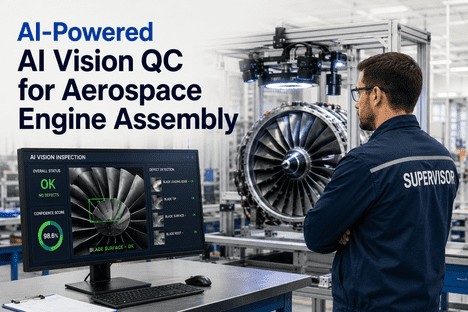
A blade seating deviation detected after the compressor drum is fully assembled requires disassembly of the module, replacement of any damaged components, re-assembly, and re-inspection. A fastener torque deviation found at final inspection requires breaking the torque seal on every fastener on the affected panel, re-torquing, re-sealing, and re-certifying. The time cost of late defect discovery in aerospace engine assembly is measured in hours, not minutes — and it is avoidable when inspection happens at the station where the work is performed. AI vision detects blade seating, fastener presence, torque seal integrity, and assembly sequence compliance at the point of assembly — before the module leaves the station. The rework loop shrinks from hours to minutes because the operator corrects the issue before the next assembly step covers it.
03
AS9100 Documentation Paperwork Lag
-20 to -45 min per shift
Every assembly step in aerospace engine production requires a signed inspection record. The operator fills the form, the inspector signs it, the record is filed, and the traveller moves with the engine to the next station. The paperwork cycle adds 3 to 7 minutes per inspection milestone — filling forms, chasing signatures, resolving legibility issues, correcting entries. For an engine with 40 to 60 inspection milestones across the build, the cumulative paperwork time adds 120 to 420 minutes to the total build cycle. AI vision generates the inspection record automatically from the vision data. No forms to fill. No signatures to chase. The inspection record is created at the moment the operator completes the vision check and is linked to the engine serial number, the station, the operator ID, and the timestamp — audit-ready before the engine leaves the station.
Station by Station: Where AI Vision Saves Minutes on Every Engine Assembly Line
The 10 to 20% cycle time reduction is the sum of minutes saved at each assembly station. Not one big change — dozens of small time savings that compound across the build. The section below shows four stations on a typical large-engine assembly line, the time trap at each station, and the minutes AI vision recovers per engine.
Station 01 — Component Receipt and Pre-Kitting
Before: Manual dimensional check of critical components at goods receiving — operator measures 10 to 15 dimensions per component, records on paper, waits for QC to verify. Average time per component: 6 min.
After: AI vision inspects all critical dimensions in 3 seconds as components pass under the station camera. Inspection record populates automatically in the engine build file. Component moves to kitting immediately.
Time Saved Per Engine
18-24
minutes
36 critical components inspected per engine at 30 sec each instead of 6 min each
Time Saved Per Engine
15-20
minutes
4 sub-assemblies at 4 min saved each on QC wait + documentation
Station 02 — Blade and Disc Sub-Assembly
Before: Operator installs blades, then stops assembly to call QC for seating and alignment check. QC arrives within 8-14 min, performs visual and dimensional check, signs traveller. Total station cycle time per sub-assembly: 22 min.
After: AI vision inspects blade seating, platform gap, and disc alignment during the assembly process. Operator completes the vision check in 20 seconds as part of the assembly sequence. No QC call-out. Station cycle time per sub-assembly: 14 min.
Station 03 — Major Module Assembly
Before: After fan case, compressor, combustor, and turbine modules are assembled, each requires a module-level inspection and handover. Dual-operator verification and QC sign-off add 15-20 min per module. Four modules per engine.
After: AI vision performs a 360-degree module inspection during the rotation stand cycle already in the assembly sequence. Defect detection, dimensional verification, and interface condition checks are completed during the rotation. Handover documentation generated automatically.
Time Saved Per Engine
20-30
minutes
4 modules at 5-8 min saved each on inspection + documentation
Time Saved Per Engine
25-35
minutes
Final assembly verification at 15-20 min saved. Build record closure at 10-15 min saved.
Station 04 — Final Assembly and Build Record Closure
Before: Final assembly verification requires a comprehensive check of all fasteners, connections, harness routing, and seal integrity against the build sheet. Dual verification with QC sign-off takes 30-45 min. Build record compilation and filing takes another 15-20 min per engine.
After: AI vision checks each assembly step against the digital build sheet in real time as the operator completes it. Final verification is a system-generated report of all vision checks completed during the build, with each step already signed, timestamped, and linked to the operator and station records.
Your Cycle Time Dashboard: Four Metrics That Drive Every Shift
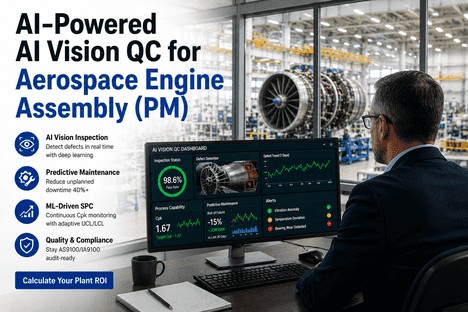
The iFactory AI vision dashboard for engine assembly operators is built around four cycle time metrics that together answer the single question that matters every shift: is the build time on track or falling behind? Each metric is displayed as a live bar showing the current value against the target, with the deviation and the trend direction visible at a glance.
Metric 01
Station Cycle Time Compliance
Current: 82%Target: 95%
Percentage of stations completing assembly within the standard cycle time. Rising trend indicates process stability. Falling trend flags a station-level bottleneck that needs investigation.
Metric 02
Inline Inspection Coverage
Current: 88%Target: 100%
Percentage of inspection milestones completed inline by AI vision without QC call-out. Every percentage point increase converts directly to minutes saved on QC wait time.
Metric 03
First-Pass Assembly Yield
Current: 91%Target: 96%
Percentage of assembly steps completed without defect rework. Inline AI vision catches deviations at the station of origin, keeping rework time measured in minutes rather than hours.
Metric 04
Documentation Closure Time
Current: 14 minTarget: 5 min
Average time from assembly completion to inspection record being available for the next station. AI vision targets under 5 minutes. Paper-based systems average 25-40 minutes.
What Changes in Your Shift: Before and After AI Vision
The table below shows the practical difference for the operator on an engine assembly line before and after AI vision quality inspection. Every row represents a change the operator experiences directly — not a management metric, not an engineering calculation, but a change in how the shift works.
Activity
Before AI Vision
After AI Vision
Inspection at assembly milestone
Stop work, call QC, wait 8-14 min for inspector to arrive
Complete inline vision check in 20-30 sec, proceed immediately
Defect found during inspection
Defect discovered at next station or final inspection — rework loop of hours
Defect detected at station of origin — corrected before module moves forward
Inspection record keeping
Fill paper form, get inspector signature, file in traveller — 3-7 min per milestone
Record generated automatically from vision data — zero operator documentation time
Non-conformance disposition
Wait for engineering review, wait for disposition decision, wait for rework instruction
Vision data and deviation record sent to engineering with the inspection image — disposition faster
End-of-shift reporting
Compile shift activity log, list engines worked, note open inspection items, estimate time to next milestone
Shift report generated automatically from station-level AI vision data — operator reviews and submits in 2 min
Inline AI Inspection · Automated Documentation · Station-to-Station Flow · AS9100 Records
The 10-20% Cycle Time Reduction Is the Sum of Minutes Saved at Every Station. Not One Big Change — Dozens of Small Ones, Every Shift.
iFactory's AI vision quality platform for aerospace engine assembly operators — inline inspection at every station, automated AS9100 records, real-time defect detection that catches deviations at the point of origin, and a station-to-station workflow that keeps the engine moving instead of waiting for QC.
Before AI vision, my shift would lose an average of 45 minutes waiting for QC between stations. I would finish a sub-assembly, call for inspection, and wait. Sometimes the inspector was on the other side of the plant. Sometimes he was on break. The engine sat. The next station operator waited. The build time stretched. After three months with the AI vision system, our line cycle time dropped 14%. The operators on my shift did not work faster. We just stopped waiting. The inspection happened at the station, the record was generated automatically, and the engine moved to the next station without a gap. That 14% came entirely from time we were wasting between value-adding steps.
— Senior Assembly Operator, Turbofan Engine Assembly Line — 15 Engines per Month, 6 Assembly Stations
Conclusion
Cycle time reduction in aerospace engine assembly is not a takt-time engineering problem. It is a waiting-time visibility problem. The operator cannot build the engine faster than the inspection queue between stations allows, and the inspection queue exists because QC capacity is shared across multiple lines while AS9100 requires a signed record at every milestone. AI vision quality inspection breaks this structural constraint by moving the inspection capability to every station, eliminating the wait, and automating the documentation that the compliance system requires.
The 10 to 20% cycle time reduction range is not aspirational — it is the documented outcome of operations that deployed inline AI vision on engine assembly lines and measured the before-and-after station cycle times. The savings come from the time traps that every operator knows exist but no individual operator can fix alone: the QC queue, the rework loop from late defect discovery, and the paperwork lag that keeps the build record chasing the engine instead of travelling with it. AI vision addresses all three simultaneously because inspection, documentation, and compliance are built into a single station-side system that the operator controls.
iFactory's AI vision quality platform is designed for operators on aerospace engine assembly lines who need to reduce cycle time without changing the assembly process, the tooling, or the headcount. Book a Demo to see the AI vision station configured for your engine assembly line layout, or talk to an expert about a free cycle time assessment and station-by-station time trap analysis for your assembly operation.
Frequently Asked Questions
Yes. iFactory's AI vision system generates AS9100-compliant inspection records that include the inspection timestamp, the operator ID, the inspection criteria used, the measured values against specification, the pass-fail result, and a link to the inspection image captured by the vision system. The record format is configurable to align with your existing QMS documentation structure and can be exported directly to your quality management system. For AS9100 Clause 7.1.5 and 8.2.4 requirements, the key audit question is whether inspection records demonstrate objective evidence of conformity — and an AI vision record with the measured data and the inspection image provides stronger objective evidence than a manual inspector sign-off that records only a pass-fail tick without measurement data. Many aerospace assembly operations using AI vision retain the QC inspector role but transition it from station-by-station sign-off to audit-based verification, freeing the inspector to cover more ground while the operator maintains station throughput. Talk to an expert about configuring the AI vision inspection record format for your AS9100 audit requirements.
Operator training for the AI vision inspection station takes 30 to 45 minutes per operator and most operators are fully proficient after three to five inspection cycles. The station interface is designed around three actions the operator already performs — position the component under the camera, confirm the part number on the screen, and review the inspection result (green pass or red fail with deviation highlighted). The inspection itself takes 20 to 30 seconds per check, which is faster than the manual inspection process it replaces and does not add time to the assembly cycle because it is performed during the natural pause between assembly steps. The net time impact per station is positive from the first day: the operator saves the 8 to 14 minute QC wait time and gains 20 to 30 seconds of vision inspection time, for a net saving of 7 to 13 minutes per inspection milestone. Book a Demo to see the operator interface and the training materials included in the iFactory deployment package.
The AI vision system is configured to support the operator's decision, not override it. When the system detects a deviation from specification, it displays the result with the affected dimension highlighted, the measured value versus the tolerance range, and a pass-fail indicator. The operator decides how to proceed based on the severity of the deviation, the station context, and the established non-conformance procedure. For minor dimensional deviations within the accept-by-engineering-authority range, the operator can flag the record for engineering review and continue the assembly process. For critical deviations (blade seating out of tolerance, fastener torque below minimum, seal integrity breach), the system generates an automatic hold notification that prevents the operator from completing the station sign-off until engineering disposition is received. The system records the operator's decision and the outcome in all cases, creating a complete audit trail. The key design principle is that AI vision provides the data — the operator provides the judgment. Talk to an expert about configuring the deviation severity levels and operator decision authority rules for your engine assembly line.
Yes. The iFactory AI vision system is designed for mixed-model production and can switch between engine models without operator intervention or station reconfiguration. Each engine model is registered in the system with its own inspection recipe — a digital profile that defines the critical dimensions, the tolerance ranges, the inspection points, and the acceptable surface condition criteria specific to that model. When the engine build traveller is scanned at the first station, the system loads the correct inspection recipe and the vision station automatically applies the right criteria at every subsequent station. The operator does not need to select the engine model, adjust camera settings, or configure inspection parameters between engine types. For lines producing four or five different engine models on the same stations, the model-switching capability eliminates the setup time that manual inspection processes require between configuration changes. Historical inspection data is segmented by engine model automatically, giving quality engineers the ability to compare process capability across models without manual data sorting. Book a Demo to see the mixed-model inspection recipe switching on a live engine assembly line.
Cycle Time Is Hiding Between Stations, Not in the Assembly Work. AI Vision Finds It at Every Milestone. Get a Free Station-by-Station Cycle Time Assessment.
iFactory's AI vision quality platform for aerospace engine assembly operators — inline inspection at every station, automated AS9100 documentation, real-time defect detection at the point of origin, and mixed-model support that switches between engine configurations without setup time. Works with existing assembly station layouts and tooling.