In May 2026, Japan Airlines placed two humanoid robots on the tarmac at Tokyo's Haneda Airport and started a timer that the rest of the aviation industry is watching. The robots — 130cm-tall Unitree platforms, priced at roughly $15,400 each — were tasked with cargo container transport and baggage loading: physical, repetitive, labour-intensive work that human ground crews have performed for decades. The trial is not a publicity exercise. It is a three-year operational commitment from one of the world's most safety-conscious carriers, in direct response to a labour supply problem that is not going to reverse. The question aviation facility managers are now asking is not whether robots will work at airports. It is which robots, in which zones, doing what — and what infrastructure is needed to manage them when they arrive.
Robots Are Arriving at Airports. The Facilities That Manage Them Will Outperform Those That Don't.
iFactory's preventive maintenance and asset management platform is built for the facilities that deploy, service, and integrate robotic systems into airport operations — keeping every asset on schedule, every inspection documented, every compliance record current.
Airport robots market projected by 2031, growing at 13.65% CAGR from $1.47B in 2026
8.2B
Passengers IATA projects by 2037 — double today's volume — the core pressure forcing aviation automation
$5,900
Entry price of Unitree's R1 humanoid in 2026 — down from ~$85,000 in 2023, making airport deployment economically viable
3 years
Duration of JAL's Haneda humanoid robot trial — a phased operational commitment, not a demonstration event
Why Aviation Is the Industry Where Robotics Transitions From Pilot to Platform
Three structural pressures are converging in aviation simultaneously — and none of them resolve without automation. The workforce is shrinking: Japan's working-age population is projected to fall 31% between 2023 and 2060, and the country's aviation sector is already operating at capacity with 4,000 JAL ground handling workers serving 85.9 million annual Haneda passengers. Passenger volumes are rising: IATA projects global traffic will double to 8.2 billion by 2037. And robot prices are collapsing: average humanoid platform costs dropped from approximately $85,000 in 2023 to $25,000 in 2025, with entry-level models now under $6,000. When labour supply falls, demand rises, and technology cost drops simultaneously, adoption is not a question of if — it is a question of which zone, which task, and which operator moves first.
The Three Pressures Driving Aviation Robotics in 2026
Workforce Scarcity
Ground handling, MRO, and cabin service roles face structural shortfalls in every major aviation market. Japan, Europe, and North America are all operating with fewer qualified workers than their traffic volumes require. The shortage is permanent — demographics don't reverse on operational timescales.
2x
Doubling Passenger Volume
IATA's 8.2 billion passenger forecast by 2037 means airports must handle twice the throughput on largely the same physical infrastructure. Robots add virtual capacity — Frankfurt Airport's 2025 AI-enabled security scanner rollout shortened checkpoint wait times while holding staffing flat.
93%
Cost Collapse in Platforms
A 93% price reduction in humanoid robot platforms over three years transforms the ROI calculation entirely. Unitree's G1 and R1 models now enter the market at price points comparable to annual salary costs in many markets — making fleet deployment economically rational for operations of any scale.
The Four Aviation Zones: Where Each Robot Type Operates and Why
Aviation facilities are not a single environment — they are four distinct operational zones with different physical conditions, regulatory requirements, safety classifications, and robot form-factor demands. The right robot for a terminal passenger zone is not the right robot for an MRO hangar floor. Understanding where each platform type performs determines which deployments succeed and which stall in trial.
Zone 01
Terminal & Landside
Humanoid + Service Bots
The terminal is the most human-visible zone — and the one where humanoid form factor matters most. South Korea's Incheon Airport deploys AirStar, an AI-powered service robot using voice recognition to guide passengers. Munich Airport's Josie Pepper provides multilingual passenger interaction. Singapore Changi's Living Lab integrates food-delivery bots and autonomous cleaning units. These environments are structured, well-lit, and built around human-scale architecture — exactly the conditions where bipedal humanoid robots and wheeled service platforms operate with highest reliability. Task types include passenger wayfinding, check-in assistance, retail restocking, and terminal cleaning.
Passenger guidance
Terminal cleaning
Retail restocking
Disinfection patrol
Zone 02
Airside & Ground Ops
Humanoid + Autonomous Vehicles
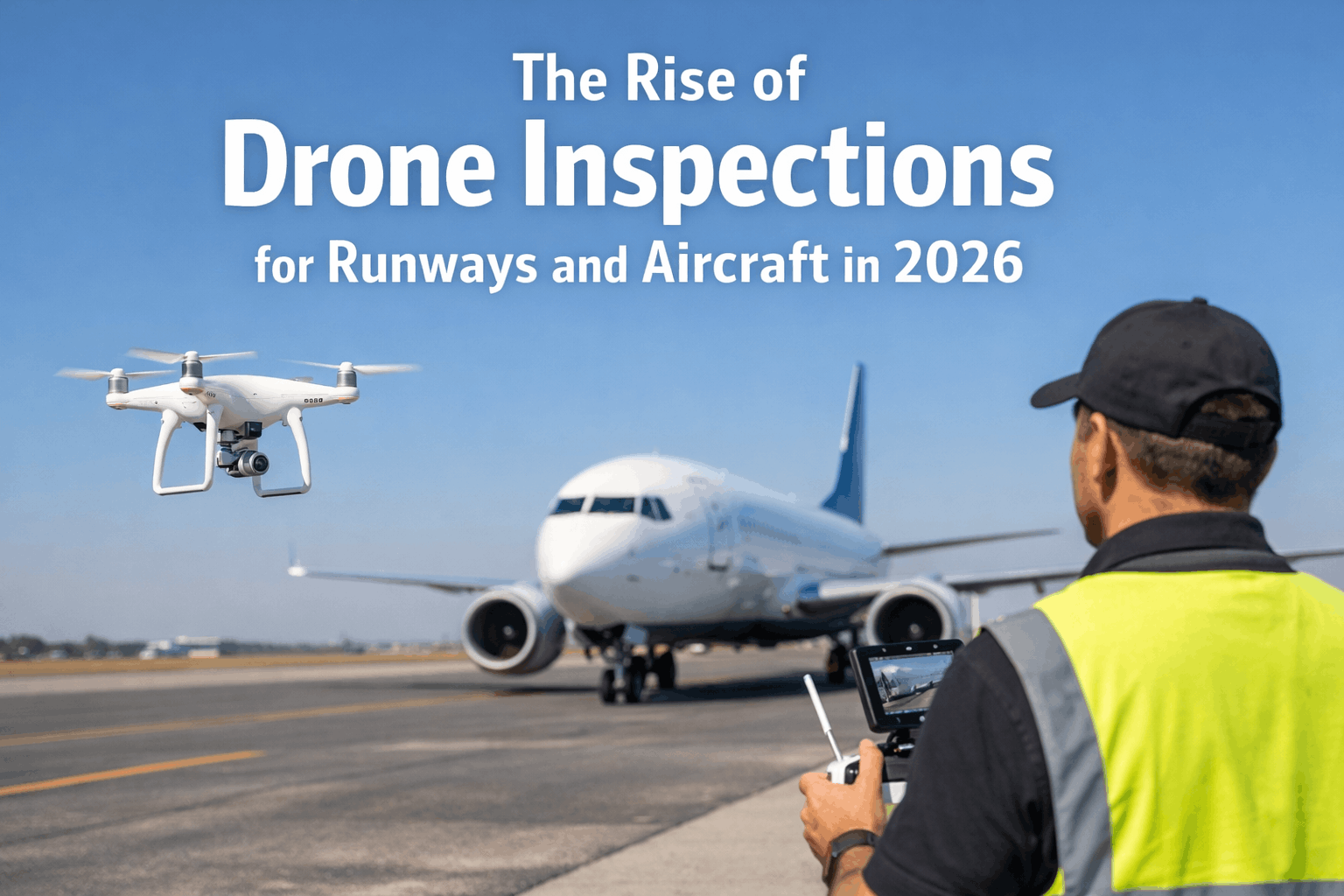
This is where JAL's Haneda trial operates. Airside ground handling — baggage loading, container transport, cargo handling, aircraft servicing — is physically demanding, repetitive, and chronically understaffed. Humanoid robots are suited here because aircraft bays, jetbridges, and cargo holds are built to human dimensions. Autonomous DollyTugs are already trialling at Gatwick and Cincinnati, moving baggage without a driver. Cobot Lift's partnership with Amsterdam Schiphol targets autonomous handling of up to 90% of bags to reduce workforce strain. FOD (Foreign Object Debris) detection robots equipped with computer vision patrol runways and taxiways for debris that could cause engine damage — a task that previously required dedicated human inspection teams on regular schedules.
Baggage loading
Cargo transport
FOD detection
Aircraft servicing
Zone 03
MRO Hangar
Quadruped + Inspection Drones
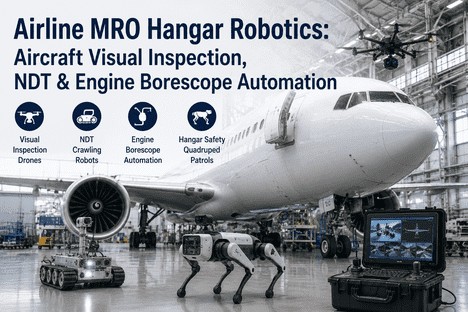
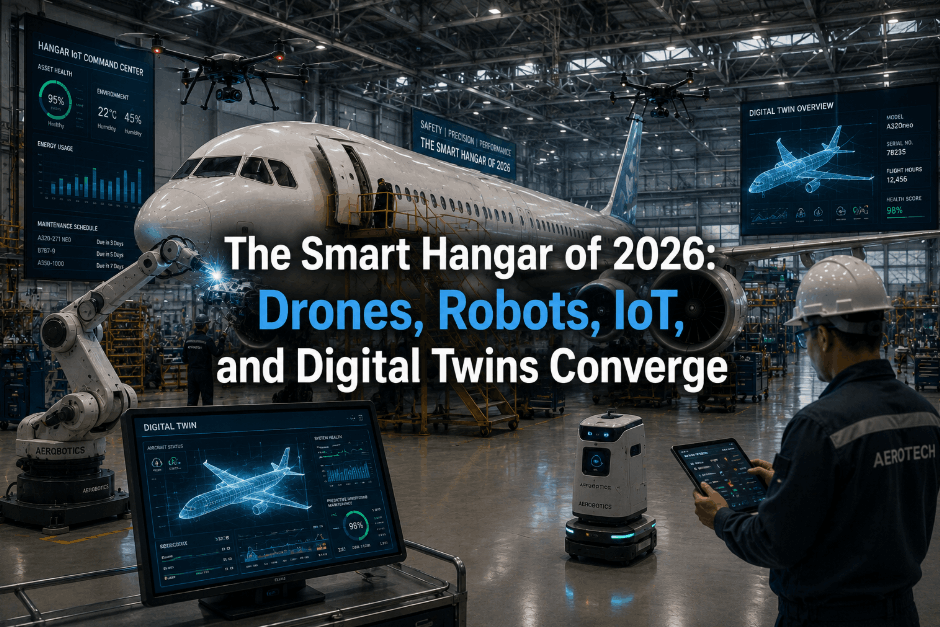
The MRO hangar is where quadruped robots have the clearest near-term deployment case. ST Engineering MRAS — a 1.5 million-square-foot aerospace manufacturing facility in Maryland — deploys Boston Dynamics' Spot to autonomously inspect critical equipment using thermal cameras and acoustic imaging sensors. Spot detects overheating components, abnormal vibrations, and air leaks before they escalate into failures, navigating stairs and uneven hangar floors on a timetable that would require multiple human inspectors to replicate. ST Engineering's new 84,000m² smart hangar in Singapore, designed around integrated robotic inspection from the ground up, is scheduled to open by end-2026. Quadrupeds excel in hangar environments because their four-legged gait handles the terrain variability that wheeled platforms cannot — tooling trolleys, cable runs, fluid spills, and aircraft wheel chocks are all navigable obstacles.
Thermal inspection
Acoustic monitoring
3D facility mapping
Predictive maintenance
Zone 04
Security & Perimeter
Autonomous Security Platforms
Autonomous security robots equipped with 360-degree cameras and AI anomaly detection patrol terminal perimeters and restricted zones without shift gaps or fatigue. San Antonio Airport deployed the Knightscope K5 autonomous security robot in 2024, operating continuous patrols that no human shift schedule can replicate without significant staffing cost. Boston Dynamics' Spot, now equipped with Google DeepMind's Gemini Robotics-ER embodied AI, autonomously identifies dangerous debris, spills, and visual anomalies during patrol — producing alerts and building searchable inspection histories without manual image review. These platforms integrate with existing airport CCTV and access control infrastructure, extending coverage into zones that are expensive to staff with humans around the clock.
A Robot Is a Facility Asset. It Needs a Maintenance Record Like Every Other Asset in Your Airport.
iFactory registers every robotic platform in your airport as a tracked, schedulable asset — with manufacturer PM intervals, inspection logs, software update records, and operational performance history maintained alongside every other facility asset in the same platform.
Humanoid vs Quadruped: The Right Platform for the Right Task
The humanoid vs quadruped distinction is not a competition — it is a task allocation question. Each platform type has a set of conditions where its form factor is the optimal choice, and aviation environments contain both.
Thermal inspection, acoustic monitoring, FOD detection, facility mapping
Lead example
JAL / GMO Unitree at Haneda — baggage & cargo handling, May 2026
Boston Dynamics Spot at ST Engineering MRAS — autonomous MRO inspection
Key advantage
Uses tools, opens panels, operates in spaces designed for human hands and reach
Stable on uneven surfaces, carries sensor payloads, traverses stairs and obstacles
2026 price range
$5,900 (Unitree R1) to $25,000 (mid-tier platforms)
$175,000 to $300,000 (Boston Dynamics Spot, depending on payload)
Real Deployments: What Is Already Operating at Scale in 2026
The airport robotics narrative has moved past proof of concept. These are operational programmes with documented outcomes — not announcements.
JAL + GMO — Haneda Airport, Tokyo
Active May 2026
Japan Airlines and GMO AI & Robotics launched Japan's first humanoid robot airport demonstration in May 2026. Two Unitree-based platforms at approximately $15,400 each were deployed for baggage loading and container transport. The programme is structured as a three-year phased trial — beginning with airport mapping and simulation, progressing to supervised live operation, then targeting autonomous expansion into cabin cleaning and equipment handling. JAL Ground Service president Yoshiteru Suzuki stated the objective explicitly: reduce physical strain on staff while maintaining human-led safety management.
Platform: Unitree humanoid
Duration: 3-year phased trial
Tasks: Baggage + cargo
Driver: Labour shortage
Spot at ST Engineering MRAS — Maryland MRO
Operational
Inside a 1.5 million-square-foot aerospace manufacturing facility producing composite structures for aircraft engines, Boston Dynamics' Spot patrols autonomously on a timed schedule — inspecting autoclaves, high-voltage equipment, and production machinery using thermal cameras and acoustic imaging. Spot detects overheating components and abnormal vibrations before they escalate into failures, collecting sensor data that human inspectors would miss during busy operational periods. The programme is part of a broader digital transformation strategy, with 3D facility mapping data feeding predictive maintenance systems.
Platform: Boston Dynamics Spot
Facility: 1.5M sq ft MRO
Tasks: Thermal + acoustic
Output: Predictive PM data
Cobot Lift + Schiphol — Baggage Automation
Trial Phase
Amsterdam Schiphol Airport is testing Cobot Lift's autonomous baggage handling system, targeting autonomous management of up to 90% of bags to reduce workforce strain on ground handling teams. The trial runs alongside Schiphol's testing of autonomous baggage tractors — a parallel programme integrating driverless vehicles into the airside baggage movement chain. Japan Airlines separately co-invested in Fox Robotics, a developer of autonomous forklifts, as part of a broader cargo automation strategy — demonstrating that major carriers are building robotics portfolios, not making one-off technology bets.
Target: 90% autonomous bags
Location: Amsterdam Schiphol
Parallel: Auto baggage tractors
JAL also: Fox Robotics forklifts
Singapore Changi Living Lab — End-to-End Automation
Operational
Singapore Changi's Living Lab integrates autonomous baggage tractors and food-delivery bots as a proving ground for end-to-end airport automation at peak traffic scale. The programme is designed to demonstrate that multiple robot types — ground vehicles, delivery platforms, inspection systems — can operate in coordinated fashion without requiring a proportional increase in human oversight headcount. ST Engineering's new 84,000m² smart hangar in Singapore, designed from the ground up around integrated robotic systems, is scheduled to open by end-2026 — the first large-scale purpose-built robot-integrated MRO facility in the world.
Model: Multi-robot coordination
ST Engineering hangar: end-2026
First purpose-built MRO robot hangar
Peak-traffic proven scale
The Facility Management Question No One Is Asking — But Every Airport Deploying Robots Will Face
When a humanoid robot joins a ground handling team, it becomes a facility asset. It has a manufacturer PM schedule. It requires software updates logged against an operational record. Its battery system has a service interval. Its sensor payload needs calibration. When it is out of service, the facility manager needs to know which tasks it was covering and how that coverage gap is being managed. None of the current conversation about airport robotics adequately addresses the facility management infrastructure required to sustain a robot fleet at operational scale — which is exactly what creates an integration problem for airports that deploy first and manage second.
What Happens When Airport Robots Are Managed Without a Structured Asset Platform
Unscheduled downtime accumulates undetected
A humanoid robot with a missed battery system service interval goes offline mid-shift. No PM record exists. The fault is reactive. The task it was covering — baggage container transport — is not reassigned systematically because no work order tied it to a coverage zone. The operational gap is invisible until a supervisor notices manually.
Robot inspection findings don't drive action
A Spot quadruped conducting thermal inspection of MRO hangar equipment identifies an anomaly. The data sits in a siloed robotics platform. No work order is generated. No PM task is escalated. The anomaly progresses to failure two weeks later. The robot found the problem. The facility management system didn't connect it to a response.
Compliance documentation doesn't exist for robot assets
An airside safety audit requires documentation of inspection coverage for all automated systems operating in restricted zones. The airport's robot fleet has no unified maintenance record. Each robot vendor has its own app. None of them produces a compliance report in a format the safety authority recognises. The audit generates a corrective action notice that paper records can't resolve.
"
The technology roadmap follows a clear progression. Individual robot units operating in defined zones with measurable results — the technology is validated. The remaining challenge is integration: getting robot outputs connected to maintenance systems so findings drive action rather than sitting in siloed apps.
— Airport Automation Industry Analysis, 2026 — on the gap between robot deployment and facility management integration
How iFactory Bridges the Gap Between Robot Deployment and Facility Management
iFactory treats every robotic platform as a registered facility asset — tracked, scheduled, and connected to the work order system that turns robot findings into maintenance actions. When a quadruped detects an equipment anomaly, that finding should create a work order. When a humanoid robot's service interval falls due, that should trigger an automatic PM task. When a robot goes offline, coverage allocation should be documented, not improvised.
Robot as Asset
Every Platform Registered, Every Service Interval Tracked
Each robot in the airport fleet is registered in iFactory with its platform type, serial number, operating zone, manufacturer PM schedule, and software update history. PM work orders generate automatically at the correct service interval — battery system, sensor calibration, joint inspection, firmware update — with the same scheduling discipline applied to every HVAC unit, elevator, and plumbing asset in the facility portfolio.
Inspection to Work Order
Robot Findings That Drive Maintenance Action, Not Siloed Reports
When a robotic inspection platform identifies an anomaly, iFactory provides the connected work order system that converts that finding into a documented maintenance task — assigned to a technician, tracked to completion, attached to the affected asset's fault record. The robot finds the problem. The platform closes the loop between finding and resolution.
Compliance Documentation
Robot Operational Records That Satisfy Safety Authority Requirements
Airside robot deployments operate in safety-classified zones that require documented maintenance records for regulatory compliance. iFactory produces structured maintenance history exports for every asset in the registry — including robot platforms — covering PM completion rates, fault records, downtime events, and service history in formats exportable on demand for audit purposes.
Fleet Performance Analytics
Which Platforms Are Delivering ROI, and Which Are Consuming It
As a robot fleet grows across zones, iFactory's analytics surface which platforms have the highest uptime, which zones generate the most maintenance overhead, and which units are approaching end-of-useful-life based on fault frequency and PM compliance history — giving aviation facility managers the data to optimise fleet allocation and support capital replacement decisions with documented performance evidence.
The Airports Deploying Robots in 2026 Will Need to Manage Them in 2027. iFactory Is Ready.
Register your robot fleet alongside every other airport asset — with the PM scheduling, inspection documentation, and compliance reporting that turns a technology deployment into a managed, auditable programme.
Japan Airlines launched Japan's first humanoid robot airport deployment in May 2026 at Tokyo's Haneda Airport, in partnership with GMO AI & Robotics. Two Unitree-based humanoid platforms — approximately 130cm tall at around $15,400 per unit — were deployed for baggage loading and container transport tasks. The trial is structured as a phased, multi-year programme targeting progression from supervised operation to autonomous deployment, with potential expansion into cabin cleaning and aircraft servicing. Its significance for the global industry is structural: it is a confirmed three-year operational commitment from a legacy carrier in a highly regulated safety environment, not a demonstration trial. It establishes a documented precedent that airports and airlines worldwide can reference in their own deployment planning. Get In Touch to start building the asset management infrastructure your airport will need when robots arrive.
Boston Dynamics' Spot is in active operational use at ST Engineering MRAS, a 1.5 million-square-foot aerospace manufacturing facility in Maryland that produces thrust reversers and nacelle systems for commercial aircraft. Spot autonomously patrols the facility on a timed schedule, using thermal cameras and acoustic imaging sensors to detect overheating equipment, abnormal vibrations, and air leaks — collecting data that human inspectors would miss in a facility operating at capacity. The findings feed predictive maintenance systems, reducing unplanned downtime. In 2026, Spot was also upgraded with Google DeepMind's Gemini Robotics-ER embodied AI, enabling autonomous visual anomaly detection including debris, spills, and equipment wear — outputs directly relevant to MRO hangar safety inspections. ST Engineering's new purpose-built smart hangar in Singapore, designed around robotic inspection from the ground up, is scheduled to open by end-2026. Book a Demo to see how iFactory connects robot inspection findings to your facility maintenance work order system.
This is the gap that most early-stage airport robot deployments expose: the robot operates, but its operational record doesn't exist in a format that safety authorities or auditors can review. Airside robot deployments in cargo handling, ground operations, and security zones operate under the same documentation obligations as any other system in a safety-classified area — maintenance records, service intervals, calibration history, and downtime logs are all required for compliance purposes. iFactory registers robotic platforms as tracked assets with the same structured maintenance records applied to HVAC units, elevators, and security equipment — producing exportable compliance reports that cover PM completion rates, service history, and fault records across the entire robot fleet. Get In Touch to register your robot assets and build the compliance record your airside operations programme requires.
Foreign Object Debris — any material on a runway, taxiway, or apron that could cause damage to an aircraft — is one of the most safety-critical inspection tasks in airport operations. Historically, FOD detection required dedicated human inspection teams walking runways and aprons on scheduled patrols, a process that is time-intensive, weather-dependent, and limited by human visual capability. Robotic FOD detection systems use computer vision and machine learning to autonomously patrol airside hard surfaces, identifying objects as small as 0.125 inches and routing collection autonomously. Quadruped platforms like Spot, now equipped with AI visual anomaly detection via Google DeepMind's Gemini Robotics-ER, can identify surface debris during inspection patrols without requiring dedicated FOD-specific equipment — integrating safety-critical detection into existing autonomous inspection programmes. Book a Demo to see how iFactory structures airside inspection records and FOD detection task documentation.
Conclusion
JAL's Haneda deployment, Spot's MRO hangar patrols, Schiphol's autonomous baggage trials, and Changi's end-to-end living lab are not isolated experiments. They are the visible edge of a structural shift in how aviation facilities operate — one driven by irreversible labour economics, doubling passenger volumes, and a technology cost curve that has made robot deployment economically rational at operational scale for the first time. The airports and airlines that are moving in 2026 are not ahead of the curve. They are on schedule with the timeline the industry's own structural pressures have imposed.
What separates successful robot deployments from stalled trials is not the technology — it is the facility management infrastructure that turns a robot fleet into a managed, documented, auditable programme. iFactory provides that infrastructure: asset registration, PM scheduling, inspection-to-work-order connectivity, compliance documentation, and fleet performance analytics — built for aviation facilities managing both conventional assets and the robotic platforms that are joining them. Book a Demo to see how iFactory manages robot assets alongside your existing facility portfolio, or Get In Touch to start building the asset registry your aviation robotics programme will require.
The robots are arriving. The airports that manage them as assets from day one will outperform every airport that manages them as experiments.
iFactory registers every robot in your aviation facility alongside every HVAC unit, elevator, and compliance asset — with PM scheduling, inspection records, and audit-ready documentation built in from the first deployment.