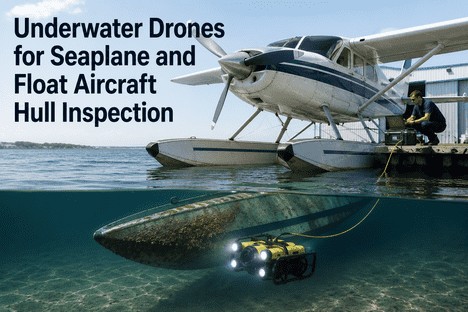
Every seaplane operator knows the dilemma. The most critical structural components of a float aircraft are also the least accessible. Above the waterline, the hull can be visually inspected, tapped, and tested during routine preflight. Below the waterline, the story is hidden — submerged in murky water, obscured by biofouling, and accessible only through costly dry dock haul-outs or diver deployments. A corroded float strut attachment, a cracked weld seam on a pontoon keel, or a delaminating composite layer on a amphibious hull step can go undetected for months, silently compromising structural integrity until the moment of maximum stress during takeoff or landing. Underwater Remotely Operated Vehicles change this. A compact inspection-class ROV, small enough to deploy from a dock or chase boat, can reach every submerged surface of a seaplane float in under 30 minutes — capturing high-definition video, ultrasonic thickness measurements, and cathodic protection readings without drydocking, without divers, and without pulling the aircraft from service. The technology is proven across commercial shipping, offshore energy, and marine infrastructure. It is now available for the aviation operators who need it most.
The Below-Waterline Blind Spot
Why Seaplane Floats Hide Damage Where You Cannot See It
A seaplane float looks simple from above — a sealed metal or composite pontoon bolted to the aircraft structure. But the submerged environment subjects every surface below the waterline to a combination of stressors that above-waterline structures never experience: continuous immersion in fresh or salt water, galvanic corrosion at dissimilar-metal interfaces, impact debris at takeoff and landing speeds, biofouling accumulation that traps moisture against the hull, and freeze-thaw cycling in cold climates. The diagram below shows the critical inspection zones of a typical seaplane float, divided by the waterline.
Four Ways to Inspect a Seaplane Float
Cost, Time, and Coverage Compared Across Inspection Methods
| Method | Cost per Inspection | Aircraft Downtime | Coverage | Data Quality | Safety Risk |
|---|---|---|---|---|---|
| Above-water visual only | $0 (preflight) | None | Above waterline only | Low — surface only | None |
| Dry dock haul-out | $2,500-$8,000 per event | 1-3 days | 100% of external surfaces | High — full access for NDT | Lifting / handling risk |
| Commercial diver inspection | $1,500-$4,000 per session | 2-6 hours | 80-90% dependent on conditions | Moderate — visibility limited | Diver safety in currents |
| Underwater ROV inspection | $300-$800 per session | 30-60 minutes | 95%+ with onboard sensors | High — HD video, UT, sonar | None — remote operation |
What an Underwater ROV Detects Below the Waterline
Sensor Capabilities Matched to Float Defect Types
An inspection-class ROV is not a single camera on a tether. It is a multi-sensor platform that can be equipped with payloads matched to the specific defect types that threaten seaplane float integrity. The grid below maps common float defects to the ROV sensor capable of detecting them.
The Cost of Deferred Float Maintenance
What Happens Below the Waterline When Inspection Is Delayed
Unlike above-waterline defects that become visible during preflight walks, below-waterline damage progresses silently until the structural or performance consequences become unavoidable. The bars below show how the cost of deferred float maintenance escalates over time, based on documented corrosion and biofouling progression rates in marine aircraft operations.
How an Underwater ROV Float Inspection Works
From Drop-In to Data Delivery — The Complete Workflow
A typical ROV inspection of a seaplane float follows a standardized workflow designed to maximize coverage in minimum time. The entire process — from ROV deployment to data upload into iFactory's Marine Aircraft Module — completes in under one hour for a single float aircraft.
How iFactory's Marine Aircraft Module Works
From ROV Inspection Data to Maintenance Action — One Integrated Platform
Frequently Asked Questions
Can an underwater ROV really see through murky water near a seaplane dock?
Yes. Modern inspection-class ROVs are equipped with multiple sensor types that compensate for low visibility. In clear water, the HD camera provides broadcast-quality video. In turbid water with visibility below 30cm, the onboard sonar system builds a 2D or 3D acoustic map of the float surface that is unaffected by water clarity. Most ROVs also carry high-output LED arrays that improve visibility in dawn, dusk, or shaded dock conditions. For extreme turbidity, the operator can switch to a touch-based inspection using physical contact with the float surface guided by the sonar overlay.
Does an ROV inspection require the aircraft to be out of service?
No — and this is one of the primary advantages over dry dock inspection. The ROV inspection is typically completed in 30 to 60 minutes while the aircraft remains on the water. The inspection can be performed between flights, during scheduled layovers, or as part of routine overnight maintenance checks. The aircraft does not need to be flown to a dry dock facility, does not need to be hoisted out of the water, and does not lose revenue-generating flight time. The only requirement is that the aircraft remain stationary in the water with no engine operation during the ROV pass.
What types of float materials can underwater ROVs inspect?
Inspection-class ROVs can inspect all common seaplane float materials: aluminum (2024-T3, 6061-T6), stainless steel, coated aluminum, composite sandwich structures, fiberglass, and carbon fiber laminates. The ultrasonic thickness gauge must be calibrated to the specific material, but the calibration process takes under 5 minutes and is stored in iFactory as part of the float configuration profile. For composite structures, the ROV's visual inspection identifies delamination and impact damage, while ultrasonic inspection detects subsurface disbonding and moisture ingress.
How often should seaplane floats be inspected with an underwater ROV?
Inspection frequency depends on operating environment and regulatory requirements. For aircraft operating exclusively in fresh water, quarterly inspections are recommended. For salt water or brackish water operations, monthly inspections are the standard recommendation. For amphibious aircraft that transition between water and land operations, the inspection interval may be driven by water landings rather than calendar time — typically every 50 to 100 water landing cycles. iFactory's Marine Aircraft Module automatically adjusts inspection intervals based on operating environment, corrosion history, and regulatory requirements for each specific float and airframe combination.
What is the upfront investment for an underwater ROV inspection capability?
Inspection-class ROV systems suitable for seaplane float inspection range from $4,000 to $25,000 depending on sensor payload. A basic system with HD camera, LED lighting, and sonar starts around $4,000 to $8,000. A fully equipped system with ultrasonic thickness gauge and cathodic protection probe ranges from $12,000 to $25,000. Against the cost of a single dry dock haul-out at $2,500 to $8,000, a complete ROV system pays for itself in 2 to 6 inspections. Operational cost per inspection is minimal — typically battery charging and occasional tether maintenance. iFactory's platform setup starts at $150 per month including ROV data import, corrosion tracking, and CMMS integration.
Can ROV inspection data satisfy regulatory airworthiness requirements?
Yes. ROV inspection data is increasingly accepted by aviation authorities as an alternative to physical dry dock inspection for continued airworthiness of float-equipped aircraft. The key requirements are that the inspection provides equivalent coverage to a dry dock inspection, that the data is documented with traceable records, and that corrosion progression is tracked over time. iFactory's Marine Aircraft Module meets these requirements by recording every inspection with geo-tagged defect locations, ultrasonic thickness readings, HD imagery, and technician sign-off — creating the complete audit trail that regulators and insurance underwriters require for continued airworthiness certification.