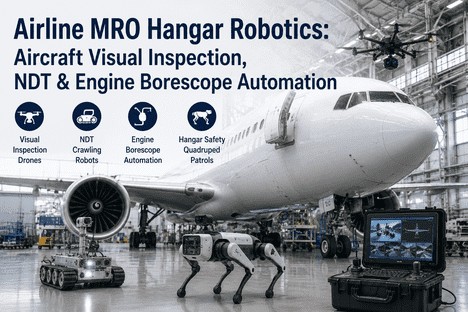
The global robotics and drone-based NDT market reached USD 1.24 billion in 2025 and is projected to double to USD 2.52 billion by 2030. Wall-climbing robots represent the fastest-growing segment within that market, and for good reason: a single technician with a climbing robot can scan an entire narrowbody fuselage in under 90 minutes, capturing ultrasonic thickness readings, eddy current crack detections, and high-resolution surface imagery at every grid point, with every data point geo-tagged to the aircraft's structural coordinate system. This article examines the adhesion technologies, NDT payload configurations, and operational workflows that make climbing robots a practical inspection tool for MRO operators in 2026.
Three Adhesion Technologies for Climbing Robots
The adhesion mechanism determines where a climbing robot can operate, how much NDT payload it can carry, and what surfaces it can traverse. Each technology has a specific operating envelope that makes it suitable for different aircraft inspection scenarios.
NDT Payload Configurations: What the Robot Carries
A climbing robot is only as useful as the sensors it carries. The NDT payload determines which defect types can be detected, at what resolution, and at what coverage rate. Modern climbing robots carry interchangeable payload modules that allow the same platform to switch between inspection modalities between flights or even between zones on the same aircraft.
Ultrasonic Testing
Phased array and single-element UT probes measure skin thickness, detect disbonding in composite repairs, and locate subsurface corrosion in lap joints. Couplant delivery systems integrated into the robot carriage maintain consistent acoustic coupling at speeds up to 10 cm/s per channel.
Coverage: 0.5 m²/min per probe
Eddy Current Array
Surface and near-surface crack detection around fastener rows, lap joints, and skin panels. Eddy current arrays with 32 to 64 channels provide 100% coverage of the scanned area in a single pass. Coating-tolerant operation detects cracks through paint layers up to 2 mm thick.
Coverage: Full surface scan per pass
Thermographic Camera
Passive and active thermography detects subsurface delaminations in composite skins, water ingress in honeycomb structures, and impact damage that is invisible on the outer surface. Active thermography using integrated flash lamps provides controlled thermal excitation synchronised with the robot's scan path.
Coverage: 1.2 m²/min at 2 mm resolution
High-Resolution Vision
4K visible-light and UV cameras capture surface condition imagery for visual inspection documentation. UV fluorescence imaging reveals cracks and corrosion products that are not visible under white light. All imagery is geo-tagged to the aircraft coordinate system and stitched into a full-fuselage inspection map.
Coverage: 4K imagery at 15 fps continuous
Inspection Performance: Climbing Robots vs. Manual Methods
75%
Time reduction for full fuselage NDT scan versus manual scaffolding-based inspection on a narrowbody aircraft
100%
Coverage repeatability — every scan follows the identical programmed path, eliminating zone omissions common in manual inspection
0.01 mm
Thickness measurement accuracy achieved by production climbing robots with ultrasonic probes on aluminium skin panels
50x
Faster defect identification claimed by robotic NDT platforms compared to manual methods, per US Navy deployment data
How a Climbing Robot Inspection Works: Operational Workflow
A complete climbing robot inspection cycle from hangar arrival to documented output follows six stages. The entire process is managed through the iFactory Robotic Inspection Tracking platform, which links every scan point to the aircraft record without manual intervention.
1
Surface Mapping and Path Planning
The operator loads the aircraft type into the inspection platform. The system retrieves the structural coordinate map and generates a scan path covering all required zones. The path is validated against the maintenance work scope and adjusted if specific areas require higher resolution or additional NDT modalities. Total setup time: 8 to 12 minutes.
2
Robot Deployment and Adhesion Verification
The climbing robot is placed on the aircraft surface at the designated start position. Built-in adhesion sensors verify contact force on each wheel or suction chamber before movement begins. For hybrid systems, the adhesion mode is automatically selected based on the surface material at the start position.
3
Automated Scan Execution
The robot follows the programmed path, collecting NDT data continuously. Each reading is tagged with the robot's position in the aircraft coordinate system. The operator monitors scan progress on a tablet, with real-time data quality indicators showing coupling status, coverage completion, and anomaly alerts.
4
AI-Assisted Defect Detection
Collected NDT data is processed through AI models trained on aircraft-specific defect signatures. Ultrasonic A-scans and C-scans are classified for corrosion, disbond, and thickness anomalies. Eddy current data is analysed for crack indications around fastener locations. Thermographic sequences are processed for subsurface delamination mapping.
5
Finding Documentation and Limits Comparison
Each detected anomaly is automatically documented in the inspection record with its location, size, severity classification, and NDT modality that detected it. The iFactory platform compares findings against the operator's loaded limits document for that aircraft model and flags findings that approach or exceed serviceable limits.
6
Report Generation and Work Order Trigger
A complete inspection report is generated containing the full scan coverage map, all detected findings with coordinates, AI classification confidence scores, and limits comparison results. Findings requiring action automatically create work orders in the connected MRO platform with the inspection data attached. The entire inspection cycle, from deployment to report, completes within 90 minutes for a narrowbody fuselage.
Frequently Asked Questions
Yes, but the adhesion technology must match the surface material. Composite fuselages are non-ferromagnetic, so magnetic adhesion alone is not sufficient. Vacuum-based climbing robots or hybrid systems with vacuum-assisted adhesion are required for composite-dominant airframes. The Boeing 787 and Airbus A350 have aluminium floor structure and metallic lightning strike protection mesh embedded in the composite skin, which provides limited magnetic attraction in some zones, but reliable adhesion across the full fuselage requires vacuum capability. iFactory's deployment planning process includes surface material mapping for each aircraft model to specify the correct adhesion configuration before the inspection begins.
Modern climbing robots are designed with articulated chassis or multi-joint suspension systems that conform to single-curvature and double-curvature surfaces. The robot maintains consistent wheel or suction contact across crown-to-keel transitions on the fuselage barrel section and around the nose and tail cones. Lap joints produce a surface step of typically 1 to 3 mm, which the suspension system accommodates without losing adhesion or NDT probe contact. Fastener rows are handled by the NDT data processing software: ultrasonic and eddy current signals around fasteners are analysed separately from skin panel data, with AI models trained to distinguish fastener signature from defect indications. Eddy current arrays are designed with flexible probes that conform to the surface contour around fastener rows.
Climbing robots are designed with multiple layers of fail-safe protection. Magnetic adhesion robots maintain grip without power — the permanent magnets do not release if power is lost. Vacuum-based robots have redundant vacuum chambers: losing one chamber does not cause detachment, and the robot can continue operating with reduced payload or initiate a controlled descent. Battery-powered robots have low-battery protocols that complete the current scan line and return to the start position before power runs out. In the event of an unrecoverable fault, tether-based systems provide a secondary physical attachment, and the robot can be winched down safely. iFactory's incident reporting module documents any adhesion events or aborted scans automatically in the inspection record.
iFactory's platform accepts NDT data through multiple integration paths. For robotic systems with API access, the platform pulls scan data, defect classifications, and position coordinates directly. For systems that output DICONDE-format files (the NDT equivalent of DICOM for medical imaging), iFactory imports and parses the structured data into the inspection record. For systems with CSV or XML output, a configurable data mapping tool maps the robot's output fields to the iFactory data model. The platform standardises data from different NDT modalities — UT, ECT, thermography, and vision — into a unified inspection record that links every finding to a specific aircraft coordinate and work order. Integration is typically completed within 2 to 4 weeks per robot model and NDT configuration.
The total system cost varies significantly by adhesion type, NDT payload configuration, and software integration scope. A basic magnetic adhesion robot with a single UT probe and vision camera typically ranges from USD 80,000 to 120,000. A multi-sensor hybrid adhesion robot with phased array UT, eddy current array, and thermographic payload ranges from USD 180,000 to 280,000. The iFactory Robotic Inspection Tracking platform integration is licensed separately, typically USD 1,500 to 3,000 per month per robot cell, depending on the number of integrated NDT modalities and MRO platform connectors. Several operators are adopting a Robotics-as-a-Service model where the robot system and software are bundled into a monthly fee of USD 8,000 to 18,000, which includes hardware maintenance, software updates, and integration support.
iFactory Robotic Inspection Tracking
Full Fuselage Inspection. 90 Minutes. Documented Automatically.
iFactory Robotic Inspection Tracking connects climbing robot NDT data directly to aircraft records, limits documents, and work order systems. Supports magnetic, vacuum, and hybrid climbing robots from all major manufacturers. Trusted by MRO operators across the UK, EU, Middle East, and Asia-Pacific for fuselage inspection programmes that deliver faster scans, better data, and complete documentation.
Pilot in 30 days. Full deployment in one quarter.