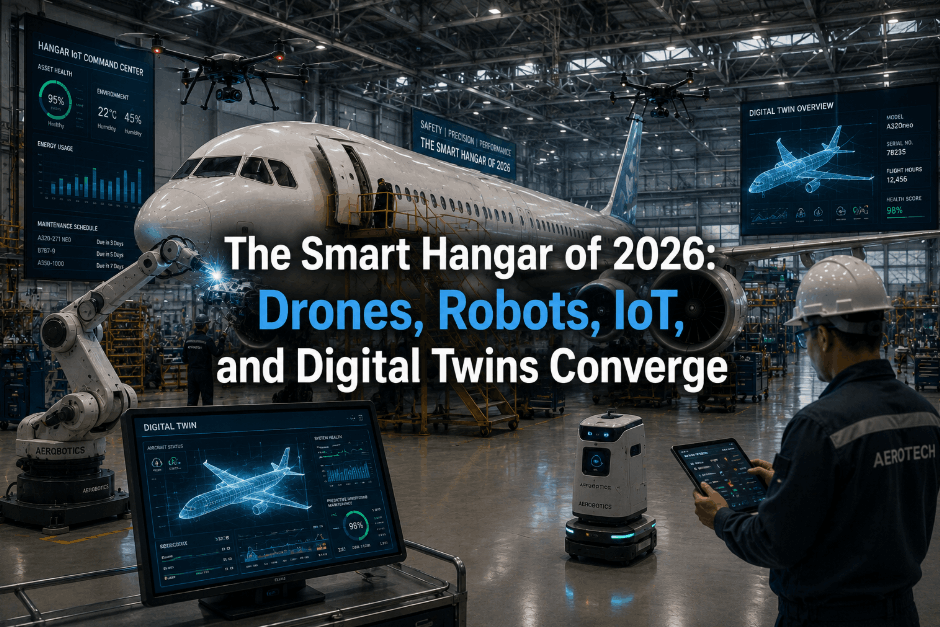
The aerospace robotics market reached USD 5.79 billion in 2026, with collaborative robots growing at over 30% annually, yet most MRO hangars have not deployed a single unit. The gap between general manufacturing cobot adoption and aviation-specific deployment is not about technology readiness. It is about understanding where a cobot adds measurable ROI in a hangar environment where every aircraft is different, every task card is unique, and every technician works differently. This article breaks down the use cases that work, the ROI numbers that matter, and how iFactory's Robotics Work Order Tracking connects cobot execution directly to maintenance documentation.
The Hangar Automation Gap: Why MRO Lags Behind Manufacturing
Manufacturing adopted cobots at scale because production lines are predictable. A car door is the same car door every time. An aircraft in a hangar for a C-check presents a different configuration, different damage pattern, and different task scope on every visit. This variability has historically made hangar automation harder to justify. But three converging forces are closing the gap in 2026.
Workforce Demographics
The aviation maintenance workforce is aging. With 2,000 experienced technicians retiring daily in the US alone and a documented shortage of over 400,000 skilled manufacturing workers, MRO operators cannot grow headcount to match rising fleet size. Cobots fill the gap for repetitive, physically demanding tasks without requiring five years of A&P training to operate.
Payload and Precision Maturation
Cobot arms now reach 30 kg payload with sub-0.03 mm repeatability, making them capable of drilling, riveting, sealing, and NDI scanning on airframe structures. Integrated force-torque sensing and vision-guided positioning allow cobots to adapt to part position variation without fixed tooling.
Software and Connectivity
Modern cobots no longer require dedicated robot programmers. Table-based teaching, drag-and-drop workflow builders, and direct integration with MRO platforms through API connectors mean a hangar technician can deploy a cobot for a new task in hours, not weeks. iFactory's Robotics Work Order Tracking bridges the gap between cobot execution data and maintenance documentation automatically.
Five Cobot Use Cases in Aviation Hangars That Deliver Measurable ROI
Not every hangar task is suitable for cobot deployment. The applications that deliver consistent ROI share three characteristics: they are physically demanding or ergonomically harmful, they involve repetitive motion patterns, and they produce measurable output data that can feed maintenance records. The following five use cases meet all three criteria across multiple MRO operator deployments in 2025 and 2026.
ROI Analysis: What Cobot Deployment Costs and Returns
The following figures are drawn from published MRO operator case studies and iFactory deployment data across 12 aviation maintenance facilities in the UK, EU, and Asia-Pacific during 2024 through 2026. Individual results vary by task type, hangar configuration, and aircraft mix, but the directional numbers are consistent across operator segments.
$38k–$65k
Average cobot hardware and deployment cost per cell, including end-effector and vision guidance
12–18 mo
Typical payback period for a single cobot cell in a 2-shift hangar operation at 65% utilisation
2.1x
Average labor productivity multiplier across drilling, painting, and sealing applications
8–14%
Reduction in total maintenance turnaround time for C-checks where cobots handle drilling, sealing, and NDI
Cost-Benefit Breakdown: Single Cobot Cell — Drilling Application
Upfront Cost
Cobot arm (UR10e or equivalent): $45,000
Drilling end-effector: $12,000
Vision guidance system: $6,000
Integration and programming: $8,000
Total: ~$71,000
Annual Return
Labor savings (1.2 FTE avoided): $62,000
Rework elimination: $14,000
Productivity gain (faster TAT): $18,000
Tooling and consumables reduction: $5,000
Total: ~$99,000/year
Deployment Models: How Hangars Are Integrating Cobots Today
The way a cobot is deployed in a hangar determines the ROI profile as much as the task itself. Three deployment models have emerged across MRO operators in 2025 and 2026, each suited to a different operational scale and task mix.
Model 01
Mobile Cobot Cart
A cobot mounted on a wheeled cart with onboard controller and battery power. Positioned next to the aircraft for a specific task, then moved to the next aircraft or hangar bay. Best suited for NDI scanning, sealant application, and light drilling tasks across multiple aircraft positions. Minimum facility modification required.
Investment: $45k–$70k per cart
Utilisation target: 50–70%
Model 02
Fixed Workcell
A dedicated cobot cell with permanent mounting, integrated safety systems, and tool changers supporting multiple end-effectors. Best suited for high-volume tasks like component painting, heavy drilling, and part preparation where the work comes to the robot. Requires hangar layout modification but delivers highest per-cell throughput.
Investment: $85k–$140k per cell
Utilisation target: 75–90%
Model 03
Cobot-as-a-Service
Operators pay a monthly fee covering hardware, maintenance, and software updates rather than purchasing the cobot. iFactory's CaaS model includes the cobot cell, integration with the RWT platform, and guaranteed utilisation. Best suited for operators who want to validate cobot ROI before committing capital or who need seasonal capacity scaling.
Investment: $2,500–$4,800/month per cell
Utilisation target: operator-managed
Frequently Asked Questions
Collaborative robots are designed to operate without safety caging when they meet the force, speed, and power limiting requirements of ISO 10218 and ISO/TS 15066. In practice, most hangar cobot deployments use a hybrid approach: the cobot operates in collaborative mode for slow-speed tasks like sealant application or NDI scanning, with reduced speed and force limits that allow safe human proximity. For high-speed tasks like drilling, a lightweight perimeter or laser scanner reduces robot speed when a technician enters the defined zone. The specific safety configuration depends on the task risk assessment, which iFactory supports during deployment planning. Most hangar installations do not require the heavy fixed guarding typical of industrial robot cells.
Modern cobot programming interfaces have reduced task changeover time significantly. For tasks that use the same end-effector, reprogramming for a different aircraft panel or component geometry typically takes 2 to 8 hours for an experienced technician using vision-guided path teaching or tablet-based drag-and-drop programming. For tasks requiring an end-effector change, additional time is needed for tool centre point calibration, typically 1 to 2 hours for the first setup and under 30 minutes for subsequent swaps with pre-calibrated end-effectors. iFactory's RWT platform stores program variants indexed by aircraft type, task card, and operator, allowing recall and deployment of validated programmes in under 15 minutes during the same shift.
Collaborative robots deployed in MRO hangars typically achieve 8 to 12 years of operational life with proper maintenance. The primary wear components are the joint gearboxes, which are rated for 20,000 to 35,000 operating hours depending on the manufacturer and payload utilisation. At 2,000 operating hours per year (single-shift hangar operation), gearbox replacement is typically required at year 10 to 12. End-effectors have shorter service life (3 to 5 years) and are often replaced or upgraded as task requirements evolve. iFactory's RWT platform monitors cobot operating hours, joint torque profiles, and end-effector cycle counts automatically, generating predictive maintenance alerts that prevent unplanned downtime.
Standard cobot arms are rated IP54, which provides protection against dust ingress and water splash but is not sufficient for paint booth or chemical-intensive environments. For painting and sealant applications, iFactory deploys cobots with IP65 or IP67 protection ratings, positive pressure enclosures, and chemical-resistant bellows covering the joint mechanisms. The control cabinets are positioned outside the hazardous area or housed in pressurised enclosures. For drilling and NDI tasks in standard hangar environments, IP54-rated cobots with regular cleaning schedules perform reliably. iFactory conducts an environmental exposure assessment during the deployment planning phase to specify the correct protection rating for each task location.
iFactory's RWT platform operates as a middleware layer between the cobot controller and the operator's CMMS or MRO platform. The cobot executes its task and outputs structured data - cycle completion status, measured torque or force values, inspection results, process timestamps - via the robot controller's API or digital I/O interface. iFactory maps each output to the corresponding work order, task card step, and component serial number in the MRO platform. Standard connectors are available for AMOS, TRAX, SAP PM, and Swiss AviationSoftware. The integration creates a complete audit trail showing which cobot performed which task, with what parameters, on which aircraft component, and with which result. No manual data transcription is required.
iFactory Robotics Work Order Tracking
Every Cobot Cycle. Every Torque Reading. Every Inspection Result. Documented Automatically.
iFactory Robotics Work Order Tracking connects cobot execution directly to maintenance documentation, creating a complete audit trail from robot cycle to compliance record. Supports Universal Robots, FANUC CRX, ABB GoFa, and KUKA LBR iiwa. Trusted by MRO operators across the UK, EU, Middle East, and Asia-Pacific for hangar automation that delivers documented, traceable results.
Pilot in 30 days. Full hangar deployment in one quarter.