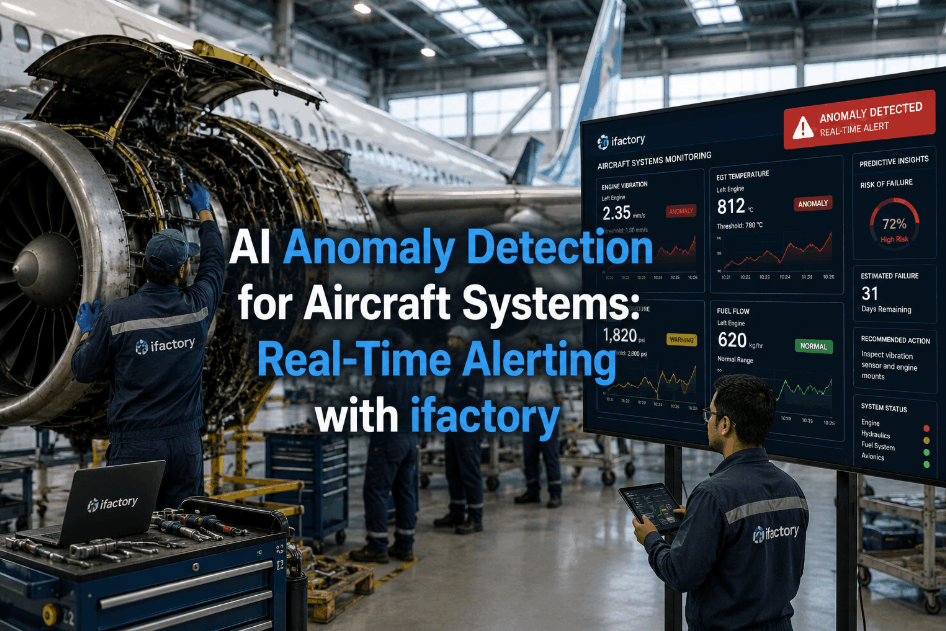
The global aircraft MRO paint and strip market exceeds USD 1.8 billion annually, with manual labour accounting for roughly 65% of total painting expenditures. A standard narrowbody repainting cycle demands 10 to 14 days of hangar downtime, during which the aircraft generates no revenue and occupies valuable facility capacity. Robotic aircraft painting systems have emerged as a proven alternative, reducing total repainting time by up to 60% while improving coating consistency, reducing material waste, and eliminating worker exposure to hazardous chemicals. This article examines how robotic painting systems achieve these outcomes, the technical specifications that define each system, and how iFactory's Painting Work Order Module integrates with automated paint cells to manage every job from surface preparation through final certification.
Cut Repainting Downtime from 10 Days to 4.
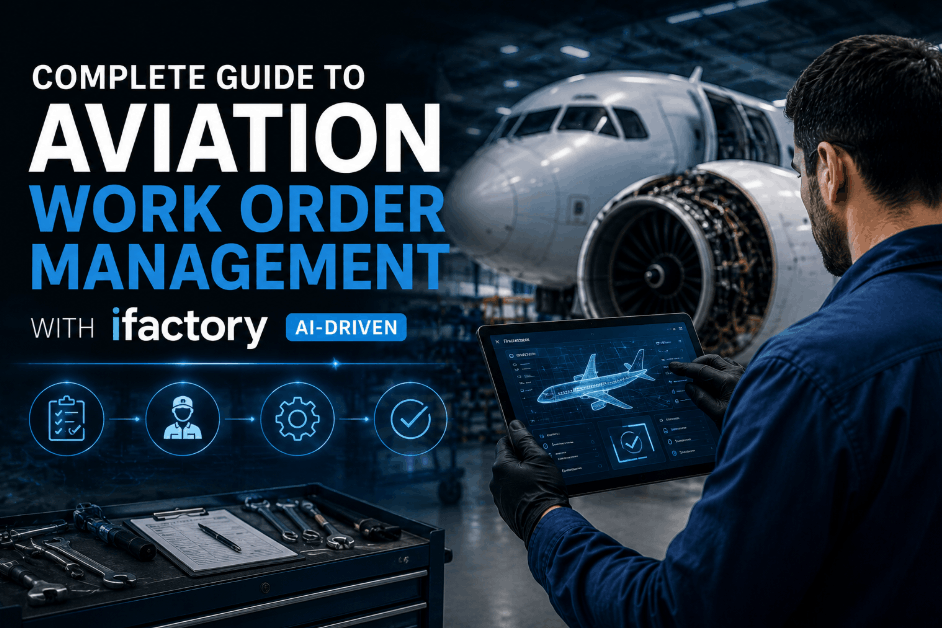
iFactory Painting Work Order Module tracks every robotic paint job from strip to final inspection.
The Four Metrics That Define Automated Painting
MRO operators who have deployed robotic paint cells consistently report improvements across four key dimensions. These metrics establish the business case for automation and set performance benchmarks that every prospective system should meet.
60%
Faster Repainting
Downtime compressed from 10–14 days to 4–5 days per narrowbody aircraft, recovering up to 10 additional revenue flying days per year per airframe.
30%
Less Paint Waste
Programmable spray paths and real-time flow control reduce overspray by 25–35% compared to manual application. Annual paint cost savings of USD 40,000 to 80,000 per aircraft.
25%
Better Consistency
Coating thickness variation reduced to within ±8 microns versus ±25 microns for manual spraying. Fewer rework cycles and improved corrosion protection compliance.
10→4
Days Saved
Six fewer days in the hangar per repainting cycle translates to USD 120,000–180,000 in additional revenue per narrowbody aircraft per year.
Traditional vs Robotic Painting: Phase-by-Phase Comparison
The most effective way to understand the impact of robotic painting is to examine each phase of the repainting process side by side. The five phases below represent the complete workflow from incoming surface preparation through final cure and inspection.
Traditional — 3 Days
Manual chemical stripper application by scaffolding crews. Methylene chloride and other aggressive solvents are brushed or sprayed onto the fuselage, left to dwell, and then scraped off. The process is labour-intensive, exposes workers to hazardous vapours, and produces large volumes of chemical waste. Inconsistent strip depth can lead to substrate damage and adhesion failures in the new coating system.
Robotic — 12 Hours
Laser ablation or dry-ice blasting end effector mounted on a multi-axis robotic arm. Programmable scan patterns, power settings, and standoff distance ensure complete removal with zero substrate damage. Closed-loop feedback adjusts ablation parameters in real time based on surface thickness readings. No chemical solvents, no hazardous waste stream, and no scaffolding required.
Traditional — 2 Days
Manual application of masking tape, paper, and plastic sheeting to cover windows, antennas, landing gear, engines, and other areas that must not be painted. Technicians work from scissor lifts and scaffolding. Masking errors are common and cause expensive rework. Each aircraft consumes 400 to 800 metres of tape.
Robotic — 6 Hours
Reusable programmable silicone masks and robotic placement arms reduce consumable tape usage by 80%. The robot positions precision masks over every opening and component with repeatable accuracy of ±1 mm. Automated surface mapping detects previous mask registration points, enabling consistent coverage across repeat painting cycles.
Traditional — 2 Days
Manual spray gun operation with the painter controlling gun distance, angle, traverse speed, and overlap entirely by feel. Transfer efficiency typically ranges from 25% to 40%, meaning 60 to 75% of the paint never reaches the aircraft. Film thickness varies widely across the fuselage, requiring remedial sanding and spot respraying on 15–20% of painted surfaces.
Robotic — 1 Day
Six-axis robot with integrated paint delivery system controls all spray parameters digitally. Programmed gun paths maintain optimal standoff, angle, and speed across every fuselage contour. Transfer efficiency reaches 65–75%, and film thickness varies less than ±8 microns across the entire surface. Real-time flow monitoring detects nozzle wear and compensates automatically.
Traditional — 2 Days
Complex livery designs require manual masking of colour boundaries and multiple spray passes. Registration errors between colour sections are common resulting in overspray bleed and blurred edges. Each livery colour adds a full day to the cycle. Total paint consumption per narrowbody ranges from 250 to 350 litres.
Robotic — 1 Day
Livery files are imported directly as digital painting programs. Colour boundaries are registered to the aircraft 3D model with sub-millimetre precision. Multi-colour paint heads switch between colours in under two seconds without stopping the process. Total paint consumption drops to 170–220 litres per narrowbody. Livery complexity adds hours rather than days.
Traditional — 1–2 Days
Ambient temperature curing with visual and tactile inspection by quality technicians. Film thickness is measured at 50–100 spot locations using an ultrasonic gauge. Defects discovered at this stage require partial sanding and spot respraying, which adds another 8–24 hours to the cycle. Documentation is completed on paper forms or basic spreadsheets.
Robotic — 12 Hours
Infrared curing accelerates paint cure time while inline vision and thickness scanners inspect 100% of the painted surface automatically. Every measurement is geo-tagged to the aircraft structural coordinate system and exported to the iFactory Painting Work Order Module. Defects are flagged in real time with precise location data for targeted rework. Complete digital documentation is generated automatically.
Technical Specifications Comparison
Robotic painting systems vary by payload capacity, reach, paint delivery technology, and integration capability. The table below compares five leading robot models and their specifications.
| Specification |
Robot A — Compact |
Robot B — Mid-Range |
Robot C — Large |
Robot D — Gantry |
| Reach (mm) |
1,800 |
2,500 |
3,200 |
6,000+ |
| Payload (kg) |
12 |
20 |
30 |
60 |
| Applicable Area |
Components & small parts |
Wings & tail sections |
Narrowbody fuselage |
Widebody fuselage |
| Transfer Efficiency |
68% |
70% |
72% |
75% |
| Paint System |
Air spray |
Airless / Air assist |
Electrostatic rotary bell |
Multiple interchangeable |
| Film Thickness Tolerance |
±10 µm |
±8 µm |
±8 µm |
±6 µm |
| iFactory Integration |
API connect |
Native module |
Native module |
Native module |
All specifications are based on manufacturer datasheets available as of early 2026. iFactory integration status is verified for the Painting Work Order Module v2.5 and later.
iFactory Painting Work Order Module
From Strip to Signoff. One Platform.
iFactory Painting Work Order Module integrates directly with all major robotic painting systems. Every paint job phase is tracked: work order creation, surface preparation, primer application, topcoat, livery, cure, inspection, and certification. Real-time dashboards show hangar occupancy, paint usage, film thickness compliance, and cycle time performance. Supports narrowbody, widebody, and component painting cells across single and multi-site MRO operations.
Digital work order creation and assignment
Robot program import and version control
Real-time paint consumption tracking
Film thickness compliance dashboard
Automated certification documentation
Multi-site hangar occupancy planning
Pilot in 30 days. Full deployment in one quarter.
Three Critical Success Factors for Robotic Painting Deployment
Deploying a robotic painting cell requires more than purchasing hardware. MRO operators who achieve the fastest ROI share three common practices that determine success or failure in automated painting implementation.
01
Digital Paint Program Library
Every aircraft type and livery variant must be programmed and tested before the robot enters production. Operators who build a library of validated paint programs during the deployment phase achieve full production throughput within 60 days. Those who program ad-hoc on the production floor see first-year utilisation rates below 50%.
02
Work Order Integration
Connecting the robotic paint cell to the MRO work order system eliminates duplicate data entry, ensures correct paint specifications are loaded for each job, and provides real-time cycle tracking. The iFactory Painting Work Order Module provides native integration with all major robot controllers and paint delivery systems, reducing integration effort by 60% compared to custom middleware.
03
Inline Quality Measurement
Robots that paint without inline inspection still require separate quality checks, undermining cycle time gains. Deploying integrated thickness gauges, vision systems, and cure monitors on the robot end effector enables 100% inspection during the paint process. Defects are corrected immediately rather than discovered during a separate inspection shift, saving 4–8 hours per aircraft.
Frequently Asked Questions
Ready to Automate Your Paint Shop?
Cut Repainting Downtime by 60% with iFactory.
iFactory Painting Work Order Module connects your robotic paint cell to your entire MRO operation. Track every job from surface preparation through certification with real-time dashboards, automated documentation, and multi-site hangar planning. Trusted by MRO operators across the UK, EU, Middle East, and Asia-Pacific for painting work orders that deliver measurable ROI from day one.
Pilot in 30 days. Full deployment in one quarter.