An A380 touches down every 90 seconds at a major international hub, and with each arrival, a silent clock starts. The turnaround crew has 90 minutes to deplane, inspect, clean, refuel, restock, and board before the next departure. In the hangar a mile away, an MRO technician climbs scaffolding to inspect a horizontal stabiliser joint by joint, knowing that a missed hairline crack means a grounded aircraft and a six-figure delay cost. On the tarmac, a ramp worker lifts their 800th bag of the shift while a humanoid robot walks past them toward the cargo hold, ready to absorb the next cycle. The aviation industry is not debating whether to deploy humanoid and quadruped robots. It is deciding which zone to automate first.
The State of Aviation Robotics 2026
Humanoid and Quadruped Robots for
Aviation and Airports 2026
A complete guide to terminal, MRO hangar, airside, and baggage operations where humanoid and quadruped robots are deployed today, with real-world deployments, form-factor decision frameworks, and the platform that connects patrol data to safety and operational outcomes.
$6.5B
Projected airport robotics market by 2035, up from $1.4 billion today. Compound annual growth of 16.6 percent across terminal, airside, and MRO segments driven by labour shortages and safety compliance pressure.
85%
Faster MRO inspections using drone and quadruped systems compared to manual walkdowns. A widebody exterior inspection that required six hours and full scaffolding now completes in under one hour.
32%
Of major airports worldwide actively seeking robotic deployment partners in 2026, driven by record passenger volumes, workforce shortages, and the need to maintain safety compliance without increasing headcount.
iFactory connects humanoid and quadruped EHS patrol data to CMMS, MES, and OEE dashboards across airport and airline operations — auto-logging near-misses, eliminating hazardous zone entries, and closing the loop between safety compliance and operational analytics.
Four Aviation Zones Where Robots Replace Human Exposure
Zone 01
Terminal / Cabin
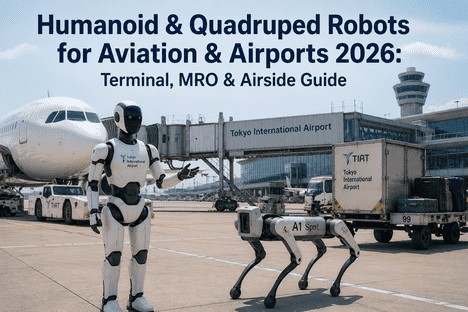
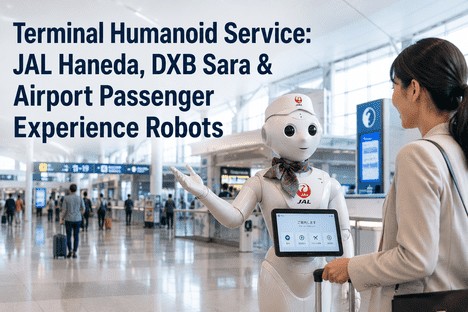
Humanoids assist passengers with wayfinding in over 50 languages, perform cabin cleaning between short-turn flights, and patrol gate areas for safety compliance. Deployed at San Jose Mineta and Haneda. Bipedal mobility required for jet bridges, aisles, and stairs.
Zone 02
Airside / Runway
Quadruped robots patrol runways and taxiways for foreign object debris using AI vision and thermal cameras. All-weather operation, stair climbing on boarding bridges, and 24/7 perimeter security. FOD costs the aviation industry up to $13 billion annually in direct and indirect damage.
Zone 03
MRO Hangar
Boston Dynamics Spot and MRO-specific robots perform aircraft exterior inspections, read analog gauges for hydraulic pressure and flow, detect thermal anomalies in avionics bays, and listen for compressed air leaks. Agentic AI integration with IFS enables autonomous work order generation from patrol data.
Zone 04
Baggage / Cargo
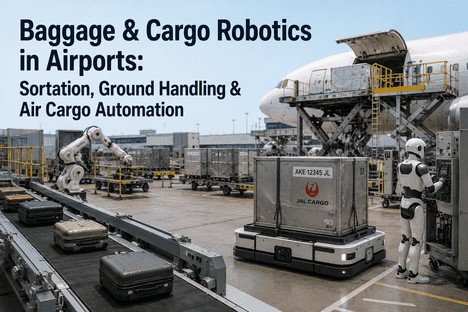
Autonomous mobile robots from Journey Robotics and Azalea Robotics handle baggage transport between touchpoints, reducing manual handling injuries. JAL's Haneda trial uses humanoids for ULD handling and cargo sorting. Baggage handlers lift cumulative tonnage exceeding safe ergonomic limits per shift.
The Convergence of Safety and Operational Data in Aviation
The insight that transforms the business case for humanoid and quadruped deployment in aviation is that EHS improvement and operational efficiency are not separate initiatives requiring separate robots. They are two outputs of the same patrol. When a quadruped walks a thermal patrol through an MRO hangar to eliminate human exposure to falls from height and hazardous chemical zones, it simultaneously captures the bearing temperature trends, hydraulic pressure readings, and cycle-time variances that reveal developing maintenance bottlenecks. When a humanoid performs a cabin inspection between flights, it also records the equipment state data that feeds the turnaround optimisation model. iFactory ingests every patrol reading once and routes it to two destinations: the EHS dashboard for near-miss logging and compliance reporting, and the maintenance analytics engine for work order generation and OEE calculation. One patrol. Two outcomes. Zero additional data collection cost.
EHS Compliance Outcome
Near-Miss Auto-Logging and Regulatory Reporting
Every thermal anomaly, gas reading above threshold, and unauthorised zone entry detected by the robot is auto-logged as an EHS event in iFactory. Near-misses that previously went undocumented because no human was present to witness them are captured continuously with timestamps, geolocation, sensor data, and photographic evidence. OSHA 300 logs and ISO 45001 incident records populate automatically. Safety audit preparation shifts from a paper reconstruction exercise to a dashboard data extract.
Operational Outcome
Bottleneck Detection and OEE Visibility
The same sensor data that flags an EHS event — a bearing running three degrees above baseline, a hydraulic line showing pressure drop, a door seal degrading — is simultaneously analysed by iFactory's maintenance analytics engine. The platform correlates the finding against maintenance schedules from the CMMS, historical trend data, and production data from the MES. If the anomaly indicates a developing bottleneck, iFactory generates a risk-ranked alert with the projected OEE impact and recommends the optimal intervention window.
One Patrol. Two Outcomes. Zero Additional Data Cost.
Every robot patrol in your airport or airline operation generates both a safety outcome and an operational outcome. iFactory routes each reading to both destinations simultaneously. No duplicate patrols, no additional sensors, no extra data collection cost.
From Detection to Resolution — The Aviation Robotics Automation Pipeline
The difference between a humanoid or quadruped deployment and a traditional safety programme is not the quality of the sensor data. It is the speed at which detection becomes documentation and drives corrective action. In a conventional programme, a near-miss observed by a human worker requires a form, a supervisor review, a data entry step, and a safety meeting before it influences operations. By that time, the maintenance issue that the near-miss signalled has already caused downtime. iFactory compresses this pipeline from days to seconds.
Detect
Sensor Capture
Log
Auto Record
Alert
Dual Routing
Close
Verified Resolution
Robot detects anomaly
Thermal, vibration, gas, acoustic, or visual anomaly captured by humanoid or quadruped sensors during autonomous patrol in hangar, runway, or terminal zone where no human was present.
iFactory auto-logs event
Platform timestamps, geolocates, and classifies the finding. EHS record and maintenance log created automatically with full sensor context attached. No human data entry required.
Dual routing to EHS + CMMS
Event routed to EHS dashboard as near-miss and to maintenance engine as work order trigger. Corrective action prioritised based on safety and operational impact on flight schedules.
Resolution verified by patrol
Humanoid or quadruped executes corrective action or technician is dispatched. Next robot patrol verifies resolution. CMMS work order closed. EHS loop completed. OEE model updated.
Real-World Aviation Robotics Deployments Driving the Shift in 2026
JAL / Tokyo Haneda
First Airline Humanoid Trial
Japan Airlines launched a two-year trial in May 2026 deploying Unitree G1 and UBTech Walker E humanoids for baggage handling, cargo ops, and cabin cleaning. The phased pilot is the first operational humanoid deployment by any airline at a major international hub.
San Jose Mineta
Humanoid Passenger Assistance
IntBot deployed humanoid Jose at Terminal B Gate 24 in March 2026. Jose provides wayfinding and flight information in over 50 languages while collecting passenger flow data that feeds terminal optimisation analytics.
Multiple Global Sites
IFS + Boston Dynamics MRO Partnership
Agentic AI-powered Spot robots perform autonomous MRO inspections at multiple aviation sites, reading gauges, detecting overheating, and identifying hazards. The system generates work orders directly in IFS maintenance software from patrol data.
Pittsburgh International
Autonomous Baggage Handling
Journey Robotics deployed autonomous baggage handling robots at Pittsburgh International, reducing manual handling injuries and improving bag processing speed. The system handles luggage between touchpoints with zero lost bags.
Frequently Asked Questions
The optimal form factor depends entirely on the operational zone. Quadrupeds like Boston Dynamics Spot excel in outdoor airside environments, expansive MRO hangar floors, and perimeter patrol where all-weather operation, stair climbing, and long patrol distances are required. Humanoids are preferred in terminal environments, aircraft cabins, and baggage holds where narrow aisles, mixed human traffic, jet bridges, and manipulation tasks demand bipedal mobility and dexterous hands. Most major airport deployments increasingly use a mixed fleet approach, deploying each form factor to its optimal zone and routing all data through a single platform like iFactory. Get In Touch to discuss which form factor fits your operational profile.
iFactory connects to existing CMMS, MES, and EHS platforms via API, webhook, or flat-file integration. Robot patrol data from any humanoid or quadruped vendor flows into the platform and is automatically routed to the correct destination: EHS events populate your safety dashboard and compliance logs, while equipment health data feeds your maintenance work order system and OEE analytics engine. The platform supports integration with IFS, SAP, Ramco, and all mainstream CMMS and EHS platforms used in aviation operations. Book a Demo to see iFactory connected to your existing technology stack.
ROI timelines vary by deployment scope and operational zone. Single-robot patrol deployments in MRO hangars or baggage zones typically achieve positive ROI within 12 to 18 months, driven by reduced inspection labour costs, decreased worker injury claims, and improved asset uptime. Multi-zone fleet deployments across terminal, airside, and baggage operations achieve ROI in 18 to 24 months. EHS compliance benefits and injury reduction produce additional savings that accelerate the timeline. iFactory's dual-routing capability amplifies ROI by delivering both safety and operational value from every patrol cycle without additional data collection cost. Get In Touch for a deployment-specific ROI analysis for your operation.
The Safest Aviation Patrol Is the One No Human Takes.
iFactory connects humanoid and quadruped EHS patrols to near-miss auto-logging, maintenance work order generation, and OEE visibility in one platform. Built for airport and airline operations where worker safety, regulatory compliance, and operational uptime are the same priority.