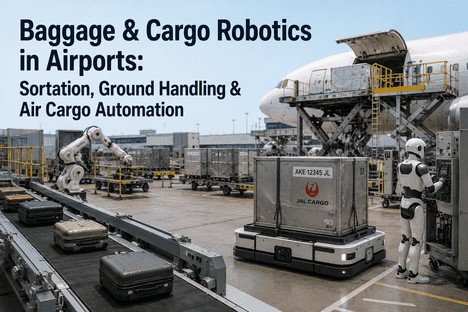
Baggage & Cargo Robotics in Airports: Sortation, Ground Handling & Air Cargo Automation
By Grace on June 5, 2026
Every bag that moves through an airport crosses more than a dozen physical handoffs between check-in and aircraft loading. Each handoff is a point of potential delay, damage, or misrouting. The industry processed 5.3 billion passengers in 2024 and 4.5 billion bags annually, yet traditional baggage handling systems still lose 6.3 bags per thousand to mishandling at a cost of $5 billion per year to airlines. The margin between a D:00 departure and a delayed flight is measured in minutes, and those minutes are increasingly determined not by how fast baggage handlers can lift, but by how well robotic systems can sort, transport, load, and track. Baggage and cargo robotics have moved from the warehouse automation playbook into the airport operations core, and the airports deploying them are the ones winning the turnaround time battle.
Baggage & Cargo Robotics 2026
Robotic Sortation, ULD Handling, Ground Humanoids and the Automation of Airport Cargo
How robotic systems are reshaping baggage handling systems, cargo terminal operations, ground handling workflows, and cold chain compliance across the global airport network.
$20B+
Global airport BHS market size, driven by capacity expansion and automation investment at major hub airports.
$5B
Annual airline cost of mishandled baggage. Robotic sortation and tracking reduce misloads and transfer errors.
6.3
Mishandled bags per thousand in 2024. Down from 18 per thousand a decade ago through automation and tracking.
85.9M
Annual passengers at Haneda Airport, where humanoid robots began ground handling trials in May 2026.
Your Baggage and Cargo Robots Are Facility Assets. Track Them Like Every Other Critical System.
iFactory registers every robotic sorter, autonomous tug, ULD handler, and ground humanoid as a tracked asset with PM scheduling, software version logging, inspection history, and operational uptime analytics alongside your BHS and cargo terminal equipment.
The Baggage Journey: Five Stages Where Robotics Replace Manual Handling
A checked bag moves through five discrete operational stages between the passenger check-in counter and the aircraft cargo hold. Each stage has historically been staffed by manual handlers performing repetitive physical tasks. Each stage now has a robotic alternative that is faster, more consistent, and trackable — and the airports that deploy robotics across all five stages are achieving measurable reductions in both mishandling rates and turnaround times.
Stage 01
Check-In Sortation
Robotic conveyor merges and high-speed diverters route bags from check-in to screening at rates exceeding 2,400 bags per hour per lane. RFID-tagged bags are sorted automatically with near-zero error.
Azalea Robotics, Vanderlande, BEUMER
Stage 02
Screening & Security
Automated screening lanes with CT scanners and robotic tray return systems process bags without manual lifting. AI-based threat detection reduces false alarm rates by up to 40%.
Smiths Detection, Leidos, Rapiscan
Stage 03
BHS Sortation
Robotic tilt-tray and cross-belt sorters with vision-guided destination coding achieve 99.8% sort accuracy at speeds exceeding 6,000 bags per hour. Early baggage storage managed automatically.
Siemens Logistics, Daifuku, PSI
Stage 04
ULD Makeup & Loading
Azalea Robotics ARC 1, the first fully-mobile baggage manipulator cobot, loads ULDs and carts autonomously. JAL Haneda humanoids handle baggage container transport and cabin cleaning tasks.
Azalea ARC 1, JAL/GMO Unitree, Cobot Lift
Stage 05
Arrival & Carousel
Automated make-up carousels and robotic offload systems deliver bags to passengers within minutes of aircraft arrival. Real-time bag tracking via RFID enables proactive delay notifications.
SITA BagManager, BCS, G&S Airport Conveyor
Ground Handling Robotics: Where Humanoids and Cobots Meet the Ramp
The ramp is the most physically demanding environment in airport operations. It is also the zone where robotics adoption is accelerating fastest. IATA's 2026 Air Cargo Technology Trends report identifies Automated Guided Vehicles and Stationary Robotics as Very High and High impact technologies with near-term adoption timelines. The shift is structural and driven by workforce availability: ground handling staff pools are under pressure globally, and robotic alternatives for baggage container transport, ULD loading, and cargo pallet movement are no longer prototype stage.
Deployment Spotlight
Azalea Robotics ARC 1
Berkeley-based Azalea Robotics, founded by alumni of Google X, NASA, and United Airlines, launched ARC 1 in January 2026 as the world's first fully-mobile baggage manipulator cobot. The system autonomously handles bag loading into carts and ULDs across any makeup configuration — ICS, flat belts, or carousels — without additional safety infrastructure. It maintains a complete digital record of every bag's location and can operate alongside human handlers in tight bagroom environments. The seed-funded company's platform targets the $20B+ BHS market with a zero-CapEx deployment model.
Zero lost or damaged bags
24/7 autonomous operation
>98% bag transfer rate
Vision-guided manipulation
Deployment Spotlight
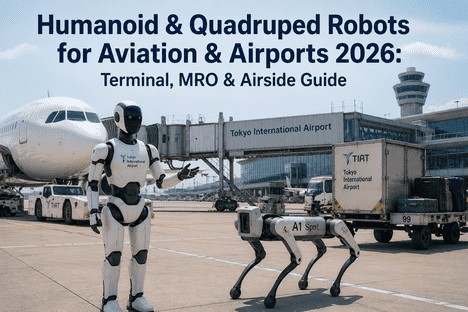
JAL Humanoid Trial at Haneda
Japan Airlines and GMO AI and Robotics launched Japan's first humanoid robot trial for airport ground handling at Tokyo Haneda in May 2026. Unitree-based humanoids at $15,400 per unit handle baggage container transport, cargo loading, and cabin cleaning. The programme is structured in three phases over three years: airport mapping and simulation, supervised live operation, and autonomous expansion. GMO designated 2026 as the First Year of Humanoids and opened a dedicated physical AI research hub in Shibuya.
132cm Unitree platform
$15,400 per unit
3-year phased programme
Baggage + cargo + cabin
Deployment Spotlight
Schiphol Cobot Lift
Amsterdam Schiphol Airport partnered with Cobot Lift to test robotic lifting aids for baggage handling in the bagroom. The collaborative robots reduce physical strain on handlers and enable a targeted 90% autonomous baggage handling rate. The Cobot Lift platform focuses specifically on the ergonomic challenge of repetitive heavy lifting that causes the highest injury rates in ramp operations.
90% automation target
Ergonomic lifting aid
Collaborative robot design
Injury reduction focus
Deployment Spotlight
Oceaneering AGV Cargo
Oceaneering Mobile Robotics deploys autonomous mobile robots for air cargo handling across major airport facilities. Their systems automate the movement of airfreight pallets and ULDs between knockdown areas, processing zones, conveyor systems, and staging positions. The robots operate in both airside and landside environments and are designed to work within tight aircraft turnaround windows without requiring infrastructure modifications.
ULD + pallet transport
Airside + landside ops
Zero infrastructure mods
24/7 consistent flow
From Sortation to Loading, Every Robot on the Ramp Needs Scheduled PM and Software Version Control.
iFactory manages your entire ground handling robot fleet — from Azalea cobots to Oceaneering AGVs to JAL humanoids — as registered assets with PM schedules, software deployment logs, inspection records, and uptime analytics in one platform.
Cargo Terminal Automation: AGVs, Stationary Robotics, and the IATA Technology Radar
Air cargo is a different operational environment from passenger baggage. Cargo shipments vary in size, weight, temperature sensitivity, and regulatory handling requirement. The robotics deployed in cargo terminals must therefore be more configurable than the systems handling standardized passenger bags. IATA's 2026 Technology Radar, drawing on input from over 120 industry stakeholders, ranks Automated Guided Vehicles and Stationary Robotics as the two highest-impact cargo technologies with near-term adoption timelines — ahead of AI analytics, wearables, and drone systems.
Automated Guided Vehicles
AGVs handle ULD and pallet movement between airside and landside operations and on the ramp. IATA rates them Very High impact with near-term adoption. Systems from Oceaneering, Westwell, and McGrath Industries are deployed at major cargo hubs worldwide, moving containers between staging areas, storage, and aircraft positions without manual tow tractors.
IATA Impact Rating: Very High
Stationary Robotics
Stationary robotic arms automate cargo sorting and build-up within cargo facilities. These systems handle the high-volume, repetitive task of arranging cargo pallets and containers for aircraft loading. IATA rates Stationary Robotics High impact with near-term adoption, noting that the technology has moved decisively forward between 2025 and 2026 editions of the survey.
IATA Impact Rating: High
Autonomous Mobile Robots
AMRs navigate dynamically between cargo processing zones without fixed guide paths. Westwell and other providers deploy AMR fleets that coordinate with warehouse management systems for real-time task allocation. IATA rates AMRs High impact with a 5-to-10-year adoption window, reflecting the complexity of dynamic navigation in high-density cargo environments.
IATA Impact Rating: High
Collaborative Robots (Cobots)
Cobots work alongside human handlers in cargo build-up and breakdown. The gap between airline and non-airline views on cobot adoption is among the widest in IATA's survey, with ground handlers and terminal operators significantly more optimistic about cobot timelines than airlines. Cobot Lift and Azalea ARC 1 are active examples.
IATA Impact Rating: Medium
Special Cargo and Cold Chain: CEIV Pharma, Perishables, and the Temperature-Controlled Robotics Frontier
The fastest-growing segment of air cargo requires the most precise handling. Pharmaceutical shipments, perishable foods, and biologics must move through cargo terminals without breaking the cold chain at any point between aircraft landing and storage. A temperature excursion of even 15 minutes on the tarmac can compromise an entire shipment of vaccines valued at hundreds of thousands of dollars. Robotics that move pharma cargo faster and with documented temperature compliance are becoming a core requirement of IATA CEIV Pharma certification, which Lufthansa Cargo renewed through 2029 and UPS Healthcare expanded to 18 global locations in 2025.
Temperature-Controlled AGVs
Robotic transport vehicles with insulated cargo beds maintain +2 to +8 C or +15 to +25 C ranges during transit between aircraft and cold storage. Temperature data logged at each handoff for CEIV compliance.
Automated Cold Storage
Robotic storage and retrieval systems in temperature-controlled cargo warehouses move pharma pallets between zones without human entry into cold environments. Reduces thermal excursion risk and labor exposure.
Robotic Break-Build Stations
Stationary robotic arms at temperature-controlled workstations handle cargo build-up and breakdown with precision timing, minimizing the window that pharma shipments spend outside active cold chain environments during processing.
Regulatory Compliance Mapping
IATA CEIV Pharma + Robotic Cold Chain Integration
CEIV Requirement
Temperature-controlled handling environment
Robotic Solution
AGVs with insulated cargo beds and real-time temp logging reduce tarmac exposure windows by 40%+
CEIV Requirement
Staff training and competency documentation
Robotic Solution
Robotic systems require fewer operators; training is standardized and logged in the asset management platform
CEIV Requirement
Equipment calibration and maintenance records
Robotic Solution
iFactory logs every robot's calibration schedule, temperature sensor validation, and PM completion against the CEIV audit trail
CEIV Requirement
Risk assessment and deviation management
Robotic Solution
System-generated fault alerts and temperature excursion records feed directly into deviation reporting workflows
Frequently Asked Questions
iFactory registers every robotic asset in your baggage and cargo operations — from BHS sorters and Azalea ARC 1 cobots to Oceaneering AGVs, cold chain transport robots, and stationary cargo palletizers — as tracked facility assets with manufacturer-specific PM schedules, software version histories, temperature sensor calibration logs, and inspection records. When a sortation robot requires service, its PM work order is generated automatically and its operational downtime is logged against your baggage flow metrics. For cold chain compliance, iFactory maintains temperature sensor validation records and calibration schedules alongside the CEIV Pharma documentation trail. Book a Demo to see how iFactory manages cargo robotics alongside your existing BHS and cold chain infrastructure.
BHS (Baggage Handling System) robotics covers the fixed infrastructure within the terminal: check-in conveyor merges, high-speed sorters, make-up carousels, and early baggage storage systems. These are typically provided by integrators like Vanderlande, Siemens Logistics, Daifuku, and BEUMER. Ground handling robotics covers the ramp and bagroom operations outside the terminal: ULD loading and unloading, baggage cart transport, cargo pallet movement, and cabin cleaning. Examples include Azalea ARC 1 for bag loading, Oceaneering AGVs for ULD transport, and JAL's Unitree humanoids for cargo container handling. BHS robotics is primarily about sortation accuracy and throughput. Ground handling robotics is primarily about physical labor reduction, worker safety, and turnaround time. Both categories converge in the bagroom where automated make-up carousels hand off to robotic loading systems. Get In Touch to discuss how iFactory supports both domains in a single asset management platform.
IATA CEIV Pharma certification requires cargo handlers to demonstrate controlled temperature environments, validated equipment, trained staff, and documented deviation management across the entire cold chain. Robotics directly supports multiple CEIV requirements: temperature-controlled AGVs reduce tarmac exposure windows, automated cold storage eliminates human-entry thermal breaches, and robotic break-build stations minimize the time pharma shipments spend outside cold chain environments. The robotics equipment itself must be maintained with calibration records for temperature sensors, PM schedules for refrigeration units, and software version control for control systems. iFactory provides the asset management layer that logs every robot's temperature sensor calibration, maintenance history, and operational compliance data in the structured format that CEIV audits require. Lufthansa Cargo's renewed CEIV certification through 2029 and UPS Healthcare's expansion to 18 certified locations demonstrate the growing expectation for documented cold chain compliance that robotic systems help deliver. Book a Demo to see how iFactory supports CEIV compliance documentation for your cargo robotics fleet.
ARC 1 is the world's first fully-mobile baggage manipulator cobot, launched by Azalea Robotics in January 2026. Unlike fixed robotic arms that require dedicated infrastructure, ARC 1 is a mobile platform that autonomously navigates to any makeup position in the bagroom — whether the airport uses ICS, flat belts, or carousels — and loads bags into carts and ULDs without requiring any facility modifications. It uses vision-guided manipulation to handle a wide variety of bag shapes and sizes. The system maintains a complete digital record of every bag's location, reducing mishandling and providing real-time tracking data. ARC 1 is designed to operate safely alongside human baggage handlers without additional safety infrastructure. In rare cases where the system encounters a bag it cannot manipulate, human handlers can work alongside it with no operational delay. The system operates 24/7 with zero reported lost or damaged bags and a transfer rate exceeding 98%. Get In Touch to see how iFactory supports ARC 1 and other robotic baggage handlers within your facility asset portfolio.
Conclusion
Baggage and cargo robotics are not an emerging trend in airport operations. They are the operational standard at the world's most efficient hub airports, and the technology gap between automated and manual airports is widening. IATA's 2026 Technology Radar confirms that AGVs and stationary robotics have moved decisively into near-term deployment. Azalea Robotics has shipped the first mobile baggage cobot. JAL has committed to a three-year humanoid trial. Schiphol targets 90% autonomous baggage handling. And CEIV Pharma certification increasingly requires the kind of documented temperature control that only robotic cold chain systems can reliably deliver.
The facility management infrastructure that supports these robotic fleets is not optional. A cargo terminal with AGVs moving ULDs, cobots loading bags, and temperature-controlled robots handling pharma shipments needs the same maintenance discipline applied to those robots as it applies to its BHS conveyors, cold storage units, and screening equipment. iFactory provides that infrastructure: asset registration across all robotic types, PM scheduling aligned with manufacturer specifications, software version and calibration documentation, uptime analytics, and compliance audit trails — built for the airports and cargo operators deploying robotics fleets today. Book a Demo to see how iFactory manages baggage and cargo robotics alongside your entire airport facility portfolio, or Get In Touch to begin registering your robotics fleet.
A Robotic Sorter That Goes Down in Peak Departure Bank Costs Thousands Per Minute. Your Facility Platform Should Keep Every Robot Running.
iFactory registers every baggage robot, cargo AGV, ULD handler, and cold chain robotic asset alongside your BHS and terminal equipment — with PM scheduling, software lifecycle management, temperature calibration tracking, and compliance documentation in a single platform.