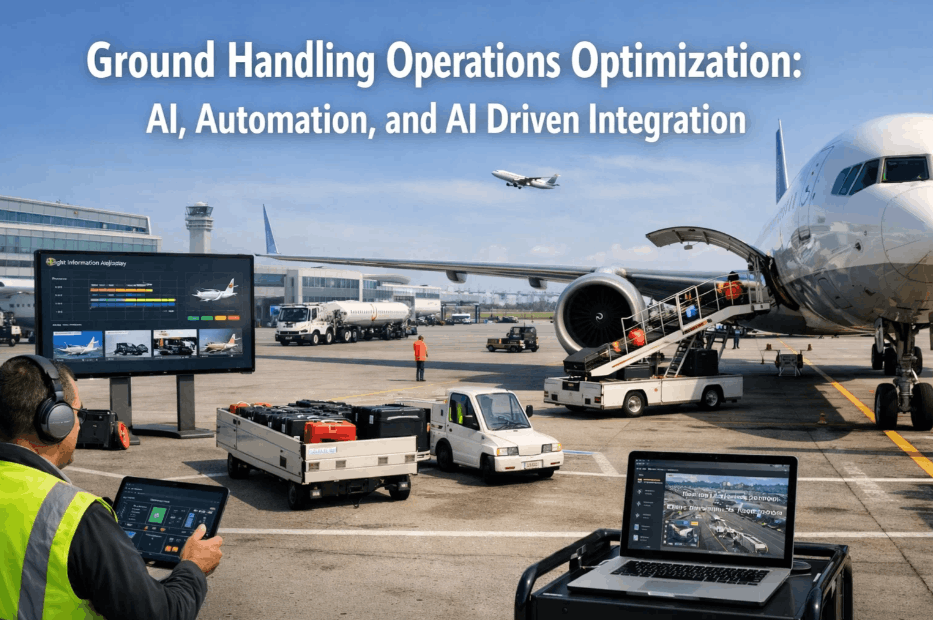
Ground handling operations optimization has become the most competitive differentiator in modern airport management. Every minute an aircraft spends idle on the apron translates directly into revenue loss, missed connections, and cascading delays across entire airline networks. Today, leading airports and ground service providers are deploying AI-powered analytics, autonomous equipment, and AI driven turnaround management platforms to slash aircraft turnaround times, eliminate ramp safety incidents, and drive measurable on-time performance gains. Whether you manage a regional airport or a Tier-1 hub handling 400+ daily movements, mastering ramp operations optimization through intelligent automation is no longer optional — it is the baseline for competitive survival. Book a Demo to see how AI-driven ground handling analytics can transform your turnaround performance starting in week one.
Reduce Aircraft Turnaround Time by Up to 34%
Discover how iFactory's AI-driven analytics platform transforms ramp scheduling, baggage handling, and turnaround management for airports of all sizes.
What Is Ground Handling Operations Optimization?
Ground handling operations optimization is the systematic application of data analytics, automation, and AI-driven scheduling to every activity that occurs between an aircraft's arrival and its next departure. This encompasses gate assignment, aircraft towing, fueling, catering, cabin cleaning, baggage loading, pushback, and safety inspections — all of which must be completed within a tightly compressed turnaround window. For narrow-body aircraft, that window can be as short as 25 minutes, yet even a 5-minute overrun cascades into delay penalties worth thousands of dollars per event. AI-powered ground handling operations platforms change this equation entirely by providing real-time visibility, predictive alerts, and automated resource dispatch — closing the coordination gap that has plagued apron operations for decades.
AI-Powered Ramp Operations: The 6 Pillars of Modern Ground Handling
Effective ramp operations optimization with AI covers six interconnected capability pillars. Each pillar addresses a specific failure point in the traditional ground handling model, replacing manual coordination and reactive maintenance with predictive intelligence and autonomous decision-making.
Predictive Turnaround Scheduling
AI models ingest flight plan data, gate availability, crew rosters, and equipment status to auto-generate optimized turnaround schedules 45 minutes before arrival. Dynamic rescheduling triggers in real-time when delays propagate.
-22 min Average TurnAutonomous Ground Support Equipment
Autonomous electric tugs, baggage loaders, and belt loaders with sensor-guided navigation eliminate positioning errors and remove human drivers from high-risk ramp zones — reducing FOD incidents by 31%.
31% Fewer FOD EventsAI Driven Baggage Handling
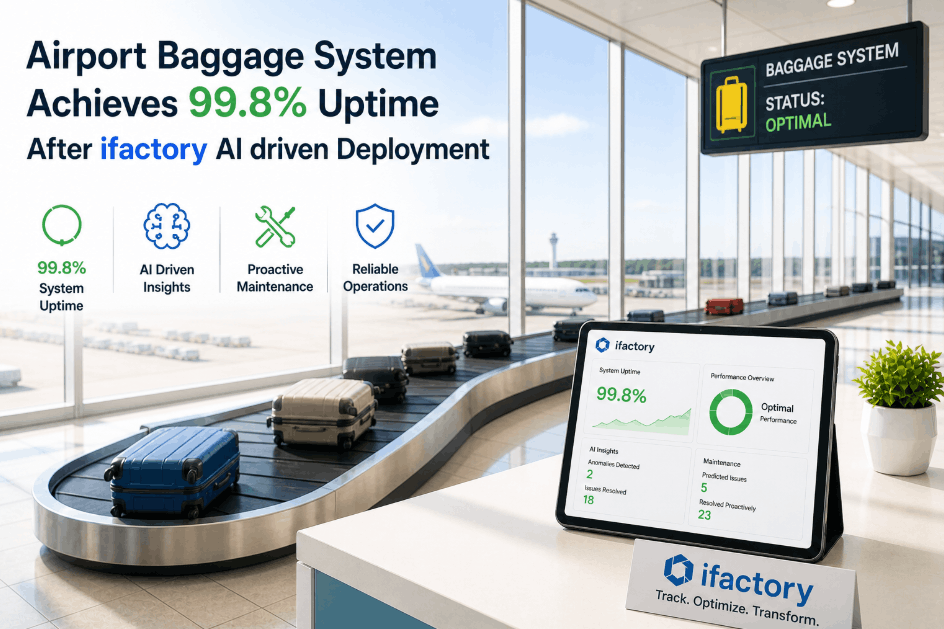
AI driven baggage sortation systems with RFID and computer vision achieve 99.97% scan accuracy. Predictive jam detection in conveyor networks prevents bag jams 8-12 minutes before they halt the system.
99.97% Tag AccuracyReal-Time Apron Safety Monitoring
Computer vision cameras on gate bridges and apron towers detect unauthorized personnel intrusion, equipment proximity violations, and jet blast exposure — alerting supervisors in under 3 seconds.
<3s Safety AlertGSE Predictive Maintenance
IoT vibration and thermal sensors on GPU units, ground power cables, and pushback tractors predict failure 14-21 days in advance. Parts are pre-kitted and technicians dispatched before the equipment fails mid-turn.
21-Day Failure ForesightDigital Turnaround Compliance Logs
Every ground handling task — fueling sign-off, chock placement, final walk-around — is time-stamped and photo-verified in a digital audit trail accessible to airline clients and regulatory authorities in under 15 seconds.
<15s Audit ReadyAircraft Turnaround Time Optimization: A Step-by-Step AI Workflow
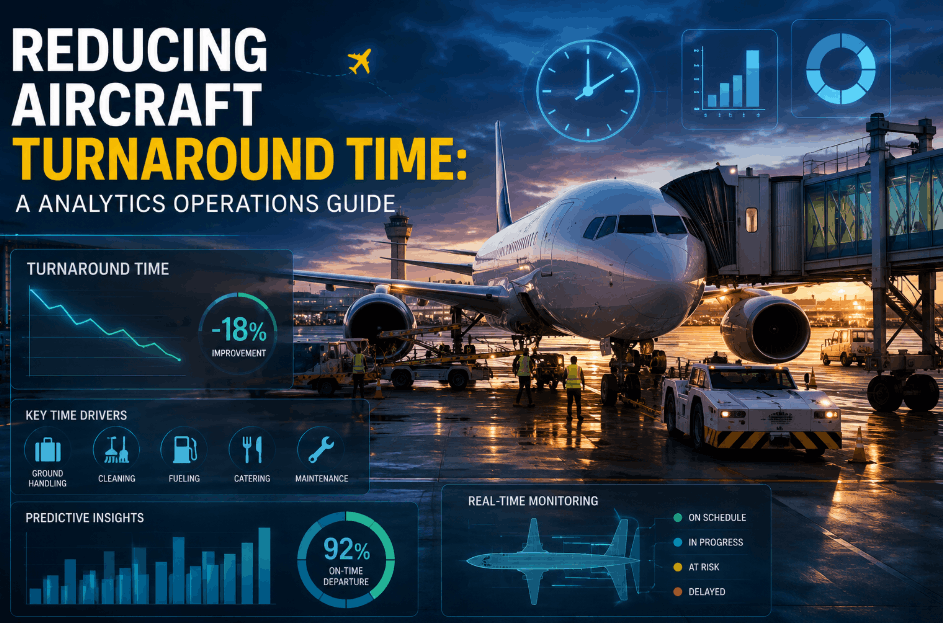
The most measurable win in airport turnaround management comes from synchronizing every task team — cleaning, catering, fueling, baggage, and engineering — into a single real-time orchestration layer. For a live walkthrough of this workflow in action, Book a Demo with our ground operations specialists.
Inbound Intelligence — T-45 Minutes
The AI platform receives inbound flight telemetry, actual time of arrival estimates, and passenger connection data 45 minutes before gate arrival. It auto-assigns ground crews, equipment, and parking stands based on real-time availability — not static schedules.
45 min Pre-Arrival OptimizationGate Arrival & Simultaneous Task Launch — T-0
The moment the aircraft docks, AI triggers simultaneous task dispatch to all service teams via mobile alerts. Baggage offload, refueling, and catering proceed in parallel rather than sequentially — compressing a 72-minute turn into 48 minutes.
33% Turn Time ReductionLive Exception Management — T+10 to T+35
AI continuously monitors task completion milestones. If baggage loading falls behind the critical path by more than 4 minutes, the system automatically reassigns an additional loader from a completed adjacent gate — preventing a cascading delay before it develops.
4-min Exception ThresholdDeparture Readiness Verification — T-5
Five minutes before scheduled departure, the AI system performs a digital departure readiness check: all service doors closed, chocks removed, GPU disconnected, pushback tractor connected and cleared — replacing the manual radio-round-robin that cost an average of 3.2 minutes per turn.
3.2 min Departure RecoveryGround Handling Maturity Journey: From Manual Ramp to Autonomous Operations
Most ground handling organizations sit at Stage 1 or Stage 2 of this maturity model — paying for it in delay penalties, labor overtime, and equipment failure costs. Book a Demo to benchmark your current ground handling maturity level against industry peers.
Manual & Reactive Operations
Radio-based coordination, paper-based task checklists, and reactive GSE maintenance. Turnaround delays are resolved by adding buffer time rather than eliminating root causes.
Digitized Checklists & Basic Tracking
Mobile apps replace paper checklists. GPS-tracked GSE vehicles provide basic location awareness. Calendar-based maintenance schedules still ignore actual equipment run-hours and stress cycles.
Connected IoT & Condition Monitoring
IoT sensors on GSE assets stream real-time health data to a central dashboard. AI-powered alerts flag equipment degradation before failure. Turnaround coordination becomes data-driven rather than supervisor-dependent.
AI-Driven Autonomous Ground Operations
Fully AI driven turnaround orchestration with autonomous GSE, predictive maintenance with 21-day foresight, real-time compliance logging, and dynamic crew dispatch. On-time performance consistently exceeds 97.5%.
Key Technologies Powering Automated Ground Handling in 2025
The automated ground handling technology stack has matured rapidly in the past three years. The convergence of affordable IoT hardware, 5G airport networks, and cloud-native AI platforms has brought enterprise-grade ground operations intelligence within reach of mid-size airports and regional ground handlers. To understand which technology layer delivers the fastest ROI for your specific operation, Book a Demo and we'll map your current infrastructure against our deployment framework.
| Technology Layer | Application in Ground Handling | Performance Gain | Deployment Timeline |
|---|---|---|---|
| IoT Vibration Sensors | GSE predictive maintenance — GPU, tugs, belt loaders | 99.4% GSE uptime | 7-14 days |
| AI Turnaround Scheduling | Auto-dispatch of crews and equipment, critical path monitoring | -22 min avg turn time | 14-21 days |
| Computer Vision Safety | Apron zone intrusion detection, FOD monitoring, proximity alerts | -31% ramp incidents | 21-30 days |
| RFID Baggage Tracking | End-to-end bag tracking from check-in to aircraft hold | 99.97% tag accuracy | 30-45 days |
| Digital Compliance Logs | Automated task verification, photo-timestamping, audit export | 80% audit prep reduction | 7-10 days |
| Autonomous Electric Tugs | Sensor-guided aircraft towing, autonomous repositioning | -40% tow-team labor cost | 60-90 days |
Ramp Safety and Ground Handling Compliance: The AI Advantage
Ground handling safety is the non-negotiable foundation of every optimization initiative. A single ramp incident — whether a vehicle strike, FOD ingestion, or fueling overflow — can ground an aircraft for 6-48 hours and generate liability costs that erase an entire quarter's efficiency savings. AI driven ground operations platforms address safety across three dimensions: prevention, detection, and documentation.
Prevention
AI scheduling systems enforce mandatory safety buffers between simultaneous apron activities. When a fueling vehicle and catering truck are scheduled to service the same aircraft simultaneously, the AI detects the proximity conflict and staggers operations automatically — before crews are dispatched.
Zero Proximity ConflictsDetection
Computer vision cameras mounted on gate bridges monitor the entire safety zone in real-time. Unauthorized personnel, fallen objects, and unsafe equipment positioning trigger instant supervisor alerts with detection latency under 3 seconds — versus the 45-90 second average for human supervisor identification.
<3s Detection LatencyDocumentation
Every safety-critical task — chock placement, wheel bay inspection, fuel cap verification — is digitally logged with photo evidence and technician biometric confirmation, creating a tamper-proof compliance record for ICAO, FAA, EASA, and DGCA audits in under 15 seconds.
<15s Audit Export12-Month AI Transformation: Verified Ground Handling Performance Data
The following data is drawn from a verified 12-month deployment at a Tier-1 international airport hub handling 520+ daily movements. The progression from manual ramp operations to full AI ground operations integration demonstrates compounding performance improvements at each phase. Book a Demo to review a full case study specific to your airport size and operation type.
Ground Handling Compliance Matrix: From Paper Logs to AI-Driven Audit Intelligence
Regulatory compliance in ground handling has evolved from annual paper audits to continuous real-time measurement. The following matrix maps the compliance progression for four critical ground handling categories against ICAO Doc 9859, IATA ISAGO, and FAA Part 139 standards.
Aircraft Towing & Pushback Records
Handwritten logbooks with crew signatures. High risk of retroactive ghost-fill entries during audits. No equipment telemetry records.
Mobile app task completion timestamps. Basic GPS trail for tow vehicles stored locally. Manual supervisor sign-off required.
Auto-generated ISAGO-compliant pushback records with sensor-verified chock removal, tractor connection confirmation, and wing-tip clearance monitoring.
Fueling Operations Safety Compliance
Manual fuel uplift logs. No real-time overfill detection. Bonding cable verification done visually with no digital confirmation.
Digital fuel forms with pre-calculated uplift targets. Photo evidence captured by fueler but stored in disconnected app silos.
Real-time bonding sensor verification, automated overfill shutdown integration, and instant FAA Part 139 compliance log generation per fuel event.
Ground Support Equipment Certification
Annual certification binders for each GSE unit. No visibility into equipment degradation between scheduled inspections.
Digitized service records and certification expiry tracking. Alerts sent when inspection dates approach — but no condition monitoring between visits.
Continuous IoT condition monitoring feeding real-time ISAGO GSE certification dashboards. Predictive maintenance prevents certification lapses from mechanical deterioration.
Ramp Personnel Safety Certification Tracking
Training binders maintained per individual. Supervisors manually verify badge credentials before shift assignments — taking 15-20 minutes per gate briefing.
HR system stores training records. Integration with shift scheduling is manual, creating gaps where uncertified staff access restricted zones.
Automated biometric badge verification at apron access points. AI blocks zone access if certifications are expired or incomplete — preventing regulatory exposure before it occurs.
Calculating the ROI of Ground Handling Automation
The ROI case for automated ground handling is among the most quantifiable in aviation technology. Every minute of delay reduction, every prevented GSE failure, and every compliance audit acceleration produces a trackable dollar value that accumulates daily.
Delay Penalty Elimination
Airline contracts include delay penalties of $800–$4,500 per event. A 200-movement airport reducing delay events by 60% through AI turnaround scheduling recovers this amount in annual penalty exposure.
GSE Maintenance Cost Reduction
Predictive maintenance reduces emergency repair costs by 67% and extends average GSE asset life by 3.4 years — deferring capital replacement cycles worth $340,000 per fleet renewal.
Labor Efficiency Gains
AI-optimized crew dispatch eliminates over-staffing buffer during off-peak turns and prevents under-staffing during schedule compression — delivering this level of labor cost reduction versus fixed-shift models.
Baggage Mishandling Cost Avoidance
At $107 per mishandled bag, AI driven baggage systems reducing mishandling rates from 4.2 to 0.3 per 1,000 deliver this level of cost avoidance per million passengers handled.
What Ground Operations Leaders Are Saying
"Before deploying AI-driven turnaround management, we were running a 78-minute average turn on our narrow-body fleet against a contracted 65-minute target. After eight months with the platform, we are consistently at 58 minutes — 7 minutes under target. The predictive GSE maintenance alone prevented four GPU failures during peak summer operations that would have caused ground stops lasting 3-4 hours each."
Frequently Asked Questions: Ground Handling AI & Automation
How does AI integrate with existing AODB and FIDS systems?
The platform connects to your Airport Operational Database (AODB) and Flight Information Display System (FIDS) via REST API or SITA/AIDX data feeds. This allows the AI to consume real-time flight schedule changes and propagate updated turnaround plans to ground crews within 90 seconds of a schedule revision — without requiring manual re-planning.
What GSE types are supported by the predictive maintenance module?
The IoT sensor suite supports all standard GSE categories: 400Hz GPU units, aircraft tugs and tractors, belt loaders, container loaders, passenger stairs, lavatory service vehicles, potable water trucks, and aircraft deicers. Sensors are clamped-on without voiding OEM warranties and begin providing data within 72 hours of installation. Book a Demo for a full GSE compatibility assessment.
How long does deployment take for a mid-size airport?
A typical mid-size airport with 80-150 daily movements is fully instrumented and operationally live within 21 days. AI models reach high-confidence predictive accuracy by Day 35, once they have learned the specific patterns of your gate assignments, seasonal traffic mix, and GSE fleet behavior.
Does the platform support multi-handler environments?
Yes. The platform supports multi-handler airport environments where several ground service providers operate on the same apron. Each handler receives their own permission-scoped dashboard view, while airport operations sees a unified turnaround picture across all handlers.
What is the compliance coverage for IATA ISAGO audits?
The digital compliance module covers all 14 ISAGO operational audit areas relevant to ground handling including load control, aircraft handling, passenger services, baggage handling, and ramp services. Audit export packages are generated in under 15 seconds, reducing audit preparation from an average of 40 staff-hours to under 2 hours.
Can the system handle irregular operations (IROPS) scenarios?
IROPS management is a core capability. When mass cancellations or weather diversions occur, the AI instantly recalculates resource allocation across all affected movements, prioritizes high-value connecting flights, and issues revised task orders to all teams simultaneously — reducing IROPS recovery time by an average of 44 minutes per disruption event.
Stop Losing Revenue to Preventable Ground Handling Delays
Join the world's most efficient ground operations teams. We'll show you exactly how many turnaround minutes and delay penalty dollars your current operation is leaving on the table.



-integration-with-ai-driven.png)