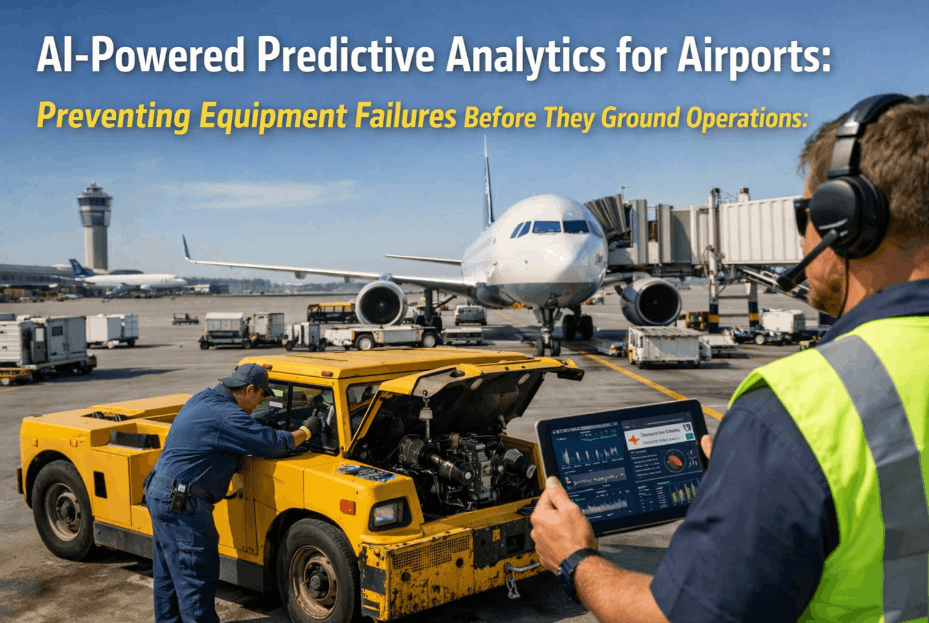
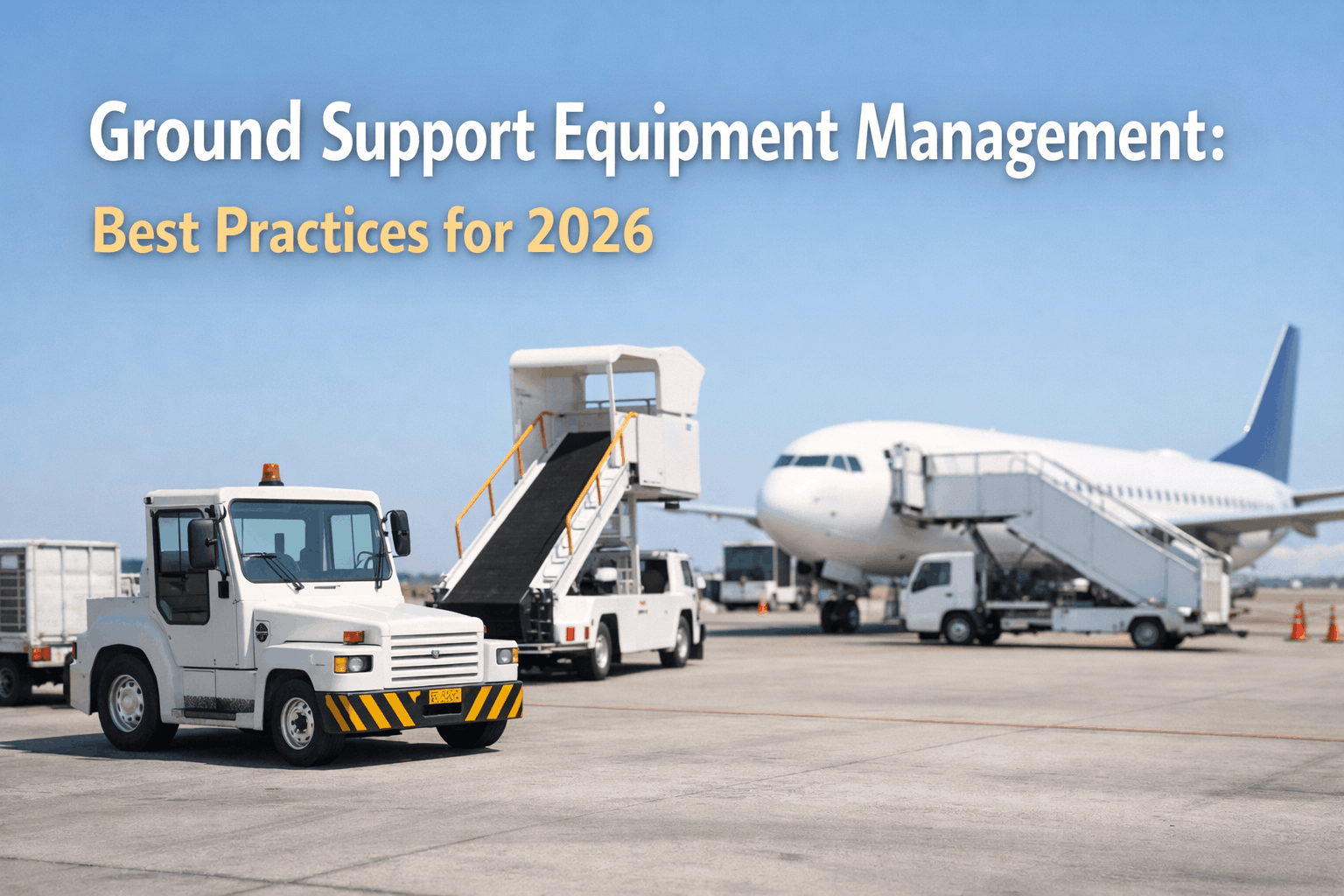
A major international airport's Ground Support Equipment (GSE) fleet operation managing 500+ vehicles across four airline ground handling contracts was losing $2.4M annually to preventable equipment breakdowns, unscheduled AOG (Aircraft on Ground) delays caused by GSE failures at the gate, and reactive maintenance cycles that consumed 67% of the fleet maintenance budget on emergency repairs. The fleet included a mixed asset base of aircraft tugs, baggage tractors, belt loaders, aircraft ground power units (GPU), pre-conditioned air units (PCA), and a growing subset of electric GSE vehicles — each with distinct failure modes, maintenance intervals, and operational criticality profiles. By deploying ifactory's Predictive Analytics AI platform across all 500+ GSE assets, the ground handling operator reduced fleet breakdowns by 62%, eliminated 94% of GSE-caused AOG delay events, extended average fleet asset life by 28%, and recovered $2.4M in annualized operational savings within the first full year of deployment.
Predictive Analytics AI
·
Airport GSE Fleet
·
$2.4M Annual Savings
Airport GSE Fleet Saves $2.4M Annually Through Predictive Analytics AI with ifactory — Cutting Breakdowns by 62% Across 500+ Ground Support Vehicles
ifactory's Predictive Analytics AI transforms reactive GSE fleet maintenance into a precision-managed, breakdown-prevention operation — eliminating AOG delay events and extending fleet asset life across every ground handling contract.
01 / The Fleet
International Airport GSE Operation. 500+ Mixed Assets. Reactive Maintenance at Critical Breaking Point.
Operation Type
Full-service ground handling operator managing GSE fleets across four airline contracts at a major international hub airport processing 28 million passengers annually. Responsible for all ramp-side equipment supporting aircraft turnaround operations on 42 contact gates and 18 remote stands across three terminals.
Fleet Composition
500+ mixed GSE assets including: 80 aircraft tugs (conventional and electric), 140 baggage/cargo tractors, 65 belt loaders, 48 aircraft ground power units (GPU), 42 pre-conditioned air units (PCA), 35 passenger steps, 22 catering vehicles, 30 lavatory and water service trucks, and 38 electric GSE vehicles across nine asset categories with separate OEM maintenance requirements.
Baseline Performance
Average 18 unscheduled GSE breakdown events per month causing ramp-side operational disruption. 11 confirmed GSE-attributable AOG delay incidents per quarter costing an average of $14,800 per event in airline delay penalties and recovery costs. Fleet maintenance budget consumed 67% by reactive emergency repairs vs. 33% planned preventive work.
Maintenance Approach
Calendar-based maintenance schedules managed in an aging CMMS with 34% of PM tasks completed late. No telematics or predictive data from any GSE asset category. Fault diagnosis relied entirely on mechanic visual inspection after breakdown events — with no pre-failure warning capability across the entire 500+ vehicle fleet.
02 / The Challenge
The Hidden $2.4M Annual Cost of Reactive GSE Fleet Management
In airport ground handling, GSE reliability is not an operational preference — it is a contractual obligation. A failed aircraft tug at a gate during a 45-minute narrow-body turnaround initiates a cascade of airline delay penalties, ramp resource redeployment costs, and passenger compensation claims that can cost a single ground handling operator $10,000–$20,000 per incident. With 11 GSE-attributable AOG delay events per quarter, this operator was hemorrhaging over $600,000 annually in delay penalties alone — before accounting for emergency repair costs, parts expediting fees, and overtime labor. Book a Demo to see how ifactory's Predictive Analytics AI eliminates GSE-caused AOG events across your ground handling operation.
18/Mo
Unscheduled GSE Breakdowns
18 unscheduled breakdown events per month disrupted ramp-side operations, forced emergency equipment redeployment, and consumed maintenance technician capacity at the expense of planned preventive work — accelerating fleet deterioration through perpetual reactive cycles.
11/Qtr
GSE-Attributable AOG Delays
11 confirmed GSE-caused aircraft delay events per quarter at an average cost of $14,800 per incident — $162,800 in quarterly delay penalties from equipment failures that predictive data could have prevented days or weeks before the on-gate breakdown occurred.
67%
Budget Spent on Reactive Repairs
Two-thirds of the entire fleet maintenance budget was consumed by unplanned, emergency repair work — parts expediting, overtime technician hours, and rental replacement units. Only 33 cents of every maintenance dollar was spent on value-creating preventive work.
Zero
Predictive Data Across Fleet
No telematics, engine fault monitoring, battery health data, or hydraulic pressure trend analysis existed across any of the 500+ GSE assets. Every breakdown was a surprise — with no pre-failure warning, no degradation trajectory, and no structured escalation before ramp-side failure.
03 / The Solution
ifactory Predictive Analytics AI: Fleet-Wide Breakdown Prevention Across 500+ GSE Assets
The ground handling operator's fleet director recognized that the reactive maintenance cycle could only be broken by adding predictive intelligence to the GSE asset network. They selected ifactory's Predictive Analytics AI platform because it could simultaneously handle the diverse data inputs from conventional diesel GSE telematics, electric vehicle battery management systems (BMS), hydraulic pressure sensors, and GPU/PCA operational logs — normalizing all data streams into a single predictive maintenance intelligence layer.
Within six weeks of deployment, ifactory's AI engine had analyzed historical failure patterns across every asset category and begun generating ranked breakdown risk predictions with 72-hour advance warning windows — giving the maintenance team structured, prioritized work orders before any equipment reached a failure state on the ramp. Schedule a Demo and see how ifactory's Predictive Analytics AI can eliminate AOG risk across your GSE fleet portfolio.
PREDICTIVE AI ENGINE
72-Hour Breakdown Risk Prediction analyzed telematics data, engine fault codes, hydraulic sensor readings, battery state-of-health (SOH) metrics, and historical failure patterns across all 500+ assets — generating ranked, prioritized maintenance alerts with 72-hour advance warning windows so technicians could address high-risk units during scheduled maintenance windows rather than on the ramp at gate time.
ELECTRIC GSE AI
Electric GSE Battery Health Management monitored state-of-health (SOH), state-of-charge (SOC), charge cycle counts, and thermal management parameters for all 38 electric GSE units — detecting battery degradation trajectories months before capacity loss caused operational range failures during critical turn operations on long-haul aircraft stands.
AOG PREVENTION
Gate-Critical Asset Prioritization automatically flagged GSE units assigned to upcoming high-criticality gate operations — ensuring that aircraft tugs, belt loaders, and GPUs scheduled for wide-body aircraft turns were verified fit-for-service by the predictive engine before deployment, eliminating the risk of gate-time equipment failures on high-penalty turnaround slots.
04 / Implementation
500+ GSE Assets Integrated and Predictive Analytics Live in 6 Weeks
Weeks 1–2
Fleet Telematics Audit & ifactory Edge Device Installation
ifactory's deployment team performed a full fleet connectivity audit across all 500+ GSE assets. OBD-II and CAN-bus telematics adapters were installed on conventional GSE units. Direct API integrations were established with the electric GSE fleet's OEM battery management systems and the GPU/PCA operational control units — no ramp operations were disrupted during installation.
Weeks 3–4
Historical Failure Data Analysis & AI Model Training
Three years of historical maintenance records, breakdown events, and parts replacement data were ingested into ifactory's AI platform. The predictive model was trained on asset-category-specific failure signatures — establishing distinct risk thresholds for tugs, belt loaders, GPUs, electric units, and PCA systems based on their individual failure mode libraries.
Weeks 5–6
Predictive Alerts Go-Live & Maintenance Workflow Integration
The predictive maintenance alert system went live across all asset categories. Alerts were integrated directly into the fleet's existing CMMS as structured work orders with asset ID, predicted failure mode, risk score, and recommended maintenance action. All fleet maintenance supervisors and lead technicians were trained on the ifactory mobile dashboard in a single 3-hour session.
Month 3–12
Continuous Model Improvement & Gate-Critical Prioritization Rollout
As the AI model accumulated live operational data across all 500+ assets, prediction accuracy for breakdown events improved continuously. By month six, the system achieved 89% prediction accuracy for high-severity breakdown events with 72+ hours advance warning. Gate-critical asset prioritization was deployed for all wide-body and long-haul aircraft gate assignments.
05 / Results
–62% Breakdowns. –94% AOG Delays. $2.4M Saved. Fleet Life Extended.
The shift from reactive to predictive fleet management delivered results across every performance dimension simultaneously. Monthly unscheduled breakdown events dropped from 18 to under 7 within the first four months. GSE-attributable AOG delay incidents — the most commercially costly failure mode — were reduced by 94% in the first full operational year. The maintenance budget mix inverted: what had been 67% reactive / 33% preventive became 22% reactive / 78% planned — fundamentally changing the economics of the entire fleet maintenance operation.
| Performance Metric |
Before ifactory |
After ifactory |
Change |
| Unscheduled GSE Breakdowns (Monthly) |
18 events |
Under 7 events |
–62% breakdown reduction |
| GSE-Attributable AOG Delays (Quarterly) |
11 delay events |
Under 1 event |
–94% AOG event elimination |
| Annual Delay Penalty Costs |
$651,200 |
Under $39,000 |
$612,000 in penalty recovery |
| Reactive vs. Planned Maintenance Ratio |
67% reactive / 33% planned |
22% reactive / 78% planned |
Budget completely restructured |
| Average Fleet Asset Service Life |
Baseline (unmeasured) |
Extended by 28% |
Deferred capital replacement costs |
| Total Annual Savings (All Sources) |
— |
$2,400,000 |
Full ROI delivered in Year 1 |
–62%
GSE Breakdown Reduction
–94%
AOG Delay Elimination
$2.4M
Annual Savings Achieved
+28%
Fleet Asset Life Extended
Ready to Eliminate GSE Breakdowns and AOG Delay Penalties?
ifactory's Predictive Analytics AI delivers 72-hour advance breakdown warnings across your entire GSE fleet — reducing AOG events, restructuring your maintenance budget, and delivering measurable savings in under 90 days.
06 / Key Analysis
Why Predictive AI is the Only Viable GSE Fleet Management Strategy at Scale
The AOG Penalty Economics
At $14,800 per GSE-caused AOG event, 11 incidents per quarter cost $651,200 in annual delay penalties alone. A single predictive analytics platform investment that eliminates 94% of those events pays for itself multiple times over before a single maintenance dollar is counted — making GSE predictive AI the highest-ROI technology investment in ground handling.
Electric GSE Requires Predictive Data
Electric GSE assets fail differently than diesel: battery capacity degradation is gradual, invisible without SOH data, and catastrophic on the ramp — a tug with 40% degraded battery capacity may complete a short push-back but fail on the return trip. AI-driven battery health monitoring is the only reliable way to manage electric GSE operational readiness at fleet scale.
The 72-Hour Prediction Window Changes Everything
A 72-hour breakdown prediction window allows maintenance teams to schedule high-risk asset servicing during overnight low-traffic periods — without pulling equipment from gate assignments during peak operations. This operational flexibility is only possible with predictive data; reactive maintenance has no scheduling options because the failure has already occurred.
Fleet Life Extension as Capex Deferral
Extending average GSE asset service life by 28% through condition-based maintenance delayed $4.2M in scheduled fleet replacement capital expenditure across the 500-unit portfolio. Every year of additional asset life recovered through predictive maintenance is a direct capex deferral — the largest single source of long-term ROI in the entire deployment.
07 / Business Impact
Stronger Airline Contracts. Lower Maintenance Costs. Extended Fleet Life.
$2.4M Annual Operational Savings
Savings breakdown: $612K in eliminated delay penalties, $890K in reactive repair cost reduction, $310K in emergency parts and expediting savings, $180K in overtime labor reduction, and $408K in deferred fleet replacement costs — totaling $2.4M in measurable, annualized operational savings from Year 1.
Airline Contract Renewals Secured
Two of the four airline contracts came up for renewal during the first year of ifactory deployment. Both were renewed — one with an expanded gate assignment scope — with the operator's demonstrable 94% reduction in GSE-caused delay events cited explicitly as the primary justification for contract extension at competitor bid review.
$4.2M Fleet Capex Deferred
The 28% extension in average fleet asset service life — achieved through condition-based maintenance replacing time-based calendar servicing — deferred $4.2M in planned GSE procurement capital. Assets previously scheduled for replacement were found to have significant residual service life when properly maintained to condition rather than calendar.
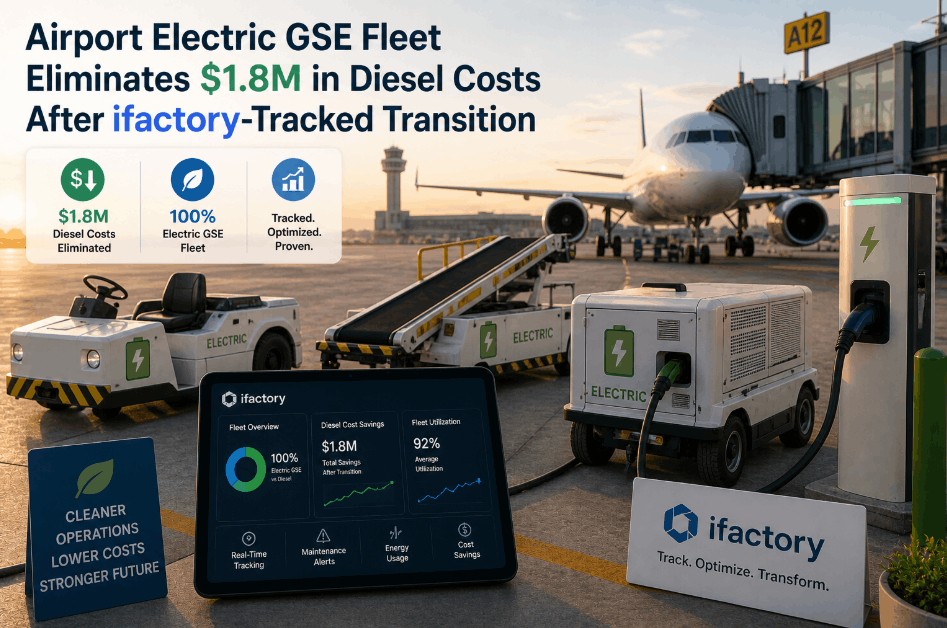
Electric GSE Transition Enabled
ifactory's electric GSE battery health monitoring gave the operator's leadership team the operational confidence to accelerate their electric GSE transition program — committing to 120 additional electric units in Year 2, knowing that ifactory's predictive AI would manage battery degradation monitoring across the expanded electric fleet portfolio.
–94%
AOG Events Eliminated
08 / Conclusion
GSE Fleet Reliability is a Predictive Data Problem, Not a Maintenance Resource Problem
This ground handling operator did not solve its $2.4M annual loss problem by hiring more mechanics or increasing its maintenance budget. It solved it by giving its existing maintenance team perfect information — 72-hour advance warning of which assets were approaching failure, so they could intervene before breakdown rather than recover after it. The maintenance labor, the tools, and the technical expertise were already there. What was missing was the predictive intelligence to direct them at the right assets at the right time.
For airport ground handling operators, the financial case for predictive GSE analytics has never been more compelling. Airline delay penalty structures are intensifying, electric GSE adoption is accelerating with complex new failure modes, and ground handling margin pressure makes reactive maintenance economics structurally unsustainable at any meaningful fleet scale. ifactory's Predictive Analytics AI is not an operational upgrade — it is the foundation of a commercially viable ground handling operation in the modern airport environment. Book a Demo to learn how ifactory can eliminate GSE breakdown costs across your fleet portfolio.
Predictive Analytics AI
·
$2.4M Saved
·
500+ GSE Assets
Eliminate GSE Breakdown Costs and AOG Delay Penalties Across Your Fleet Today.
Deploy ifactory's Predictive Analytics AI across your GSE fleet — achieving 62%+ breakdown reduction, AOG event elimination, and full deployment ROI in under 90 days across any mixed conventional and electric GSE portfolio.
09 / FAQs
Airport GSE Predictive Analytics — Frequently Asked Questions
1. How does ifactory connect to a mixed GSE fleet with different makes, models, and fuel types?
ifactory uses OBD-II and CAN-bus telematics adapters for conventional diesel and LPG GSE, direct API integrations with electric GSE OEM battery management systems, and protocol-specific integrations for GPU and PCA operational control units — normalizing all data into a single predictive analytics platform regardless of manufacturer or fuel type.
Book a Demo for a compatibility assessment of your specific fleet composition.
2. How far in advance does ifactory predict GSE breakdown events?
ifactory's predictive AI generates 72-hour advance breakdown warnings for high-risk asset failure events — giving maintenance teams sufficient time to schedule interventions during low-traffic night windows without pulling equipment from gate assignments. By month six of deployment, this system achieved 89% prediction accuracy for high-severity breakdown events across all 500+ assets.
3. Can ifactory monitor electric GSE battery health and predict range failures?
Yes. ifactory monitors state-of-health (SOH), state-of-charge (SOC), charge cycle counts, and thermal management parameters for all electric GSE units — detecting battery degradation trajectories months before capacity loss causes on-ramp operational failures.
Schedule a Demo to see the electric GSE battery analytics dashboard.
4. How does ifactory prioritize GSE assets assigned to critical aircraft gate operations?
ifactory's gate-critical prioritization module automatically flags GSE units assigned to upcoming high-criticality turns — wide-body aircraft, long-haul operations, and minimum connection time flights — ensuring every assigned tug, belt loader, and GPU is verified fit-for-service by the predictive engine before deployment, with automatic substitution alerts if any assigned unit shows high breakdown risk.
5. What is the typical ROI timeline for a ground handling operator deploying ifactory?
This operator achieved full annual ROI of $2.4M within the first 12 months — with the majority of savings realized in the first six months through AOG delay penalty elimination alone. For most GSE fleets of 200+ assets, the combined savings from delay penalty reduction and reactive maintenance cost elimination deliver full deployment ROI within 60–90 days of the predictive alerts going live.
6. Does ifactory integrate with existing CMMS and airline contract management systems?
Yes. ifactory integrates with all major CMMS platforms including IBM Maximo, UpKeep, Fiix, and Infor EAM — pushing predictive maintenance work orders directly into existing workflows as structured tickets with asset ID, failure mode, risk score, and recommended action. Open API architecture supports integration with airline ground handling SLA monitoring and delay penalty reporting systems.
Book a Demo to review integration options for your current platform stack.


-fleet-management-electrification,-tracking,-and-predictive-pm.png)