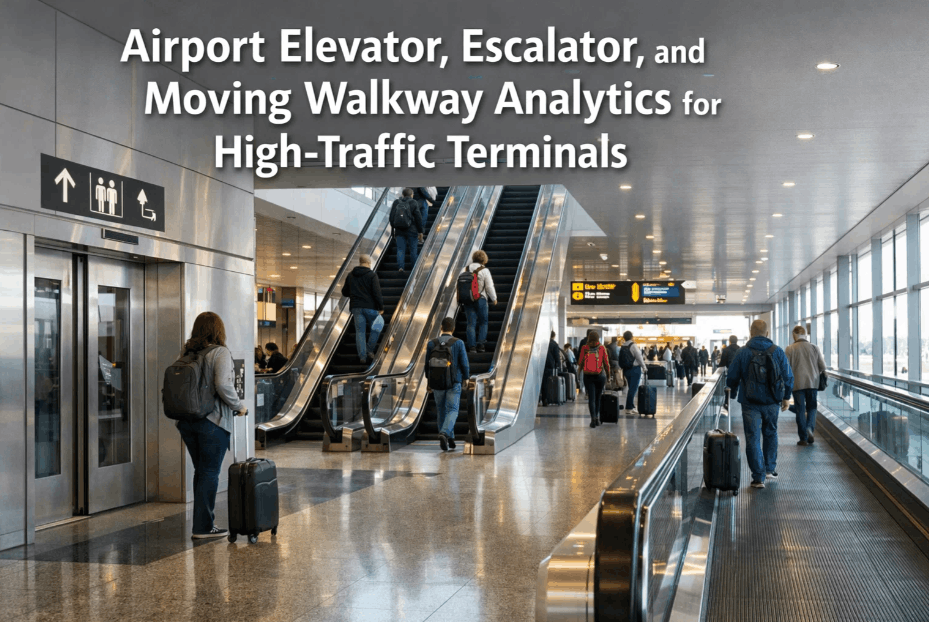
Passenger conveyance systems—elevators, escalators, and moving walkways—are the circulatory system of a modern airport terminal, directly impacting everything from boarding schedules to retail revenue. In a high-traffic environment where equipment must operate 24/7 under massive loads, an unplanned outage during peak hours doesn't just block a hallway; it creates a cascade of passenger congestion, missed connections, and ADA compliance risks. Traditional maintenance programs, governed by ASME A17.1, often depend on calendar-based inspections that cannot account for the variable stress of holiday travel or heavy luggage weight. Modern airport mobility analytics platforms solve this by integrating IoT sensors with predictive AI to identify mechanical friction, drive motor wear, and chain elongation before they trigger a hard stop. Facility directors looking to eliminate mobility bottlenecks can schedule a terminal mobility audit to benchmark their equipment health today.
Why Conventional Maintenance Fails the Modern High-Traffic Airport Terminal
The challenge with airport elevators and escalators isn't just their age; it's the intensity of their duty cycle. Conventional Maintenance Control Programs (MCP) are often reactive, focusing on cleaning and lubrication while missing the subtle internal vibrations or thermal drifts that signal a gearbox failure. When a moving walkway fails in a 1,500-foot terminal corridor, the impact on "Mean Time to Gate" becomes a critical metric for airline operational performance.
AI-driven predictive analytics layer a "digital supervisor" over your entire conveyance fleet. By analyzing motor current signatures and handrail friction patterns, the platform detects mechanical degradation 30 to 60 days before a service interruption. This enables "Corrective-Before-Failure" scheduling during low-traffic night windows, ensuring that every asset is at peak performance during the 6:00 AM rush. Book a demo to see how iFactory keeps your terminal moving.
Reactive repairs usually happen during high-usage periods when equipment is under the most stress. AI detects wear patterns during low-load times, allowing for repairs *before* the peak-time break.
Step chains and drive belts wear down invisibly. IoT vibration sensors capture the high-frequency harmonics of microscopic wear, flagging the exact component that needs attention.
An out-of-service elevator can instantly block access for passengers with reduced mobility. Predictive maintenance ensures these critical path assets are never the bottleneck in your terminal operations.
Without hard data, it's impossible to verify if third-party maintenance providers are performing deep preventive work. AI provides a transparent record of all asset state changes and performance benchmarks.
How AI-Driven Predictive Maintenance Automates Terminal Mobility Efficiency
Maximizing uptime requires more than just knowing *if* a machine is running; it requires knowing *how well* it is performing against its original safety design. This requires an AI that understands the specific friction and load profiles of vertical transport machinery. Talk to our engineers to explore how to integrate your existing elevators and escalators with AI-driven analytics.
IoT Multi-Sensor Retrofitting
We add non-invasive vibration, thermal, and current sensors to drive motors and gearboxes across your fleet. This brings even legacy elevators and 20-year-old moving walkways into a unified digital management dashboard.
Friction & Load Signature Modeling
AI establishes a "normal" performance baseline for every asset. By correlating motor power consumption with passenger load (via heatmaps or ticket data), the system identifies when an escalator is working "too hard" for its current load.
Mechanical Anomaly Detection
Machine learning algorithms filter out "noise" from terminal operations to pinpoint the specific harmonic signatures of bearing wear, misaligned steps, or door operator drag before they trigger a safety trip.
Digital MCP (ASME A17.1) Integration
The platform automatically logs periodic tests, daily safety checks, and predictive alerts into a digital Maintenance Control Program. Every entry is geolocated and timestamped, creating a perfect audit trail for safety inspectors.
Real-Time Global Fleet Dashboard
Terminal operations gain a single view of all vertical and horizontal transport status. Instant color-coded alerts allow for rapid reassignment of ground staff to assist passengers when an asset goes out of service.
Passenger Conveyance Comparison: Technical Monitoring & AI Benefits
Elevators, escalators, and walkways have distinct failure modes and sensor requirements. The following table illustrates how iFactory's AI-driven platform adapts to each specialized technology. Schedule a passenger conveyance assessment to plan your fleet upgrade.
| Equipment Type | Critical Sensor Targets | Common Failure Mode | AI Predictive Benefit | Safety/ADA Impact |
|---|---|---|---|---|
| Escalators | Drive chain vibration, Handrail speed | Step alignment drift, motor heat | Detects "comb plate" risks early | Eliminates entrapment risks |
| Elevators (Traction) | Rope tension, Door motor current | Brake wear, door guide friction | Predicts "leveling" inaccuracies | Ensures smooth ADA-compliant entry |
| Moving Walkways | Sprocket torque, Roller vibration | Palette wear, bearing seized | Identifies "slow-spots" in corridors | Maintains consistent terminal flow |
| Hydraulic Elevators | Oil temperature, Pump cavitation | Seal leakage, valve sticking | Detects oil degradation/leakage | Prevents floorspace oil contamination |
| Dumbwaiters (Cargo) | Line voltage, Load sensor | Overload trip, relay failure | Optimizes baggage/cargo lift shifts | Reduces baggage handling bottlenecks |
| Wheelchair Lifts | Battery health, limit switches | Switch fouling, motor stall | Guarantees 100% ADA availability | Prevents accessibility violations |
| Control Systems | Logic supply, Comm signal lag | Relay chatter, board overheating | Identifies intermittent "ghost trips" | Reduces unneeded reset labor |
The AI Advantage for Vertical Transport: Digital Transparency vs. Maintenance ROI
Modernizing terminal mobility is about moving from "inspecting the machine" to "managing the asset's lifecycle." By using AI to track every maintenance touch and every mechanical deviation, airports gain the transparency needed to hold vendors accountable and maximize asset life. talk to our specialists to see ROI case studies from other international hubs.
Ditch the paper logbooks. Every predictive alert and manual test is captured in a digital Maintenance Control Program (MCP) that meets ASME A17.1 Section 8.6 standards natively.
Compare the "Actual Work Performed" data from the technician against the AI's "Component Health Score" to ensure that aging parts are truly being inspected and maintained.
Identify elevators and escalators with excessive power draw, often indicating mechanical drag or electrical inefficiencies that can be solved with a simple tune-up.
Technicians perform daily safety verification of emergency devices with mandatory photo/video upload, ensuring no safety switch is ever "pencil-whipped" during inspection.
Group assets by age, manufacturer, and usage intensity to identify "trouble-child" equipment and justify capital budget for targeted modernization or replacement.
Terminal ops center receives instant notification of any out-of-service status, along with an AI-estimated "Mean Time to Recovery" based on parts and tech availability.
Implementation Roadmap: Deploying Predictive AI for Passenger Conveyance
Deploying AI for terminal mobility is a phased journey that respects the high stakes of vertical and horizontal transport. The roadmap below is used by major hubs to stabilize their conveyance infrastructure and achieve "Zero Outage" goals. Leading airports book a demo with iFactory to see where they sit on this maturity curve.
Asset Inventory & MCP Digitization
Mapping all elevators, escalators, and walkways into a digital hierarchy. We ingest your existing ASME 8.6 Maintenance Control Program into the platform to establish a digital compliance baseline.
IoT Sensor Deployment & Condition-Mapping
Installing vibration, current, and thermal sensors on the most critical assets (e.g., primary concourse escalators). AI begins learning the specific load and vibration signatures for "healthy" operation.
Mechanical Anomaly Detection Go-Live
AI-driven predictive models start identifying early deviations in bearing heat and chain speed. Maintenance teams transition from calendar scheduling to condition-based "Readiness Alerts."
Fleet-Wide Optimization & Predictive Parts Hub
Lifecycle analytics identify the "ideal" PM frequency for every asset based on its unique stress profile. Parts procurement is automated based on predicted wear, ensuring rollers and belts are on hand before they fail.
Autonomous Mobility & Zero-Outage Core
The final stage: AI autonomously monitors the entire terminal mobility ecosystem, coordinating maintenance windows with flight schedules to achieve the highest possible availability at the lowest operational cost.
Mobility Analytics KPIs: Measuring Uptime and Safety Performance
Measuring vertical transport performance requires looking beyond "available/not available." These specific KPIs define the health of your passenger flow and identifies risks before they become congestion events.
Passenger Mobility Analytics Across All Terminal Tiers
Conveyance challenges scale with terminal length and passenger volume. Our AI analytics scale with your mobility infrastructure complexity. book a demo with iFactory to explore segment-specific mobility solutions.
Managing 200+ elevators and escalators across multiple concourses. AI-driven path analytics and predictive motor health are essential for maintaining 24/7 passenger flow without congestion.
Focusing on reliability for boarding bridges and gate elevators. Predictive analytics ensure that a single elevator failure doesn't block ADA boarding at a 10-gate concourse.
Managing heavy-duty cargo lifts and high-usage parking escalators. AI analyzes load-bearing stress to predict gearbox wear caused by constant luggage transit and weather exposure.
Limited tech staff benefit from automated daily safety switch logs and remote health monitoring, allowing a single facility manager to handle compliance with AI-guided diagnostics.
Frequently Asked Questions: Terminal Mobility & AI Predictive Maintenance
Yes. By retrofitting legacy drive motors with vibration and current sensors, AI can "listen" to the internal state of the machine. The age of the asset doesn't change the laws of physics; wear patterns still manifest as harmonic deviations that our AI can interpret.
No, AI enhances it. Your OEM technicians still perform the work, but AI tells them *exactly what* needs fixing before it breaks. This shifts your contract from reactive "call-outs" to high-value predictive work, saving thousands in emergency labor and part costs.
The platform is built to align with ASME A17.1 Section 8.6 requirements for a Maintenance Control Program (MCP). Every alert, inspection, and repair is timestamped, geolocated, and user-verified, exceeding the documentation standards of paper logbooks.
Yes. Door sensors are a common point of failure. By monitoring door operator motor current and opening/closing time patterns, AI identifies when a sensor or guide is beginning to drag, allowing for a 5-minute adjustment before it causes a 4-hour OOS event.
Most airports see an ROI within 12 months through a 30% reduction in unplanned downtime, a 20% extension in component lifecycle (like drive chains), and the elimination of fines related to ADA compliance outages.