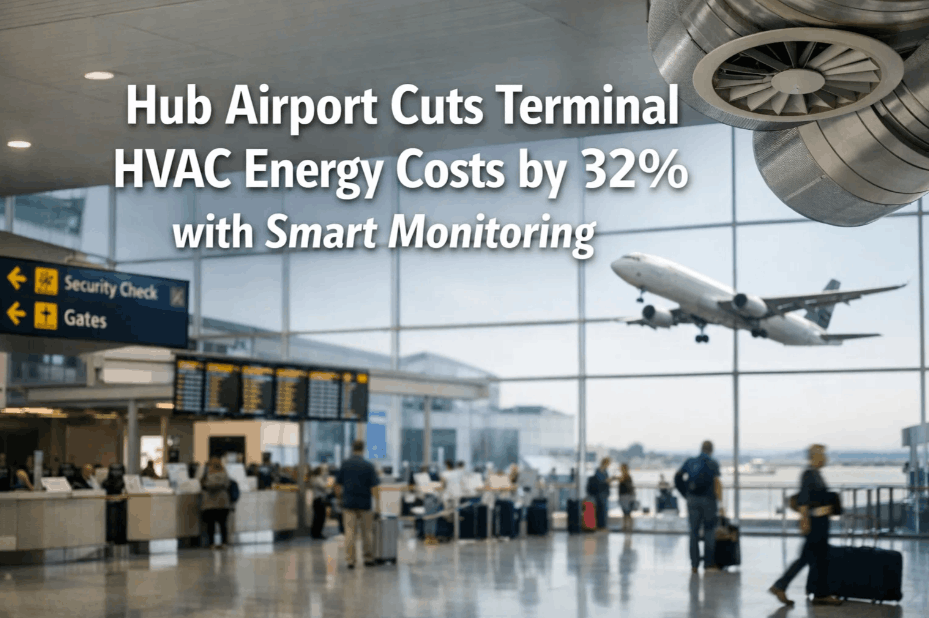
A major international hub airport operating three passenger terminals — spanning 2.1 million sq ft of conditioned space across departure halls, retail concourses, gate lounges, and baggage claim areas — was spending $18.4M annually on terminal HVAC energy, representing 61% of total facility energy expenditure. Despite a recent $12M capital investment in high-efficiency AHU and chiller plant equipment, energy consumption had not materially declined because the new equipment was operating on legacy fixed-schedule control strategies that bore no relationship to actual real-time terminal occupancy, outdoor ambient conditions, or aircraft docking schedules. By deploying ifactory's Energy & ESG Reporting platform integrated with a network of 340 IoT environmental sensors and the airport's BMS data, the terminal operations team achieved a 32% reduction in HVAC energy costs within the first full operational year — saving $5.9M annually, cutting terminal Scope 2 carbon emissions by 4,800 tonnes CO₂e, and delivering airports board-level progress toward their 2030 net-zero commitment.
Hub Airport Cuts Terminal HVAC Energy Costs by 32% Using ifactory Smart Monitoring with IoT Integration and AI Energy Optimization
ifactory's Energy & ESG Reporting platform connects IoT environmental sensors, BMS data, and occupancy intelligence — delivering AI-optimized HVAC scheduling that saves millions while accelerating net-zero progress.
International Hub Airport. 2.1M Sq Ft of Conditioned Terminal Space. $18.4M Annual HVAC Energy Bill.
The $5.9M Annual Cost of Conditioning Empty Terminals
Terminal HVAC energy waste in airports is structurally embedded in how conventional BMS systems operate. Fixed time-clock schedules condition spaces to full comfort setpoints regardless of occupancy — a wide-body aircraft departure at 06:00 fills Terminal 3 Gate Lounge C to 400 passengers for 45 minutes, but the HVAC has been running at full cooling capacity since 04:00 to pre-condition the space for that peak load. Between 02:00 and 04:00, the same zone had fewer than 30 people in it and was still being conditioned identically. Multiply this pattern across 120 zone controllers, 48 AHUs, and 3 terminals operating 24/7 — the result is the structural overcooling and overheating that makes airport HVAC the single largest energy waste category in terminal operations. Book a Demo to see how ifactory's Energy & ESG platform eliminates terminal HVAC energy waste at your airport.
ifactory Energy & ESG Reporting: AI-Optimized HVAC Control Integrated with IoT, BMS, and Flight Schedules
The airport's facilities director recognized that optimizing HVAC energy required three things simultaneously: real-time occupancy intelligence at zone level, integration with flight schedule data to predict passenger load ahead of peaks, and an AI engine capable of translating that real-time occupancy and thermal load intelligence into dynamic HVAC setpoint recommendations that the existing BMS could execute. They selected ifactory's Energy & ESG Reporting platform because it could integrate with the airport's existing BMS infrastructure, the flight information system (FIDS), and a new network of IoT environmental sensors — without replacing the BMS or any HVAC equipment.
340 IoT environmental sensors measuring temperature, humidity, CO₂ concentration (as an occupancy proxy), and particulate levels were installed across all three terminals in 8 days. ifactory's AI engine began correlating sensor data with flight schedule data and historical energy consumption patterns — generating dynamic, zone-specific HVAC setpoint recommendations every 15 minutes that the integrated BMS executed automatically. Schedule a Demo to see ifactory's airport energy optimization dashboard live.
340 IoT Sensors Deployed and AI Optimization Live Across 3 Terminals in Under 3 Weeks
ifactory's deployment team mapped all 120 BMS zone controllers and 48 AHU data points across three terminals. The existing BMS was integrated via open BACnet protocol — no BMS replacement required. 340 wireless IoT sensors were physically installed across all terminal zones in 8 days by the airport's facilities team under remote guidance, without terminal closure or passenger disruption.
ifactory was integrated with the airport's flight information display system (FIDS) to pull real-time and 72-hour-ahead flight schedule data. Twelve months of historical energy consumption, occupancy patterns, and weather data were loaded to establish the AI model's baseline consumption benchmarks for each terminal zone across all occupancy scenarios.
The AI-driven dynamic setpoint optimization system went live across all three terminals. BMS setpoint recommendations were initially delivered as advisory alerts for the energy management team to manually approve — building operator confidence before full automated execution was enabled in week 5. Energy managers were trained on the real-time consumption dashboard and ESG reporting module.
Fully autonomous BMS setpoint control was enabled following 4 weeks of advisory mode confidence-building. ifactory's AI model accumulated 12 months of operational data across all seasonal occupancy patterns — improving optimization accuracy continuously and identifying three structural HVAC inefficiency sources that were corrected through targeted maintenance interventions, delivering additional energy savings beyond the initial AI optimization gains.
32% HVAC Cost Reduction. $5.9M Saved. 4,800 Tonnes CO₂e Eliminated.
The AI-optimized HVAC control system delivered energy savings that the $12M capital equipment investment alone had failed to achieve — because new high-efficiency equipment running on legacy fixed-schedule controls still wastes energy conditioning empty spaces. ifactory's dynamic occupancy-responsive optimization unlocked the full efficiency potential of the existing equipment by aligning conditioning output to actual thermal load in real time. By the end of the first operational year, energy managers had real-time visibility into every watt consumed across every terminal zone — a capability that had never previously existed in the airport's 24-year operational history.
| Performance Metric | Before ifactory | After ifactory | Change |
|---|---|---|---|
| Annual Terminal HVAC Energy Cost | $18,400,000 | $12,512,000 | –32% / $5.9M annual saving |
| Chiller Plant Average Load Factor | 68% (all hours) | 41% (occupancy-responsive) | –40% chiller energy consumption |
| Terminal Scope 2 Carbon Emissions | Baseline | –4,800 tonnes CO₂e/year | Significant net-zero progress |
| HVAC Energy Reporting Frequency | Monthly (utility invoice) | Real-Time (zone-level) | Continuous operational intelligence |
| Off-Peak Overcooling Events | Book a Demo for a customized ROI projection for your terminal energy profile. |