Baggage handling system analytics is rapidly transforming how airports prevent costly conveyor failures, reduce flight delays, and maximize operational uptime. Modern airports process millions of bags every day across complex networks of conveyors, sorters, and scanners — and a single unplanned breakdown can cascade into gate delays, missed connections, and regulatory scrutiny. With AI-powered BHS predictive analytics, airports are moving from reactive maintenance to zero-downtime operations. If your baggage handling equipment still relies on calendar-based inspections and paper work orders, the gap between your operation and industry leaders is widening every day. Book a demo to see how iFactory's predictive analytics AI closes that gap.
Stop Reacting to BHS Failures — Start Predicting Them
iFactory's AI-powered predictive analytics platform gives your maintenance team real-time conveyor health scores, automated work orders, and audit-ready compliance documentation — all in one connected system.
$4.7B
Global BHS Market by 2030
42%
Of Flight Delays Linked to Ground Handling Failures
68%
Downtime Reduction with Predictive Maintenance
$11B+
Supply Chain Excess Costs in Aviation (2025)
What Is Baggage Handling System Analytics?
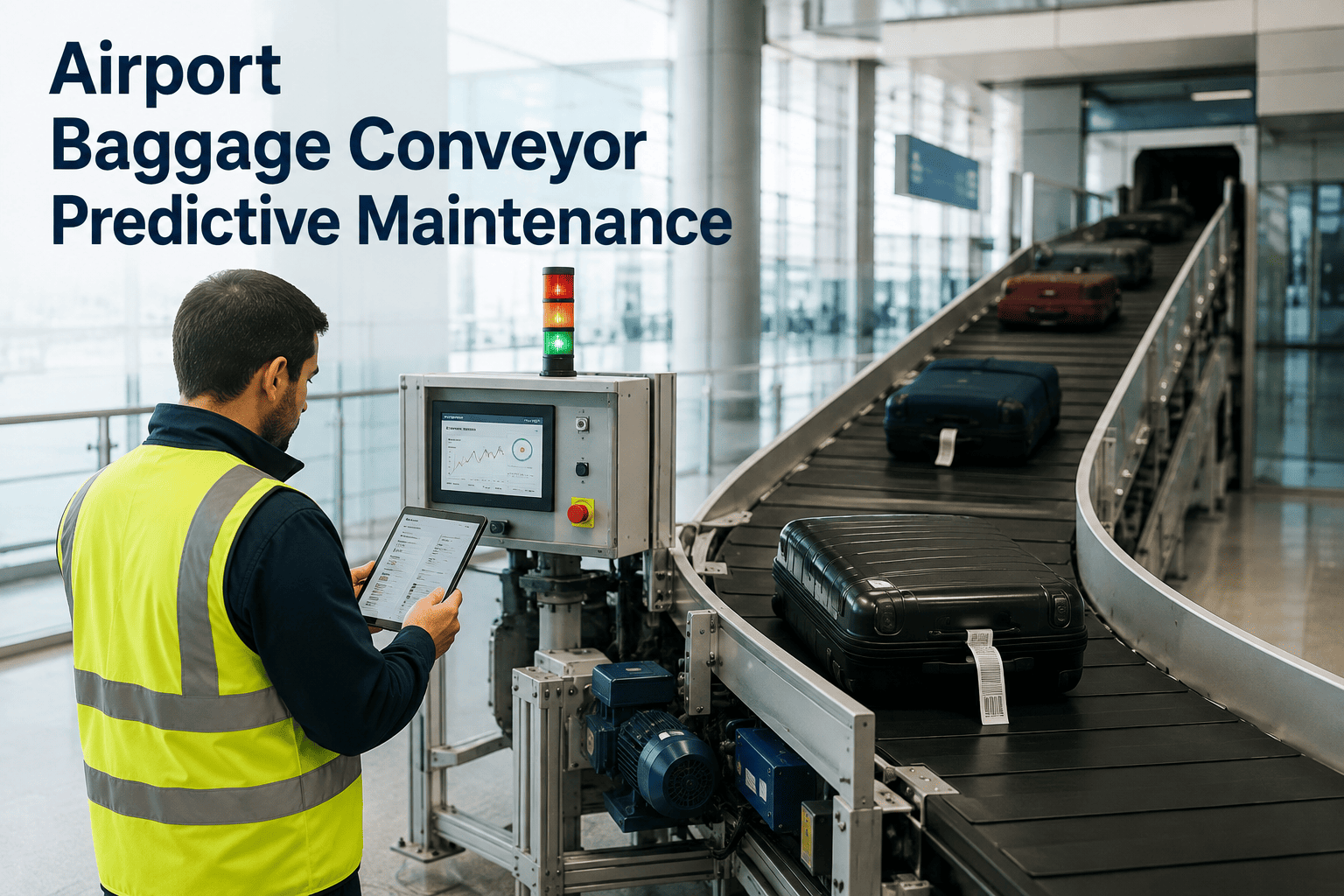
Baggage handling system analytics refers to the continuous collection, processing, and interpretation of operational data generated by airport conveyor belts, sortation systems, tub fillers, tray return systems, and early baggage storage units. By connecting IoT sensors, SCADA systems, and AI-driven monitoring platforms, airports can build a real-time digital picture of every component in their BHS network — tracking motor temperatures, belt tension, vibration signatures, jam frequencies, and throughput rates. Unlike traditional scheduled maintenance, which treats every component identically regardless of actual wear, BHS predictive analytics uses condition-based triggers to flag degradation before it results in failure — reducing both over-maintenance waste and catastrophic breakdown risk simultaneously.
Why Baggage Conveyor Analytics Is a Strategic Priority
The economics are straightforward: a single BHS stoppage at a high-traffic airport can disrupt hundreds of bags per minute, trigger flight holds, generate passenger compensation liabilities, and require emergency technician callouts — all at premium cost. Yet most airports still operate baggage handling equipment on fixed preventive maintenance cycles that were designed decades ago, long before real-time sensor data was available. Airport conveyor analytics changes this equation fundamentally. When your maintenance team can see that a specific drive motor is running 12°C above its normal operating temperature trend, they can schedule a targeted intervention during the next scheduled downtime window — before the motor seizes and grounds an entire baggage hall for six hours. Want to see how this works in practice? Book a demo with iFactory's aviation maintenance specialists.
What Most Airports Still Do
✗ Wait for conveyor failure before dispatching technicians
✗ Fixed PM intervals regardless of actual component condition
✗ Paper-based inspection logs with no trend visibility
✗ Emergency parts procurement at premium cost
✗ Siloed maintenance data across shifts and teams
What Leaders Operate On
✓ AI flags component degradation 2–4 weeks before failure
✓ Condition-based work orders triggered by sensor thresholds
✓ Digital inspection records with full maintenance history
✓ Automated spare parts reorder based on predictive demand
✓ Unified platform visible to operations, maintenance, and management
Core Components of an AI-Powered BHS Predictive Analytics Platform
Effective baggage system AI monitoring is not a single tool — it is an integrated data architecture that spans sensor hardware, edge computing, cloud analytics, and maintenance execution workflows. Understanding these layers helps airport operators evaluate solutions and identify gaps in their current approach.
01
Sensor Layer
IoT Sensor Integration for Real-Time Conveyor Monitoring
Vibration sensors, thermal cameras, current monitoring on drive motors, belt tension gauges, and photoelectric jam-detection arrays feed continuous data streams into the analytics engine. Modern BHS installations can generate millions of data points per hour across hundreds of monitored assets.
02
AI Analytics
Machine Learning Models for Baggage System Failure Prediction
Anomaly detection algorithms establish normal operating baselines for each component and flag statistically significant deviations. Over time, models trained on airport-specific failure histories improve prediction accuracy — learning which vibration signatures reliably precede bearing failures at your specific load profiles and ambient temperatures.
03
Digital Twin
Digital Twin Modeling for BHS Network Simulation
Physics-accurate digital twins of the entire baggage handling network allow operators to simulate the downstream impact of a predicted failure before it occurs — identifying which flights, gates, and check-in zones will be affected and enabling pre-emptive reallocation of baggage flow to alternate conveyor paths.
04
Execution Layer
Automated Work Order Generation and PM Scheduling
When the analytics engine detects a threshold breach, it automatically generates a prioritized work order in the CMMS — pre-populated with the asset history, recommended corrective action, required spare parts, and technician skill requirements. Maintenance teams act on intelligence rather than guesswork, and every action is fully documented for compliance.
BHS Downtime Prevention: The Financial Case
The financial argument for investing in automated baggage analytics is compelling and well-documented. A single major BHS failure at a hub airport can generate direct costs exceeding $500,000 within a single operating day — including passenger compensation under EC 261 regulations, emergency maintenance labor at overtime rates, parts procurement from non-preferred suppliers, and flight delay cost absorption. These direct costs are compounded by reputational damage and the competitive disadvantage of poor on-time performance scores.
Drive Motor Seizure
4–8 hours
$80K–$200K
Thermal trend monitoring + vibration analysis
Belt Splice Failure
2–6 hours
$40K–$120K
Belt tension analytics + wear cycle tracking
Sortation System Jam
30–90 min
$15K–$60K
Jam frequency trending + tray inspection AI
Control System Fault
1–4 hours
$30K–$100K
SCADA integration + automated alert thresholds
Roller/Idler Failure
1–3 hours
$10K–$40K
Vibration pattern recognition + scheduled replacement
Leading airports that have deployed integrated baggage system reliability platforms consistently report 60–70% reductions in unplanned downtime within 18 months of go-live. When you factor in reduced emergency parts spend, lower overtime labor costs, and the elimination of delay-related compensation payouts, the ROI case for BHS predictive analytics investment typically shows payback periods under 14 months. Book a demo to model the ROI for your specific airport operation.
Robotic Inspection Technologies Transforming BHS Maintenance
Robotic inspection is emerging as a transformative capability in baggage conveyor inspection programs. Traditional manual inspections require technicians to enter confined conveyor spaces, work around operational schedules, and rely on subjective visual assessment — a process that is slow, hazardous, and inconsistent. Autonomous robotic inspection platforms are eliminating these constraints entirely.
1
Crawler Robots for Under-Belt Inspection
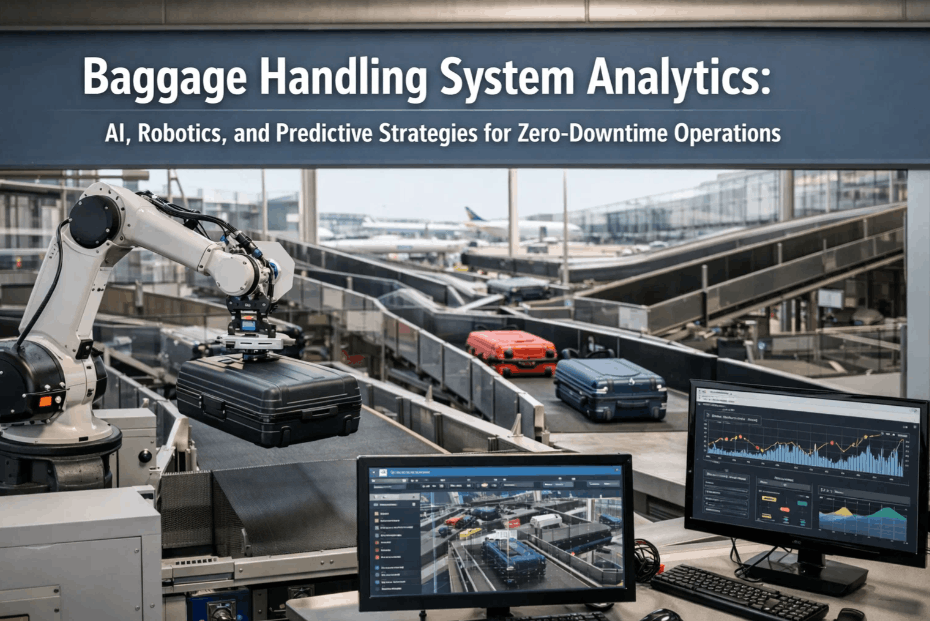
Compact crawler robots equipped with high-resolution cameras, thermal sensors, and LIDAR navigate the underside of active conveyor systems — capturing detailed imagery of rollers, idlers, belt undersides, and structural supports without requiring system shutdown. Inspection data feeds directly into the analytics platform for AI-driven defect classification.
Deployed Now
2
AI-Powered Vision Systems for Baggage Belt Surface Analysis
Fixed overhead vision systems with AI object recognition continuously monitor belt surface condition — detecting cracks, fraying, splice wear, and foreign object debris (FOD) in real time. Anomaly alerts are generated automatically and dispatched to maintenance teams before surface defects propagate to splice failures.
Deployed Now
3
Drone Inspection for Large-Scale Baggage Hall Infrastructure
Autonomous drone platforms inspect elevated conveyor sections, overhead structural mounts, and large-format early baggage storage facilities — areas where manual inspection requires significant scaffold setup. Thermal imaging detects heat signatures from overloaded electrical systems and failing drive units.
Scaling Rapidly
4
Acoustic Emission Monitoring for Bearing Degradation
Ultrasonic acoustic emission sensors attached to conveyor drive units and gearboxes detect the characteristic high-frequency sound patterns produced by bearing surfaces in early-stage degradation — providing 3–6 weeks of advance warning before bearing failure becomes audible or thermally detectable.
Growing Adoption
Ready to Digitize Your BHS Inspection Workflows?
Replace paper-based conveyor inspection checklists with mobile digital forms, auto-generated work orders, and real-time defect tracking — all connected to iFactory's predictive analytics engine.
BHS Spare Parts Management: Analytics-Driven Inventory Optimization
Spare parts availability is a critical determinant of BHS recovery time. When predictive analytics identifies an impending component failure, the value of that advance warning depends entirely on whether the required replacement part is in stock — yet most airports operate spare parts inventories based on historical consumption averages, a system that consistently leads to either costly overstocking of rarely needed components or critical shortages of high-demand items. AI-driven BHS spare parts management changes this dynamic by connecting failure prediction models directly to inventory systems, automatically raising a purchase requisition when stock falls below the dynamically calculated safety level for that failure scenario. This end-to-end integration between predictive analytics and parts management is one of the highest-value capabilities in modern airport baggage operations.
Supply chain disruptions imposed over $11 billion in excess costs on the global airline industry in 2025, with $3.1 billion attributed directly to aging fleet maintenance. For baggage handling infrastructure — which faces the same parts availability pressures — airports that integrate predictive demand forecasting into their spare parts procurement cycles are reducing emergency procurement spend by 35–50% while simultaneously improving first-time fix rates.
Baggage Sorting System Analytics: Optimizing Throughput and Accuracy
Beyond failure prevention, advanced baggage sorting system analytics delivers significant operational value through throughput optimization and accuracy improvement. Modern tilt-tray and cross-belt sorters generate rich operational data — tray speeds, divert success rates, read rates at barcode/RFID scanners, jam frequencies by zone, and sort accuracy by destination — that most airports still analyse only in monthly aggregate reports rather than in real time. A sorter zone operating at 92% divert accuracy instead of the design target of 99.5% will silently misroute thousands of bags over a season, generating bag tracing costs and passenger compensation liabilities that dwarf the cost of the targeted maintenance intervention the analytics would have recommended.
Compliance and Audit Readiness in BHS Operations
Airport regulators — including ICAO, IATA Ground Operations Manual (IGOM) compliance teams, and national civil aviation authorities — increasingly require documented evidence of systematic baggage handling equipment maintenance. Audit findings related to BHS maintenance gaps can result in operational restrictions, insurance premium increases, and reputational damage that far exceeds the cost of implementing proper documentation systems.
Common Gaps That Surface in Audits
✗ Missing inspection sign-offs for specific conveyor zones
✗ No evidence of corrective action follow-through
✗ Inability to demonstrate PM schedule adherence rates
✗ Fragmented records across shifts and maintenance teams
What Audit-Ready Operations Look Like
✓ Complete inspection history with timestamped photo evidence
✓ Corrective action tracking from finding to verified closure
✓ Automated PM schedule adherence reporting
✓ One-click audit pack generation with all supporting records
Organizations using integrated digital BHS maintenance platforms consistently report 3–5x reductions in audit preparation time and significantly higher compliance scores. More importantly, the continuous documentation discipline that digital platforms enforce means that compliance gaps are identified and remediated in real time — not discovered during an external audit.
Implementing Baggage Handling System Analytics: A Phased Approach
Successful deployment of airport baggage operations analytics follows a structured implementation pathway that manages integration complexity, delivers early wins to build organizational confidence, and scales systematically across the full BHS asset base.
Phase 1
Asset Registry and Baseline Data Collection (Weeks 1–6)
Complete digital asset register of all BHS components — conveyors, sorters, scanners, drives, and controls — with manufacturer data, installation dates, and maintenance history migration. Establish IoT sensor deployment on highest-criticality assets. Begin generating baseline performance profiles.
Phase 2
Predictive Model Training and Alert Configuration (Weeks 6–16)
AI models train on baseline sensor data supplemented by historical failure records. Alert thresholds are calibrated to your specific equipment types and operational profiles. Maintenance team workflows transition from scheduled PM dispatch to condition-based work order response.
Phase 3
Full BHS Network Integration and Optimization (Months 4–12)
Sensor coverage extends to the full conveyor network. Digital twin modeling enables network-wide impact simulation. Spare parts inventory optimization activates based on predictive demand forecasting. Compliance documentation workflows replace paper-based inspection systems across all shifts.
Frequently Asked Questions: BHS Predictive Analytics
What sensors are needed for baggage conveyor analytics?
Effective baggage conveyor analytics typically requires vibration sensors on drive motors and bearings, thermal sensors for motor and gearbox monitoring, current transducers to detect load anomalies, belt tension gauges, and photoelectric jam-detection arrays. The exact sensor mix depends on conveyor type, criticality, and existing SCADA integration — a good analytics provider will complete a sensor gap assessment as part of implementation scoping.
How long before BHS predictive analytics delivers measurable ROI?
Most airports report measurable reductions in unplanned downtime within the first 3–6 months of predictive analytics deployment, as the AI models build sufficient baseline data to generate reliable failure predictions. Full ROI — accounting for reduced emergency parts spend, lower overtime labor, and eliminated delay-related penalties — typically materializes within 12–18 months of full deployment across the BHS network.
Can BHS analytics integrate with existing SCADA and CMMS systems?
Yes. Modern BHS predictive analytics platforms are designed with open API architectures that integrate with major SCADA systems (Siemens, Rockwell, Schneider), existing CMMS platforms, and airline departure control systems. Integration complexity depends on the age and openness of existing systems — legacy proprietary systems may require protocol translation layers, but this is standard practice for experienced implementation teams.
What is the difference between preventive and predictive BHS maintenance?
Preventive maintenance follows fixed schedules — lubricating bearings every 30 days, replacing belts every 12 months — regardless of actual component condition. Predictive maintenance uses real-time sensor data and AI models to trigger maintenance actions based on observed degradation, meaning components are serviced precisely when they need it — not before (waste) and not after (failure). Predictive approaches consistently reduce total maintenance cost while improving asset availability.
How does baggage system AI monitoring handle false alarms?
False alarm management is a critical capability in mature BHS AI monitoring systems. Alert confidence scoring — where the system rates each alert by the statistical strength of the anomaly signal — allows maintenance teams to prioritize high-confidence critical alerts over low-confidence advisory notices. Over time, feedback loops from technician action records help the AI models self-calibrate, progressively reducing false positive rates as the system learns the specific characteristics of your equipment.
One Platform for BHS Maintenance, Safety, and Compliance
iFactory connects baggage handling system analytics, predictive maintenance scheduling, robotic inspection workflows, and compliance documentation into a single aviation-grade platform. Mobile access, automated work orders, and audit-ready reporting — built for zero-downtime BHS operations.


-preventive-analytics-checklist.png)