Baggage handling systems (BHS) are the circulatory system of every airport — moving millions of bags daily through networks of conveyors, sorters, and screening equipment. Yet most airports still operate BHS maintenance reactively, waiting for belt failures, jams, and sorting errors to disrupt operations before dispatching technicians. In 2026, predictive analytics powered by IoT sensors, digital twin technology, and AI-driven CMMS integration is transforming how airports manage baggage infrastructure — shifting from costly breakdowns to intelligent, data-driven foresight. iFactory's AI platform brings this transformation to your airport. Book a free consultation and discover how predictive analytics eliminates baggage handling failures before they happen.
Predictive Analytics for Baggage Handling Systems
Predict. Prevent. Perform.
Airports lose millions annually to BHS failures, mishandled luggage, and unplanned conveyor downtime. iFactory's AI-powered predictive analytics platform uses IoT sensor fusion, digital twin simulation, and intelligent CMMS integration to forecast failures 72+ hours ahead — keeping every belt, sorter, and screening lane running at peak performance.
Globally per Year
of Mishandled Bags
With Predictive AI
What Goes Wrong in Baggage Handling — And What It Costs
Baggage handling is one of the most mechanically intensive and failure-prone systems in any airport. Here's where operations break down without predictive intelligence.
How Predictive Analytics Works for BHS
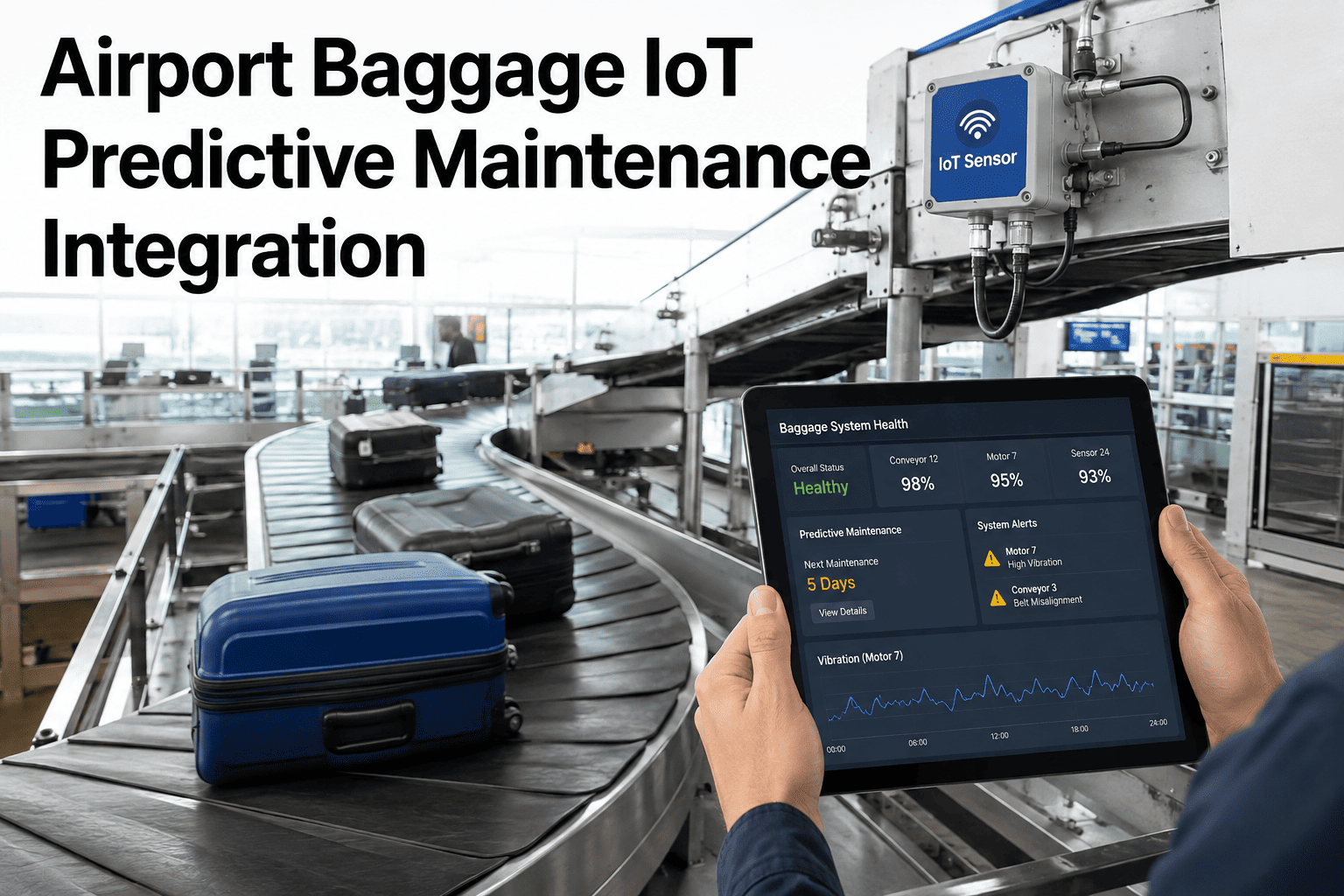
iFactory's platform connects IoT sensors on every BHS component to a digital twin engine that feeds AI predictive models — creating a closed-loop system that detects, predicts, and acts autonomously.
Your BHS Predictive Analytics Journey — Phase by Phase
Our proven 6-phase deployment framework transforms your baggage handling maintenance from reactive firefighting to intelligent prediction.
BHS Infrastructure Audit & Sensor Gap Analysis
We map every conveyor segment, sorting station, screening lane, and motor across your BHS — identifying existing sensor coverage, CMMS data quality, and critical monitoring gaps that must be closed for predictive accuracy.
IoT Sensor Deployment & Data Integration
Deploy vibration, thermal, current, belt tension, and speed sensors on critical BHS assets. All data streams are integrated into iFactory's platform via edge gateways, creating a unified real-time data fabric across your baggage infrastructure.
BHS Digital Twin Creation & Calibration
Build a real-time digital replica of your complete baggage handling system — every conveyor, diverter, sorter, and screening unit. The twin continuously mirrors live sensor data, establishing baselines for normal operation and degradation patterns.
AI Model Training & Predictive Calibration
Machine learning models are trained on your BHS-specific failure patterns, maintenance history, and environmental factors. Models learn to forecast belt wear, motor degradation, bearing failure, and sorting accuracy drops 72+ hours before they occur.
Supervised Prediction & Accuracy Verification
AI predictions run in parallel with existing maintenance for 4–6 weeks. Every forecast is verified against actual outcomes — refining model accuracy, tuning alert sensitivity, and building operational trust before full autonomous deployment.
Full Predictive Operations & Continuous Learning
The platform runs autonomously — generating predictive work orders, dispatching crews, pre-staging parts, and continuously improving accuracy as new data flows in. Quarterly reviews optimize model performance and expand coverage to new BHS zones.
The Predictive Maintenance Revolution — In Numbers
The aviation industry is investing heavily in predictive analytics as airports realize the staggering cost of reactive baggage handling maintenance.
| Metric | Current State | With Predictive AI | Improvement | Source |
|---|---|---|---|---|
| BHS Unplanned Downtime | 120+ hrs/year | <48 hrs/year | 60% reduction | SITA Air Transport IT Report |
| Mishandled Bag Rate | 7.6 per 1,000 | 3.2 per 1,000 | 58% reduction | SITA Baggage IT Insights |
| Maintenance Cost per Bag | $0.42 | $0.19 | 55% savings | ACI Airport Economics |
| Mean Time to Repair | 3–5 hours | 45–90 minutes | 75% faster | Airport Technology Review |
| Spare Parts Waste | 25–35% excess | <8% excess | 70% reduction | MRO Aviation Benchmark |
Talk to our aviation AI specialists before the next conveyor failure costs you thousands.
Deployment Timeline — Phases, Deliverables & Outcomes
A typical BHS predictive analytics deployment runs 10–16 weeks. Here's how each phase maps to outcomes and risk reduction.
| Phase | Focus Area | Timeline | Key Deliverables | Risk Mitigated |
|---|---|---|---|---|
| 01 Discovery | BHS audit, sensor gap analysis | 1–2 weeks | Asset map, gap report | Blind spot failures |
| 02 Instrumentation | IoT sensor deployment, data pipes | 2–3 weeks | Connected sensor network | Data gaps |
| 03 Digital Twin | BHS twin build, baseline calibration | 2–3 weeks | Live digital twin | False positives |
| 04 Intelligence | AI model training, pattern learning | 2–4 weeks | Prediction models, alerts | Missed failures |
| 05 Validation | Supervised testing, accuracy tuning | 2–3 weeks | Accuracy report, SOPs | Trust deficit |
| 06 Autonomous | Full predictive ops, continuous AI | Ongoing | Auto work orders, dashboards | Reactive relapse |
Reactive BHS Maintenance vs. iFactory Predictive Analytics
Purpose-Built for Airport Baggage Infrastructure
BHS-Native AI Models
Our predictive models are purpose-trained for baggage handling system failure patterns — belt degradation, motor bearing wear, sorter diverter misalignment, and screening lane jams. Not generic industrial models retrofitted for aviation.
Deep CMMS Integration
Seamlessly connects with existing airport CMMS platforms — auto-creating work orders, pre-staging spare parts, routing crews by skill and proximity, and closing the loop from prediction to resolution without manual handoffs.
Digital Twin Validated Decisions
Every AI prediction is validated against the BHS digital twin before alerts are triggered — testing failure scenarios, rerouting options, and maintenance windows in simulation to eliminate false positives and reduce alert fatigue.
Continuous Learning Architecture
The platform gets smarter with every maintenance event. AI models continuously retrain on new failure data, seasonal traffic patterns, and equipment aging curves — delivering compounding accuracy improvements quarter over quarter.
BHS Components Monitored by Predictive Analytics
Everything You Need to Know About BHS Predictive Analytics
What is predictive analytics for baggage handling systems?
Predictive analytics for BHS uses IoT sensors, machine learning algorithms, and digital twin technology to continuously monitor the health of conveyor belts, sorters, screening equipment, and motors — forecasting failures 72+ hours before they occur. Instead of waiting for breakdowns, AI identifies degradation patterns (vibration changes, temperature spikes, current draw anomalies) and triggers preventive maintenance actions through CMMS integration.
How does the digital twin work for baggage handling?
A BHS digital twin is a real-time 3D virtual replica of your entire baggage handling infrastructure — mirroring live sensor data from every conveyor, sorter, and motor. The twin enables scenario simulation (what happens if Belt 7 fails at peak hour?), validates AI predictions before alerting crews, and provides a visual operations dashboard showing asset health across your entire BHS network in real time.
What IoT sensors are needed for BHS predictive analytics?
The core sensor types for BHS monitoring include vibration sensors (bearing/motor health), thermal cameras (overheating detection), current sensors (motor load profiling), belt tension gauges (wear tracking), and speed encoders (throughput monitoring). iFactory assesses your existing sensor infrastructure during the Discovery phase and recommends only the additional sensors needed to close critical monitoring gaps.
Does this integrate with our existing airport CMMS system?
Yes. iFactory's platform integrates with all major CMMS and EAM systems via pre-built API connectors — including SAP, Maximo, eMaint, and Infor. When a predictive alert is triggered, the system auto-generates a work order in your CMMS, pre-stages required spare parts, and routes the crew with the right skills — all without manual intervention.
How accurate are the failure predictions?
After the Validation phase, iFactory's BHS prediction models typically achieve 92–97% accuracy for major failure modes (motor bearing, belt wear, sorter misalignment). Accuracy improves continuously as the AI retrains on new maintenance events and seasonal patterns. The supervised validation phase ensures prediction quality is proven before full autonomous deployment.
How long does deployment take for a mid-size airport BHS?
A standard deployment for a mid-size airport (20–40 gates) runs 10–16 weeks from initial audit to autonomous predictive operations. Larger hub airports with complex multi-terminal BHS may require 16–22 weeks. Book a free 30-minute demo to get a deployment timeline scoped to your specific BHS infrastructure.
What ROI can we expect from BHS predictive analytics?
Airports typically see 3–5× ROI within the first 12 months through reduced unplanned downtime (60% average reduction), lower spare parts waste (70% reduction in excess inventory), faster repair times (75% MTTR improvement), and fewer mishandled bags (58% reduction). Visit our Support Center for detailed case studies and ROI calculators.
Ready to Stop Baggage Handling Failures Before They Start?
Every unplanned BHS outage is preventable with the right predictive intelligence. Let our aviation AI specialists show you exactly how — in a free, no-obligation 30-minute demo tailored to your airport's infrastructure.