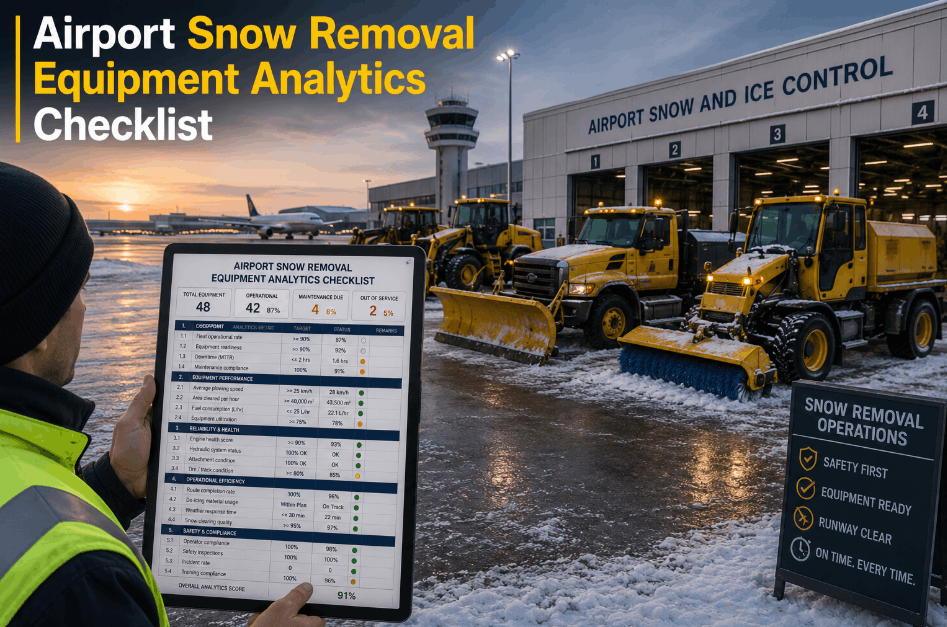
Airport snow and ice control is one of the most operationally demanding challenges in winter aviation management — where a single equipment failure during an active storm event can cascade into runway closures, flight diversions, and FAA compliance exposure that costs millions within hours. Airports that consistently maintain winter runway readiness do not rely on manual checklists and operator intuition alone; they build their operations around structured equipment analytics, predictive maintenance scheduling, and AI-driven storm response plans that convert reactive firefighting into coordinated, data-backed winter operations. Whether you manage a regional airfield or a major hub with dozens of snow removal assets, the analytics infrastructure you deploy before the first snowfall of the season is the most important investment you can make in winter operational continuity. To see how leading airport operations teams are building smarter winter readiness programs, Book a Demo and explore how analytics transforms airport snow and ice control from season to season.
Ready to Build a Smarter Airport Winter Operations Program?
iFactory's preventive analytics platform gives airport operations teams real-time snowplow health scoring, de-icing equipment PM scheduling, glycol consumption tracking, and AI-driven storm response readiness — purpose-built for airfield winter operations.
Why Airport Snow Removal Analytics Is the Foundation of Winter Runway Readiness
Traditional airport winter operations rely heavily on fixed preventive maintenance calendars — snowplows are serviced before the season begins, de-icing trucks receive standardized inspections, and glycol tanks are topped at scheduled intervals regardless of actual consumption rates or equipment condition. This approach systematically misallocates maintenance resources while leaving the most operationally critical failure modes undetected until they surface during active storm operations. Airport snow removal analytics replaces calendar-driven assumptions with continuous equipment condition intelligence — giving operations managers real-time visibility into every asset's health status before, during, and after winter storm events. When your highest-consequence snowplow shows early signs of hydraulic pressure degradation three weeks before a major storm, analytics converts that latent failure into a scheduled repair. Without it, it becomes an emergency breakdown in the middle of runway clearing operations.
Snowplow Analytics: Monitoring the Critical Asset Category in Airport Winter Operations
Airfield snowplows — including runway plows, high-speed broom sweepers, and combined plow-blower units — represent the highest operational consequence equipment category in winter runway readiness. A single high-speed runway plow carries a capital value often exceeding $750,000, and its availability during peak storm operations directly determines whether FAA runway clearance time standards can be met. Snowplow analytics platforms deploy continuous condition monitoring across the component failure modes most likely to cause operational interruption: hydraulic system pressure and fluid contamination levels, engine coolant temperature profiles under load, transmission oil degradation in variable-speed operations, blade wear progression relative to clearing distance accumulated, and electrical system health across heated cab and plow control circuits. Airfield operations teams deploying snowplow analytics for the first time can Book a Demo to see how condition monitoring is configured for their specific fleet composition.
Plow Lift and Angle System Health Monitoring
Hydraulic pressure trending detects pump wear, valve seat degradation, and fluid contamination before system failures interrupt runway clearing operations. Continuous pressure profiling across lift and angle actuator circuits identifies component degradation weeks before loss-of-function events occur during active storm response.
Transmission and Transfer Case Condition Analytics
High-capacity airfield plows operate in demanding variable-load conditions across extended clearing cycles. Oil temperature and pressure analytics within transmission and transfer case systems detect internal wear progression and fluid degradation before the thermal and mechanical damage signatures that precede catastrophic failure events.
Cutting Edge Wear Rate and Replacement Interval Optimization
Blade wear analytics correlate clearing distance accumulated with residual blade thickness measurements to generate condition-based replacement schedules that eliminate both premature replacement waste and the pavement damage and clearing inefficiency associated with worn edges operating past optimal replacement intervals.
Cold-Weather Electrical Health and Heated System Monitoring
Airport snowplow electrical systems — including heated mirrors, cab heating circuits, and plow control electronics — are disproportionately failure-prone in sustained low-temperature operations. Current draw analytics detect resistive heating element degradation and circuit load anomalies before they create operator comfort or equipment control failures during storm operations.
De-Icing Equipment Analytics: Preventive Maintenance for Airfield Chemical Application Systems
De-icing truck analytics addresses a distinct and equally critical equipment category — the high-capacity chemical applicator fleet responsible for applying glycol-based runway de-icing and anti-icing treatments to airfield pavement surfaces. These vehicles combine complex pump and spray system infrastructure with precise application rate control requirements that directly determine both de-icing effectiveness and glycol consumption efficiency. Preventive maintenance programs for de-icing equipment must account for the accelerated corrosion environment created by constant glycol exposure, the precision calibration requirements of flow control and spread rate systems, and the regulatory implications of application rate documentation for environmental compliance reporting. Teams looking to close de-icing PM gaps before the next winter season can Book a Demo to walk through a structured equipment assessment for their applicator fleet.
Airport Glycol Management Analytics: Consumption Tracking and Environmental Compliance
Glycol management represents one of the most financially significant and environmentally regulated dimensions of airport winter operations. Airports consume millions of gallons of propylene glycol and ethylene glycol-based de-icing and anti-icing fluids annually, and the environmental fate of these chemicals — captured in stormwater collection systems, measured in airport effluent monitoring programs, and reported under Clean Water Act NPDES permit requirements — creates a regulatory compliance dimension that makes glycol consumption analytics both financially and legally important. Airports seeking to reduce glycol waste and strengthen environmental compliance posture can Book a Demo to review a glycol management analytics configuration matched to their operational scale.
Real-Time Glycol Usage Tracking by Asset and Zone
Per-vehicle and per-zone consumption analytics identify over-application patterns, application rate calibration drift, and operator behavior variances that collectively drive glycol waste above operationally necessary levels. Usage dashboards generate the documentation base required for environmental permit compliance reporting.
Predictive Glycol Inventory and Storm Demand Forecasting
Consumption rate analytics combined with storm forecast integration generate predictive inventory requirements — ensuring glycol supply adequacy for projected storm event sequences without the capital inefficiency of excessive pre-season stockpiling based on worst-case assumptions rather than demand modeling.
NPDES Permit Documentation and Effluent Monitoring Integration
Automated glycol application documentation integrates with stormwater monitoring data to generate permit compliance records, COD loading calculations, and regulatory reporting packages — converting manual compliance documentation workflows into instrumented reporting processes that eliminate audit exposure from record gaps.
Glycol Recovery Infrastructure Performance Monitoring
Airports with glycol recovery and reconcentration systems can monitor collection volume recovery rates, reconcentration system efficiency, and recovered fluid quality metrics — maximizing the economic and environmental value of glycol recovery infrastructure investments through continuous performance tracking.
AI-Driven Storm Response Planning for Airport Winter Operations
AI-driven storm response planning elevates airport winter operations from a reactive mobilization challenge to a systematically pre-positioned operational readiness state. Traditional storm response relies on weather forecast review, manual crew notification, and equipment pre-inspection checklists executed under time pressure as storm conditions approach. AI-driven planning systems integrate weather forecast data with real-time equipment health scores, crew availability tracking, and historical storm response performance data to generate dynamic readiness assessments and resource allocation recommendations before operational demands materialize.
Storm Forecast Integration and Equipment Readiness Assessment
AI systems ingest NWS and aviation weather forecast data and automatically cross-reference projected storm severity, duration, and accumulation rates against current fleet equipment health scores. Assets flagged below readiness thresholds generate prioritized maintenance work orders while crew scheduling systems begin resource allocation modeling for projected operational demand.
Pre-Storm Maintenance Execution and Glycol Inventory Confirmation
Condition-prioritized maintenance work orders are executed and completed equipment re-enters readiness scoring. Glycol inventory levels are confirmed against projected storm demand models, and replenishment orders are triggered if supply falls below the storm-required threshold. Equipment pre-positioning plans are generated based on expected clearing sequence requirements.
Real-Time Fleet Monitoring and Dynamic Dispatch Optimization
Equipment health monitoring continues during active operations, with anomaly alerts enabling early crew intervention before operational failures develop. GPS-integrated coverage tracking confirms clearing pattern completion against runway condition reporting requirements. Dynamic dispatch adjustments respond to equipment availability changes without manual supervisor intervention.
Storm Performance Review and Predictive Model Refinement
Post-storm analytics capture equipment performance data, glycol consumption actuals versus forecast, crew productivity metrics, and runway clearance time performance against FAA standards. This operational data refines predictive models for subsequent storm events — continuously improving response accuracy and resource allocation efficiency across the winter season.
Winter Operations Equipment Benchmarking: Where Does Your Airfield Fleet Stand?
Understanding your airport winter operations equipment readiness relative to industry benchmarks requires structured evaluation across equipment monitoring depth, maintenance strategy maturity, glycol management practices, and storm response planning capability. The table below maps current industry distribution across operational capability levels against the analytics infrastructure that defines each stage. Operations teams ready to benchmark their current position can Book a Demo and run a maturity gap analysis specific to their airfield.
| Operations Level | Equipment Monitoring | Maintenance Strategy | Glycol Management | Storm Response |
|---|---|---|---|---|
| Level 1 — Reactive | Operator inspection only | Breakdown-triggered | Manual inventory logs | Ad hoc mobilization |
| Level 2 — Scheduled | Seasonal PM checklists | Calendar-based service | Spreadsheet tracking | Fixed crew call-out plans |
| Level 3 — Condition-Based | Real-time sensor alerts | Threshold-triggered PM | Digital consumption tracking | Forecast-integrated planning |
| Level 4 — Predictive | AI health scoring | Predictive work orders | Demand forecasting | AI-driven readiness scoring |
| Level 5 — Autonomous | Closed-loop optimization | Self-scheduling PM | Automated procurement | Dynamic storm adaptation |
FAA Compliance and Runway Condition Reporting: How Analytics Strengthens Regulatory Posture
FAA runway condition reporting requirements under the Runway Condition Assessment Matrix (RCAM) and associated NOTAM issuance obligations create a time-critical documentation demand that runs in parallel with active snow removal operations. Analytics platforms that integrate equipment performance data with clearing operation records generate the documentation foundation required for accurate RCAM assessments — ensuring that runway condition reports reflect actual surface treatment completion status rather than crew estimation under operational pressure.
Building the Business Case for Airport Winter Analytics Investment
The financial case for airport snow and ice control analytics investment is built across four value dimensions that compound in ROI impact as operational capability matures. Direct downtime prevention delivers the most immediate payback — a single prevented equipment failure during active runway clearing operations eliminates costs that routinely exceed the annual software investment within a single event. Glycol waste reduction through consumption analytics and application rate optimization compounds silently across millions of gallons of annual chemical spend. Regulatory compliance risk avoidance — the environmental penalty that never materialized, the FAA compliance gap that was documented before audit — delivers risk-adjusted value that every airport operations leadership team fully understands. And extended equipment service life from condition-optimized maintenance reduces capital replacement expenditure on assets that cost hundreds of thousands of dollars per unit. Airports ready to build the business case for their winter analytics investment can Book a Demo and work through a facility-specific ROI analysis with their team.
Frequently Asked Questions: Airport Snow and Ice Control Analytics
What types of sensors are used in airport snowplow analytics programs?
Non-invasive vibration, temperature, pressure, and current sensors are deployed on hydraulic systems, drivetrains, electrical circuits, and blade wear indicators. Installation occurs during scheduled maintenance windows with no production interruption. Most platforms also integrate with existing vehicle telematics to combine health data with GPS-referenced operational coverage tracking.
How does de-icing equipment analytics help reduce glycol consumption?
De-icing equipment analytics monitors pump pressure profiles and flow rate calibration accuracy continuously — detecting application rate drift that causes over-application before it compounds across multiple treatment cycles. Per-vehicle consumption dashboards also identify operator behavior variances and application pattern inefficiencies that aggregate into significant waste reduction opportunities across the fleet.
Can analytics platforms integrate with FAA weather data for storm response planning?
Yes. AI-driven storm response platforms ingest NWS Aviation Weather Center forecast data and airport-specific ATIS feeds to generate dynamic storm readiness assessments. Equipment health scores are automatically cross-referenced against projected storm severity to produce pre-storm maintenance priority rankings and resource allocation recommendations calibrated to expected operational demand.
How does runway de-icing analytics support NPDES permit compliance documentation?
Analytics platforms automatically generate per-treatment glycol application records with timestamp, GPS coverage confirmation, application rate data, and product documentation. These records form the structured dataset required for NPDES permit compliance reporting, COD loading calculations, and environmental audit documentation — replacing manual log compilation with continuously generated, audit-ready records.
What is the typical implementation timeline for airport winter analytics deployment?
A structured deployment covering priority snow removal and de-icing equipment typically requires 6–10 weeks from sensor installation through baseline modeling and alert calibration. Airports initiating deployment before the winter season have sufficient time to establish equipment health baselines and configure storm response integration before the first significant weather event.
Can smaller regional airports benefit from snow and ice control analytics?
Yes. Smaller airports with limited equipment fleets and maintenance staff capacity benefit significantly from analytics — particularly because they lack the redundant equipment buffers that allow larger hubs to absorb individual unit failures without operational impact. Condition monitoring on a five-unit fleet provides proportionally higher operational risk reduction than the same monitoring on a fifty-unit fleet with natural redundancy built in.
Build a Winter-Ready Airfield Operations Program — Before the First Storm of the Season
iFactory's preventive analytics platform equips airport operations teams with real-time snowplow health scoring, de-icing equipment PM automation, glycol consumption tracking, and AI-driven storm response readiness — turning winter equipment risk into a scheduled, managed variable rather than an operational emergency.