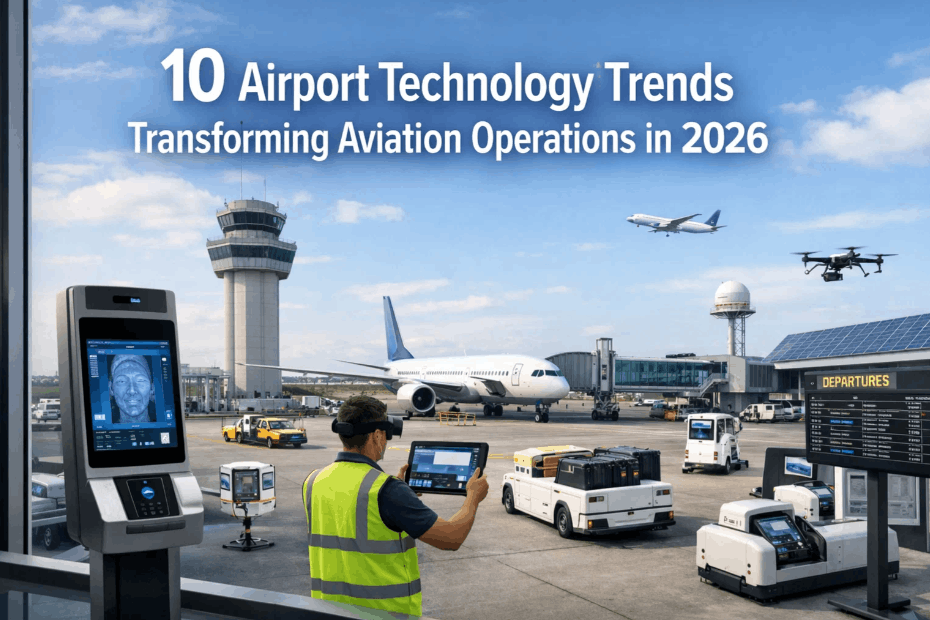
Aviation is being asked to do something no other transport sector has achieved: grow passenger demand while eliminating net carbon emissions by 2050. The response is reshaping every layer of airport operations, from the fuel stored in hydrant pits to the ground support equipment maneuvering around aircraft doors, from the solar arrays on terminal rooftops to the carbon accounting systems tracking Scope 3 emissions across hundreds of airline tenants. Airports Council International reports that 590 airports across 91 countries are now certified under Airport Carbon Accreditation, covering 53.6% of global passenger traffic. The European Union ReFuelEU mandate requires SAF blending starting at 2% in 2025 and escalating to 70% by 2050. ICAO CORSIA enters its final compliance phase year in 2026 with 130 participating states. And the technologies delivering measurable reductions, electric TaxiBots that cut taxi fuel burn by 65%, autonomous ground power connection robots that eliminate APU idling, humanoid robots handling cargo on the tarmac, and AI-driven energy management systems that reduce terminal consumption by 20-30%, are no longer experimental. They are production systems deployed at Schiphol, Changi, Haneda, and Heathrow. The airport ESG transition is not a sustainability report exercise. It is an operational transformation that demands asset-level tracking, calibration, and compliance infrastructure for every electric vehicle charger, solar inverter, SAF storage tank, and carbon monitor in the facility.
Four converging forces are accelerating the adoption of ESG robotics and automation across airport operations. Regulatory mandates including ReFuelEU aviation fuel blending requirements, ICAO CORSIA verified carbon reporting, and ACI Airport Carbon Accreditation Level 4 and 5 certification create compliance deadlines that airports cannot defer. Airline pressure is intensifying as carriers face their own Scope 3 emissions scrutiny and increasingly select airports based on availability of fixed electrical ground power, eGSE charging infrastructure, and SAF blending capability. Energy economics are shifting as on-site solar generation, battery storage, and AI-optimized microgrids deliver measurable ROI alongside carbon reduction, with airports like Istanbul and Athens approaching full electricity independence. And labor demographics in markets like Japan and Europe are driving ground handling automation, with JAL launching humanoid robot trials at Haneda in 2026 and Schiphol deploying autonomous robots for GPU connection to address chronic staffing shortages. The airports that integrated these four forces into a coherent ESG automation strategy are reporting lower carbon intensity scores, higher ACI accreditation levels, and stronger tenant retention. Those still managing sustainability through spreadsheets and manual data collection face accreditation delays, compliance gaps, and growing airline tenant dissatisfaction.
Every Solar Inverter, eGSE Charger, SAF Tank, and Carbon Monitor in Your Airport Needs PM, Calibration, and Audit Tracking.
iFactory registers every decarbonization asset across your airport as a managed device with automated PM scheduling, calibration interval tracking, energy production monitoring, and full compliance audit trails built for ACI Airport Carbon Accreditation, ICAO CORSIA, and EU CSRD reporting frameworks.
Airports across 91 countries now certified under ACI Airport Carbon Accreditation, representing 53.6% of global passenger traffic actively managing carbon emissions in 2026.
65%
Fuel consumption reduction per departure using electric TaxiBot technology at Amsterdam Schiphol, saving 95kg of fuel and 299kg of CO2 per flight on long-taxi routes.
21
Airports worldwide have reached ACI Level 5 certification achieving net-zero for Scope 1 and 2 emissions and committing to net-zero Scope 3 by 2050.
Four Levers of Airport Decarbonization Robotics
The airport ESG transition is being delivered through four distinct but interconnected technology levers. Each addresses a specific emission source category within the airport carbon footprint, and each has documented deployments with measurable results across major global hubs. The airports achieving the highest ACI accreditation levels are those that deploy all four levers as an integrated system rather than pursuing them as isolated initiatives.
Lever One
Electric Ground Support Equipment and Autonomous Towing
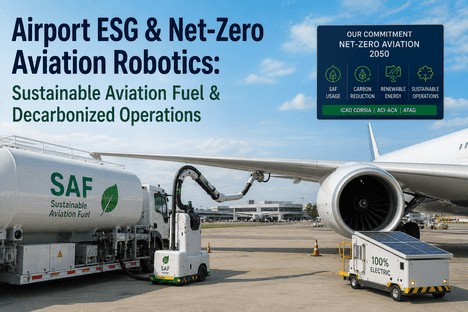
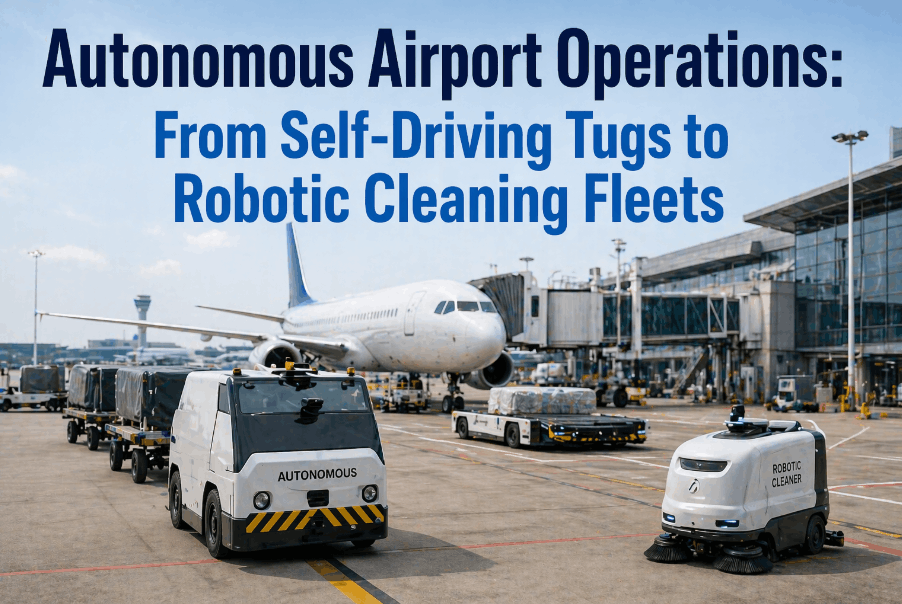
Battery-electric baggage tractors, pushback tugs, belt loaders, and ground power units replace diesel equivalents across the apron. Smart Airport Systems electric TaxiBot at Schiphol tows Airbus A320 aircraft from gate to runway without engine use, achieving up to 65% fuel reduction per departure. Singapore Changi deployed 80 electric baggage tractors across one terminal, cutting 627 tonnes of CO2 annually. Global eGSE fleet currently represents under 20% of 38,000 installed units, with targets to reach 200,000 units by 2035. JAL and GMO AIR launched humanoid robot trials at Haneda in May 2026 for cargo handling, towing, and baggage loading.
65% fuel cut per TaxiBot departure
Lever Two
Renewable Energy Microgrids and AI Energy Management
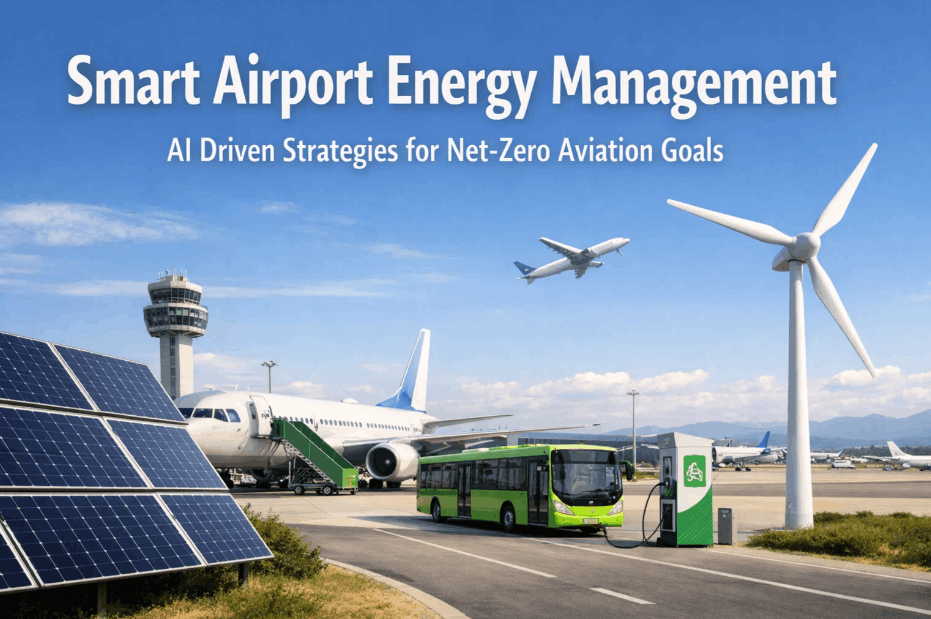
Airports are transforming into energy hubs with on-site solar generation, battery storage, and AI-powered microgrid controls. Istanbul and Athens International Airports approach full electricity independence through integrated solar farms. London City Airport modernized its electrical infrastructure connecting solar panels, storage, and smart controls into one unified network, doubling electricity capacity. AI-driven energy management systems optimize HVAC, lighting, and ground power based on real-time occupancy and flight schedules, delivering 20-30% terminal energy reduction. Predictive systems regulate terminal conditions by forecasting passenger flow patterns hours in advance.
20-30% terminal energy reduction
Lever Three
SAF Infrastructure and Blending Automation
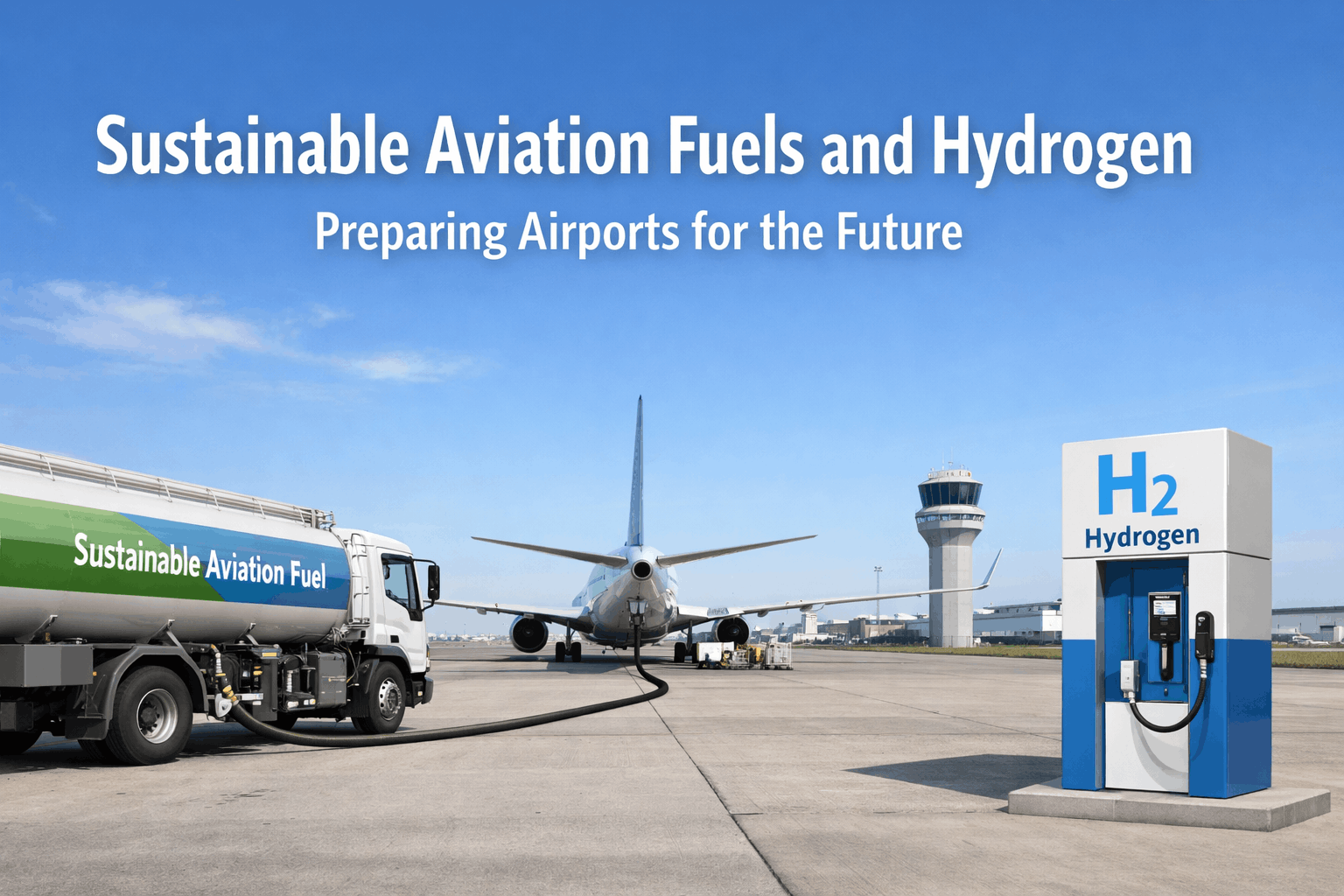
Sustainable Aviation Fuel remains the primary scalable solution for reducing flight emissions in the near term, with ReFuelEU mandating 2% blending in 2025 rising to 70% by 2050. Airports are investing in dedicated SAF storage tanks, blending skids, and pipeline connectivity. Heathrow owns and operates its own fuel storage with an incentive program targeting 11% SAF usage by 2030. Changi Airport receives SAF via Neste refinery integration with a 1% departing flight target for 2026. Japan targets 10% SAF for all departing flights by 2030. AI-enabled fuel management systems track blend ratios, certify sustainability attributes, and generate CORSIA-eligible fuel documentation automatically.
ReFuelEU 2% to 70% blending mandate
Lever Four
Automated Carbon Reporting and ESG Compliance
ICAO CORSIA requires verified CO2 emissions reporting from 130 participating states in 2026, the final year of its first compliance phase. ACI Airport Carbon Accreditation Edition 1.0 effective May 2026 requires granular Scope 1, 2, and select Scope 3 emissions data with third-party verification. EU CSRD mandates detailed sustainability disclosures from airports meeting size thresholds. Automated carbon accounting platforms integrate with utility meters, fuel management systems, and GSE telemetry to generate audit-ready emissions inventories. Digital twins simulate energy and carbon scenarios before infrastructure investment. Airports using automated reporting reduce accreditation preparation time from weeks to hours.
130 states under CORSIA in 2026
The Robots Decarbonizing Your Apron and Terminal Need PM Schedules, Calibration Logs, and Compliance Tracking Too.
iFactory manages every airport ESG asset from electric TaxiBots and eGSE chargers to solar inverters, SAF storage tanks, and carbon monitoring sensors with manufacturer PM scheduling, calibration tracking, energy production monitoring, and compliance audit trails for ACI, CORSIA, and CSRD.
Deployment Spotlight: Electric TaxiBot at Amsterdam Schiphol
The most significant single robotics deployment for airport decarbonization in 2026 is the world's first electric TaxiBot now operating at Amsterdam Airport Schiphol. This deployment demonstrates how a single automated ground operation technology can deliver measurable, auditable emission reductions across a major international hub.
Deployment Spotlight
Smart Airport Systems Electric TaxiBot First Passenger Flights April 2026
Schiphol Airport, in partnership with easyJet, Airbus, and Menzies Aviation, launched the world's first electric TaxiBot for commercial Airbus A320 operations in April 2026. The electric tug, supplied by Smart Airport Systems, transports aircraft from gate to runway without using the main engines, achieving fuel savings of up to 65% on the airport's longest taxi route to the Polderbaan Runway. Each TaxiBot-assisted departure saves approximately 95kg of fuel and avoids 299kg of CO2 emissions, while also reducing nitrogen oxides, ultrafine particles, and apron noise by an average of 10 dB. The pilot controls the TaxiBot from the cockpit using standard tiller and brake controls, starting the main engines only moments before takeoff. The electric TaxiBot complements two hybrid TaxiBots in service since 2022 for KLM Boeing 737 operations. Three additional electric units are expected in 2026, with Schiphol targeting fully sustainable taxiing by 2030. The project is part of the broader FTE Smart Ramp initiative, which also includes the ARC Autonomous Robot for GPU Connection developed with KLM and NEURA Robotics, designed to autonomously connect aircraft to ground power upon arrival, eliminating APU idling and further reducing apron emissions.
65%
Fuel reduction per departure
299kg
CO2 avoided per flight
95kg
Fuel saved per TaxiBot trip
Autonomous Ground Power Connection
Schiphol ARC Robot GPU Connection
Schiphol, KLM, and NEURA Robotics developed ARC Autonomous Robot for GPU Connection. The robot navigates the apron using LiDAR, identifies the aircraft access panel via computer vision, opens the panel using a custom suction tool, and connects the heavy ground power cable without human intervention. This eliminates the need for APU operation during docking, reducing fuel burn, emissions, and physical strain on ground staff. ARC is part of the Smart Ramp initiative targeting fully autonomous aircraft turnaround.
Humanoid Ground Handling
JAL and GMO AIR at Haneda Airport
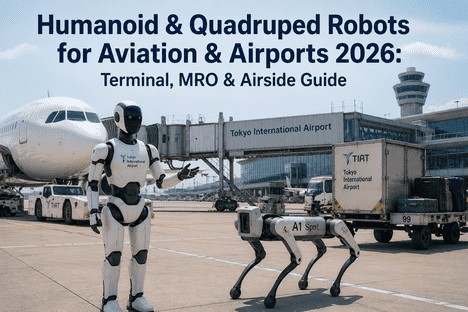
Japan Airlines and GMO AI & Robotics launched Japan's first humanoid robot demonstration for airport ground handling at Haneda Airport in May 2026. The phased trial runs through 2028, starting with cargo container movement and expanding to baggage loading, aircraft towing, GSE operation, and cabin cleaning. Humanoid form factors require no facility modifications since airports are designed for human workers. GMO AIR operates a Humanoid-as-a-Service model, designating 2026 as the First Year of Humanoids.
Electric GSE Fleet Conversion
Singapore Changi Airport eGSE Program
Changi Airport operates one full terminal with a fully electric baggage tractor fleet, deploying 80 electric units that save 627 tonnes of CO2 annually. Changi pioneered a common-use charging system shared across ground handling agents, reducing infrastructure costs. The Civil Aviation Authority of Singapore mandates electric as default for new light GSE purchases from 2025. SATS aims for 100% sustainable energy GSE fleet by 2030. Changi targets full airside vehicle electrification by 2040 with over 300 charging points.
Solar-Powered Terminal Operations
Istanbul and Athens Airports Solar Independence
Istanbul and Athens International Airports are approaching full electricity independence through large-scale on-site solar farms integrated into terminal operations. London City Airport doubled its electricity capacity by connecting solar panels, battery storage, and AI-powered smart controls into a unified microgrid network. AI-driven predictive energy management systems optimize HVAC, lighting, and ground power in real time based on passenger flow forecasts and flight schedules, achieving 20-30% energy consumption reductions across terminal infrastructure.
590
Airports certified under ACI Airport Carbon Accreditation across 91 countries in 2026
130
States participating in ICAO CORSIA offsetting scheme during its final first-phase year of 2026
70%
SAF blending target under ReFuelEU by 2050, rising from 2% in 2025 through incremental mandates
627t
Annual CO2 saved by Changi Airport electric baggage tractor fleet replacing 80 diesel units
The Compliance Architecture: How Automated Asset Management Supports ESG Certification
Every decarbonization asset in an airport, electric TaxiBot, solar inverter, eGSE charger, SAF storage tank, carbon monitor, and ground power unit, requires a documented maintenance and calibration history to support the emissions reduction claims made in ACI accreditation submissions and CORSIA reports. Unverified data is not accepted by auditors. Manual record-keeping cannot scale across the hundreds of distributed assets that comprise a modern airport energy ecosystem. The airports achieving Level 4 Transformation and Level 5 Net Zero accreditation are those that deploy automated asset management systems that capture, timestamp, and store every maintenance event, calibration certificate, and energy production reading as auditable evidence.
ACI Airport Carbon Accreditation Level 4 and 5 Compliance
Edition 1.0 effective May 2026 requires airports at Level 4 Transformation and Level 5 Net Zero to demonstrate absolute Scope 1 and 2 emissions reductions aligned with science-based targets, verified carbon management plans, comprehensive stakeholder engagement with airline tenants and ground handlers, and third-party verification of all emissions data. Automated asset management systems provide the continuous monitoring, event logging, and evidence packaging that accreditation auditors require, reducing submission preparation from weeks to hours.
ICAO CORSICA Emissions Reporting
2026 marks the final year of CORSIA first phase, with 130 states required to submit verified CO2 emissions data through the CORSIA Central Registry by July 31, 2026. Aeroplane operators must submit verified Emissions Reports by April 30, 2026. The CORSIA CO2 Estimation and Reporting Tool CERT supports monitoring and reporting. Airports playing an active role in their airline tenants' carbon reporting supply chain gain competitive advantage by providing verified fuel consumption, ground power usage, and SAF blend ratio data through integrated systems.
Frequently Asked Questions
ACI Airport Carbon Accreditation has seven levels: Level 1 Mapping requires carbon footprint measurement, Level 2 Reduction requires demonstrated emissions cuts, Level 3 Optimization extends to Scope 3 stakeholder engagement, Level 3+ Neutrality offsets residual emissions, Level 4 Transformation requires absolute emissions reduction aligned with science-based targets, Level 4+ Transition extends transformation across the value chain, and Level 5 Net Zero requires net-zero Scope 1 and 2 with a public commitment to net-zero Scope 3 by 2050. Robotics and automation support each level by providing the verified data infrastructure needed for accreditation: electric TaxiBots and eGSE reduce Scope 1 apron emissions, AI energy management reduces Scope 2 terminal consumption, automated carbon reporting generates audit-ready evidence packages, and digital twins enable scenario modeling for Level 4 transformation planning. As of 2026, 21 airports have reached Level 5 certification. Get In Touch to see how iFactory maps to ACI accreditation requirements.
TaxiBot is a semi-autonomous towing vehicle developed by Smart Airport Systems that transports aircraft from gate to runway without using the main engines. The pilot controls the tug from the cockpit using standard controls, starting engines only moments before takeoff. Schiphol Airport launched the world's first electric TaxiBot in April 2026 with easyJet Airbus A320 aircraft on the Polderbaan Runway, achieving up to 65% fuel reduction and saving 95kg of fuel and 299kg of CO2 per flight. Two hybrid TaxiBots have been operating at Schiphol since 2022 for KLM Boeing 737 operations. Air India pioneered TaxiBot commercial service in 2019 at Delhi Airport. The technology is EASA, FAA, and CAAC certified for Airbus A320 and Boeing 737 families, with certification underway for A220, 737 MAX, and Embraer E-Jet families. Book a Demo to see how iFactory tracks TaxiBot PM scheduling and battery system calibration.
The European Union ReFuelEU Aviation Regulation mandates that aviation fuel suppliers supply a minimum SAF share at EU airports starting at 2% of total fuel in 2025, increasing to 6% by 2030, 20% by 2035, 34% by 2040, and 70% by 2050. Sub-targets for synthetic e-fuels require 1.2% within the 2030 target. Non-compliance penalties are calculated as a multiple of the price differential between conventional jet fuel and SAF. In the UK, a SAF mandate requires 10% blending by 2030. Japan targets 10% SAF for departing flights by 2030. Singapore targets 1% SAF for departing flights in 2026. These mandates require airports to invest in dedicated SAF storage tanks, blending skids, pipeline connectivity, and certified fuel management systems that track blend ratios and generate CORSIA-eligible fuel documentation. Book a Demo to see how iFactory manages SAF storage tank calibration and fuel blending equipment PM schedules.
iFactory registers every decarbonization asset in an airport including electric TaxiBots, eGSE fleets and chargers, solar panels and inverters, SAF storage tanks and blending skids, ground power units, battery storage systems, carbon monitors, and energy meters as managed devices with complete lifecycle records. For each asset, iFactory maintains the manufacturer PM schedule, calibration interval, energy production and consumption data, software version history, and operational uptime log. For ACI Airport Carbon Accreditation, iFactory generates evidence packages with verified maintenance records, calibration certificates, and energy data timestamped to each source meter. For ICAO CORSIA compliance, iFactory tracks fuel storage equipment calibration and generates audit trails for SAF blending verification. For EU CSRD disclosure, iFactory provides the asset-level data infrastructure that supports Scope 1, 2, and 3 emissions calculations. Get In Touch to begin registering your airport ESG assets.
Conclusion
The airport ESG transition in 2026 is not measured in sustainability report pages. It is measured in tonnes of CO2 avoided by electric TaxiBots at Schiphol, kilowatt-hours saved by AI-optimized microgrids at London City, litres of SAF blended into hydrant systems at Heathrow, and accreditation levels achieved by the 590 airports now certified under ACI Airport Carbon Accreditation. The technologies delivering these results, electric ground support equipment, autonomous towing robots, solar microgrids, AI energy management, automated carbon reporting platforms, are production systems with documented, auditable outcomes. They are not pilot projects awaiting validation.
The asset management infrastructure that keeps these decarbonization systems maintained, calibrated, and audit-ready is the foundation upon which credible ESG reporting rests. iFactory provides that infrastructure: asset registration for every electric TaxiBot, eGSE charger, solar inverter, SAF tank, and carbon monitor in your airport, PM scheduling aligned with manufacturer and regulatory requirements, automated calibration tracking, energy production monitoring, and compliance audit trails built for ACI Airport Carbon Accreditation, ICAO CORSIA, and EU CSRD frameworks. Book a Demo to see how iFactory manages airport ESG assets, or Get In Touch to begin registering your decarbonization equipment.
Every Decarbonization Asset in Your Airport Is Tracked by Regulators. Track It with iFactory.
iFactory registers every electric TaxiBot, eGSE charger, solar inverter, SAF storage tank, battery storage system, and carbon monitor as a managed asset with PM scheduling, calibration tracking, energy monitoring, and compliance audit trails for ACI Airport Carbon Accreditation, ICAO CORSIA, and EU CSRD frameworks.