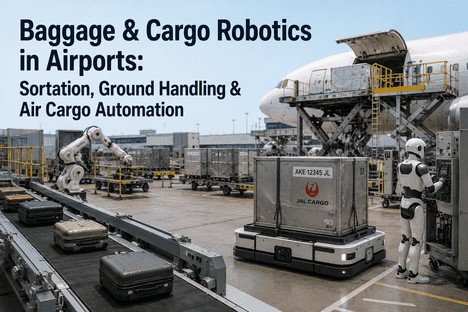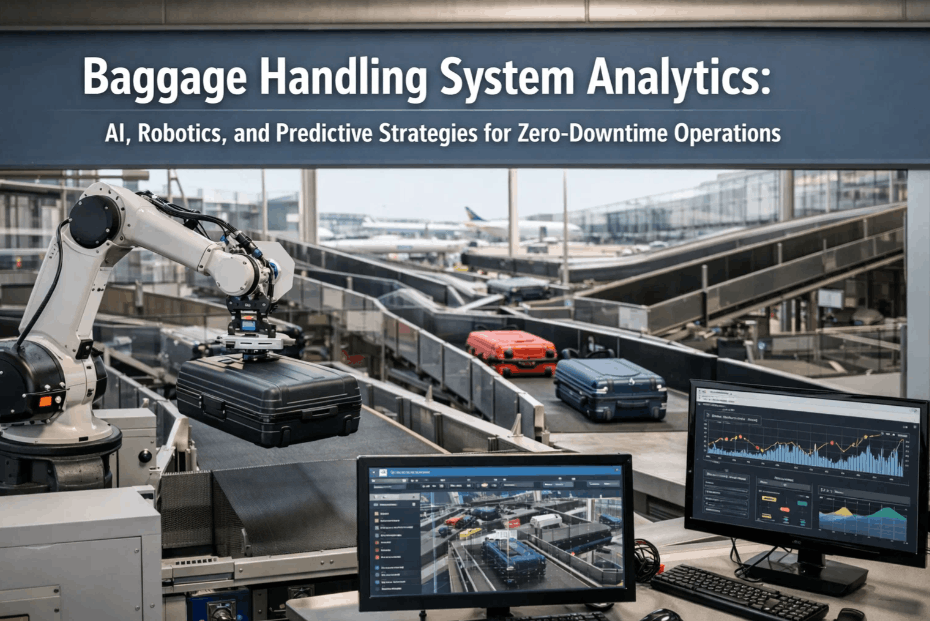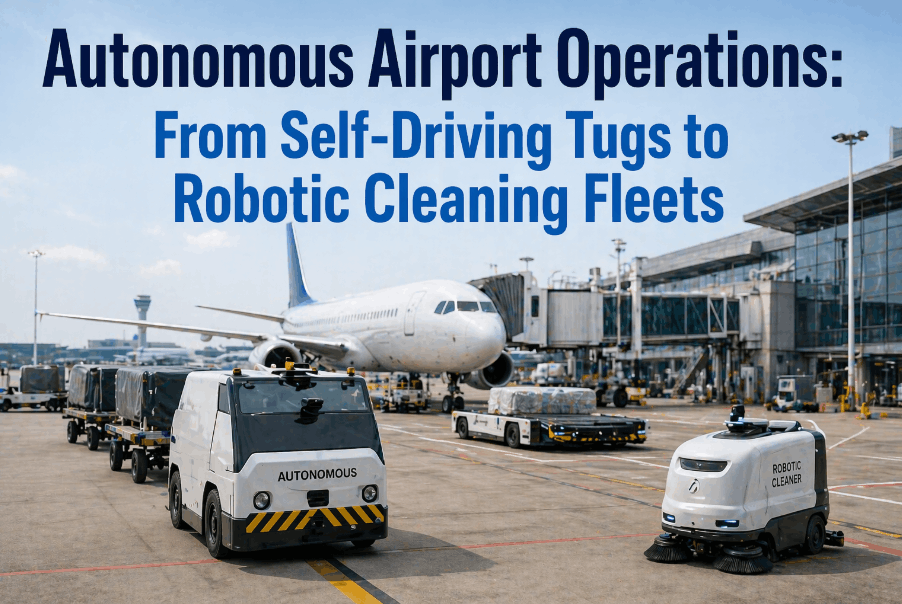
The autonomous airport has transitioned from a future-state concept to an operational reality in 2026. As global passenger volumes climb and labor technical technical shortages persist, hub airports are deploying robotic fleets to manage everything from baggage transport and terminal cleaning to high-precision airfield drone inspections. Digital autonomous airport operations management replaces fragmented manual oversight with a unified AI-driven command center, providing real-time mission planning, safety validation, and lifecycle analytics for every self-driving asset on the ramp and in the terminal. This systemic shift allows airports to decouple operational growth from labor headcount, ensuring that infrastructure scales in lock-step with passenger demand while maintaining the highest levels of safety and precision. Airports looking to lead the transition to autonomous ground handling can schedule a fleet readiness audit to identify optimization opportunities today.
Orchestrate Your Entire Autonomous Airport Ecosystem from One AI Interface
iFactory's autonomous operations platform connects your self-driving tugs, cleaning robots, and airfield drones into a single mission-control system — increasing operational throughput by 35% and ensuring zero-incident safety compliance through real-time Lidar telemetry and behavioral analytics.
Why Global Hubs are Transitioning to AI-Driven Autonomous Ground Operations
The ground operations at a modern airport are among the most labor-intensive and error-prone environments in the transport sector. Manual baggage tugs, floor scrubbers, and ramp inspections are bottlenecked by human fatigue, shift changeovers, and safety variances. A single driver-related incident on a crowded ramp can ground an aircraft and trigger millions in cascading costs, including flight delays and expensive insurance payouts. The move toward autonomy isn't just about labor savings — it's about the precision, 24/7 availability, and safety-validated performance that only robotic fleets can deliver without the variability of human error.
Digital autonomous fleet management software for airports provides the critical orchestration layer for these high-stakes assets. By integrating self-driving tugs, robotic cleaners, and inspection drones into a centralized AI Copilot, airports gain real-time visibility into mission progress and asset health. This transition turns "isolated robots" into a "synchronized autonomous ecosystem," allowing facility managers to scale operations without commensurate increases in payroll or occupational risk. Book a Demo to understand how your autonomous ROI increases with every asset integrated into the centralized AI command center.
The Hidden Inefficiencies of Manual Airport Ground Handling
Manual airport operations are increasingly struggling to keep pace with flight schedules and heightened security requirements. Understanding these systemic friction points highlights the immediate value of an autonomous transition for the modern airport facility manager.
High Labor Turnover & Skill Gaps
Ground handling roles have some of the highest turnover in aviation. Constant retraining of manual drivers leads to inconsistent safety standards and reduced ramp efficiency. Autonomous tugs remain 100% "trained" and consistent every shift, eliminating the cost of the recruitment cycle and ensuring throughput stability during holiday peaks.
Human Error & Ramp Incidents
90% of airport apron incidents are caused by human error during pushback or transport. AI-driven autonomous GSE uses lidar and computer vision to maintain "Virtual Safety Envelopes" around aircraft, significantly reducing the liability costs associated with aircraft damage or worker injury in high-traffic zones.
Inconsistent Terminal Hygiene
Manual cleaning teams cannot guarantee 100% path coverage across millions of square feet. Robotic fleets follow precise, data-verified routes and provide "Proof of Clean" logs for every floor tile in real-time, which is essential for maintaining VIP passenger scores and terminal air quality standards.
Manual Airfield Inspection Lag
Human-driven runway inspections are limited to daylight hours and require closing flight lines. Autonomous drones and AGVs perform high-speed thermal and visual inspections between flights with no human intervention needed, maximizing the revenue-generating hours of your runway infrastructure.
Fragmented Fleet Telemetry
Maintaining manual GSE is reactive because managers lack real-time health data. Autonomous assets are natively "Digital First," streaming battery, motor, and sensor health to the AI Copilot to prevent mission-stopping failures before the asset even leaves the charging bay for its first flight.
Idle Asset & Energy Waste
Manual fleets often sit idle or take inefficient paths due to a lack of coordination. AI mission planning optimizes the "Empty Return" miles for baggage tugs and AGVs, reducing energy consumption and battery strain by up to 28% while extending the operational life of the electric motor.
How AI Copilot Orchestrates Autonomous Airport Operations
A purpose-built airport robotics management platform is the digital brain for your autonomous assets. It manages the complex logic of mission dispatch, collision avoidance, and predictive maintenance across thousands of simultaneous robotic tasks, ensuring that every robot is an asset, not a barrier.
Unified Fleet Telemetry & Connectivity
The platform ingests real-time data from tugs, cleaners, and drones regardless of manufacturer. Managers see a single "Fleet Health View" with live battery states, sensor integrity, and connectivity strength, allowing for the precise synchronization of heterogeneous robotic assets across airside security boundaries. Book a Demo to see live robotic telemetry in a production terminal.
AI Copilot Mission Planning & Dynamic Routing
Integrating with flight schedule and baggage data, the system automatically dispatches autonomous tugs to the correct gate based on aircraft arrival. Routes are dynamically adjusted to avoid manual vehicle traffic or passenger congestion, ensuring that "Time-to-Bag-Drop" KPIs are consistently met during peak hours.
Preventive Readiness & Health Monitoring
Every autonomous asset is monitored for motor strain, Lidar accuracy, and battery degradation. If a threshold is crossed, the asset is automatically routed to a charging or maintenance bay and replaced by a ready unit, ensuring that your autonomous fleet maintains a 100% mission readiness state at all times.
Autonomous Safety & Mission Simulation
Before any major fleet expansion, the AI engine runs a "Digital Twin" simulation to validate safety buffers and throughput impact. This virtual testing ensures that new robotic paths do not conflict with existing airfield logistics or passenger security flows, minimizing deployment friction.
Performance Analytics & ESG Reporting
The platform generates detailed reports on "Mission Success Rate," "Human-Intervention Frequency," and "CO2 Reduction" from fleet electrification. This provides the verified data needed for airport ESG audits and empowers managers to defend capital expenditure with hard performance evidence.
Autonomous Airport Asset Matrix: What Gets Automated
Autonomy is deployed across multiple specialized asset categories for the 2026 airport. The following table outlines how AI-driven workflows manage each robotic segment to maximize operational yield and terminal reliability.
| Autonomous Asset Class | Mission Types Managed | Key Autonomous Sensors | Operational Benefit | Human Intervention % |
|---|---|---|---|---|
| Self-Driving Baggage Tugs | Gate-to-BHS transport, Empty storage | Lidar, GPS, Computer Vision | 35% cost reduction / zero ramp incidents | < 5% |
| Robotic Cleaning Fleets | Terminal scrubbing, UV disinfection | 3D Lidar, Impact sensors | 100% path coverage / consistent hygiene | < 2% |
| Airfield Inspection Drones | Pavement, PAPI/Light, FOD checks | Thermal, IR, High-Res Visual | 90% faster runway inspection vs manual | < 1% |
| Passenger Assist AGVs | Wayfinding, luggage assistance | Obstacle avoidance, voice AI | Improved PAX accessibility and scores | < 10% |
| Baggage Loading AGVs | ULD loading, sorting automation | Load sensors, Torque monitoring | Reduces workplace injury and baggage damage | < 5% |
| Security Patrol Robots | Perimeter check, Thermal sweep | Night vision, Audio anomaly | Extends perimeter security reach by 3x | < 3% |
Scale Your Robotic Fleet with the Intelligence of iFactory AI Copilot
Our platform manages the world's most complex autonomous airport deployments — ensuring that your self-driving tugs and robots are always on-mission, perfectly safe, and operating at peak energy efficiency through every shift.
AI Copilot: The Intelligence Layer Behind the Robot
Autonomous airport operations fail when they rely on static programming. An AI-driven command system for airport robotics provides the real-time situational awareness and predictive decision-making needed for high-traffic terminals and ramps where every movement must be validated.
Context-Aware Obstacle Negotiation
Rather than just "stopping" for an obstacle, the AI Copilot distinguishes between a static pillar and a moving catering truck — calculating whether to wait, reroute, or alert a human supervisor based on flight urgency. This prevents the "Robotic Logjam" common in non-AI systems.
Fleet Battery Load Balancing
The system predicts regional energy demand and charging bay availability. It staggers autonomous cleaning or charging tasks to ensure the fleet never peaks airport power loads or sits idle waiting for a plug, maximizing the utility costs for the entire facility.
Predictive Sensor Maintenance
Robotic sensors degrade in moisture or dust common on the apron. The AI monitors Lidar "noise" patterns and automatically generates a cleaning work order for the robot BEFORE it fails a safety check mid-mission, ensuring continuous operation without safety pauses.
Mission-to-Flight Correlation
Every autonomous mission is linked to a flight number. If a flight is delayed, the AI automatically re-prioritizes the baggage tug's mission, ensuring that limited robotic resources are always serving the active aircraft and minimizing turnaround delays at the gate.
Autonomous Performance Metrics: Scaling with Data Confidence
Digital airport robotics analytics produces high-resolution data on fleet efficiency. Every mission closure creates a timestamped data point that evolves into a terminal performance dashboard for senior executives and board members.
Airport terminal managers using iFactory's analytics report that fleet visibility alone allows them to scale terminal size without adding additional grounds staff or sacrificing hygiene quality. Book a Demo to explore the full autonomous analytics dashboard and see how we measure robot-to-human productivity ratios.
Compliance & Safety: Regulatory Ready Autonomy
Robotic deployment in airports requires rigorous compliance validation. Our platform generates the validated logs and safety telemetry required for FAA, ICAO, and international aviation security reviews to ensure your fleet is legally sounds.
Collision Avoidance Audit Logs
Immutable records of every "Near-Miss" or Lidar-braking event. This data proves safety standard compliance to airport board members and insurers, showing the fleet is statistically safer than manual drivers in high-risk zones.
Terminal Access Validation
Documentation of every robotic "Security Entry." Proves that autonomous cleaning or patrol robots are staying within their authorized zones and haven't accessed restricted side-doors, maintaining 100% security integrity.
Drone Flight Compliance
Complete digital flight logs for airfield inspection drones — including pilot-in-command status, GPS paths, and mission purpose — meeting all Part 107 and airport-specific regs without the need for manual paperwork.
Implementation Roadmap: Scaling Autonomy in a Hub Airport
Deploying autonomous fleets is a phased journey. iFactory ensures that your airport scales from "Pilot Program" to "Full Fleet Maturity" with data-backed confidence and zero operational disruption to active flight schedules.
Digital Twin & High-Precision Mapping
We create a 3D digital map of the terminal or airfield movement area. The AI Copilot identifies "Autonomous-Only Zones" and defines safety buffers for human interaction. The first pilot robots are onboarded to the telemetry engine.
Semi-Autonomous Pilot & Mission Validation
Robotic assets begin live missions with human supervisor monitoring. The AI engine refines "Edge-Case Logic" (e.g., lighting changes, sudden obstacles) to achieve >95% intervention-free missions while generating initial ROI data.
Full AI Copilot Fleet Orchestration
Full fleet deployment. Mission planning is 100% automated based on real-time flight data. The "Predictive Service" engine begins identifying maintenance needs, and charging load balancing is activated across the facility grid.
The Zero-Incident Autonomous Airport
Autonomous operations are standard across cleaning, GSE, and inspections. Unplanned asset downtime is near zero. Capital replacement budgets are optimized based on 12 months of high-resolution robotic health and mission data.
7 Features to Demand from Any Airport Autonomous Fleet Platform
Not all management tools can handle the dynamic complexity of airport robotics. Use these criteria for your strategic evaluation to ensure you aren't locked into a single-vendor robotic silo.
Vendor-Agnostic Fleet Control
Your management platform must control robots from different manufacturers in a single dashboard to avoid data silos. This allows you to cherry-pick the best cleaning robot and the best tug without managing separate software.
High-Precision Indoor GIS Integration
Traditional GPS fails inside million-square-foot terminals. The platform must natively support high-precision indoor mapping to ensure cleaning and pathing accuracy is accurate to within 2 centimeters.
Real-Time Flight Schedule Sync (FIDS)
Autonomous missions must be dynamically triggered by your Flight Information Display System. If a flight moves gate, the autonomous tug must know instantly and reroute itself without human dispatcher intervention.
Safety-First Geofencing Enforcement
The platform must provide "Hard-Stop" geofences that prevent any robotic asset from entering restricted airside areas or taxiways. Any breach should trigger an immediate fail-safe lock on the robotic motor.
Predictive Health & Battery Analytics
The software should predict when a Lidar sensor needs cleaning or a battery is likely to fail mid-mission, automatically routing the robot for service to prevent mid-terminal outages during peak travel hours.
Cyber-Secure "Edge-First" Architecture
For airport security, the platform should manage mission logic locally at the "Edge" while syncing telemetry to the cloud — ensuring that robots can complete their missions even if the central terminal WiFi drops.
Automated Mission "Compliance Vault"
Every autonomous movement should be recorded in an immutable, searchable database for safety audits and passenger incident liability investigations, providing a complete playback of any event on demand.
Frequently Asked Questions: Autonomous Airport Operations
How do autonomous tugs interact with manual vehicles on the ramp?
Autonomous tugs are governed by the AI Copilot, which monitors all connected fleet movements. On the ramp, robots use Lidar and Computer Vision to detect non-connected vehicles and will always default to a "Yield and Hold" posture unless a safe, AI-validated path is confirmed, ensuring safety in mixed-traffic environments.
How long does it take to map a terminal for robotic cleaning?
A standard 500,000 sq ft terminal portion can be mapped and "Digital Twinned" in 3–5 working days using mobile Lidar scanners. Once the map is in the iFactory system, robotic paths are generated and safety-tested virtually before a single robot ever touches the live floor, minimizing disruption to passenger flow.
Can drones really perform runway inspections without closing the airfield?
Yes. By using high-speed autonomous drone swarms that fly pre-defined, T-minus-to-arrival windows. The AI engine coordinates with the tower to identify 120-second "Gap Windows" where drones can perform high-speed visual scans for FOD without interrupting aircraft traffic cycles.
What is the typical intervention rate for autonomous airport robots?
In a mature iFactory deployment, the "Human Intervention Frequency" is less than 2% of total mission time. This means for every 100 baggage transport missions, 98 are completed with zero human contact, allowing your staff to focus on complex troubleshooting rather than repetitive transport.
How does the system handle "Lost" robots or network dead-zones?
The mobile mission logic is stored locally on the robot's edge-processor. If a robot enters a WiFi dead-zone, it will continue its mission using its internal map and local sensors, then re-sync all mission logs the moment it enters a live coverage zone, ensuring no data loss.
Is it possible to track the energy savings from transitioning to autonomous GSE?
Yes. The platform provides a real-time ESG dashboard that compares the energy/fuel consumption of your autonomous fleet against your historical manual baseline. Most airports report a 25-30% energy efficiency gain through optimized pathing and reduced idle periods.
What is the total ROI timeline for a robotic fleet deployment?
Most hub airports document a full ROI within 14–18 months. This is driven by significant labor cost reduction, the elimination of ramp-damage incidents, and much lower maintenance costs per asset-hour through the predictive health monitoring system.
The Future of Airport Operations is Autonomous. Is Your Management Platform Ready?
Join the world's leading hub airports who are scaling their robotic fleets with iFactory's AI Copilot — achieving 35% higher throughput, 100% cleaning coverage, and zero driver-related incidents across every shift.