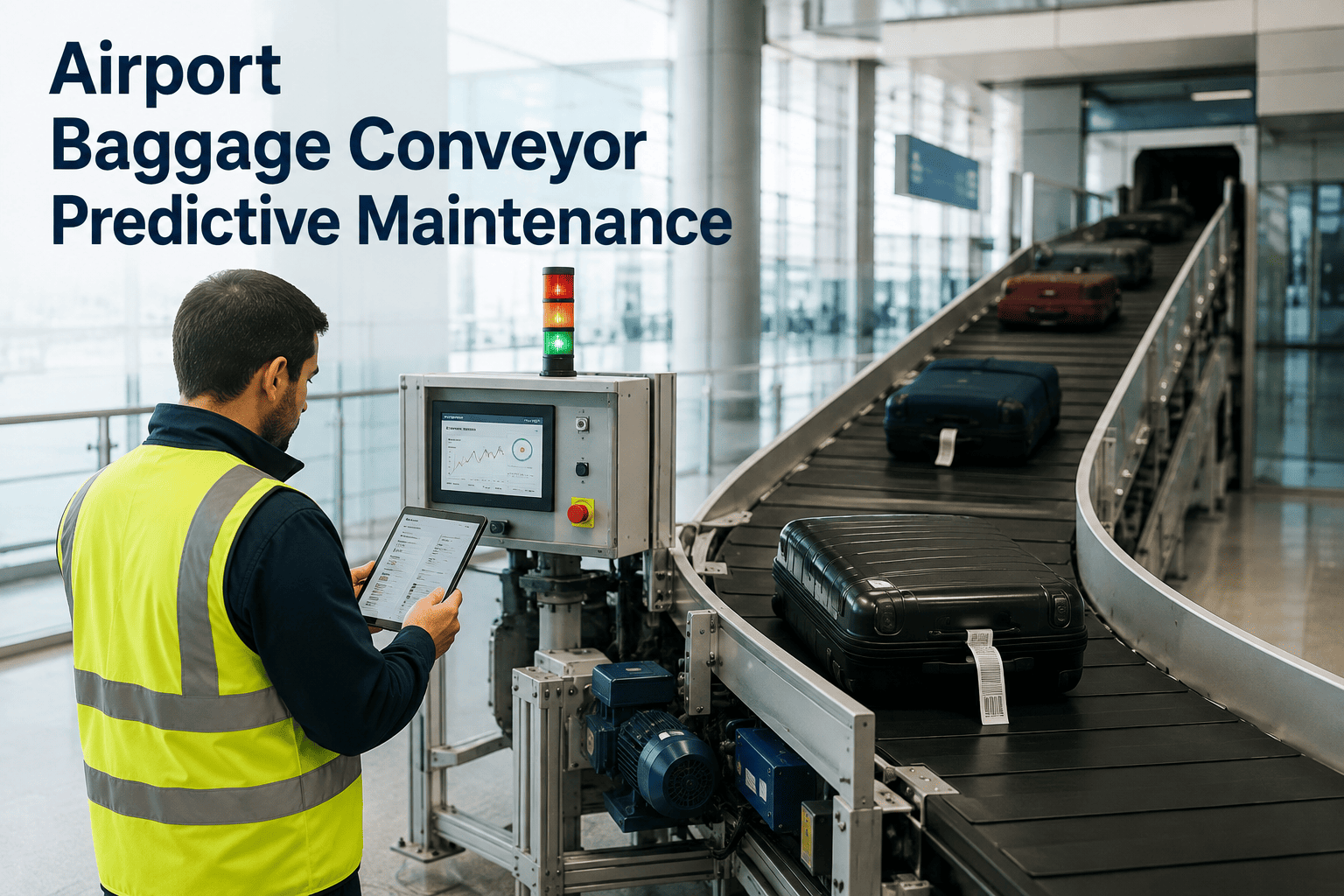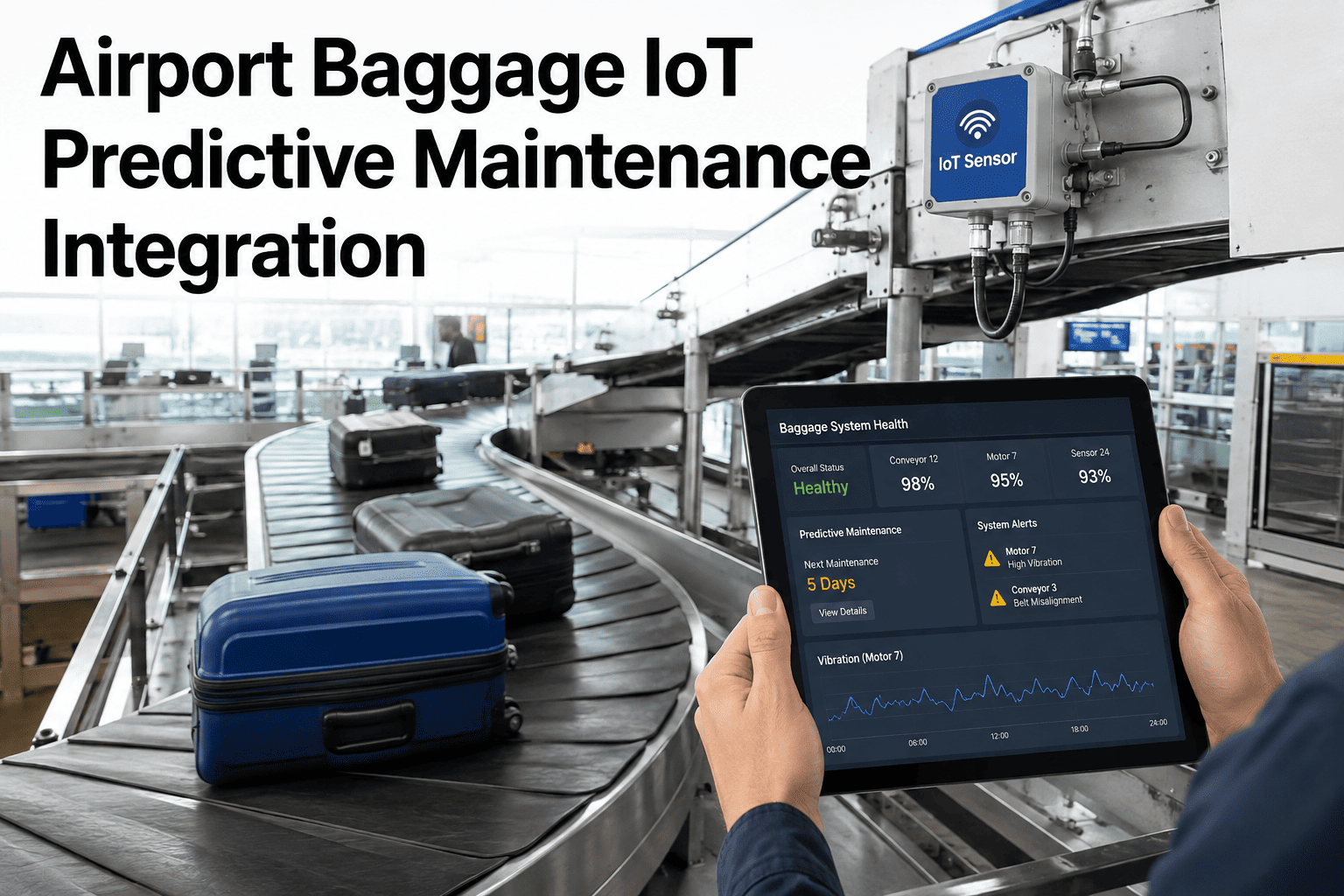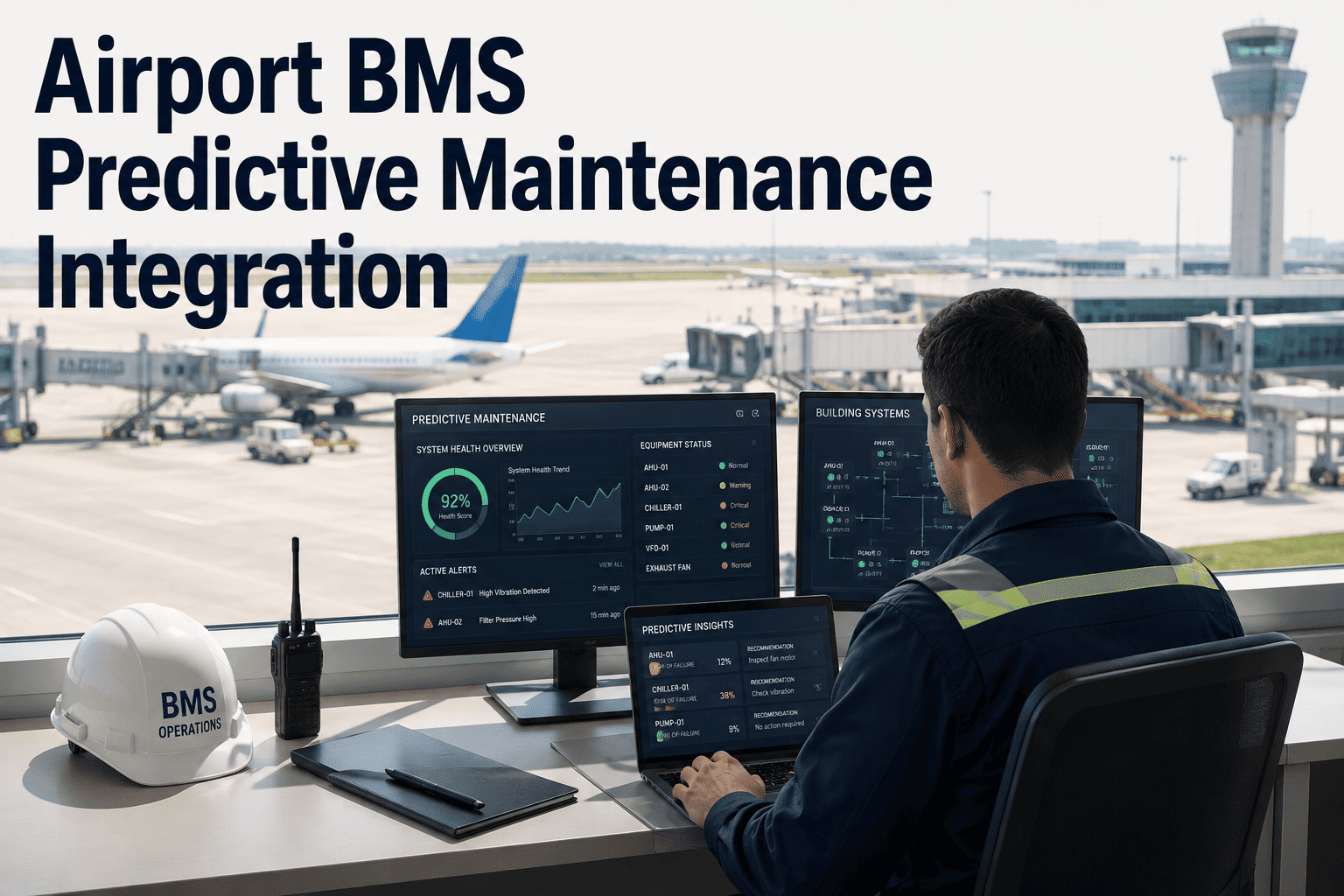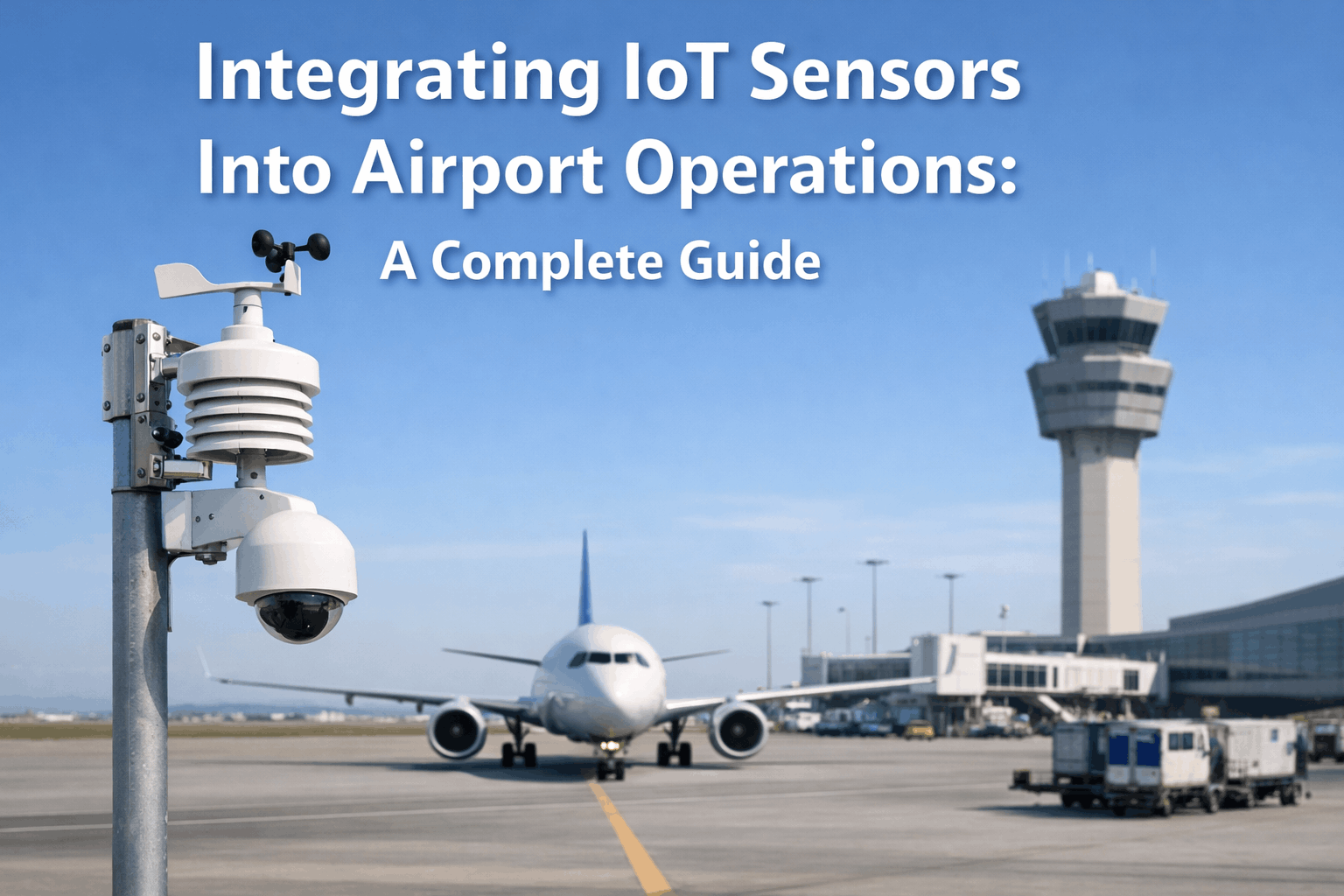
At 5:22 AM on a Tuesday in November 2025, the duty engineer at a major European hub airport received an alert that would have been impossible to generate three years earlier. A vibration anomaly had been detected on the baggage carousel drive unit serving Pier C — the busiest baggage reclaim zone during the morning intercontinental wave. The sensor had been monitoring the unit's bearing signature for 11 weeks. The AI model had identified a developing spall on the outer race of the primary drive bearing, with a calculated 72-hour window before failure. The engineer scheduled a replacement for the following Sunday night — a 4-hour planned intervention during the quietest period of the week. The carousel ran without interruption through the 6,800-passenger morning peak. The bearing was replaced on Sunday. No passenger ever waited for a bag because of that failure, because that failure never happened. Before IoT sensor integration, the same bearing would have failed on a Wednesday morning at 7:40 AM, taken the carousel offline for six hours, and generated 340 late baggage reports, four airline delay claims, and one regulatory incident report. The only difference between these two outcomes was 78 grams of vibration sensor mounted on a bearing housing — and an AI platform that knew what to do with the data it generated. In 2026, integrating IoT sensors into airport operations is not a pilot program or a future-state aspiration. It is the operational baseline that separates airports managing their infrastructure from airports being managed by it. This complete guide covers every critical IoT integration domain — from infrastructure monitoring and passenger flow sensing to environmental management, security systems, and AI-powered digital twin coordination — and shows precisely how iFactory's platform converts sensor data into operational intelligence that protects revenue, ensures compliance, and eliminates the reactive maintenance model that costs airports $2.4M per unplanned system failure on average. Book a free IoT integration assessment for your airport — or visit our Support Center to explore the platform.
Critical Infrastructure Monitoring: The Foundation of Airport IoT Integration
Airport critical infrastructure — escalators, elevators, moving walkways, baggage handling conveyors, HVAC systems, power distribution units, and jet bridges — represents the physical backbone of the passenger experience. Each of these systems operates under continuous duty cycles that generate predictable failure signatures weeks before the failure materializes. Yet in 2026, most airports still discover infrastructure failures when a system stops — not when it begins the degradation trajectory that makes stopping inevitable. The business case for IoT sensing on critical infrastructure is straightforward: a $180 vibration sensor and an AI platform that processes its output can prevent a $240,000 baggage conveyor motor failure. The same sensor logic applied to an escalator gearbox prevents a $95,000 emergency repair and a safety incident investigation. Applied systematically across all critical infrastructure, IoT sensing converts the airport's maintenance posture from emergency response to planned intervention — reducing total infrastructure maintenance cost by 25–40% while simultaneously improving system availability.
Explore iFactory's infrastructure monitoring platform and see how vibration, temperature, and current sensing integrate into one AI dashboard.
Multi-Sensor Infrastructure Health Monitoring & AI Predictive Alerts
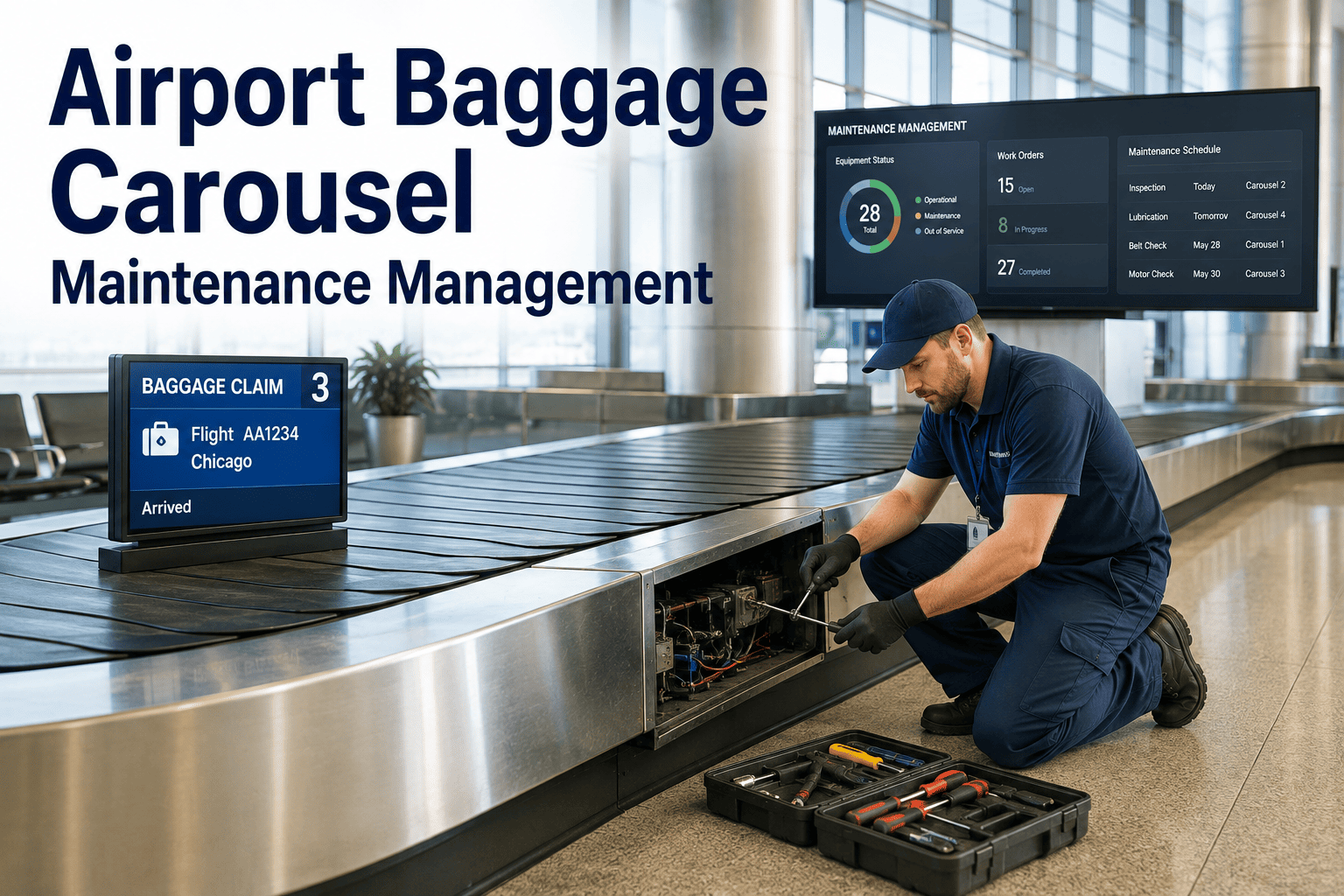
iFactory deploys a coordinated sensor stack across every critical infrastructure asset category: vibration sensors on all rotating equipment (conveyors, escalators, moving walkways, baggage carousels, fans, pumps), temperature sensors on motors, bearings, and electrical panels, current draw monitoring on drive systems for load anomaly detection, and acoustic emission sensors for early bearing spall detection. All sensor streams feed iFactory's AI analysis engine, which applies equipment-class-specific failure models — a baggage conveyor motor uses a different degradation model than a passenger escalator — to calculate remaining useful life and generate prioritised predictive maintenance alerts. The CMMS integration converts every AI alert into a pre-populated work order with recommended parts, estimated labor hours, and optimal scheduling window. Airports report 50–65% reduction in unplanned infrastructure failures within 12 months of full sensor deployment.
Passenger Flow IoT: Counting, Queuing, and Dynamic Space Utilisation
Passenger flow IoT is the fastest-growing airport sensing category in 2026 because the business case is immediate and visible. Every queue that exceeds 15 minutes at a security checkpoint is a future negative review, a potential missed connection, and a concrete risk to the airport's ASQ satisfaction score. Every terminal space that is chronically under-utilised while adjacent areas overflow represents a commercial revenue leak. And every gate area that is packed beyond fire safety capacity because two widebody departures were assigned adjacent positions on the same schedule wave is a compliance risk that no airport manager should discover at 7:30 AM on a Saturday. IoT people-counting sensors — overhead time-of-flight sensors, thermal array counters, and computer vision zone monitors — provide the real-time occupancy data that converts these reactive discoveries into predictive management decisions. Combined with AI queue prediction models fed by flight schedule data, passenger flow IoT transforms security, check-in, immigration, and gate management from queuing management to passenger experience engineering.
Book a passenger flow IoT demo to see real-time queue prediction and digital signage integration in action.
Real-Time Passenger Counting, Queue Prediction & Digital Signage Integration
iFactory integrates overhead people-counting sensors, thermal occupancy arrays, and computer vision zone monitors into a unified passenger flow intelligence platform. Real-time occupancy data per zone is combined with flight schedule data and historical demand patterns to generate predicted queue wait times 30–60 minutes ahead of each departure wave — alerting operations teams before queues exceed thresholds rather than after passengers are already queuing. AI calculates optimal staff allocation per time block and generates specific redeployment recommendations when predicted wait times will breach configured thresholds. Digital signage integration pushes live wait time data to checkpoint displays and mobile apps — reducing perceived wait times through passenger information and enabling checkpoint routing that balances load across all available security lanes. Airports deploying iFactory's passenger flow IoT report 92% passenger satisfaction in AI-managed zones and 40% fewer peak-hour wait exceedances.
Environmental IoT: Air Quality, Temperature, Humidity & Energy Sensing
Airport terminals are large, complex environmental systems where HVAC performance, air quality, and energy consumption interact in ways that no manual inspection regime can continuously monitor or optimise. A terminal that is 3°C over the IAQ standard in the check-in hall during peak hour has a measurable impact on passenger comfort scores that shows up in ASQ data six weeks later. An HVAC unit running at 140% of its design duty cycle because a sensor failure has disabled the demand-modulated control loop will fail three months earlier than its maintenance-interval-predicted replacement date — but only if that interval was ever calculated from real runtime data. Environmental IoT sensing converts the terminal's climate and energy management from a facilities management task into a data-driven optimisation program. Air quality sensors, CO₂ concentrations, temperature and humidity arrays, and energy metering at zone level create the continuous environmental data feed that AI can use to optimise HVAC scheduling, identify equipment inefficiency, predict maintenance needs before comfort metrics degrade, and generate the emissions and energy consumption reports that airports increasingly need for regulatory compliance and ESG commitments.
Continuous Environmental Monitoring, HVAC Optimisation & Energy Intelligence
iFactory deploys a distributed environmental sensor network across all terminal zones — CO₂ and particulate sensors for air quality, temperature and humidity arrays for comfort monitoring, energy metering at circuit level for consumption tracking, and HVAC performance sensors for efficiency monitoring. AI correlates occupancy data from the passenger flow IoT layer with environmental readings to drive demand-responsive HVAC scheduling — pre-conditioning spaces before passenger demand peaks rather than responding after comfort metrics have degraded. Equipment efficiency degradation is identified from energy-per-unit-output trends weeks before it manifests as a maintenance fault. Airports using iFactory's environmental IoT report 20–30% energy cost reduction in terminal HVAC operations and 95%+ compliance with IAQ standards throughout operational hours.
Airside & Apron IoT: GSE Tracking, Fuelling Monitoring & FOD Detection
The airport apron is simultaneously the most operationally critical and the least comprehensively monitored zone in the airport system. Ground support equipment operates on the ramp without location visibility beyond manual radio coordination. Fuel bowsers complete fuelling cycles without automated volume reconciliation against aircraft uplifts. And Foreign Object Debris — the $4B annual problem that costs aviation in emergency maintenance, engine damage, and regulatory investigation — is still detected primarily by human visual inspection at most airports worldwide. IoT integration on the apron addresses each of these gaps with a technology stack that was cost-prohibitive five years ago and is standard-infrastructure affordable in 2026. GPS telematics on every GSE asset provides second-by-second position and status data. Automated fuelling volume sensors reconcile delivered volumes against flight plans without manual dipping. And computer vision FOD detection systems monitor runway and taxiway surfaces continuously at resolution that human patrol inspection cannot match at scale.
Explore iFactory's apron IoT integration — GSE telematics, fuelling monitoring, and FOD detection in one platform.
GSE Fleet Intelligence, Automated Fuelling Reconciliation & AI FOD Monitoring
iFactory's apron IoT layer integrates GPS telematics across the full GSE fleet — real-time position, utilisation status, and operator identification — into an operational dispatch dashboard that enables AI-optimised equipment pre-staging before each aircraft arrival. Automated fuelling sensors feed volume data directly to the reconciliation engine, eliminating manual dipping and generating immediate alerts on uplift discrepancies. Computer vision systems mounted on elevated apron positions continuously scan runway and taxiway surfaces for FOD objects down to 25mm in any lighting condition, generating precise GPS-located alerts to apron control within 90 seconds of object detection. AI apron management correlates all data streams — GSE position, fuelling status, FOD alerts, passenger boarding progress — into a unified turn coordination dashboard. Airports report 35% improvement in average turn time efficiency and 80% reduction in FOD-related incident reports after full apron IoT deployment.
Security & Access Control IoT: Perimeter Monitoring, Biometrics & Anomaly Detection
Airport security IoT in 2026 has evolved far beyond access card readers and CCTV cameras to a coordinated sensing infrastructure that monitors perimeter integrity, tracks access events across hundreds of controlled points simultaneously, and applies AI anomaly detection to identify behavioral patterns that correlate with security threats before incidents occur. The integration challenge is substantial: a major international airport may have 2,000+ access control points, 4,000+ CCTV cameras, perimeter intrusion detection along 15–40km of boundary fence, and biometric identity verification systems at multiple processing touchpoints — all generating data streams that have historically been managed by separate security management systems with no cross-system intelligence. IoT integration on a unified AI platform converts this data fragmentation into coordinated security intelligence: a perimeter alarm at the north cargo fence, an access anomaly at a maintenance gate, and an unusual vehicle movement on the cargo apron are individually low-significance events. Correlated in real time by AI, they may constitute an active security situation requiring an immediate operational response.
Book a security IoT integration demo to see multi-system correlation and AI anomaly detection in a live airport environment.
Unified Security IoT Platform with AI Cross-System Correlation & Anomaly Detection
iFactory integrates data from access control systems, CCTV networks, perimeter intrusion detection, and biometric processing points into a single AI security intelligence platform. All access events are logged and analysed against baseline patterns — AI identifies access anomalies (wrong time, wrong zone, unusual sequence) and surfaces them for investigation without flooding operators with false positives from rule-based threshold systems. Computer vision analyses CCTV feeds for behavioral anomalies — loitering in restricted zones, tailgating at access points, abandoned items — generating graded alerts that distinguish high-confidence security events from low-significance noise. Perimeter sensor data is correlated with access events and apron movement data in real time, enabling multi-signal threat assessment. Compliance audit reporting — access logs, incident timelines, CCTV event indexing — is generated automatically for regulatory submissions. Security operations teams report 55% reduction in false-positive alerts and 40% improvement in threat identification speed after AI correlation deployment.
Digital Twin Integration: Turning Sensor Streams Into a Living Airport Model
A digital twin is not a visualisation tool. It is a real-time computational model of the airport's physical systems — fed continuously by IoT sensor data, updated every time a sensor reading changes, and capable of running forward simulations that answer "what happens next" and "what happens if" with quantified confidence. The practical value of a digital twin in airport operations is the ability to make decisions with data before they have consequences in the physical world. "If we close Gate B12 for maintenance at 14:00, what is the passenger flow impact on the B concourse security checkpoint during the 14:30 departure wave?" In a physical-only operational model, this question is answered by experience and intuition. In an IoT-integrated digital twin, it is answered in 30 seconds by simulation, with quantified wait time projections and a specific recommendation for the optimal maintenance window that minimises passenger impact. Every IoT sensor integration discussed in this guide — infrastructure health, passenger flow, environmental, apron, security — feeds the digital twin. The twin makes the sensor data actionable at a systems level that individual sensor alerts cannot achieve.
AI-Powered Airport Digital Twin — From Sensor Data to Operational Simulation
iFactory's digital twin platform ingests all IoT sensor streams — infrastructure health, passenger flow, environmental, apron, and security — into a continuously updated virtual model of the entire airport. The twin runs three operational functions simultaneously: real-time state display (what is happening now across all systems), predictive projection (what will happen in the next 30–120 minutes based on current state + scheduled demand), and scenario simulation ("what if" modelling for operational decisions). Maintenance scheduling is informed by digital twin impact analysis — every planned maintenance closure is simulated for passenger and operational impact before it is approved. AI coordinates alerts across all sensor domains in the twin context — an infrastructure alert at a baggage conveyor is assessed against the twin's passenger flow data to calculate the operational risk level and prioritise the response accordingly. Airports with full digital twin integration report 30% reduction in average incident response time and 45% improvement in planned maintenance scheduling efficiency.
CMMS Integration: Closing the Loop from IoT Alert to Maintenance Work Order
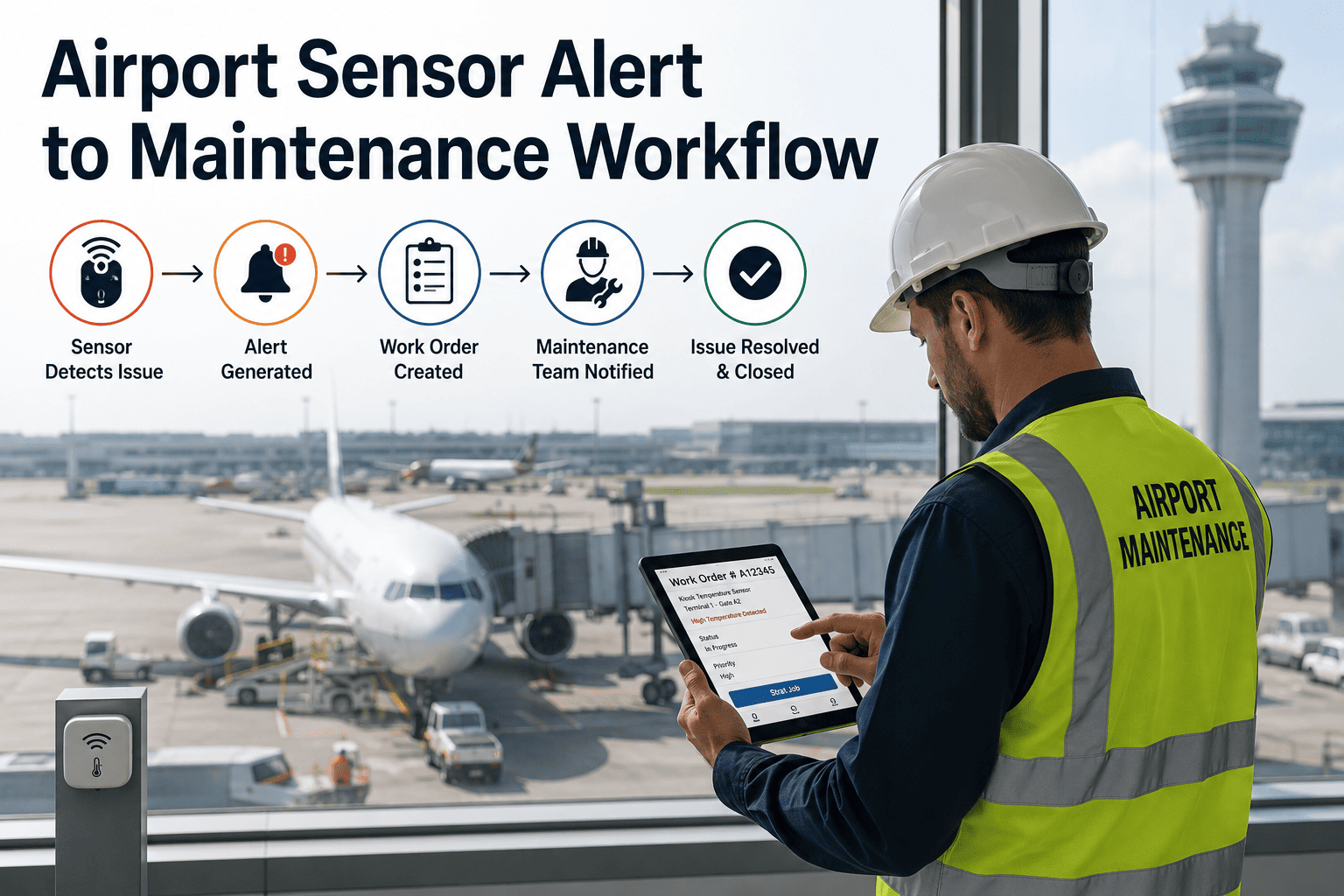
The most common failure mode in airport IoT deployments is not the sensors — it is the gap between the sensor alert and the maintenance action. An airport that deploys vibration monitoring on all conveyor drives but routes the resulting alerts to a dashboard that the maintenance planner checks twice a week has not implemented predictive maintenance. It has implemented expensive reactive maintenance with a 3-day lag. IoT integration is only operationally complete when every sensor alert that indicates an actionable maintenance need automatically triggers a work order in the CMMS — pre-populated with the asset tag, fault description, recommended action, required parts, estimated labor hours, and an optimal scheduling window calculated from the AI's assessment of remaining useful life. This closed-loop integration between IoT sensor intelligence and CMMS work order management is what converts airport IoT from a monitoring program into a maintenance transformation program. Without it, the IoT investment generates data. With it, the IoT investment generates outcomes.
Explore iFactory's CMMS integration documentation and see how IoT-to-work-order automation works across your existing maintenance management system.
Automated IoT-to-CMMS Work Order Generation with AI Scheduling Optimisation
iFactory's CMMS integration layer converts every AI-generated predictive maintenance alert into a structured work order automatically — no manual transcription, no alert-to-planner communication chain, no risk of an alert being seen and not acted on. Work orders are pre-populated from iFactory's asset master: asset tag, location, maintenance procedure reference, required parts with stock check against current inventory, estimated labor hours from historical similar-job data, and an AI-calculated optimal scheduling window based on remaining useful life, operational schedule, and crew availability. Integration is available for SAP PM, IBM Maximo, Oracle eAM, UpKeep, Fiix, and custom CMMS platforms via standard API. Bi-directional integration enables work order completion data to feed back into iFactory's AI models — improving remaining useful life calculations with every completed job. Airport maintenance teams report 70–80% reduction in time between sensor alert and work order creation, and 85%+ of predictive alerts result in planned interventions rather than reactive responses.
IoT Deployment Roadmap: From First Sensor to Full Airport Intelligence
The question airports most frequently ask when beginning an IoT integration program is not "what sensors do we need" — it is "where do we start." The answer is always the same: start where the failure cost is highest and the sensor ROI is most immediate. For most airports, that means baggage handling conveyors, passenger boarding bridges, and security checkpoint equipment — the three infrastructure categories where an unplanned failure during peak hours generates the highest immediate operational and financial impact. A phased deployment approach that begins with highest-ROI infrastructure monitoring, proves the predictive maintenance concept with documented prevented failures within the first 90 days, and then scales to passenger flow, environmental, apron, security, and digital twin integration is more reliably successful than a whole-airport deployment that attempts to activate every sensing domain simultaneously. iFactory's implementation methodology is built around this phase-gated approach — delivering measurable results at every stage that fund and justify the next phase, rather than requiring a full-platform commitment before any value is demonstrated.
Book a free IoT roadmap session — iFactory's aviation IoT specialists will map your airport's highest-ROI starting points based on your infrastructure profile and maintenance cost data.
4-Phase Airport IoT Integration Roadmap with Documented ROI at Every Stage
Phase 1 (Weeks 1–6): Deploy vibration, temperature, and current sensors on highest-criticality infrastructure — baggage conveyors, escalators, moving walkways. Connect to iFactory AI platform. First predictive alerts typically generated within 14 days. CMMS integration activated — work orders auto-generated from every alert. Phase 2 (Weeks 6–16): Expand infrastructure sensing to all terminal systems. Deploy passenger flow counting sensors and activate queue prediction with flight schedule integration. Digital signage integration activated. Phase 3 (Weeks 16–28): Deploy environmental IoT layer. Activate apron IoT — GSE telematics, fuelling sensors. Integrate security IoT data streams. Digital twin initialised from all sensor data. Phase 4 (Weeks 28+): Full digital twin operational — "what if" simulation active. All CMMS integrations bi-directional. AI models compounding improvement from accumulated sensor history. Multi-terminal and multi-airport portfolio scaling. Airports consistently report the first prevented infrastructure failure within weeks 4–6 — a concrete ROI proof point before Phase 2 begins.
iFactory for Airport IoT Integration
Every Sensor Domain. One AI Platform. Complete Airport Intelligence.
iFactory connects infrastructure monitoring, passenger flow sensing, environmental IoT, apron intelligence, security correlation, digital twin simulation, and CMMS work order automation into a single airport operations platform — from first sensor installation to full portfolio integration.
Documented Results from Full Airport IoT Integration
Outcomes documented across independent aviation research and live iFactory deployments at international hub and regional airports in 2025–2026.
The Airport That Knows Its Infrastructure Is Failing Before It Fails Has Already Won
Every unplanned infrastructure failure at your airport was predictable. The bearing that stopped the baggage carousel during the morning peak had been developing its failure signature for weeks. The escalator that closed during the afternoon departure wave had been drawing excess current for 11 days. The queue that cascaded past the checkpoint boundary was visible in the flight schedule data 45 minutes before the first passenger joined it. iFactory's IoT integration platform gives you the sensors, the AI, the digital twin, and the CMMS integration to convert every one of those predictable events into a planned maintenance intervention — before a single passenger ever experiences the consequence.
Frequently Asked Questions
What existing airport infrastructure does iFactory's IoT integration use — and what new hardware is required?
iFactory is designed to maximise the use of existing airport infrastructure before recommending new hardware investment. For passenger flow sensing, iFactory integrates with existing CCTV cameras using computer vision — no new overhead counting hardware required at most airports. For security IoT, iFactory connects to existing access control systems, CCTV management platforms, and perimeter detection systems via standard integration protocols. For infrastructure monitoring, most airports have some existing vibration or temperature monitoring on highest-criticality assets — iFactory integrates these immediately and identifies the specific gaps where new sensors deliver the highest ROI. The result is that most airports can activate significant IoT intelligence within weeks using only existing infrastructure, with new sensor hardware targeted at the specific monitoring gaps where ROI is highest. A typical full airport IoT integration adds sensors to 30–40% of monitored assets — the remaining 60–70% leverage existing instrumentation already on-site. Book a scoping session for an assessment of your current infrastructure against the full IoT integration model.
How does iFactory handle the cybersecurity requirements of connecting IoT sensors to airport operational systems?
Airport cybersecurity is a primary design constraint for iFactory's IoT integration architecture, not an afterthought. The platform operates on a segmented network architecture that maintains strict separation between the IoT sensor data network, the AI processing layer, and the operational CMMS and management systems — ensuring that a sensor network compromise cannot propagate to critical operational systems. All sensor data is encrypted in transit and at rest. Edge processing units operate on air-gapped networks where required by security policy, syncing processed results to the cloud layer without exposing raw operational data to external networks. iFactory's architecture is compatible with ICAO and EASA cybersecurity guidance for airport operational technology, and the platform supports compliance with NIS2 (EU) and TSA cybersecurity directives (US) applicable to airport infrastructure operators. Security assessment documentation and network architecture diagrams are available for review by airport IT security teams as part of the pre-deployment scoping process. Visit our Support Center for cybersecurity architecture documentation.
How long does it take from first sensor deployment to the first AI predictive maintenance alert?
iFactory generates the first AI predictive alerts within 14 days of sensor deployment for most equipment categories. The platform uses two parallel approaches: (1) Pre-trained equipment class models — vibration signatures, temperature profiles, and current draw patterns for common airport equipment types (escalator motors, conveyor drives, HVAC fans, pump systems) are pre-loaded into iFactory's AI from manufacturer specifications and fleet-wide operational data. These models generate alerts from day one based on absolute anomaly detection, before site-specific baselines are established. (2) Site-specific learning — as the sensor accumulates operational data specific to each asset's individual characteristics (installation environment, duty cycle, load patterns), the AI refines its models for that specific asset. After 4–6 weeks of continuous operation, site-specific models typically achieve 85–90% prediction accuracy with 2–4 week failure warning windows. The combination means early value is delivered quickly while model accuracy compounds continuously with operational experience. Most airports document their first prevented infrastructure failure within weeks 4–6 of Phase 1 deployment.
How does the passenger flow IoT system predict queue wait times 30–60 minutes ahead?
iFactory's queue prediction engine combines three real-time data streams: (1) Current state from IoT sensors — people-counting sensors measure queue length, occupancy per zone, and per-lane throughput rates updated every 5 seconds; (2) Incoming demand from flight schedule data — the airport's AODB/FIDS integration provides departure times, aircraft types, load factors, and connecting passenger ratios for every scheduled departure, enabling per-15-minute interval passenger demand prediction; (3) Historical pattern recognition — AI models identify how this specific combination of day-of-week, time-of-day, season, and flight mix has historically translated into queue formation rates. The prediction model calculates: if current throughput continues at X passengers per lane per minute, and Y passengers are forecast to arrive in the next 30–60 minutes from the flight schedule, then wait time at checkpoint Z at time T will be W minutes. When predicted W exceeds the configured threshold, the system alerts the operations team with a specific staff redeployment recommendation — generated from the digital twin's staffing model — before the queue forms. Book a live demo to see queue prediction operating on real flight schedule data.
What is the total investment required for a full airport IoT integration — and what does the ROI model look like?
Total investment for a full airport IoT integration varies significantly with airport size, existing infrastructure, and deployment scope — but iFactory's phase-gated approach means airports do not need to commit to full-scope investment before demonstrating ROI at Phase 1. Phase 1 deployment (highest-criticality infrastructure monitoring, initial CMMS integration) typically achieves full ROI within 6–9 months from the value of prevented infrastructure failures alone. The ROI model is calculated from three primary value streams: (1) Avoided infrastructure failure cost — each prevented unplanned failure avoids an average $95,000–$2.4M in emergency repair, operational disruption, airline delay claims, and passenger compensation depending on the system affected; (2) Maintenance cost reduction — 25–40% total maintenance cost reduction from planned-versus-reactive intervention conversion; (3) Passenger satisfaction and commercial revenue — documented correlation between reduced queue times and increased commercial dwell time that translates directly to per-passenger retail and F&B spend. iFactory produces a quantified ROI projection for your specific airport from maintenance cost data, infrastructure failure history, and passenger flow data as part of the pre-deployment assessment. Book a scoping session to receive your airport-specific ROI model.
Can iFactory's IoT platform scale from a single terminal to a multi-airport group?
iFactory is deployed in configurations ranging from single regional airports with 10-unit equipment fleets to multi-airport portfolio operators managing sensor networks across 15+ facilities from a single platform instance. The multi-airport architecture adds a portfolio intelligence layer above the individual airport operational layer — enabling group-level benchmarking of infrastructure health KPIs, cross-airport best-practice identification, and consolidated procurement of IoT sensor hardware and maintenance services. A portfolio operator can see that their Copenhagen hub's baggage conveyor MTBF is 2× their Helsinki facility's — and that the difference is attributable to a vibration-based lubrication top-up procedure at Copenhagen that has not been propagated to Helsinki. This cross-airport learning capability is a significant advantage of centralised IoT platform management versus independent site deployments. The AI models also improve faster at multi-airport scale because failure data from one facility immediately improves prediction accuracy for identical equipment at all other facilities in the portfolio. Visit our Support Center for multi-airport architecture documentation.