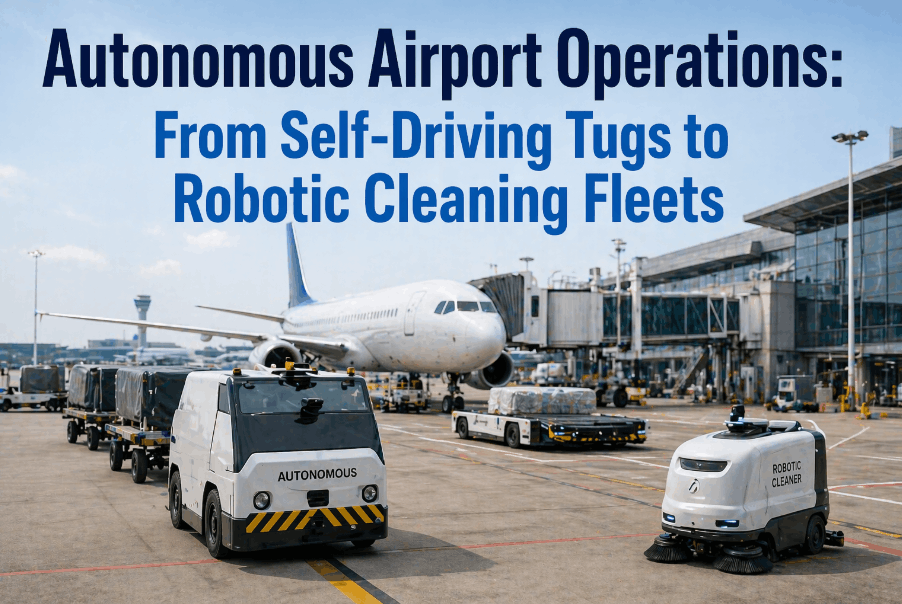
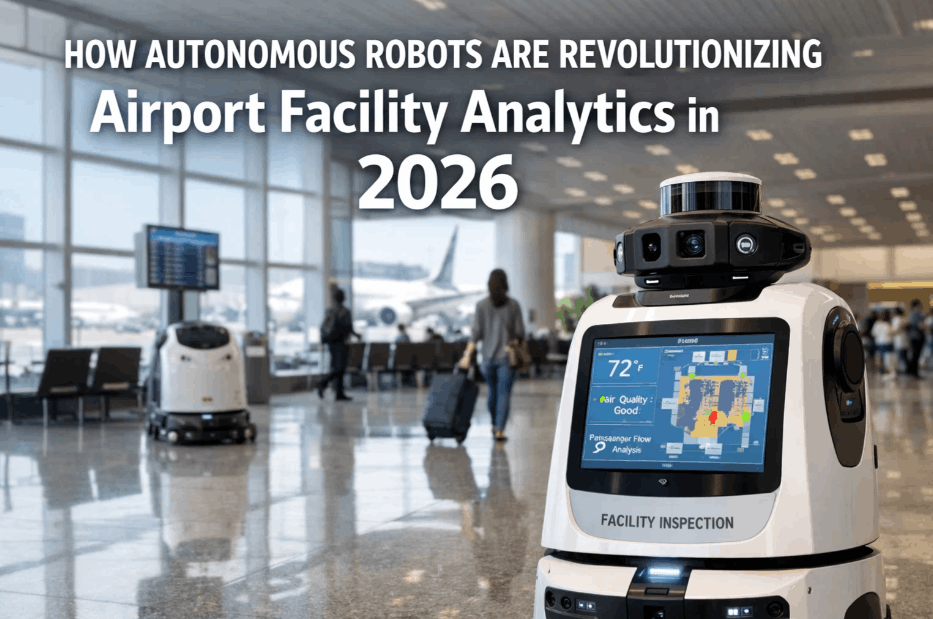
Heathrow operates 32 autonomous cleaning robots across its terminals — each one covering 4,800 square meters daily without a single break. Zurich Airport deployed 26 robotic scrubbers and recovered the investment in under two years. Singapore Changi's Living Lab runs autonomous baggage tractors alongside food-delivery bots in live terminal operations. The airport robotics market is projected to reach $6.5 billion by 2035, growing at 16.6% annually. But a fleet without structured maintenance is a liability waiting to happen. A robot with a miscalibrated LIDAR cannot navigate a gate hold correctly. A battery pack showing a 12% capacity drop may leave a unit stranded mid-corridor with no warning. This checklist gives airport facilities and robotics operations teams a structured, analytics-ready framework to inspect, monitor, and maintain every autonomous system in your terminal fleet before a single robot stops moving.
$6.5B
projected airport robotics market by 2035, up from $1.4B today
4,800 m2
daily cleaning coverage per robot — zero breaks, zero shift gaps
16.6%
compound annual growth rate in airport robot deployments globally
2 yrs
typical ROI for large-scale airport robot fleet deployment
The Airport Robot Fleet Stack
Five robot types. One unified fleet. Each category demands its own inspection cadence and failure mode profile.
TYPE 01
Cleaning
Floor Scrubbers
TYPE 02
Guidance
Wayfinding Units
TYPE 03
Tugs
Baggage & Cargo
TYPE 04
Patrol
Security Bots
TYPE 05
Delivery
Food & Retail
What Happens When You Skip a Domain
Each unchecked item creates a predictable failure mode. This is the real cost of deferred robot fleet maintenance in an airport environment.
Battery Domain
Mid-Route Stranding
Skip SoH trending -> battery degrades below route capacity -> robot stops at farthest point from dock -> manual recovery required, blocking terminal corridor for 20+ minutes
Sensor Domain
Navigation Drift
Skip LIDAR calibration -> point cloud offset grows undetected -> robot clips gate seating or retail displays -> passenger safety incident and costly damage claims
Navigation Domain
Corridor Blockage
Skip map freshness checks -> new kiosk or barrier not reflected -> robot cannot plan path -> deadlock at pinch point cascades across multiple fleet units
Safety Domain
Collision Exposure
Skip emergency stop tests -> brake actuator seizes undetected -> robot fails to stop for passenger -> regulatory investigation and fleet grounding order
Fleet Domain
Silent Disconnection
Skip communication latency checks -> robot drops offline for 30 seconds during route -> fleet manager unaware until mission fails -> lost productivity across shift
Mechanical Domain
Cleaning Quality Failure
Skip brush wear checks -> cleaning effectiveness drops 40% -> floor appearance degrades visibly -> passenger complaints spike, airport rating scores decline
Frequently Asked Questions
Inspection frequency should vary by subsystem. Battery health (SoH, cycle count) should be monitored continuously via fleet management telemetry with weekly automated reviews. Sensor calibration should be validated monthly for LIDAR and cameras, with depth cameras and ultrasonics checked quarterly. Safety systems including emergency stops and bumper sensors require weekly functional tests. Mechanical wear items such as brushes, squeegees, and drive wheels should be inspected based on operating hours, typically every 500 hours. Fleet software and communication links benefit from daily automated health checks with weekly manual verification. iFactory's AI Copilot automates the continuous monitoring of all telemetry streams, flagging inspection triggers based on actual condition rather than fixed calendar intervals.
Battery-related issues account for the largest share of unplanned downtime events across airport robot fleets. The root cause is typically not a sudden battery failure but gradual capacity fade that goes unnoticed until the robot cannot complete its assigned route. The second most common cause is sensor calibration drift, particularly in LIDAR and camera fusion systems, which leads to navigation errors that cause safety stops or path-planning failures. Both failure modes are detectable weeks in advance with continuous telemetry monitoring. At Heathrow, the 32-robot cleaning fleet is managed through a digital platform that tracks key operational metrics — the same approach applied through iFactory's predictive analytics layer can flag a degrading battery or drifting LIDAR alignment before either causes a mission failure.
iFactory's AI Copilot ingests real-time telemetry from every robot in the fleet ation status, battery SoH, sensor health scores, communication latency, mission completion rates, and safety stop events. The platform builds a performance baseline for each individual robot and each robot type, then applies anomaly detection to identify deviations before they produce failures. When a cleaning robot's brush motor current draw rises 12% above its three-week baseline, the platform generates a work order for brush inspection before the motor overheats mid-route. When a guidance robot's localisation covariance increases beyond its normal range, the system flags a LIDAR calibration check before navigation accuracy degrades. The AI Copilot does not replace existing fleet management platforms — it layers predictive intelligence on top of them, connecting directly to your fleet dashboard or CMMS via API.
Airport autonomous robots must comply with ISO 13482 (service robot safety), ANSI/ITSDF B56.5 (industrial truck safety), and relevant IEC 62061 and ISO 13849 machinery safety standards for control systems. In airport environments specifically, the robot's risk assessment should address passenger interaction zones, emergency evacuation paths, and compatibility with airport security protocols. The European Machinery Directive (2006/42/EC) applies in EU airports, while US airports follow OSHA general duty requirements and ANSI safety standards. Most airports require a documented safety case and third-party certification before autonomous robots operate in passenger-accessible areas. iFactory's platform supports compliance by maintaining timestamped, technician-attributed inspection records and automated safety system test logs in audit-ready format.
Yes. iFactory is built for heterogeneous fleets and operates as a vendor-agnostic analytics layer. The platform connects to each vendor's fleet management API or telemetry endpoint to ingest robot status, mission data, and sensor health information into a unified dashboard. Whether your fleet includes BrainOS-powered cleaning robots, autonomous tugs from Seegrid or MiR, and guidance units from SoftBank Robotics, iFactory normalises the data streams and applies consistent anomaly detection across all asset types. This is particularly valuable in airport environments where cleaning robots, security patrol units, baggage tractors, and delivery bots often come from different vendors and operate on separate management platforms. Pilot integration typically reaches go-live within 4 to 8 weeks.
iFactory AI Copilot for Fleet Analytics
Stop Chasing Robot Failures. Predict Them Before They Stop Your Fleet.
iFactory connects to your fleet management platform, battery monitoring systems, and sensor diagnostics to deliver condition-based work orders before a robot degrades below operational threshold. Trusted by infrastructure operators across the UK, EU, Middle East, and Asia-Pacific.
Pilot in 30 days. Full integration in one quarter.