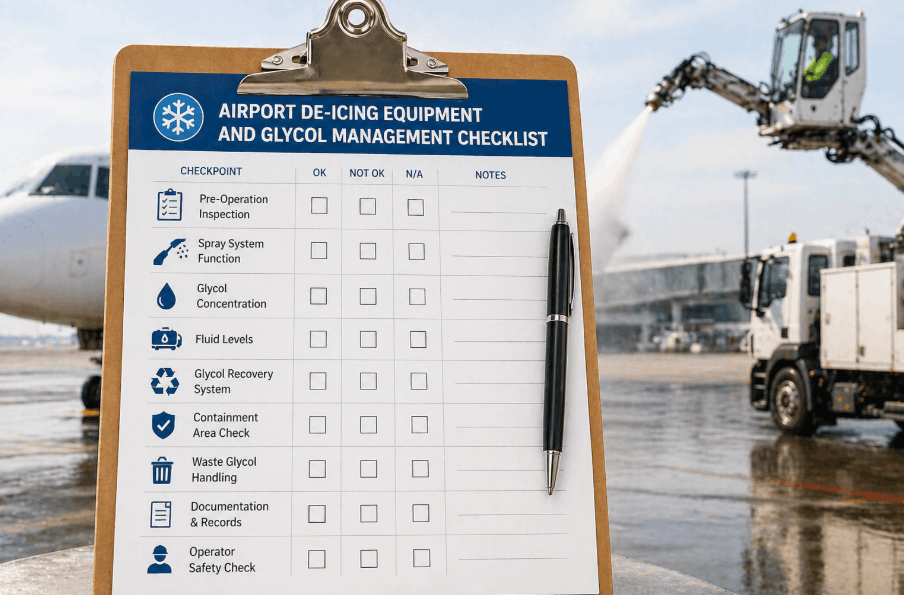
Airport ground operations depend on consistent, well-documented de-icing processes — where equipment failures, incorrect glycol concentrations, or poor recovery practices can ground flights, trigger environmental violations, and compromise aircraft safety. A structured airport de-icing equipment and glycol management checklist is the backbone of compliant, efficient winter operations — covering truck inspections, fluid storage, application equipment, glycol recovery, and regulatory documentation. Book a Demo to discover how digital compliance tracking platforms replace paper-based de-icing logs with real-time equipment monitoring, automated glycol usage reporting, and instant corrective action workflows across every ground support operation.
DE-ICING COMPLIANCE
GLYCOL MANAGEMENT
EQUIPMENT VERIFICATION
Automate Airport De-Icing Equipment Compliance and Glycol Management Tracking
Monitor de-icing truck readiness, glycol storage conditions, application equipment calibration, recovery system performance, and environmental compliance documentation — with audit-ready records for every winter operation.
Why De-Icing Equipment and Glycol Management Requires Structured Verification
Equipment Failures During Winter Operations Create Immediate Safety Risks
De-icing trucks operating with faulty booms, clogged nozzles, or inaccurate glycol concentration sensors produce inconsistent fluid application that leaves ice contamination on critical aircraft surfaces. Without pre-shift equipment verification, mechanical failures discovered mid-operation delay departures and create safety exposures that trigger FAA scrutiny and airline operational reviews.
Glycol Discharge Violations Carry Severe Environmental and Regulatory Penalties
Airports operating without documented glycol recovery verification and stormwater management controls face EPA stormwater permit violations, state environmental agency enforcement actions, and multi-million dollar remediation liabilities. Structured glycol management checklists ensure recovery system performance is verified before each de-icing season and documented throughout winter operations to satisfy National Pollutant Discharge Elimination System requirements.
DIGITAL COMPLIANCE
GLYCOL TRACKING
Ready to Digitize De-Icing Equipment Compliance and Glycol Management Across Your Airport?
Automate de-icing truck inspections, glycol concentration logging, recovery system verification, and environmental compliance documentation — and eliminate manual record gaps with real-time compliance dashboards.
Benefits of Digital De-Icing Equipment and Glycol Management
Reduced Equipment Downtime During Peak Winter Operations
Structured pre-shift equipment inspection checklists identify pump failures, nozzle blockages, and hydraulic issues before aircraft are positioned for de-icing — preventing the mid-operation breakdowns that create departure delays, ramp congestion, and airline penalty exposure during high-demand winter weather events.
Environmental Compliance and NPDES Permit Protection
Automated glycol usage logging, recovery volume tracking, and stormwater isolation verification creates the complete environmental data trail required for NPDES discharge monitoring reports — eliminating the documentation gaps that trigger permit violations and environmental agency enforcement during annual compliance reviews.
Glycol Cost Recovery and Inventory Optimization
Digital fluid dispensing records and application volume logging by aircraft type enable accurate glycol cost recovery billing to airlines and reveal usage inefficiencies — with facilities implementing structured glycol tracking typically identifying 15-25% reduction opportunities through concentration optimization and application technique improvements.
Airline Audit Readiness and Quality Assurance Compliance
Timestamped equipment inspection records, operator certification documentation, and fluid quality test results provide instant audit response capability during unannounced airline ground handler quality reviews — replacing the manual record searches that delay audit responses and create negative performance findings on airline vendor scorecards.
Corrective Action Tracking and Equipment Reliability
Automated defect logging with assigned ownership and completion deadlines eliminates the maintenance backlog accumulation that develops when equipment issues are identified verbally but never formally documented — creating visibility into recurring failure patterns that justify targeted fleet maintenance investment before critical equipment fails during operations.
Operator Accountability and Training Performance Visibility
Digital pre-shift inspection completion tracking with operator identification creates accountability for checklist compliance across all shifts and crews — while certification currency dashboards provide supervisors with advance warning of operator qualification expirations before they create staffing gaps during peak winter weather periods.
Airport De-Icing Equipment and Glycol Management FAQs
1. What regulatory requirements govern glycol management at commercial airports?
Commercial airports discharging glycol-contaminated stormwater must comply with EPA NPDES Multi-Sector General Permit requirements under 40 CFR Part 122. Airports above threshold de-icing volumes must implement Airport Deicing Effluent Limitation Guidelines, requiring glycol collection systems, Chemical Oxygen Demand monitoring, and discharge limits for deicing area runoff. State environmental agencies may impose additional requirements beyond federal minimums. Facilities must maintain glycol application and recovery records, conduct regular stormwater sampling, and submit discharge monitoring reports on schedules defined by their individual NPDES permit conditions.
2. How often should de-icing truck equipment receive formal inspection?
De-icing trucks require pre-shift operational checks before every active use period covering fluid systems, boom function, safety equipment, and vehicle systems. In addition to daily operational checks, comprehensive preventive maintenance inspections should be conducted at defined intervals — typically every 250-500 operating hours or monthly during winter seasons — covering hydraulic system condition, pump and nozzle wear, heating system performance, and structural integrity. Annual off-season overhauls should address all deferred maintenance and component replacement to ensure fleet readiness before the following winter season begins.
3. What are acceptable glycol concentration ranges for aircraft de-icing operations?
Type I de-icing fluid is typically applied at concentrations ranging from 100% neat fluid in severe conditions down to 50/50 dilution for light frost removal, depending on outside air temperature and precipitation intensity. Type IV anti-icing fluid concentration requirements are defined by holdover time tables published by the FAA and transport category aircraft manufacturers — with concentrations below 75% generally not providing adequate holdover time protection in active precipitation conditions. Operators must reference current holdover time guidelines and apply fluid at concentrations appropriate for actual ambient conditions rather than using standardized dilution ratios regardless of weather severity.
4. Are digital records acceptable for airline quality audits of de-icing operations?
Yes — major airline quality assurance programs and International Air Transport Association Ground Handling standards accept electronic records for de-icing compliance documentation provided systems maintain data integrity, record all required fields, and prevent unauthorized modification. Digital systems offer significant audit advantages including instant record retrieval by aircraft tail number and date, automated operator certification currency tracking, and trend analysis across seasonal operations that paper-based systems cannot efficiently produce. Implementing digital platforms prior to airline quality audits demonstrates operational maturity that positively influences vendor qualification assessments.
5. What corrective actions are required when glycol recovery system failures occur?
When glycol recovery systems fail during active de-icing operations, facilities must immediately assess whether operations can continue with alternative collection methods or must be suspended to prevent uncontrolled glycol discharge. Temporary collection using portable sumps, vacuum tankers, or redirected drainage may allow limited operations to continue while permanent system repairs are made. All uncontrolled discharges must be reported to the airport environmental compliance coordinator and, if surface water reaches receiving waters, to state environmental agencies per permit notification requirements. Documentation of the failure, response actions, and corrective measures taken must be maintained in the facility's SPCC or stormwater pollution prevention plan records.
6. What training certifications are required for de-icing truck operators?
De-icing operators at certificated airports must complete training meeting standards established by accredited programs such as the Society of Automotive Engineers (SAE) International ARP4737 guidelines or equivalent airline-approved training curricula. Initial certification covers fluid types and properties, holdover time concepts, application techniques, equipment operation, and safety procedures. Annual or biennial recurrency training is required to maintain certification, with some airline contracts mandating specific approved training providers. Equipment-specific operator qualifications may be required separately for specialized truck types or boom configurations not covered by standard certification programs.
GET STARTED
DIGITIZE TODAY
Digitize Your Airport De-Icing Equipment Compliance and Glycol Management Program Today
Join airport ground operations teams that have eliminated manual inspection gaps, automated glycol usage documentation, and strengthened environmental compliance with structured digital verification workflows across every de-icing operation.