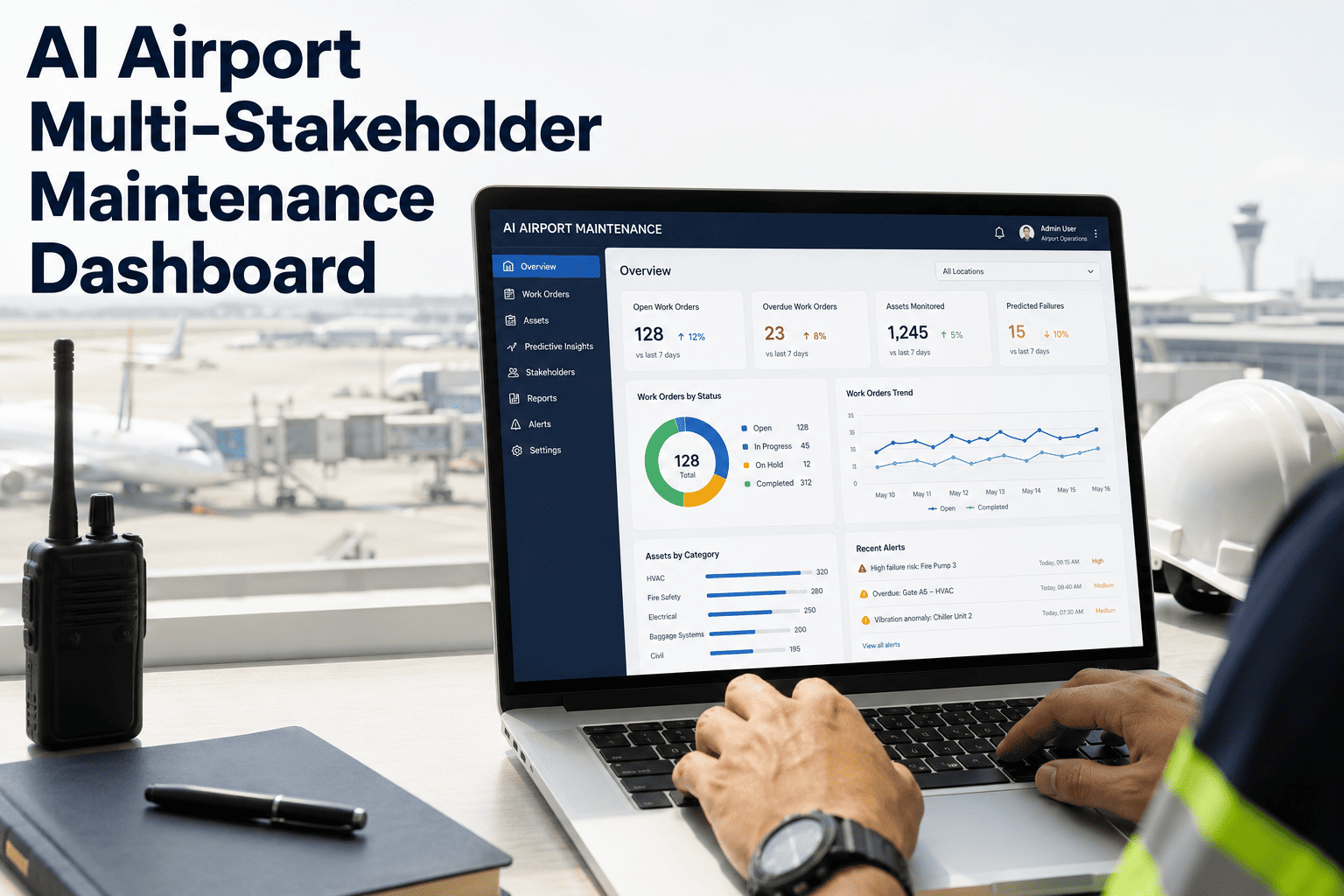
Managing analytics across multiple airport terminals from a single, fragmented stack is one of the most costly operational blind spots in modern aviation management. Gate utilization data sitting in Terminal A's system has no visibility into Terminal C's crew deployment gaps — and when centralized decisions depend on manually consolidated reports, the latency between event and response is measured in hours, not seconds. In 2026, the airports achieving measurable gains in operational efficiency and cost-per-passenger performance share a single capability: a centralized multi-terminal analytics coordination platform that aggregates live performance data across every concourse, standardizes workflows system-wide, and enables airport operations center teams to allocate crews, assets, and resources based on unified intelligence — not isolated terminal snapshots. To see how iFactory's Multi-Site Dashboard transforms your airport's cross-terminal coordination, Book a Demo with the iFactory aviation analytics team.
Why Siloed Terminal Analytics Undermine Airport-Wide Operational Performance
The Hidden Cost of Disconnected Multi-Concourse Operations Data
Most major airports operate with terminal management systems that were never designed to communicate with each other. A domestic terminal running at 94 percent gate utilization has no automated signal to the international concourse where four gates sit idle during the same peak window. Cleaning crew deployments get scheduled by supervisor headcount rather than real-time dwell traffic data. Baggage handling SLA breaches in one terminal go unreported to the central operations director until the airline complaint has already escalated. This siloed architecture is not a technology problem — it is an analytics architecture problem. When terminal-level data never aggregates into a unified operations view, every airport-wide decision carries the informational weight of the least-connected terminal in the network. Airports ready to eliminate that structural blind spot can Book a Demo to walk through a live multi-terminal analytics configuration mapped to their facility layout.
What Centralized Multi-Terminal Analytics Coordination Actually Delivers
From Terminal-Level Reporting to Airport Operations Center Intelligence
Centralized airport analytics is not about aggregating dashboards — it is about transforming the decision-making architecture of the airport operations center itself. When live performance data from every terminal, concourse, and support facility feeds into a unified intelligence layer, the operations center stops reacting to terminal-level incidents and starts managing airport-wide resource flows with the same analytical precision that airlines apply to fleet routing. Gate availability signals inform ground services crew positioning before the inbound aircraft enters final approach. Dwell time patterns across terminals drive retail staffing schedules 48 hours in advance. Cleaning service completion rates across all concourses surface in a single compliance view that eliminates the daily manual roll-up that currently consumes two hours of supervisory capacity per shift. Airport operations leads exploring this transformation can Book a Demo and review live multi-concourse analytics outputs built from real aviation operations data.
The Five Core Capabilities of an Airport Multi-Terminal Analytics Platform
Architecture Requirements for Cross-Terminal Operational Intelligence at Scale
A production-grade multi-terminal analytics coordination system is built on five interconnected capability layers. Each layer addresses a specific operational failure mode that emerges when terminal analytics remain isolated — from resource misallocation and inconsistent service delivery to blind-spot compliance monitoring and reactive capital response. Airport analytics directors and operations center managers evaluating platform options can Book a Demo to see each of these layers configured against their specific terminal network.
Multi-Terminal Analytics vs. Terminal-Level Operations: Capability Comparison
How Centralized Airport AI Platforms Compare to Isolated Terminal Management Systems
The table below maps critical operational capability dimensions across three airport management approaches — from isolated terminal systems to partially integrated CMMS configurations to fully centralized multi-terminal AI analytics platforms designed for airport operations center deployment.
| Operational Capability | Isolated Terminal Systems | Partial CMMS Integration | Centralized AI Analytics Platform |
|---|---|---|---|
| Cross-Terminal Performance Visibility | Not Available | Manual Report Consolidation | Live Unified Dashboard |
| Crew Allocation Optimization | Terminal-Specific Only | Partial — Shared Zones Only | Real-Time Cross-Terminal Redeployment |
| Workflow Standardization Monitoring | No System-Wide Baseline | Static SOP Documentation | Live Adherence Tracking Per Terminal |
| Terminal Performance Benchmarking | Not Available | Post-Period Manual Comparison | Continuous AI-Driven Ranking |
| Predictive Demand Scheduling | Shift-Based Headcount Only | Flight Schedule Import | 72-Hour AI Forecast by Terminal |
| Service Compliance Alerting | Post-Incident Reporting | Threshold Alerts — Single Terminal | System-Wide Multi-Terminal Alerting |
| Airport Operations Center Integration | Disconnected Feeds | Scheduled Data Exports | Live Bidirectional Operations Layer |
| Resource Reallocation Decision Time | Hours — Manual Process | 30–60 Minutes | Under 5 Minutes — AI Recommendation |
Six Operational Failure Patterns That Centralized Multi-Terminal Analytics Eliminates
Where Fragmented Airport Analytics Architecture Creates Avoidable Service and Cost Risk
The most persuasive case for centralized airport multi-terminal analytics is not a feature comparison — it is the catalog of specific operational failures that terminal-siloed systems produce at scale. Each pattern below represents a documented cost driver in multi-concourse airport environments, and the mechanism through which centralized AI-driven coordination prevents it.
Measured Performance Outcomes: Centralized Multi-Terminal Analytics Deployments
Documented Operational and Financial Results Across Multi-Concourse Airport Implementations
Integrating Centralized Analytics with Your Airport Operations Center
Deployment Architecture for Multi-Terminal AI Analytics at Scale
The most effective multi-terminal analytics coordination deployments are not bolt-on dashboards — they are architecture decisions that position the centralized intelligence layer as the operational nervous system connecting every terminal, support facility, and field team within the airport campus. iFactory's Multi-Site Dashboard integrates with existing terminal management systems, CMMS platforms, flight information display feeds, and ground handler scheduling tools through standard data protocols — without requiring replacement of validated terminal-level configurations. For international airports managing multiple buildings across separate concession zones, the platform's cross-facility analytics layer enables the airport operations center to manage service delivery, asset allocation, and workforce scheduling as a unified network rather than a collection of semi-independent terminal operations. Airport directors ready to build this capability can Book a Demo and walk through a live multi-site integration review with the iFactory aviation team.
Building the Executive Case for Multi-Terminal Analytics Investment
Translating Cross-Terminal Coordination Gaps into Board-Ready Financial Evidence
The business case for centralized airport analytics begins with four questions every airport COO can answer from existing records — and the answers consistently reveal a magnitude of avoidable operational cost that exceeds platform investment within the first operating year.
Frequently Asked Questions
What is multi-terminal analytics coordination for airports?
It is a centralized AI-driven framework that aggregates real-time operational data from every terminal and concourse into a unified dashboard — enabling airport operations centers to compare performance, allocate crews, and standardize workflows across all facilities simultaneously rather than managing each terminal in isolation.
How does a centralized analytics dashboard improve cross-terminal crew allocation?
By providing a live view of service demand and crew availability across all terminals simultaneously, the platform identifies imbalances in real time — flagging surplus capacity in low-demand concourses and recommending redeployment to terminals where service load exceeds current staffing, accounting for travel time and certification requirements.
Can the platform standardize workflows across terminals with different management teams?
Yes. The platform establishes a centrally defined workflow standard and monitors adherence in real time across all terminals — surfacing procedural drift before it accumulates into service inconsistency. Terminal managers retain operational authority while the central analytics layer provides system-wide compliance visibility.
What types of KPIs does cross-terminal benchmarking cover?
The platform benchmarks gate readiness compliance, turn-time adherence, cleaning cycle completion, baggage handling SLA performance, crew task completion rates, shared asset utilization, and service escalation response time — ranking each terminal against system-wide averages and flagging persistent underperformers with root-cause drill-down analytics.
How does predictive demand modeling work for multi-terminal scheduling?
AI models process flight schedule data, historical passenger flow patterns, and seasonal traffic trends to forecast service demand by terminal 24 to 72 hours in advance. Operations center teams use these forecasts to pre-position crews, assign shared equipment, and activate supplementary service contracts before demand peaks arrive.
Does the platform replace existing terminal management systems?
No. The platform integrates with existing CMMS, flight information, and terminal management systems through standard data protocols — adding a centralized intelligence layer without replacing or disrupting validated terminal-level configurations. Most multi-terminal integrations are completed within six to ten weeks without operational interruption.
What is the benefit for international airports with separate concession zones?
For airports managing domestic, international, and satellite concourses across separate physical buildings, cross-facility analytics enables the operations center to manage resource allocation and service compliance as a unified network — directing workforce and equipment to where demand is highest regardless of facility boundaries.
How quickly do airports see measurable results after deployment?
Most airports report measurable improvements in crew allocation efficiency and cross-terminal reporting time within the first four weeks of deployment. Full predictive scheduling capability and terminal benchmarking analytics are typically active within six to ten weeks, with quantifiable service compliance improvements visible within the first operating quarter.
Can this scale to airport systems managing multiple separate airport facilities?
Yes. The Multi-Site Dashboard scales from a single multi-terminal airport to regional airport authority networks managing multiple distinct facilities — enabling system-wide capital allocation, performance benchmarking, and workforce planning decisions based on unified analytics across all airports in the portfolio.
What data is required to get started?
Core inputs are an asset and facility inventory for each terminal, historical maintenance and service records, current crew scheduling documentation, and flight schedule feeds. Most airports have sufficient legacy data to begin model training within the first four weeks, with sensor integration unlocking full real-time predictive capability as the deployment matures.