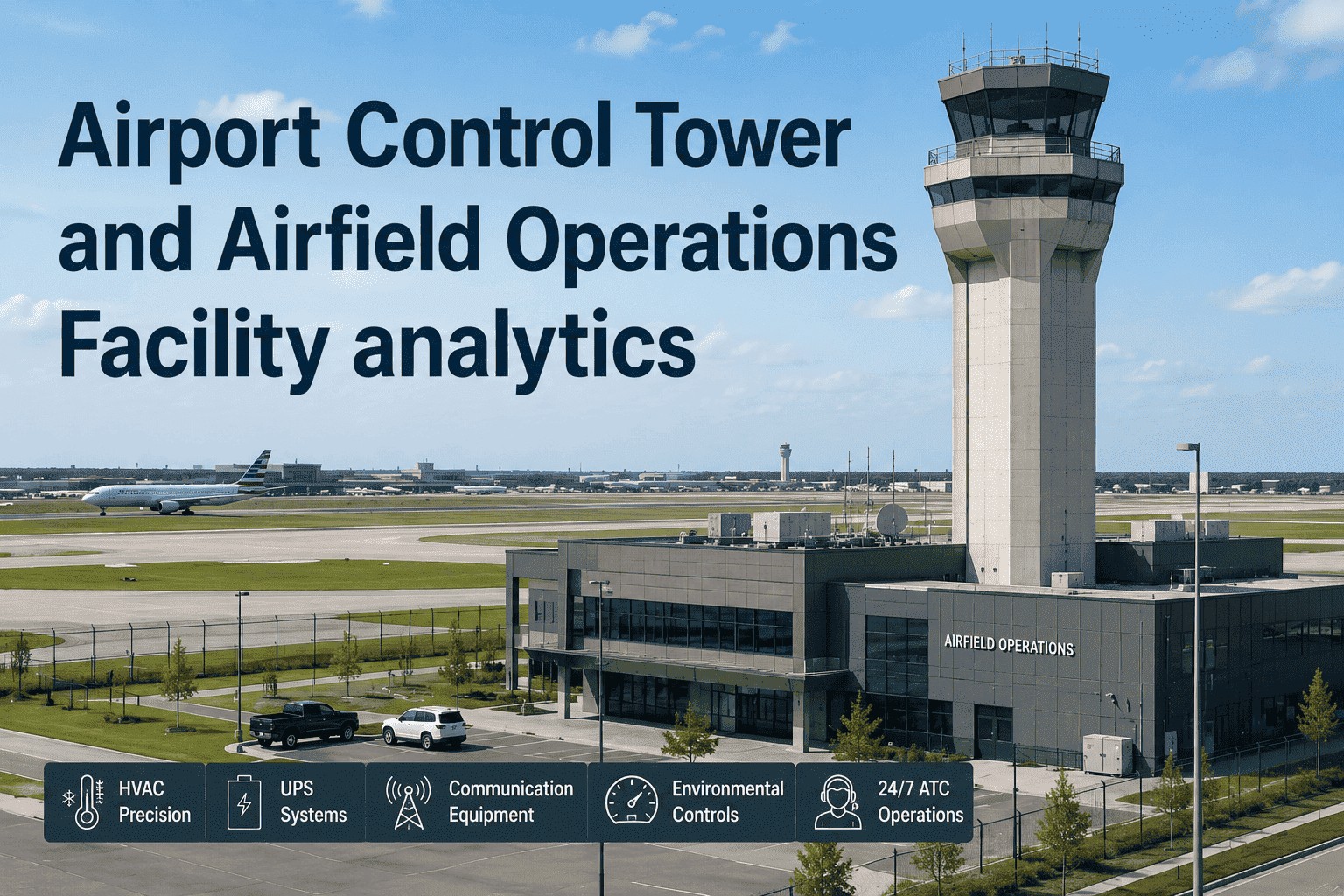
An air traffic control tower does not have business hours. It operates continuously, in all weather, under a regulatory framework that treats every equipment failure as a potential safety event — because in ATC operations, it is. The HVAC system maintaining precise temperature and humidity inside the control cab is not a comfort amenity; it is a condition requirement for the radar and communication equipment that keeps aircraft separated on final approach. The UPS bank in the equipment room is not a backup power convenience; it is the difference between a controlled transition and an unannounced system outage during peak departure flow. Facility managers responsible for control tower and airfield operations buildings carry a maintenance obligation unlike any other building type: zero tolerance for environmental drift, zero tolerance for power interruption, and zero tolerance for documentation gaps when the Civil Aviation Authority arrives for its next operational readiness inspection.
Control Tower Analytics · ATC Facility Management · UPS Tracking · Environmental Controls
ATC Facilities Run 24/7. Your Preventive Maintenance Platform Should Too. iFactory Does.
iFactory tracks every critical system in your control tower and airfield operations building — HVAC precision, UPS health, communication equipment environments, and lighting — with AI-driven PM scheduling built for continuous operations.
100%
Uptime obligation for ATC communication and radar systems — facility environmental failures are the leading non-aeronautical cause of equipment downtime
73%
Of ATC facility environmental incidents are preceded by a deferred or missed HVAC or UPS preventive maintenance task — documented in post-incident reviews
$380K
Estimated hourly cost of ATC facility downtime — including ground stops, delay cascades, airline penalties, and regulatory investigation costs
4.8x
Higher emergency repair cost for UPS and precision HVAC systems in ATC environments compared to planned replacement — driven by specialist contractor availability and expedited parts
Why Control Tower Facility Management Is a Different Category of Problem
Standard commercial facility management optimizes for occupant comfort and cost efficiency. Control tower facility management optimizes for continuous equipment operation within defined environmental parameters — and those parameters are not suggestions. ICAO Annex 11, national CAA operating standards, and equipment manufacturer specifications combine to define the temperature ranges, humidity bands, power quality tolerances, and lighting levels inside which ATC systems are certified to operate. A control cab that drifts two degrees outside its specified range is not uncomfortable — it is potentially outside the operational envelope of the radar display systems used to separate aircraft. That distinction changes everything about how preventive maintenance must be managed.
Standard Commercial Building
HVAC maintains comfort range: 20–26°C acceptable variation
Power failure: occupants evacuate, operations resume later
Maintenance deferred: inconvenience, possible tenant complaint
Compliance record gap: potential regulatory notice
ATC Control Tower Facility
HVAC maintains equipment specification range: ±1–2°C tolerance for certified systems
Power failure: aircraft separation continuity is immediately at risk — UPS bridging is mandatory
Maintenance deferred: equipment operates outside certified envelope, safety implication
Compliance record gap: CAA operational readiness review failure, potential airspace restriction
Consequence of failure: operational disruption
Consequence of failure: aviation safety event
The Six Systems That Determine Whether Your Control Tower Stays Operational
Control tower and airfield operations building facility management is defined by six critical systems. Each one requires its own PM cadence, its own environmental specification, and its own compliance record structure. A platform that manages these systems as generic building assets — treating a precision cooling unit the same as an office air conditioning unit — is not managing them at all.
System 01
Precision HVAC and Environmental Control
The control cab and equipment room HVAC systems must maintain temperature and humidity within equipment manufacturer specifications — typically 18–22°C with relative humidity between 45–60% for radar and communication systems. Deviation from these ranges accelerates component degradation, causes condensation risk on circuit boards, and in extreme cases triggers thermal shutdown on safety-critical equipment. iFactory schedules HVAC PM at the asset level with separate cadences for the control cab precision cooling units and the general building systems — ensuring the highest-criticality environments are never treated as low-priority maintenance items.
Precision cooling unit PM scheduling
Temperature and humidity log integration
Redundant unit failover readiness tracking
System 02
UPS and Standby Power Systems
UPS systems in ATC facilities must provide seamless power continuity during grid transitions, with battery banks sized and maintained to carry the full communications and radar load for the duration defined by the emergency power plan. Battery degradation is silent — a UPS that passes its monthly self-test at 80% capacity appears healthy but may fail to deliver its rated runtime under full load during an actual grid failure. iFactory tracks each UPS unit and battery string as individual assets with load test scheduling, capacity trend logging, and battery replacement forecasting — so degradation is caught on the PM calendar, not during a live outage.
Battery string capacity trend tracking
Load test scheduling and record retention
Battery replacement lifecycle forecasting
System 03
Communication Equipment Room Environments
The equipment rooms housing VHF/UHF radio transceivers, radar processors, and ATIS servers operate under more stringent environmental requirements than the control cab itself. Heat loads from densely racked equipment are high, ventilation requirements are specific, and any dust contamination event that follows a filter failure can shorten the service life of equipment worth millions. iFactory manages equipment room HVAC and air filtration as a separate asset category with its own PM schedule — decoupled from the general building maintenance calendar — and tracks filter change records, temperature excursion logs, and quarterly inspection completions against the equipment manufacturer's environmental certification requirements.
Equipment room-specific PM scheduling
Air filtration change record tracking
Temperature excursion log storage
System 04
Tower Lighting — Cab, Obstruction, and Airfield Edge
Control tower obstruction lighting is an ICAO Annex 14 requirement and an airport operating certificate obligation — not a building maintenance task. A failed tower obstruction light that goes unreported for 48 hours can trigger a NOTAM, impose night operating restrictions, and generate a regulatory investigation. Airfield edge and threshold lighting faults discovered during a runway inspection create immediate airfield restriction risk. iFactory tracks obstruction lighting, control cab operational lighting, and airfield perimeter lighting as individual assets with inspection schedules, fault report workflows, and compliance record storage — ensuring every lighting defect enters a tracked work order the moment it is identified, not when it is remembered.
Obstruction lighting inspection scheduling
NOTAM-risk fault escalation workflows
Airfield lighting compliance record storage
System 05
Electrical Distribution and Power Quality
ATC facilities require clean, stable power throughout the distribution network — not just at the UPS output. Harmonics, voltage sags, and transient events on the distribution panels serving communication and radar equipment can cause soft failures that manifest as intermittent system restarts or corrupted data logs rather than clean outages. These events are difficult to diagnose unless power quality measurement records exist from the affected distribution panels. iFactory tracks electrical distribution panels and power conditioning equipment as assets with inspection and testing schedules — capturing thermographic inspection records, power quality measurement logs, and panel certification dates that support both predictive maintenance and post-incident analysis.
Panel-level inspection scheduling
Thermographic scan record retention
Power quality log asset linkage
System 06
Fire Suppression and Life Safety Systems
Control towers and equipment buildings require clean agent fire suppression systems — gaseous suppression rather than water or foam, to protect equipment from suppression agent damage during an activation. These systems require annual inspection, semi-annual agent weight verification, and documented testing of detection and activation circuits. A clean agent system that discharges inadvertently due to a detector fault in an equipment room can destroy more equipment than the fire it prevents — making false discharge prevention through proper maintenance as important as actual fire protection. iFactory registers each suppression zone and detection circuit as a tracked asset with its inspection schedule, discharge history, and certification record maintained in a format accessible for both fire marshal review and internal safety audits.
Clean agent system certification tracking
Agent weight verification scheduling
Detector circuit inspection records
Every Deferred PM in a Control Tower Facility Is a Risk Event Waiting for a Trigger. iFactory Eliminates the Deferral.
AI-driven preventive maintenance scheduling across every critical system — with compliance records generated automatically and available before the next CAA inspection.
The ATC Facility Maintenance Calendar — What Gets Tracked and When
Control tower and airfield operations building maintenance runs on a continuous calendar — not an annual event cycle. iFactory pre-configures this calendar at the asset level, auto-generates work orders at the correct interval for each system, and escalates overdue tasks before they become compliance gaps or equipment events.
System
Weekly
Monthly
Quarterly
Annual
Precision HVAC
Temperature and humidity log review — flag any excursion from equipment specification range
Filter condition check and replacement per schedule — log date and technician ID
Full coil, drain pan, and refrigerant inspection — record findings against asset history
Full system certification — update equipment environmental compliance record
UPS and Battery
Self-test output review — confirm battery capacity reporting and alarm status per unit
Visual inspection of battery strings — check for swelling, corrosion, and terminal condition
Discharge test under representative load — log actual runtime against rated capacity
Full load test and battery capacity rating update — forecast replacement timeline from trend data
Tower Lighting
Obstruction light function test — document pass/fail per fixture, initiate work order on any failure immediately
Airfield edge and threshold lighting inspection — flag defects per airfield zone
Full cab and equipment room operational lighting test — confirm emergency circuit function
Full airfield lighting compliance review — update ICAO Annex 14 certification records
Electrical Distribution
Panel alarm status check — confirm no active faults or tripped protective devices across distribution boards
Switchgear visual inspection — check for overheating indicators and confirm breaker positions
Thermographic scan of critical distribution panels — log findings, schedule remediation if hotspots identified
Full electrical certification — update panel records and power quality measurement log
Fire Suppression
Control panel status review — confirm no active faults or suppressed alarms on detection circuits
Agent container visual check — confirm seal integrity and weight indicator status per zone
Detector function test per zone — document test date, method, and pass/fail per circuit
Full system inspection and certification — store certificate at asset level for CAA and fire marshal access
What a CAA Operational Readiness Inspection Actually Looks For
Civil Aviation Authority operational readiness inspections of ATC facilities are not general building compliance reviews. They are assessments of whether the physical infrastructure is capable of supporting continuous, certified ATC operations — and the documentation standard they apply is specific, structured, and unforgiving of gaps. Understanding what inspectors look for is the first step to ensuring your facility can demonstrate it.
What Inspectors Request — And What Most Facilities Struggle to Produce
!
Complete UPS battery capacity test records for the past 24 months — not just the most recent test
!
Temperature and humidity excursion log for equipment rooms — with evidence each excursion was investigated and resolved
!
Fire suppression inspection certificate current within 12 months — per zone, per system, not per building
!
Obstruction lighting inspection record with weekly test dates and any fault-to-resolution timelines
!
Evidence that deferred PM tasks were identified, risk-assessed, and rescheduled — not simply missed without record
How iFactory Prepares Your Facility for Every Inspection Before It Is Announced
✓
Every UPS test generates a timestamped record stored at the asset level — retrievable by date range, unit ID, or test type in seconds
✓
Environmental excursions logged as work orders — with resolution records that demonstrate response time and corrective action
✓
Suppression system certificates stored at the zone-asset level — with expiry alerts generated 60 days before certification lapses
✓
Obstruction lighting test records maintained as a continuous log — with fault-to-resolution timeline automatically captured per work order
✓
Deferred PM tasks flagged, risk-tagged, and rescheduled within the system — with a visible audit trail showing the deferral decision and approval
"
We had a CAA operational readiness inspection with 48 hours notice. The inspector asked for UPS load test records going back 18 months, environmental logs for the equipment rooms, and the fire suppression certification for each zone in the tower. Two years earlier, that request would have taken us two days to respond to and the records would have had gaps. This time we had everything printed and organised by asset within the hour. The inspector commented that it was the most complete facility documentation he had seen in a tower of our size. That did not happen because we worked harder — it happened because every maintenance event was recorded in the system the moment it occurred.
— Facility Manager, International Airport ATC and Operations Centre — 11 Years Aviation Infrastructure
Frequently Asked Questions
Conclusion
Control tower and airfield operations building facility management sits at the intersection of aviation safety and infrastructure maintenance in a way that no other facility type does. The HVAC system, the UPS bank, the obstruction lighting, and the fire suppression system are not building services — they are components of the operational infrastructure that makes continuous ATC possible. When these systems are managed with the same tools and processes used for a standard commercial office building, the gap between the maintenance standard the facility requires and the maintenance standard it receives is invisible — until a CAA inspection, a power event, or an equipment failure makes it visible in the worst possible way.
iFactory's preventive maintenance and facility analytics platform registers every critical system in your control tower and airfield operations building as a tracked asset with its own PM schedule, compliance record structure, and inspection history — with AI-driven scheduling that enforces the correct maintenance cadence for each system and generates the documentation that operational readiness inspections require. Book a Demo to see how the platform maps to your ATC facility asset profile, or Talk to an Expert to build your control tower asset registry and compliance calendar from day one.
Your ATC Facility Cannot Afford a Maintenance Gap. iFactory Makes Sure One Never Develops.
Every critical system tracked. Every PM enforced. Every compliance record ready before the inspection request arrives.



-integration-with-ai-driven.png)