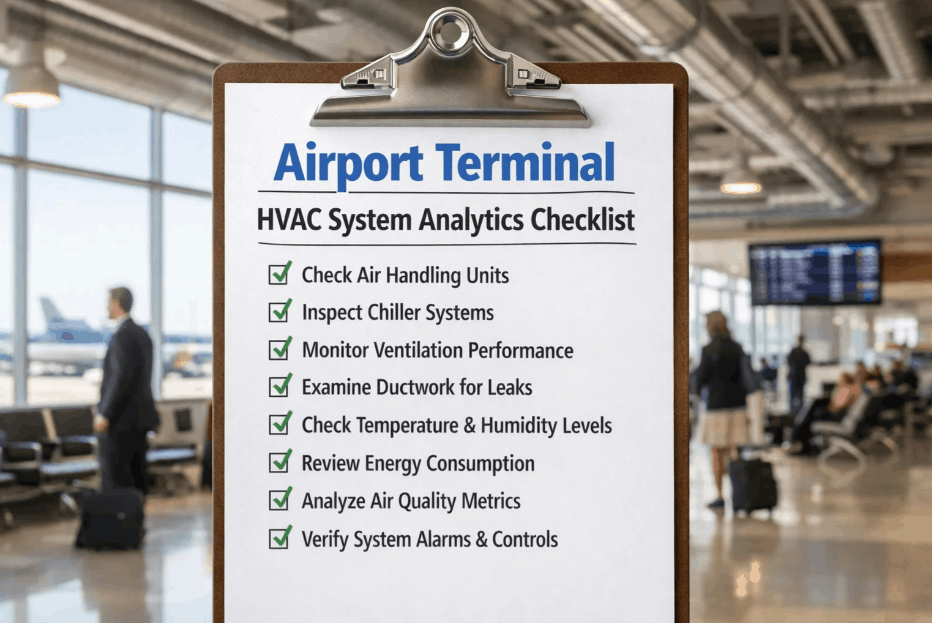
Airport terminal HVAC systems represent one of the most complex and mission-critical engineering challenges in modern infrastructure. Serving millions of passengers annually, a single terminal HVAC network can encompass hundreds of air handling units, chiller plants, VAV systems, and IAQ monitoring nodes operating simultaneously across enormous square footage. Without real-time analytics and predictive intelligence, even minor deviations in terminal climate control can cascade into passenger discomfort, regulatory violations, and multi-million dollar energy overruns. Book a Demo to see how iFactory's preventive analytics platform transforms airport HVAC management from reactive guesswork into precision-driven operational excellence.
Airport HVAC Analytics · Predictive Maintenance · Energy Intelligence
Is Your Airport HVAC System Costing You Millions in Hidden Inefficiencies?
Most large-scale airport terminals lose $800K–$2.4M annually to preventable HVAC failures, stale air quality data, and energy waste from unmonitored chiller drift. Get your free gap analysis today.
The Unique Engineering Complexity of Airport Terminal HVAC
Managing HVAC in an airport terminal is categorically different from any other commercial building environment. A mid-size international terminal may handle 40,000 to 120,000 passengers per day, each person generating heat load, humidity, and CO₂ while occupying spaces that shift from near-empty at 3 AM to absolute peak density during morning and evening waves. The HVAC system must respond dynamically to these swings while maintaining consistent indoor air quality (IAQ), temperature comfort bands, and regulatory compliance — all without interruption. Unlike office buildings or shopping centers, airport HVAC failures have zero tolerance for downtime. A chiller plant outage during peak summer operations doesn't just cause discomfort; it triggers safety protocols, delays boarding, and generates national media headlines. This high-stakes reality demands a fundamentally different approach to terminal climate control — one rooted in predictive analytics, real-time sensor intelligence, and AI-driven decision support rather than manual inspections and periodic maintenance cycles.
Dynamic Occupancy Load Swings
Passenger density fluctuates by 400–600% across a 24-hour terminal cycle. HVAC systems not governed by real-time demand data consistently overheat or overcool, burning energy on empty gates while under-serving crowded concourses.
Multi-Zone Pressure Management
Secure zones, customs halls, baggage claim, retail concourses, and jet bridges all operate under different pressure differentials. Maintaining these without cross-contamination requires continuous monitoring across hundreds of damper positions and AHU outputs.
Regulatory IAQ Compliance
Airport terminals fall under ASHRAE 62.1, local health authority mandates, and increasingly stringent post-pandemic ventilation standards. Non-compliance carries financial penalties and potential operational shutdowns.
24/7 Zero-Downtime Requirement
Unlike commercial offices, airports cannot schedule maintenance windows during business hours. All HVAC servicing must occur without impacting passenger operations, requiring predictive scheduling and condition-based maintenance triggers.
Predictive Intelligence · Zero Downtime · Compliance Ready
Stop Reactive HVAC Management Before It Costs You Another Season
Every week without predictive analytics is another week of chiller drift, unchecked IAQ deviations, and energy spend you'll never recover. Book a 30-minute session with our airport HVAC specialists today.
Airport HVAC Energy Optimization: Turning Waste Into Capital
HVAC systems account for 40–60% of total energy consumption in most airport terminals. For a major hub serving 30 million passengers annually, this translates to $6–$18 million in annual energy expenditure — a figure that holds enormous optimization potential. Traditional energy management approaches rely on scheduled audits, fixed setpoints, and reactive responses to utility bill spikes. By the time a facilities manager identifies an inefficiency pattern, weeks or months of excess spend have already occurred. Airport HVAC energy optimization requires continuous monitoring of chiller COP (Coefficient of Performance), cooling tower approach temperatures, AHU supply air temperatures, and variable frequency drive (VFD) efficiency across every major asset in the system. When iFactory's AI platform detects that a chiller's COP has degraded from 5.8 to 4.2 over a 30-day period — a subtle drift invisible to standard BMS alerts — it automatically triggers a maintenance work order, calculates the cost of continued degraded operation, and forecasts the energy savings from immediate intervention. This level of granular airport HVAC analytics is what separates top-performing airports from facilities that budget for waste as a line item. Book a Demo to see how airports are recovering millions through chiller and AHU performance analytics.
Terminal IAQ Monitoring: Beyond CO₂ — A Comprehensive Airport Air Quality Strategy
Indoor air quality in airport terminals is a passenger wellness issue, a regulatory requirement, and increasingly a competitive differentiator for airports competing for airline route contracts and passenger preference. Terminal IAQ monitoring at scale extends well beyond basic CO₂ measurement — a comprehensive airport air quality management strategy must address particulate matter (PM2.5 and PM10 from jet exhaust infiltration), VOCs from cleaning agents and retail food operations, humidity control to prevent microbial growth in AHU coils, and real-time verification that fresh air ventilation rates meet ASHRAE standards across all occupied zones simultaneously. The challenge is correlation: a single CO₂ spike in a departure lounge may indicate a failed outdoor air damper, a stuck recirculation valve, or simply a gate holding area over-capacity, and without a platform that correlates sensor data with BMS signals, occupancy counts, and equipment status in real time, facilities teams receive alarms with no actionable root cause — leading to slow response, repeat incidents, and preventable compliance violations. iFactory's airport HVAC AI-driven analytics platform ingests all of these data streams simultaneously, applies machine learning to identify fault signatures before they become incidents, and delivers root-cause diagnostics directly to the maintenance team's mobile device — this is what modern terminal ventilation system management looks like. Book a Demo and discover how real-time IAQ intelligence protects your passengers, your compliance record, and your operational reputation.
| IAQ Parameter | Manual Monitoring | Standard BMS | iFactory AI Platform | Regulatory Standard |
|---|---|---|---|---|
| CO₂ Level Tracking | Periodic Spot-Check | Zone Averages Only | Real-Time Per Node | ASHRAE 62.1 |
| PM2.5 / PM10 Monitoring | Not Tracked | Not Tracked | Continuous AI Analysis | WHO Guidelines |
| AHU Coil Humidity Control | Monthly Inspection | Fixed Setpoint Alerts | Predictive Drift Detection | ASHRAE 55 |
| Outdoor Air Ventilation Rate | Quarterly Audit | Damper Position Log | Continuous Compliance Verification | Local Authority |
| VOC / Odor Detection | Complaint-Driven | Not Supported | AI Sensor Fusion | Varies by Authority |
Airport HVAC Predictive Analytics: From Scheduled Maintenance to Condition-Based Intelligence
The traditional approach to maintaining airport HVAC assets — chillers, cooling towers, AHUs, VAV boxes, BAS controllers — relies on time-based preventive schedules. Every 90 days, technicians inspect. Every 6 months, filters change. Every year, coils receive chemical cleaning. This calendar-driven model is fundamentally blind to what the equipment is actually experiencing. A chiller bearing operating in degraded condition for 45 days will fail on day 88 regardless of whether the next scheduled inspection is in 2 days or 8 weeks.
Airport HVAC predictive analytics replaces this blunt instrument with condition-based intelligence. By continuously monitoring vibration signatures, refrigerant subcooling and superheat margins, supply air temperature deviations, fan amperage trends, and damper actuator response times, iFactory's AI engine builds a digital health profile for every major asset in the terminal. When a cooling tower fan motor begins drawing 4% more current than its 90-day baseline — a precursor signature to bearing failure — the platform flags it, estimates remaining useful life, and schedules the repair during the next planned low-occupancy window rather than waiting for catastrophic failure at peak passenger load. This is how leading airports reduce HVAC-related passenger impact events to near zero.
Capital budget forecasting across all HVAC asset classes, grant-ready energy savings documentation, regulatory compliance audit trails, and 20-year lifecycle cost modeling for terminal AHU and chiller fleets.
AI-powered fault detection across all terminal zones, predictive degradation modeling for chillers and AHUs, automated work order generation, and mobile technician dispatch with root-cause diagnostics.
Automated API sync with existing BAS/BMS platforms, IoT sensor onboarding for IAQ nodes, digitization of legacy equipment logs, and GPS-verified technician task completion for compliance documentation.
Airport Chiller Analytics: The Highest-Value Target in Terminal Energy Management
In most airport terminals, the central chiller plant represents 35–50% of total HVAC energy consumption, making it the single highest-value target for analytics-driven optimization. Airport chiller analytics encompasses far more than tracking kilowatt-hour consumption on a utility meter. True chiller optimization requires real-time calculation of COP across individual chiller units, automated staging logic that sequences chiller activation based on current demand versus part-load efficiency curves, cooling tower approach temperature optimization relative to ambient wet-bulb conditions, and condenser water flow balancing to prevent thermal stratification that degrades overall plant efficiency. Without this level of monitoring, most airport chiller plants operate at 60–70% of their thermodynamic potential — a gap that represents hundreds of thousands of dollars in annual avoidable energy cost for even a mid-size terminal. Book a Demo to see iFactory's chiller analytics platform in action and quantify your terminal's optimization potential in real time.
Key Airport Chiller Optimization Parameters
Chiller COP Trending
Continuous COP calculation against design specifications. Degradation beyond 8% triggers predictive maintenance workflow before efficiency loss compounds into a fault event.
Efficiency MonitoringPart-Load Efficiency Staging
AI-driven chiller sequencing optimizes which units operate at what capacity to hit the highest IPLV across the full range of terminal cooling loads from night minimums to peak summer demand.
AI SequencingCondenser Water Optimization
Dynamic condenser water setpoint reset based on real-time ambient wet-bulb. Eliminates the fixed 85°F setpoint that wastes fan energy during mild weather conditions.
Energy RecoveryRefrigerant Health Monitoring
Continuous subcooling and superheat margin analysis detects refrigerant charge loss or compressor valve degradation weeks before capacity impacts passenger comfort zones.
Predictive HealthAirport HVAC Compliance Management: Navigating Regulatory Requirements at Scale
Airport terminal HVAC systems operate under a complex and evolving regulatory landscape that standard BMS platforms are fundamentally not designed to navigate. Compliance requirements span ASHRAE 62.1 ventilation rates, ASHRAE 90.1 energy efficiency standards, local authority having jurisdiction (AHJ) mandates, airport authority environmental commitments, airline tenant lease requirements for cabin crew rest facility air quality, and increasingly stringent government sustainability reporting obligations tied to infrastructure funding. Managing airport HVAC compliance at a terminal serving 15+ million annual passengers requires continuous documentation — not periodic audits. Facilities directors need automated compliance reporting that pulls real-time ventilation rate data, energy performance metrics, and IAQ sensor logs into audit-ready formats without manual data assembly. When iFactory's platform detects that fresh air delivery to a concourse has dropped below its ASHRAE 62.1 minimum — even transiently during a morning surge — it logs the event, identifies the root cause (stuck outdoor air damper, failed CO₂ sensor, BAS programming error), and creates a corrective action record that satisfies regulator documentation requirements. Book a Demo and discover how airports eliminate compliance risk through continuous intelligent monitoring.
Sustainability Reporting for Airport HVAC Networks
Airport sustainability programs — many tied to ACI's Airport Carbon Accreditation scheme or government net-zero commitments — require granular HVAC energy data that goes beyond aggregate utility bills. iFactory generates the terminal-level, system-level, and asset-level energy reporting needed to support Level 3 and Level 4 carbon accreditation submissions, green airport certification programs, and environmental impact assessments required for terminal expansion approvals. By making this reporting continuous and automated rather than annual and manual, airports save hundreds of hours of consultant time per reporting cycle while producing more accurate, defensible sustainability documentation.
Deploying Airport HVAC Predictive Analytics: A Phased Approach That Minimizes Operational Risk
One of the most common concerns airport facilities leaders raise about HVAC analytics modernization is implementation risk. With 24/7 operational requirements, any technology deployment that disrupts existing BAS infrastructure or requires extended system integration downtime is simply not viable. iFactory's deployment methodology is designed specifically for mission-critical environments where zero disruption is the baseline requirement — not a stretch goal.
Data Foundation & BMS Integration
Non-intrusive read-only API connections to existing BAS/BMS platforms. IoT sensor deployment on priority assets (chillers, cooling towers, primary AHUs). Legacy equipment log digitization. Baseline analytics debt quantification — identifying current efficiency gap and compliance exposure value.
AI Model Training & Fault Signature Library
Machine learning models calibrated to terminal-specific equipment baseline performance. Custom fault signature library built from 90-day historical BMS data. Predictive maintenance trigger thresholds set per asset class. First automated work order generation and validation with maintenance team.
Full Analytics Activation & ROI Measurement
Full terminal HVAC analytics dashboard live across all zones. Automated compliance reporting active. Capital planning module populated with 5–20 year lifecycle cost forecasts. ROI measurement against baseline — energy savings, prevented downtime events, and compliance cost avoidance tracked in real time.
Frequently Asked Questions — Airport Terminal HVAC Analytics
Does iFactory integrate with existing airport BMS platforms?
Yes. iFactory operates as an intelligence layer above your existing BAS/BMS infrastructure. We use read-only API integrations with all major building automation platforms including Siemens Desigo, Johnson Controls Metasys, Honeywell EBI, and Trane Tracer, requiring no rip-and-replace of existing control systems.
How quickly does predictive maintenance deliver ROI in airport environments?
Most airport deployments identify their first high-value intervention opportunity within 30–45 days of data ingestion. Chiller COP degradation and AHU coil fouling are the most common early findings, typically representing $80,000–$400,000 in avoidable annual energy and repair costs per terminal.
Can the platform support multi-terminal airport campuses?
Absolutely. iFactory's architecture is designed for enterprise-scale airport operations. The global dashboard provides normalized performance benchmarking across all terminals in a campus, enabling facilities leadership to prioritize capital investment based on comparative analytical health scores.
How does the platform handle airport HVAC compliance documentation?
iFactory automatically generates audit-ready compliance reports in formats aligned with ASHRAE documentation requirements, ACI carbon accreditation submissions, and local regulatory authority templates. Reports are generated continuously — not assembled manually at audit time — eliminating the last-minute data scramble that exposes airports to compliance risk.
Ready to Eliminate Hidden HVAC Costs Across Your Airport Terminal?
Join world-class airport operators who protect passenger comfort, regulatory compliance, and operational budgets with iFactory predictive HVAC analytics.

-integration-with-ai-driven.png)