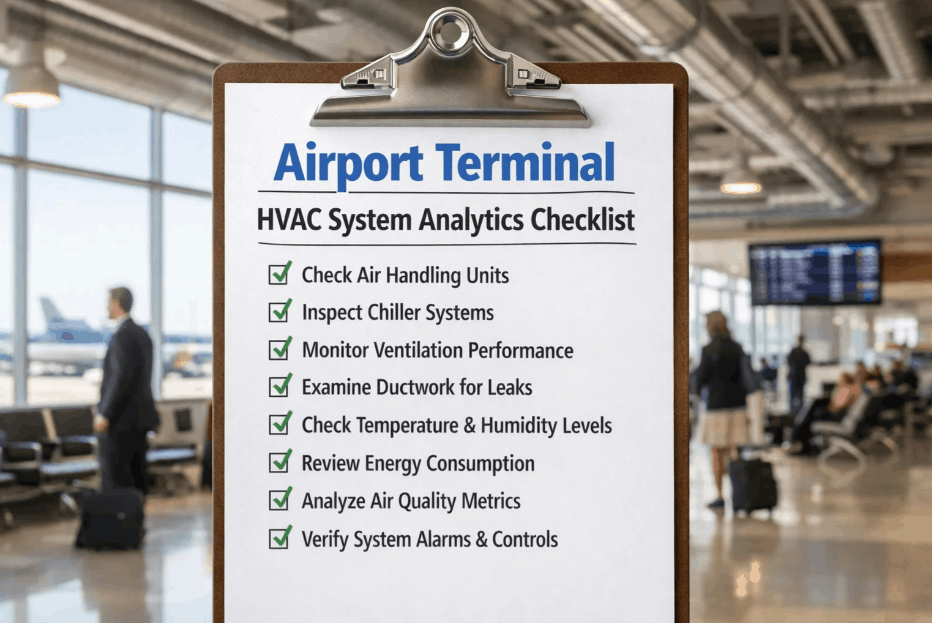
Airport terminal HVAC systems operate under extreme demands — continuous 24/7 occupancy, variable passenger loads, strict air quality mandates, and energy efficiency targets that directly impact operating costs. Without structured daily analytics and inspection routines, equipment failures, compliance gaps, and energy waste go undetected until they become critical events. A systematic HVAC analytics checklist covering air handling units, chillers, boilers, cooling towers, VAV boxes, and BAS controls ensures every critical system is verified, logged, and performing within validated parameters. If your airport facility still depends on manual rounds and paper-based logs, book a demo to see how automated preventive analytics eliminates documentation gaps across every HVAC asset in your terminal.
1. Air Handling Unit (AHU) Performance Verification
AHUs are the backbone of terminal air distribution. Daily analytics must confirm airflow rates, supply and return air temperatures, filter differential pressure, and fan performance against validated setpoints. Facilities managing multiple terminal zones can book a demo to automate AHU performance tracking with real-time deviation alerts.
2. Chiller Plant Performance & Efficiency Analytics
Chiller plants represent the largest single energy load in airport HVAC systems. Daily analytics must verify chilled water supply and return temperatures, chiller kW/ton efficiency, condenser water flow, and compressor operating conditions. Facilities requiring automated chiller efficiency trending can schedule a demo to centralize plant performance data and predictive fault detection.
3. Boiler Plant Operation & Heating System Verification
Airport boiler plants supply heating to terminal spaces, jetways, and domestic hot water systems. Daily analytics must confirm combustion efficiency, hot water supply temperatures, flue gas conditions, and burner cycling patterns. Terminals with multiple boiler units and seasonal load shifting can book a demo to automate boiler staging verification and combustion efficiency reporting.
4. Cooling Tower Performance & Water Treatment Verification
Cooling towers reject heat from chiller condensers and are a critical link in airport cooling plant efficiency. Daily analytics must confirm approach temperature, fan operation, basin water level, and water treatment chemistry to prevent Legionella risk and scaling that degrades heat transfer performance.
5. VAV Box & Zone Control Performance Analytics
Variable air volume boxes control individual zone temperatures throughout the terminal. Daily analytics must verify that VAV boxes are tracking zone setpoints, dampers are modulating correctly, and reheat coils are not simultaneously active during cooling mode. Terminals with hundreds of VAV zones can book a demo to automate zone-level fault detection and identify comfort complaint patterns before passengers report them.
6. Building Automation System (BAS) Controls & Alarm Analytics
The BAS is the central nervous system of airport HVAC operations. Daily analytics must review active alarms, suppressed points, override counts, and control loop performance to confirm the system is operating autonomously within programmed parameters and that no manual overrides are masking underlying equipment faults.
7. Indoor Air Quality (IAQ) & Ventilation Compliance Monitoring
Airport terminals must maintain IAQ compliance across diverse occupancy zones — from high-density departure gates to food service areas and ground-level baggage handling. Daily analytics must verify CO₂ concentrations, humidity levels, and particulate counts against regulatory and operational benchmarks.
8. HVAC Energy Consumption & Optimization Analytics
Energy analytics is the financial backbone of airport HVAC management. Daily consumption tracking against weather-normalized benchmarks allows facility teams to detect efficiency degradation immediately rather than discovering it on the monthly utility bill. Airports with sustainability commitments and energy reduction KPIs can book a demo to automate energy intensity reporting and anomaly detection across every HVAC system category.
9. Preventive analytics Record Management & Compliance Reporting
HVAC analytics records are the primary evidence of equipment reliability and regulatory compliance during airport authority audits, insurance reviews, and warranty claim processes. Every daily check, reading, alarm response, and corrective action must be captured with timestamps, technician identity, and equipment ID linkage.