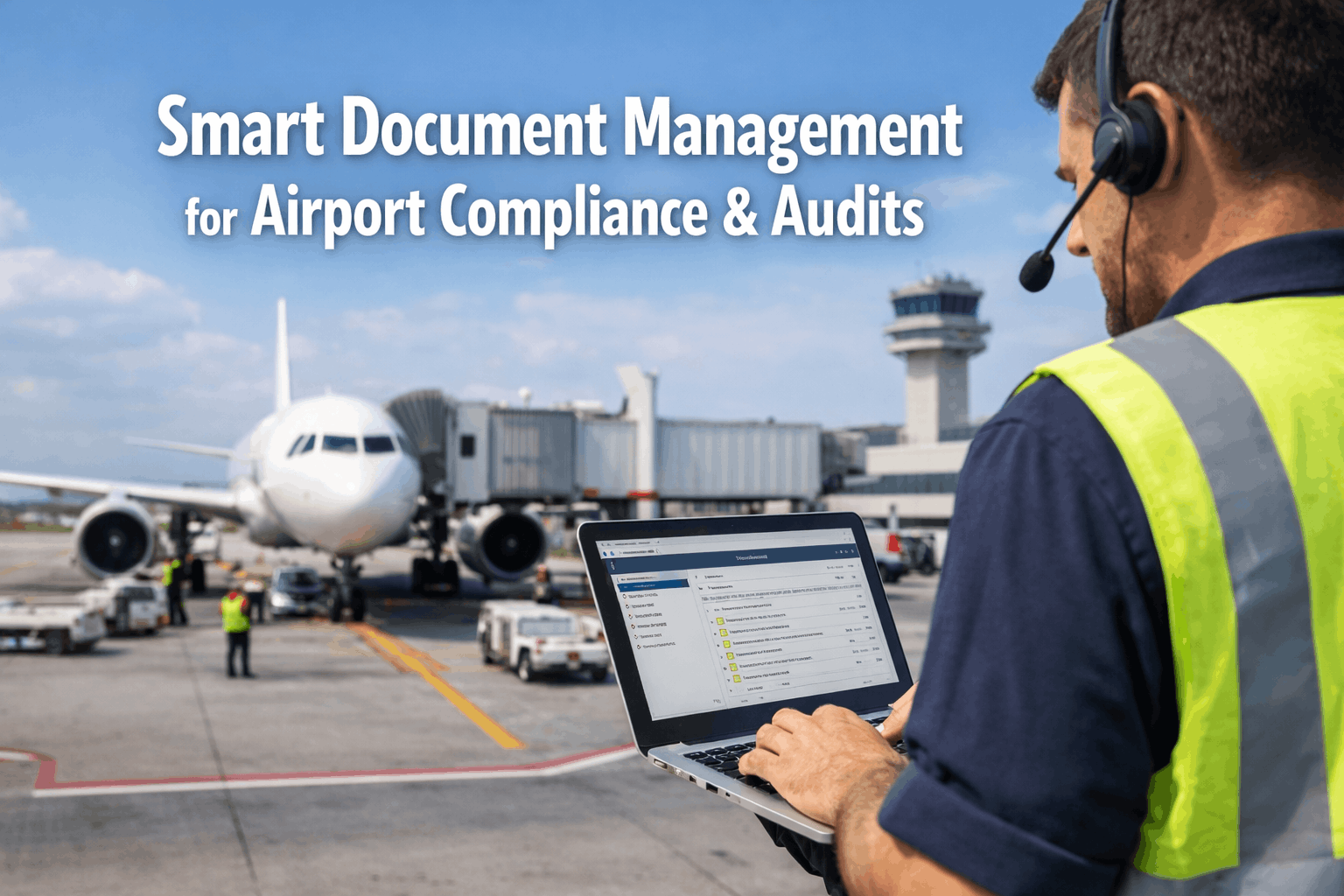
Modern airports face increasingly rigorous regulatory scrutiny from the FAA and TSA — and yet, most compliance teams still rely on spreadsheets, manual checklists, and fragmented documentation to prepare for audits. AI-driven airport audit preparation changes that reality entirely. By centralizing inspection histories, automating corrective action tracking, and generating audit-ready reports on demand, AI-powered compliance platforms give aviation operators the documentation infrastructure they need to walk into any FAA or TSA audit with confidence. If your airport is still assembling audit binders the night before an inspection, Book a Demo to see how AI-driven compliance tracking eliminates last-minute scrambles for good.
FAA AUDIT READINESS · TSA COMPLIANCE · AIRPORT AI
Generate Audit-Ready Reports Before the Auditor Arrives
Deploy AI-driven compliance tracking across your airport and demonstrate continuous regulatory adherence to FAA and TSA inspectors with a single click.
Why Traditional Airport Compliance Documentation Fails FAA and TSA Audits
FAA and TSA audit frameworks have grown more data-intensive with every regulatory cycle. Inspectors now arrive expecting not just completed checklists, but timestamped evidence trails, closed-loop corrective action records, and cross-referenced inspection histories spanning multiple years. Traditional airport compliance documentation — maintained in shared drives, paper logs, and siloed maintenance systems — cannot produce this level of organized, traceable evidence without days of manual compilation. The result is audit responses riddled with gaps, delays in producing requested records, and findings that could have been closed if documentation had been structured correctly from the start. AI-driven airport compliance management replaces this fragile documentation model with a continuously maintained evidence base that is always audit-ready, not just audit-prepared.
The Six Compliance Pillars AI Tracks for FAA and TSA Audit Readiness
Effective FAA audit readiness and TSA compliance documentation require coverage across multiple regulatory domains simultaneously. AI-driven platforms structure airport compliance evidence across six interconnected pillars that mirror the actual audit frameworks inspectors use — ensuring no documentation gap is left unaddressed when auditors request records. Airports that choose to Book a Demo consistently find compliance gaps they were unaware of within the first two weeks of deployment.
Inspection History Ledger
Maintains a tamper-evident, timestamped record of every inspection event across all airport zones, systems, and equipment classes. FAA inspectors can be handed a complete inspection chronology within minutes of requesting it.
Corrective Action Tracking
Documents every finding, assigns ownership, tracks resolution timelines, and stores closure evidence. TSA auditors reviewing repeat findings can see a complete corrective action lifecycle rather than an unsubstantiated verbal assurance.
Regulatory Change Monitoring
Monitors updates to FAA Advisory Circulars, TSA Security Directives, and 49 CFR Part 1542 amendments, then maps regulatory changes to affected compliance controls and flags gaps before the next audit cycle.
Certification Documentation Vault
Centralizes airport operating certificates, security program approvals, training records, and equipment certifications with automated expiry alerts so no credential lapses before an audit.
Audit-Ready Report Generation
Produces pre-formatted compliance reports aligned to FAA and TSA audit templates, drawing from live inspection data and corrective action records to eliminate manual report compilation entirely.
Continuous Compliance Scoring
Assigns a real-time compliance health score to each airport zone and regulatory domain, giving compliance managers a live dashboard that predicts audit exposure before inspectors set foot on the ramp.
Airport Audit Compliance Tiers: How AI Categorizes Regulatory Risk
Not all compliance gaps carry equal audit risk — a missed perimeter fence inspection log carries different consequences than an unresolved security screening equipment calibration finding. AI-driven airport regulatory documentation platforms assign each compliance gap to a risk tier that determines escalation urgency, documentation requirements, and corrective action deadlines. The following tiering structure reflects how leading airport compliance teams using AI-driven platforms structure their pre-audit risk management process. Book a Demo to review how iFactory maps these tiers into automated escalation workflows and audit response packages.
| Compliance Risk Tier |
AI Score Range |
Audit Exposure Level |
Response Timeline |
Typical Airport Compliance Areas |
| Tier 1 — Critical Finding |
85 – 100 |
Immediate enforcement risk |
24-hour corrective action |
Security Screening Systems, AOB Access Controls |
| Tier 2 — Major Non-Conformance |
65 – 84 |
Audit citation likely |
72-hour corrective plan |
Runway Safety Records, Wildlife Hazard Logs |
| Tier 3 — Minor Non-Conformance |
40 – 64 |
Documentation gap noted |
14-day resolution window |
Training Record Completeness, Equipment Logs |
| Tier 4 — Observation |
20 – 39 |
Low audit citation risk |
30-day review cycle |
Perimeter Inspections, Lighting Compliance Checks |
| Tier 5 — Informational |
0 – 19 |
No immediate audit risk |
Routine monitoring |
Ancillary Facility Records, Non-AOB Areas |
Audit Preparation ROI: What AI-Driven Compliance Delivers to Airport Operators
Quantifying the return on airport audit preparation AI investment is straightforward when the platform tracks compliance health before and after deployment. These performance benchmarks reflect outcomes from aviation operators who deployed AI-driven compliance documentation platforms ahead of scheduled FAA and TSA audit cycles — and entered those audits with documented evidence rather than assembled guesswork.
68%
Reduction in audit preparation time from weeks to hours using AI-generated compliance reports
91%
Of audit findings closed on first submission when corrective actions are tracked with AI documentation
3.4x
Faster corrective action closure rate compared to manual compliance management workflows
zero
Repeat audit citations reported by airports maintaining continuous AI compliance monitoring
Estimated Compliance Documentation Gap Cost by Airport Area (Annual)
One of the most actionable outputs of AI-driven FAA inspection preparation is the financial cost quantification of compliance documentation gaps by airport area. When the platform cross-references inspection frequency requirements with actual documentation completeness, it generates a per-area financial risk profile that directly informs where compliance teams should concentrate resources before an audit. The chart below reflects industry-aggregated benchmarks across commercial and regional airport operators.
Estimated Annual Cost of Compliance Documentation Gaps by Airport Area (USD)
Based on FAA/TSA enforcement benchmarks, legal exposure, and remediation cost data across commercial aviation operators
Security Screening Systems
AOB Access Control Records
Runway Safety Area Inspections
Wildlife Hazard Management Logs
Navigation Aid Certification
Staff Training & Credentialing
Emergency Response Documentation
Perimeter & Lighting Inspections
Values represent median annual cost exposure including regulatory fines, legal fees, remediation labor, and operational disruption. Figures vary by airport classification, traffic volume, and regional regulatory enforcement patterns.
AI vs. Manual Audit Preparation: A Side-by-Side Comparison
Airport compliance teams evaluating the transition to AI-driven aviation compliance management frequently ask how the platform differs from their existing documentation workflow. The answer lies in continuity: manual audit preparation produces a one-time evidence assembly effort while AI-driven compliance generates a perpetually current documentation state that never requires emergency compilation. Book a Demo to see a live demonstration of how iFactory's compliance engine produces TSA and FAA audit packages in real-time against your actual airport operational data.
Compliance Budget Allocation: Before vs. After AI Audit Preparation Deployment
One of the most measurable financial outcomes of deploying an AI-driven airport audit trail platform is the structural shift in how compliance budgets are consumed. In airports operating without AI compliance management, the majority of the compliance budget disappears into reactive audit preparation — emergency record retrieval, consultant fees, and unplanned corrective work triggered by audit findings. After AI deployment, that reactive spend collapses as continuous monitoring prevents findings from accumulating into audit-cycle crises.
Reactive Audit Preparation
Scheduled Compliance Reviews
Continuous AI Compliance Monitoring
Before AI Compliance
61% Reactive
28% Scheduled
11%
After AI Compliance
12%
26% Scheduled
62% Continuous AI Monitoring
↓ 49pts
Drop in reactive compliance spend after AI audit preparation deployment
↑ 51pts
Rise in proactive continuous compliance monitoring budget allocation
↓ 34%
Overall compliance cost reduction driven by eliminating emergency audit remediation
Frequently Asked Questions: AI-Driven Airport Audit Preparation
How does AI-driven compliance tracking generate FAA-ready audit reports?
The platform continuously ingests inspection records, corrective action closures, certification data, and operational logs, then maps them to FAA audit template structures. When an audit is scheduled, compliance teams generate a pre-formatted report package in minutes rather than assembling documents manually across disconnected systems.
Can the platform track TSA Security Directive compliance alongside FAA requirements?
Yes. The compliance engine supports multi-regulatory framework management, allowing airports to maintain parallel documentation streams for TSA Security Directives, FAA Advisory Circulars, and 49 CFR Part 1542 requirements simultaneously from a single dashboard without duplicating data entry effort.
What happens when a corrective action is opened during an audit finding?
The AI platform creates a structured corrective action record that captures the finding source, assigned owner, resolution deadline, interim mitigation steps, and final closure evidence. Auditors returning for a follow-up inspection receive a complete documented lifecycle rather than a verbal status update — which is the standard TSA and FAA auditors now expect.
How far back does the AI platform maintain airport inspection history for audit access?
The platform maintains a full inspection history for the duration of your data retention policy, typically five to ten years for commercial operators. FAA inspectors can be provided inspection records spanning multiple audit cycles without any manual file retrieval or format conversion.
Does the system alert compliance managers before regulatory deadlines expire?
Automated expiry alerts are built into the certification documentation vault. The system notifies designated compliance officers at configurable lead times — typically 90, 60, and 30 days before expiry — for airport operating certificates, security program approvals, equipment certifications, and staff credential renewals, eliminating the risk of lapsed documentation discovered during an audit.
How does the AI handle multi-terminal airports with separate compliance jurisdictions?
The platform supports a hierarchical compliance structure where each terminal, concourse, or operational zone maintains its own inspection and corrective action records while contributing to a unified airport-level compliance score. Enterprise compliance directors access a fleet-wide view while terminal managers work within their own operational scope.
Can reliability engineers override AI compliance scores for context the system cannot capture?
The platform includes a supervised override layer allowing certified compliance officers to adjust AI-generated risk scores with documented justification — such as temporary operational waivers, pending regulatory guidance clarifications, or active enforcement negotiation contexts. All overrides are audit-logged with timestamps, maintaining full traceability for RCM review cycles.
Stop Assembling Audit Binders the Night Before an FAA Inspection
Let AI-driven compliance tracking keep your airport audit-ready every day of the year — so the next FAA or TSA inspection is a demonstration of documented excellence, not a documentation emergency.