Airport infrastructure failures rarely begin with catastrophic events — they begin with hairline cracks in runway pavement that inspection teams miss, FOD fragments that accumulate between service windows, and terminal façade deterioration that remains invisible until it crosses from maintenance into capital replacement. In 2026, leading airport operators are replacing periodic walkthrough inspections with computer vision and AI for airport facility inspection automation — deploying machine learning models that analyze continuous visual data streams from fixed cameras, drone imagery, and mobile sensor platforms to detect defects, quantify degradation, and generate condition assessments with a consistency and coverage no human inspection program can match. Airports running automated visual AI analytics are finding surface defects 60 to 80 percent earlier than traditional inspection cycles, reducing FOD-related runway incidents, and building the condition documentation required to compete successfully for FAA capital grant funding. To see how AI-powered inspection analytics works across your airport's infrastructure portfolio, Book a Demo with the iFactory aviation team today.
Why Traditional Airport Facility Inspection Fails at Scale
The Structural Limitations of Manual Visual Inspection Programs
Human-led airport inspection programs carry three structural vulnerabilities that compound across large, complex facilities: coverage gaps created by inspection frequency limits, consistency gaps created by assessor variability, and documentation gaps created by analog reporting workflows that cannot generate the quantified condition data FAA grant programs increasingly require. A typical commercial airport with 3,000-plus acres of airfield and terminal infrastructure can only complete a full walkthrough inspection cycle every 30 to 90 days — meaning the pavement deterioration, drainage failures, and structural cracks that develop between cycles accumulate undetected until they reach a severity that forces reactive capital response. Airports currently managing significant deferred maintenance exposure from inspection gaps can Book a Demo to see how AI visual inspection quantifies and closes that gap systematically.
How Computer Vision AI Works in Airport Facility Inspection
From Raw Imagery to Actionable Infrastructure Intelligence
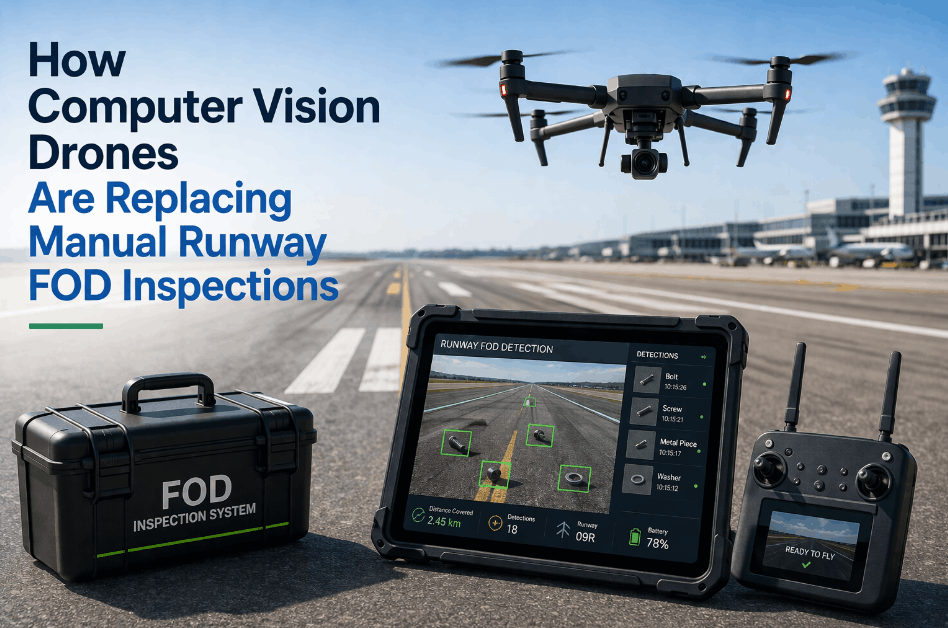
Airport computer vision inspection systems operate through a three-stage analytical pipeline. In the capture stage, imagery is collected continuously from fixed perimeter and apron cameras, drone platforms executing programmed inspection routes, and vehicle-mounted imaging systems traversing runway and taxiway surfaces. In the processing stage, deep learning models trained on aviation-specific defect libraries analyze each image frame against baseline condition signatures — detecting pavement cracks, spalling, joint deterioration, FOD objects, marking degradation, and structural anomalies at pixel-level precision. In the output stage, detected conditions are geo-referenced, severity-classified, and pushed to the inspection management platform where maintenance teams receive prioritized work orders with defect location coordinates, photographs, and condition change trends. Airport infrastructure directors exploring this capability can Book a Demo and walk through a live system demonstration using actual aviation imagery.
Core AI Inspection Capabilities Across Airport Infrastructure Classes
What Automated Visual Analytics Covers Across the Airfield and Terminal Portfolio
A fully deployed airport AI inspection platform addresses five distinct infrastructure classes, each requiring specialized machine learning models trained on aviation-specific failure modes. The capability overview below maps AI detection functions to their operational and safety impact across the airport asset portfolio. Capital program managers evaluating platform scope can Book a Demo for a live demonstration across each infrastructure class mapped to their own facility data.
AI Visual Inspection vs. Traditional Airport Inspection Methods
Capability and Performance Comparison Across Key Inspection Dimensions
The comparison below maps operational and analytical capabilities across three inspection approaches currently deployed at airports — from manual walkthrough programs to fully integrated AI computer vision platforms with continuous automated defect detection and condition scoring.
| Inspection Capability | Manual Walkthrough | Drone Imagery Only | AI Computer Vision Platform |
|---|---|---|---|
| Inspection Frequency | 30–90 Day Cycles | Weekly Scheduled Runs | Continuous Real-Time Monitoring |
| Defect Detection Resolution | Visible to Naked Eye | Operator-Dependent | Sub-Centimeter AI Detection |
| FOD Detection Capability | Walk-Down Only | Manual Image Review | Automated Real-Time Alerts |
| Pavement Condition Index Accuracy | Assessor-Variable | Post-Processing Required | Automated ASTM-Calibrated Scoring |
| Condition Trend Analysis | Not Available | Manual Comparison | Automated Degradation Modeling |
| FAA Documentation Output | Manual Report Writing | Image Archive Only | Auto-Generated Compliance Reports |
| Capital Planning Integration | Disconnected | Manual Data Export | Live CIP Data Feed |
| Coverage — Full Airfield Portfolio | Incomplete / Sampled | Scheduled Areas Only | 100% Coverage Continuously |
Operational ROI: What AI Airport Inspection Delivers Financially
Measured Outcomes from AI-Driven Visual Inspection Deployments
Integrating AI Inspection Data into Airport Capital Improvement Programs
Closing the Gap Between Visual Condition Data and CIP Investment Decisions
The strategic value of automated airport visual inspection extends beyond defect detection into capital planning — where continuous AI-generated condition data fundamentally changes the quality of infrastructure investment decisions. When pavement condition scores, remaining useful life forecasts, and defect severity trends feed directly into the capital improvement program workflow, airport planning teams can build AIP grant applications backed by objective, quantified condition evidence rather than walkthrough photographs and engineering opinions. FAA grant reviewers consistently score condition-documented applications higher — and airports deploying AI inspection analytics are reporting measurable improvement in grant award rates across multiple funding cycles. For multi-airport systems and regional airport authorities, cross-facility AI inspection data enables rational capital allocation based on actual condition comparisons rather than historical budget shares. Airport infrastructure directors ready to connect visual inspection data to their next CIP cycle can Book a Demo and review a live integration mapped to their planning timeline.
Airport AI Inspection Deployment: Implementation Pathway
From Platform Assessment to Operational Condition Intelligence
A structured deployment pathway ensures that AI computer vision inspection delivers operational value quickly while building toward full predictive capability across the airport asset portfolio.
Frequently Asked Questions
What is computer vision airport inspection?
It is an AI-powered system that analyzes imagery from cameras, drones, and vehicle-mounted sensors to detect surface defects, foreign object debris, structural deterioration, and condition changes across airport infrastructure — replacing periodic manual inspections with continuous automated monitoring and quantified condition scoring.
How does AI FOD detection work on runways?
Continuous camera feeds covering runway and taxiway surfaces are processed by object detection models trained to identify foreign objects down to 25mm in size. When a FOD object is detected, the system generates a real-time alert with precise GPS coordinates routed to airfield operations, eliminating the latency of manual walk-down inspection programs.
Can AI pavement crack detection replace ASTM D5340 inspections?
AI pavement analysis can generate ASTM-calibrated Pavement Condition Index scores continuously rather than on a triennial cycle — providing more frequent and consistent condition data than manual PCI surveys while reducing the labor cost and operational disruption of scheduled inspection programs. Many airports use AI scoring to complement and validate their formal compliance inspection cycle.
What imaging hardware does the platform require?
The platform integrates with fixed IP cameras, drone platforms, and vehicle-mounted imaging systems. Most airports have some usable existing camera infrastructure. The deployment assessment identifies coverage gaps and specifies the additional hardware required for full asset portfolio coverage — typically at a fraction of the cost of the maintenance savings generated in year one.
How does AI inspection data improve AIP grant applications?
FAA AIP reviewers weight the quality of condition documentation in competitive grant scoring. AI-generated condition data — quantified PCI scores, defect extent measurements, and remaining useful life forecasts — is significantly more compelling than walkthrough photographs and engineering opinions. Airports using continuous AI monitoring are reporting improved award rates and stronger competitive positioning in multi-airport grant cycles.
How long does deployment take for a mid-size commercial airport?
Most mid-size commercial airports complete the baseline condition capture and initial model calibration within six weeks. Full predictive capability — including continuous condition trending, remaining useful life forecasting, and CIP data integration — is typically active within 10 to 12 weeks of deployment start.
Does computer vision inspection cover terminal interiors as well as airfield surfaces?
Yes. Building inspection models address terminal exterior façades, interior floor and ceiling surfaces, and structural elements — using drone orthomosaic imagery for exterior coverage and fixed or mobile camera systems for interior condition monitoring. Terminal condition data integrates into the same capital planning dashboard as airfield infrastructure data.
Does this work for general aviation and regional airports?
Yes. The platform scales to any airport size. General aviation and regional airports often achieve the fastest ROI because their inspection and capital planning resources are most constrained — and the gap between current inspection frequency and what continuous AI monitoring delivers is typically the largest.