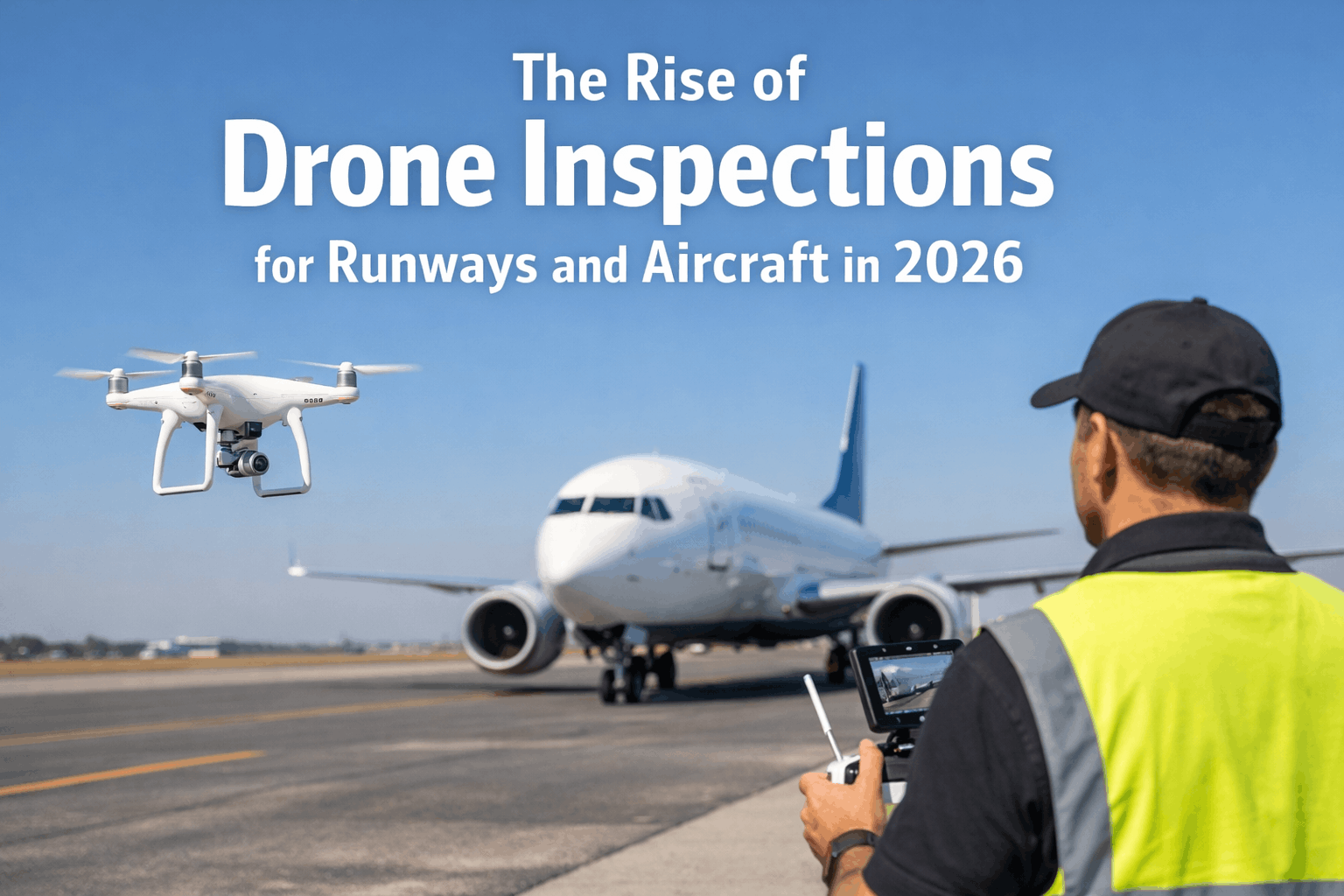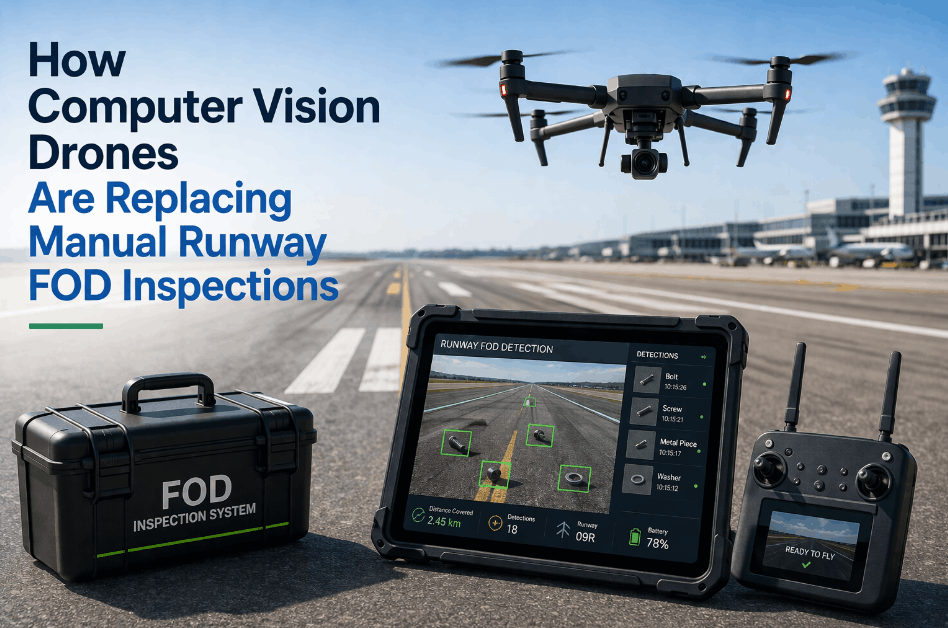
Foreign Object Debris (FOD) on airport runways costs the global aviation industry an estimated $4 billion annually — damaging engines, shredding tires, and triggering runway closures that cascade into operational disruptions affecting thousands of passengers. For decades, the standard response has been the manual FOD walkdown: teams of personnel physically patrolling runways on foot or in slow-moving vehicles, visually scanning pavement surfaces that span thousands of meters. The problem is not effort — it is physics. Human eyes operating at walking speed, in variable lighting, across vast pavement surfaces cannot match the detection speed, accuracy, or consistency that modern airfield safety demands. Computer vision-equipped drones are now replacing manual runway FOD inspections at airports worldwide — flying complete runway surveys in a fraction of the time, detecting debris as small as a few millimeters, and feeding AI-driven analytics platforms that automatically generate prioritized work orders before a single human inspector sets foot on the tarmac. If your airport is still scheduling FOD walkdowns the same way it did twenty years ago, this article explains exactly what you are risking — and what purpose-built drone analytics intelligence delivers instead. To see how AI-powered runway inspection platforms close the FOD detection gap, Book a Demo with the iFactory manufacturing intelligence team today.
Why Manual Runway FOD Inspections Are No Longer Sufficient
The Structural Limitations of Human-Led FOD Walkdowns on Modern Airfields
The manual FOD walkdown has been a standard airfield safety protocol since commercial aviation's earliest decades. Ground crews walk or drive runway surfaces at scheduled intervals — typically two to four times daily at major commercial airports — visually scanning for debris that could damage aircraft during takeoff and landing operations. The protocol is not inherently flawed in its intent. It is flawed in its physics. A human inspector walking at 4 kilometers per hour, scanning a 3,500-meter runway, cannot achieve the same detection sensitivity as a computer vision system processing 4K imagery at machine speed. More critically, manual FOD walkdowns are time-bound events separated by windows of hours during which any debris deposited on the runway surface goes entirely undetected. A 30-minute gap between an FOD event and its detection is not an operational edge case — it is a structural characteristic of schedule-driven manual inspection programs. Airports that understand this limitation and have begun deploying book a demo sessions to evaluate AI-powered drone inspection platforms are already quantifying the detection gap their current protocols cannot close.
How Computer Vision Drones Execute Runway FOD Inspections
The Technical Architecture Behind Automated AI Debris Detection on Airfield Surfaces
A computer vision drone deployed for runway FOD detection operates on a fundamentally different inspection model than any human-led protocol. The drone follows a pre-programmed autonomous flight path mapped to the precise geometry of the runway surface, maintaining a low altitude — typically 10 to 30 meters above ground level — to maximize image resolution while ensuring complete surface coverage within each flight pass. High-resolution cameras capture continuous imagery at frame rates sufficient to detect stationary objects as small as 2 millimeters across the full runway width. This raw visual data is the input layer. The intelligence layer is what transforms it into operational action.
The AI inference engine running against the drone's live or near-live video stream applies deep learning object detection models trained on extensive FOD datasets — classifying detected objects by material category (metal, rubber, plastic, organic matter), estimating physical dimensions, assigning GPS coordinates accurate to within 2.5 meters, and generating timestamped detection records that feed directly into airfield management and CMMS platforms. When the AI-driven work order generation capability is integrated, the system does not wait for a human operator to review a dashboard — it automatically creates a prioritized maintenance task, routes it to the appropriate ground crew, and marks the GPS coordinates on a real-time airfield map. From debris detection to work order dispatch in under 90 seconds is achievable with current-generation drone analytics platforms. That response window does not exist in any manual FOD walkdown program operating today.
| Inspection Capability | Manual FOD Walkdown | Computer Vision Drone |
|---|---|---|
| Minimum Detectable Debris Size | ~50mm (visual limit) | 2mm (AI vision) |
| Full Runway Survey Time | 45–90 minutes | 8–15 minutes |
| Inspection Frequency Per Day | 2–4 scheduled passes | Continuous / on-demand |
| Night / Low Visibility Operation | Severely limited | Full capability (thermal / IR) |
| Detection Consistency | Variable (fatigue, lighting) | Consistent (algorithmic) |
| GPS-Accurate Object Location | Approximate / verbal | ±2.5m GPS coordinate |
| Automated Work Order Generation | Manual documentation | AI-driven auto-dispatch |
| Traceability & Audit Records | Paper-based / inconsistent | Timestamped digital records |
5 Core Advantages of Computer Vision Drone FOD Detection Over Manual Inspection
Why AI-Powered Drone Runway Walkdowns Outperform Traditional Patrol Protocols
Real-World Drone FOD Detection Deployments: What the Evidence Shows
Airport Case Studies and Research Validation for AI-Powered Runway Inspection
The transition from theoretical capability to validated deployment is already underway at airports across multiple continents. At San Sebastián Airport in Spain, Aena partnered with Inetum and Invicsa Airtech to deploy a drone-based FOD detection system operating over a private 5G network, with real-time AI image analysis capable of classifying debris across varying weather and lighting conditions — day, night, rain, and fog. The system geolocalizes detected objects and transmits alerts to ground operations teams, dramatically compressing the detection-to-removal cycle that previously required scheduled vehicle patrols. IBM Research, working with Pixmap and Dubendorf Military Airport, deployed Foundation Models for Visual Inspection — AI systems pre-trained on 100,000-plus domain-specific runway images and fine-tuned for crack and debris detection — demonstrating that deep learning inspection models can be adapted to specific airfield environments without requiring fully annotated training datasets from scratch.
Munich Airport's commitment to autonomous FOD detection systems by 2027 — validated by FTE Smart Ramp consortium trials showing machines detect 10 times more FOD than human inspection crews — represents the clearest signal that airport operators at the highest operational tier have assessed the evidence and are moving to automated inspection as a standard operational capability, not a pilot program. FAA-sponsored evaluation of sUAS-based FOD detection using the FastFlow deep learning algorithm demonstrated 96% detection rates at Cape May County Airport and Atlantic City International Airport, with the research program formally identifying the workflow as meeting multiple FAA Advisory Circular 150/5220-24 requirements — the regulatory framework governing FOD detection equipment standards at US commercial airports. Operations leaders who want to understand how these validated capabilities map to their specific runway environments can book a demo for a structured airfield inspection gap analysis.
How AI-Driven Analytics Converts Drone FOD Data Into Automatic Work Orders
The Intelligence Layer That Transforms Detection Into Operational Action
Drone-captured imagery and computer vision detection are the data collection layer — not the operational intelligence layer. The transformation from raw detection data to actionable runway management outcomes requires an AI analytics platform that processes the drone's visual data stream, applies classification models to distinguish true FOD from false positives (including runway surface variations, lighting artifacts, and transient objects), and generates structured operational outputs that drive crew action without requiring manual review at every detection event. The AI inference pipeline in a purpose-built airfield analytics platform runs anomaly scoring against detected objects — evaluating size, material category, runway zone position, and proximity to active movement areas — to assign priority levels that determine dispatch urgency. A bolt fragment in the touchdown zone of an active runway generates a different priority and response protocol than a paper fragment near a taxiway shoulder.
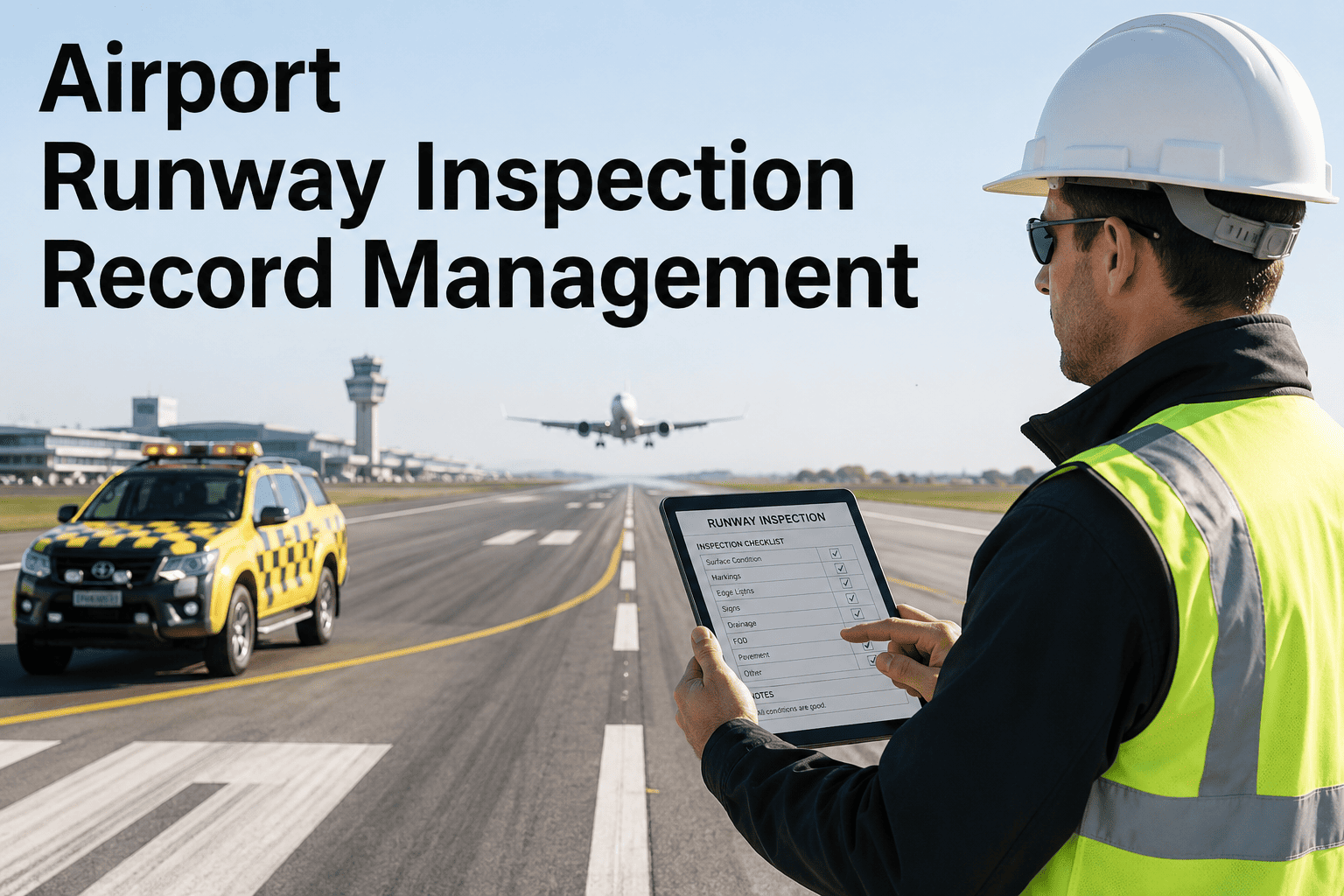
The work order generation module takes the classified detection output and creates a structured CMMS entry: object type, GPS coordinates, detection timestamp, assigned crew, required equipment, and a direct link to the drone imagery frame that captured the detection event. This record is simultaneously appended to the airport's FOD traceability log — building the continuous inspection audit trail required by regulatory frameworks and airline customer SLAs. The reduction in false alarm rates achieved by mature AI classification models — Changi Airport's iFerret 2.0 system reduced false alerts by more than 90% compared to its predecessor — is critical for operational credibility, ensuring that ground crews respond to AI-generated work orders with the same urgency they would apply to a confirmed visual sighting.
Regulatory and Compliance Dimensions of Drone-Based Runway FOD Inspection
FAA Advisory Circular Standards, Audit Requirements, and the Traceability Imperative
FAA Advisory Circular 150/5220-24 establishes the technical requirements for FOD detection equipment deployed at US commercial airports — specifying minimum detection size thresholds, alert response time requirements, location accuracy standards, and documentation protocols that any compliant system must satisfy. Manual FOD walkdown programs do not meet these standards systematically — they provide periodic observation, not continuous detection with documented performance metrics. Computer vision drone systems that achieve the detection rates and location accuracy specified in AC 150/5220-24 provide airports with a documented, auditable inspection record that manual protocols structurally cannot produce. The FAA's own research program — the sUAS-based FOD detection evaluation conducted across Cape May and Atlantic City International airports — confirms that drone AI workflows are now technically mature enough to meet multiple AC 150/5220-24 requirements, with ongoing development targeting full compliance across all specified performance parameters.
For airports operating under IATA Safety Audit for Ground Operations (ISAGO) frameworks, major airline customer FOD management requirements, or military airfield safety standards, the documentation gap between manual walkdown logs and automated digital inspection records has direct audit and contract compliance implications. A drone inspection platform that generates complete, timestamped, GPS-tagged inspection records with AI classification metadata gives safety auditors the continuous data chain they need to verify protocol compliance — rather than interpolated paper logs with inherent recording gaps. Airports and airfield operators evaluating how drone FOD analytics can strengthen their regulatory compliance posture can book a demo to see iFactory's airfield analytics compliance documentation suite in a live inspection scenario.
Implementation Roadmap: Transitioning From Manual FOD Walkdowns to Drone Analytics
A Practical Framework for Airport Operations Teams Evaluating Automated Runway Inspection
The ROI Framework for Computer Vision Drone Runway Inspection Deployment
Quantifying the Financial Return on Automated FOD Detection Technology Investment
The FAA has estimated that effective FOD management systems can generate returns exceeding $15 million over a three-year period for major commercial airports — factoring in avoided aircraft engine damage, reduced unplanned runway closures, lower insurance exposure, and eliminated departure delay cascades attributable to FOD-triggered incidents. For mid-tier commercial airports and military airfields operating at lower throughput volumes, the ROI calculation is proportionally scaled but structurally identical: every avoided FOD-related aircraft damage event eliminates costs that range from tens of thousands to millions of dollars depending on the aircraft type and extent of damage involved. The Concorde crash in 2000 — triggered by a metal strip deposited on Runway 26R at Paris CDG — resulted in 113 fatalities and effectively ended a commercial aviation program. The economic and human cost of that single undetected FOD event is not an outlier that validates exceptional concern — it is the terminal case on a risk distribution that includes routine engine Foreign Object Damage events occurring at airports globally every month. Automated AI-driven drone inspection systems that reduce that distribution's tail risk are not premium investments — they are risk management infrastructure. Airport operations leaders ready to build the ROI case for drone analytics deployment can book a demo for a structured cost-benefit analysis using their facility's operational data.
Frequently Asked Questions
How do computer vision drones detect FOD on airport runways?
Computer vision drones fly pre-programmed autonomous paths over runway surfaces at low altitude, capturing high-resolution imagery that is processed in real time by AI object detection models. These models classify debris by material type and size, assign GPS coordinates to each detected object, and generate timestamped alerts that feed directly into airfield management and CMMS platforms — automating the detection, documentation, and work order dispatch cycle that manual walkdowns handle through human observation and paper records.
What is the minimum FOD size detectable by drone computer vision systems?
Current-generation drone-mounted computer vision systems can detect debris as small as 2 millimeters under optimal conditions, with commercially deployed systems reliably identifying objects smaller than 5 centimeters — the threshold specified in FAA Advisory Circular 150/5220-24. FAA-funded research using sUAS-based AI workflows demonstrated a 96% detection rate for FOD categories specified in the Advisory Circular, significantly exceeding the consistent detection performance achievable through manual visual inspection.
How long does a drone FOD inspection survey of a full runway take?
A full runway survey using a computer vision drone typically takes 8 to 15 minutes for a standard commercial runway length — compared to 45 to 90 minutes for a manual FOD walkdown covering equivalent surface area. The compressed survey time enables significantly higher inspection frequency, on-demand inspection deployment after triggering events, and operational flexibility that schedule-driven manual protocols cannot match.
Can drone FOD detection systems operate at night and in adverse weather conditions?
Yes. Purpose-built drone FOD inspection systems equipped with thermal imaging, near-infrared cameras, and AI models trained across diverse environmental conditions maintain detection performance in low-light, rain, and fog scenarios where manual inspection capability is severely degraded. Real-world deployments including the Aena system at San Sebastián Airport have specifically validated all-condition operation as a core capability requirement, not an optional feature.
How does AI-driven work order generation work in drone FOD inspection platforms?
When the AI inference engine classifies a detected object as confirmed FOD, the analytics platform automatically generates a structured CMMS work order containing object type, GPS coordinates, detection timestamp, priority level, assigned crew, and a link to the drone imagery frame capturing the detection event. This automated workflow eliminates the manual handoff between detection reporting and crew dispatch — compressing the detection-to-removal cycle and ensuring every FOD detection event creates a permanent, auditable operational record.
Do drone FOD detection platforms meet FAA Advisory Circular 150/5220-24 requirements?
FAA-funded research evaluating sUAS-based FOD detection systems demonstrated capability to meet multiple AC 150/5220-24 requirements, including detection rate thresholds, location accuracy standards, and alert generation protocols. Continued development is targeting full compliance across all specified parameters. Airports evaluating regulatory compliance should require vendors to provide specific AC 150/5220-24 compliance documentation and conduct site-specific validation testing to confirm performance under their operational conditions.
What is the typical ROI timeline for deploying automated drone FOD inspection at an airport?
The FAA estimates FOD management systems generate returns exceeding $15 million over three years at major commercial airports through avoided aircraft damage, reduced runway closure time, and lower insurance exposure. For mid-tier facilities, ROI realization is proportionally scaled but consistently driven by avoided FOD-related engine damage events — costs that individually range from tens of thousands to millions of dollars — with full platform payback typically achieved within 12 to 24 months of full operational deployment.





-integration-with-ai-driven.png)