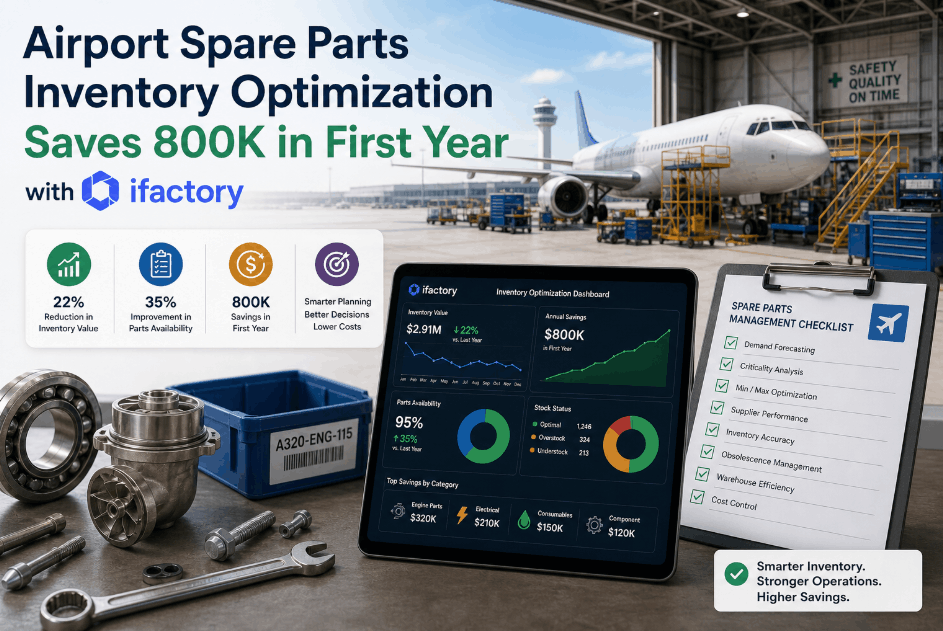
For a major international airport managing over 220 aircraft gates, 4 passenger terminals, and a fleet of 1,800+ ground support and facility assets, spare parts inventory had quietly become one of the most costly and operationally disruptive challenges in the building. Critical components sat untracked across six decentralized storerooms. Emergency procurement was routine. Stockouts grounded aircraft handling equipment at peak hours while adjacent shelves held years of overstock accumulating carrying costs. This is the account of how that airport reclaimed $800,000 in the first year alone — eliminating stockouts on critical spares, cutting overstock by 41%, and automating reorder points across every parts category — using ifactory's Inventory Management platform. Book a demo to see how ifactory's Inventory Management module delivers measurable savings for airport MRO and spare parts environments.
INVENTORY OPTIMIZATION
AIRPORT MRO
SPARE PARTS MANAGEMENT
$800K Saved in Year One. Zero Critical Stockouts.
See how an international airport eliminated stockouts, reduced overstock carrying costs, and automated reorder logic across 1,800+ assets using ifactory's Inventory Management platform — delivering $800K in documented first-year savings.
$800KFirst-Year Savings
41%Overstock Reduction
0Critical Stockouts Post-Deploy
67%Emergency PO Reduction
Client Background
The airport operates four passenger terminals, two cargo facilities, and a 220-gate airside network with a combined campus of 11 million square feet. Facilities maintenance and ground operations teams depend on continuous availability of spare parts across 14 equipment categories — including baggage handling systems, jet bridges, ground power units, runway lighting, HVAC, and building management infrastructure. Prior to ifactory deployment, spare parts were managed across six physical storerooms with no centralized inventory system, no automated reorder logic, and no demand forecasting capability. Part counts, reorder levels, and vendor lead times existed only in spreadsheets maintained independently by each storeroom team. Book a demo to see how ifactory maps to complex airport inventory environments.
Organization TypeInternational airport — public authority operated
Facility Scope4 terminals, 2 cargo facilities, 220 gates — 11M sq. ft. campus
Asset Base1,800+ ground support and facility assets across 14 equipment categories
Prior Infrastructure6 siloed storerooms, spreadsheet-based tracking, no centralized system, no automated reordering
ifactory Feature UsedInventory Management — automated reorder points, demand forecasting, stockout prevention, multi-location visibility
Primary GoalEliminate critical stockouts, reduce overstock carrying costs, and automate parts replenishment across all storeroom locations
The Challenge
Airport inventory management sits at a demanding intersection of operational risk and financial exposure. Too little stock on critical spares grounds equipment at the worst possible moment — peak-hour gate turns, overnight cargo processing windows, weather events that accelerate wear across entire asset classes simultaneously. Too much stock drives carrying costs, capital lock-up, and eventual write-off of parts superseded by equipment refresh cycles. Managing this balance across six physically separated storerooms, with no integrated view, no consumption history, and no automated alerts, meant the airport was perpetually exposed on both ends.
$1.2M
annual carrying cost on excess and obsolete inventory. Manual reorder decisions made without consumption data led to systematic overbuying on high-anxiety parts categories. The result was $1.2M tied up annually in overstock — parts that occupied shelf space, accumulated depreciation, and in many cases were never consumed before asset retirement.
47 events
critical stockout events recorded in the 12 months prior to deployment. Forty-seven times in a single year, maintenance teams found zero on-hand stock for a part needed for an active work order — triggering emergency procurement at premium cost, delaying repairs, and in 11 cases taking airside equipment offline during active gate operations.
$340K
in emergency purchase order premiums annually. Stockout events resolved through expedited procurement carried an average 38% price premium over standard purchase orders. Across 47 stockout events and associated emergency buys for adjacent parts, the airport spent $340K annually in avoidable procurement premium — not including labor and downtime costs.
6 silos
of disconnected storerooms with no cross-location visibility. Parts available in Storeroom 3 were invisible to technicians in Terminal 1. Emergency orders were placed for parts sitting 400 meters away in an adjacent facility. Cross-location visibility did not exist, and no process existed to check multi-location availability before triggering external procurement.
Zero
demand forecasting capability across any parts category. Inventory decisions were made entirely on historical intuition and individual buyer judgment — with no consumption trend data, no seasonality modeling, and no correlation to maintenance schedules or asset age curves. Every reorder was a manual estimate, and every stockout was a surprise.
18 hrs
average delay to resolve a critical stockout through emergency procurement. From the point a technician discovered a stockout to the arrival of an expedited part, the average resolution time was 18 hours — a window during which dependent equipment remained offline, downstream operations were disrupted, and maintenance labor sat idle or was redeployed to lower-priority tasks.
An airport that cannot predict what spare parts it needs — or find what it already owns — is not managing its inventory. It is reacting to it. Every unplanned stockout is a decision that was never made in time. Every dollar of overstock is a decision that was never informed by data. The gap between the two is exactly where intelligent inventory management creates value.
The Solution: ifactory Inventory Management
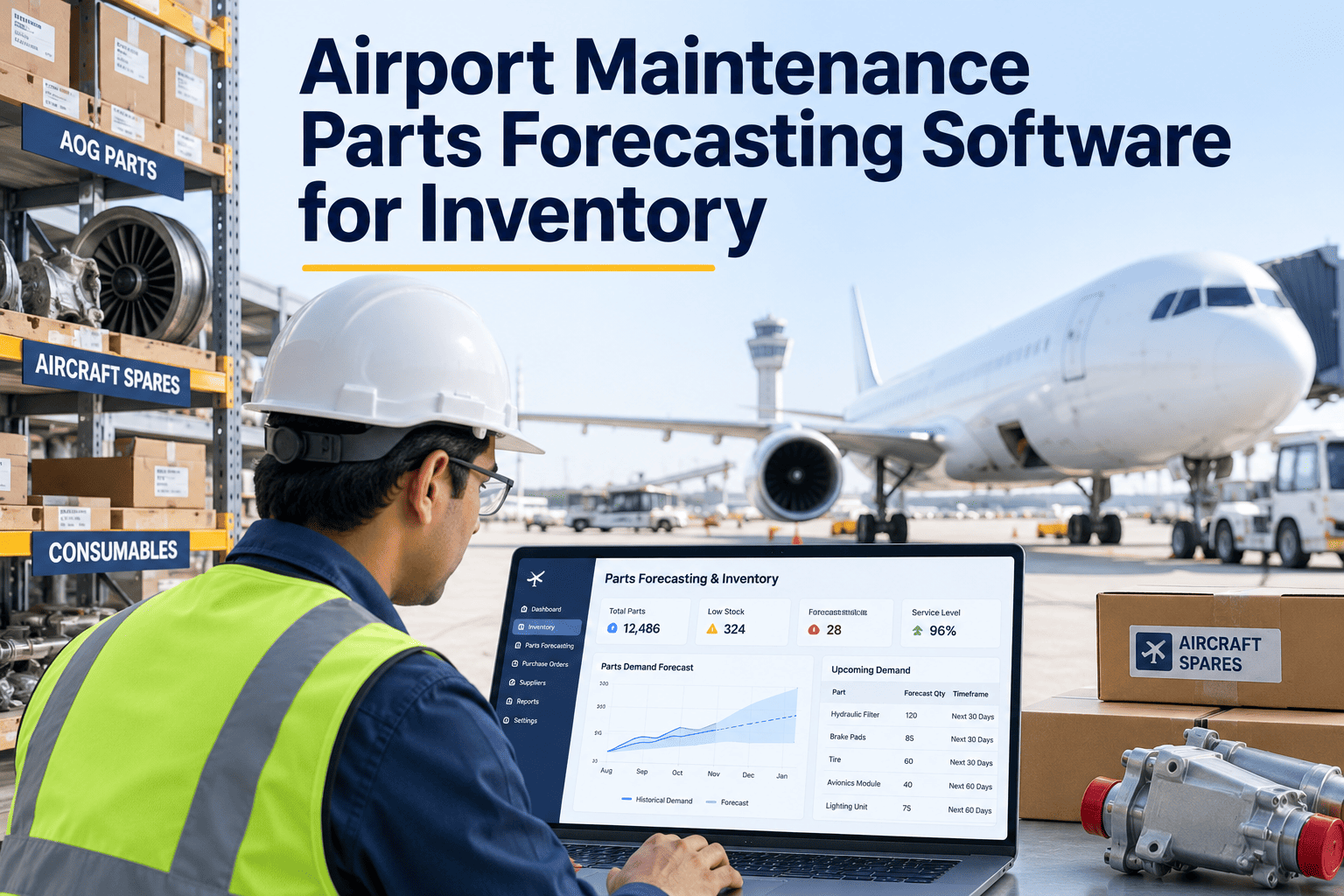
The airport deployed ifactory's Inventory Management module to unify all six storerooms under a single real-time inventory intelligence platform. The system ingested historical consumption records, active work order data, asset maintenance schedules, and vendor lead times to establish data-driven reorder points for every parts category across every location. AI-driven demand forecasting modeled seasonal consumption patterns and maintenance event clusters to anticipate parts requirements before stock depletion — enabling proactive replenishment rather than reactive emergency procurement.
01
Unified Multi-Location Inventory Visibility
- Single real-time view of on-hand stock across all six storeroom locations
- Cross-location availability check before triggering external purchase orders
- Live stock level dashboards with configurable alerts by parts category and criticality tier
02
AI-Driven Demand Forecasting
- Machine learning models analyzing consumption history, maintenance schedules, and asset age data
- Seasonal demand pattern recognition across all 14 equipment categories
- Forecast-driven reorder point recommendations updated continuously as consumption data accumulates
03
Automated Reorder Point Management
- Data-driven reorder points set per SKU based on lead time, consumption velocity, and criticality
- Automated replenishment alerts routed directly to procurement teams before stockout risk develops
- Dynamic reorder level adjustment as consumption patterns evolve across asset lifecycle
04
Critical Spares Classification and Protection
- Tiered criticality classification ensuring zero-tolerance stock thresholds on flight-critical and safety-critical parts
- Dedicated minimum stock floors for airside-impact equipment categories
- Escalation alerts for any critical-tier parts approaching minimum threshold
05
Overstock Identification and Reduction
- Consumption-velocity analysis flagging slow-moving and excess stock for review
- Obsolescence risk scoring on parts held beyond projected consumption window
- Redistribution recommendations for stock held in excess at one location but needed at another
06
Procurement Integration and Vendor Lead Time Tracking
- Vendor lead time data integrated into reorder calculations per supplier and parts category
- Purchase order generation linked directly to inventory system alerts
- Delivery tracking with automated stock receipt updates maintaining real-time accuracy
Implementation Approach
Deployment followed a structured eight-week integration sequence, beginning with data migration and storeroom digitization before advancing to forecasting model calibration and automated reorder activation. Full operational capability across all six storerooms was achieved within 54 days of project kickoff. Book a demo to walk through a deployment plan calibrated to your airport's storeroom configuration and existing procurement workflows.
Phase 1 — Weeks 1–2
Inventory Digitization and Historical Data Migration
Physical stock counts were conducted across all six storerooms and migrated into the ifactory platform. Historical consumption records from maintenance work orders, procurement systems, and storeroom logs were ingested and normalized. Parts were classified into criticality tiers — critical-airside, critical-facility, operational, and general — establishing the framework for differentiated stock management rules.
Phase 2 — Weeks 3–5
Reorder Point Configuration and Cross-Location Integration
Data-driven reorder points were configured for each SKU based on consumption velocity, vendor lead times, and criticality classification. Cross-location inventory visibility was activated, enabling technicians and procurement staff to view real-time stock across all six storerooms from a single interface. Initial overstock analysis identified 312 SKUs carrying excess inventory, with redistribution and write-down recommendations generated for each.
Phase 3 — Weeks 6–8
Demand Forecasting Calibration and Automated Alerting Activation
AI demand forecasting models were calibrated against 24 months of historical consumption data, with seasonal adjustment factors applied across parts categories tied to weather-sensitive and schedule-driven maintenance cycles. Automated replenishment alerts were activated and validated against active procurement workflows. Procurement and storeroom teams completed platform training and began operating under the new automated reorder framework.
Month 3 Onward
Full Optimization — Zero Stockouts, Overstock Reduction in Progress
By month three, zero critical stockout events had occurred since platform activation. Emergency purchase order volume had declined by 67% compared to the same period in the prior year. Overstock reduction was underway, with $490K in excess inventory identified for phase-down, redistribution, or vendor return in the first quarter of full operation.
Results After Full Deployment
The transition from six siloed, spreadsheet-managed storerooms to ifactory's unified Inventory Management platform delivered measurable improvements across every dimension of parts availability, procurement cost, and carrying cost — totaling $800,000 in documented savings within the first 12 months of full operation.
Critical Stockout Events
Pre-ifactory
47 events in 12 months — reactive emergency procurement every 8 days on average
Post-ifactory
Zero critical stockout events in first 12 months post-deployment
Automated reorder points calibrated to actual consumption velocity and vendor lead times eliminated the reactive stockout cycle entirely. AI-driven alerts routed replenishment actions to procurement teams an average of 9 days before projected stock depletion — well ahead of any supply disruption risk.
Emergency Purchase Order Volume and Cost
Pre-ifactory
$340K annually in emergency PO premiums — 38% average above standard PO pricing
Post-ifactory
$112K — 67% reduction in emergency PO volume and associated cost
Proactive replenishment alerts shifted the majority of procurement from emergency channels to planned purchase orders at standard pricing. The 67% reduction in emergency PO volume generated $228K in direct procurement savings in year one alone.
Overstock Carrying Cost
Pre-ifactory
$1.2M in excess and slow-moving inventory — 312 SKUs identified as overstock
Post-ifactory
41% reduction in overstock value — $490K recovered through redistribution and phase-down
Consumption-velocity analysis identified excess stock accumulation that had been invisible to individual storeroom managers. Redistribution of parts held in surplus at one location to locations with active demand, combined with vendor returns and structured phase-down of obsolete stock, recovered $490K in capital within the first year.
Cross-Location Stock Utilization
Pre-ifactory
Zero cross-location visibility — external POs placed for parts available on-campus
Post-ifactory
83 internal transfers completed in year one, avoiding $74K in duplicate procurement
Unified multi-location visibility surfaced on-campus stock that had been invisible to teams placing external purchase orders. Eighty-three internal stock transfers in the first year of operation directly substituted for external procurement — recovering $74K that would otherwise have been spent on parts already owned by the airport.
Average Stockout Resolution Time
Pre-ifactory
18 hours average — equipment offline during emergency procurement cycle
Post-ifactory
Stockout events eliminated — metric no longer applicable in post-deployment period
Elimination of critical stockout events made the 18-hour resolution cycle irrelevant. Maintenance teams now operate with the assurance that critical-tier parts are continuously available — a structural improvement in operational reliability that cannot be quantified through response time metrics alone.
Procurement Team Time on Manual Inventory Management
Pre-ifactory
Estimated 22 hours per week across storeroom teams on manual stock counts and reorder decisions
Post-ifactory
Under 4 hours per week — automated alerts and real-time dashboards replace manual stock review
Automated stock monitoring, reorder alerting, and real-time multi-location dashboards eliminated the manual cycle count and spreadsheet-maintenance workload that had consumed an estimated 22 hours of storeroom team capacity per week — freeing that capacity for higher-value procurement and supplier management activities.
$228K
Emergency PO Savings
$490K
Overstock Capital Recovered
$74K
Duplicate Procurement Avoided
$800K+
Total Year-One Savings
Performance Summary
| Metric |
Before ifactory |
After ifactory |
Improvement |
| Critical Stockout Events (Annual) |
47 events |
0 events |
100% elimination |
| Emergency PO Annual Cost |
$340K |
$112K |
-67% ($228K saved) |
| Overstock Inventory Value |
$1.2M excess |
41% reduced |
$490K recovered |
| Cross-Location Stock Utilization |
Zero visibility |
83 internal transfers |
$74K avoided |
| Average Stockout Resolution Time |
18 hours |
N/A — eliminated |
100% eliminated |
| Manual Inventory Management Time |
22 hrs/week |
Under 4 hrs/week |
~82% reduction |
| Total First-Year Documented Savings |
Baseline |
$800K+ |
Across 3 savings streams |
| Predictive Reorder Lead Time |
None — reactive only |
9 days avg. ahead of depletion |
From 0 to 9 days |
Eliminate Stockouts and Overstock Across Your Airport Storerooms
ifactory's Inventory Management platform connects your existing storeroom data and procurement workflows to deliver automated reorder intelligence, cross-location visibility, and AI-driven demand forecasting — without replacing your current systems.
Key Benefits and Business Impact
The deployment of ifactory's Inventory Management platform delivered value that extended well beyond first-year savings figures — reshaping how the airport manages parts availability risk, allocates procurement resources, and makes capital decisions about inventory investment across all facility and ground operations asset categories.
01
Zero-stockout assurance on critical-tier spare parts.
Automated reorder points calibrated to consumption velocity and vendor lead times eliminated the reactive stockout cycle that had produced 47 critical parts shortages in the prior year. Maintenance teams now operate with continuous availability assurance on airside-critical and facility-critical components — removing the highest-consequence inventory risk from airport operations.
02
$800K in first-year savings across three distinct cost streams.
Emergency procurement premium reduction ($228K), overstock capital recovery ($490K), and duplicate procurement avoidance through cross-location utilization ($74K) combined to deliver $800K in documented first-year savings — without adding procurement headcount or replacing any existing airport system.
03
Unified multi-location visibility replacing six information silos.
For the first time, procurement staff and maintenance teams could see real-time on-hand stock across all six storerooms from a single interface. Cross-location transfers now substitute for external procurement in dozens of scenarios annually — converting a hidden cost source into a measurable efficiency gain.
04
AI-driven demand forecasting converting reactive buying into planned procurement.
Predictive models analyzing consumption history, maintenance schedules, and seasonal demand patterns generate replenishment alerts an average of 9 days ahead of projected depletion — giving procurement teams sufficient lead time to source through standard channels at standard pricing, eliminating the premium cost of emergency procurement.
05
Overstock reduction freeing capital for operational reinvestment.
Consumption-velocity analysis surfaced $1.2M in excess inventory that had been invisible to individual storeroom managers operating in isolation. Structured overstock reduction returned $490K to the airport's operational budget in year one — with continued reduction projected as forecasting models refine reorder levels across remaining parts categories.
06
Storeroom team capacity redirected from administration to value-generating work.
Eliminating 18+ hours of weekly manual stock-count and spreadsheet-maintenance work freed storeroom and procurement team capacity for supplier relationship management, vendor negotiation, and strategic parts standardization initiatives — activities that generate long-term cost reduction rather than just maintaining current inventory accuracy.
Spare parts inventory is not a warehouse problem. It is an operational risk problem and a capital efficiency problem simultaneously. When an airport cannot see what it owns, cannot predict what it needs, and cannot connect its own storerooms to each other — it pays for that ignorance in stockout delays, emergency premiums, and capital locked in parts it does not need. Intelligent inventory management eliminates all three cost drivers at once.
Conclusion
For international airports managing complex multi-terminal operations, spare parts inventory is a hidden lever of both operational reliability and financial performance. When six storerooms operate in isolation — with no shared visibility, no demand forecasting, and no automated reorder logic — the consequences manifest as stockout delays, emergency procurement premiums, and capital permanently locked in overstock accumulation. This case study demonstrates what becomes possible when airport inventory management converges on a unified intelligence platform: 47 annual stockout events eliminated entirely, $228K in emergency procurement premium recovered, $490K in overstock capital returned, and $800,000 in total first-year savings — achieved without replacing any existing airport system or adding procurement headcount. Book a demo to see how ifactory's Inventory Management platform applies to your airport's storeroom configuration and spare parts environment.
For this airport, ifactory's Inventory Management module replaced six disconnected spreadsheet environments with a single real-time intelligence layer — making every part visible, every reorder point data-driven, and every procurement decision informed by actual consumption patterns rather than buyer intuition. Any airport managing spare parts inventory across multiple storeroom locations under reactive, spreadsheet-based conditions can achieve comparable results by making the same transition: from fragmented manual management to unified, AI-driven inventory intelligence.
Frequently Asked Questions
How does ifactory's Inventory Management integrate with existing airport procurement and CMMS systems?
ifactory connects to existing CMMS, ERP, and procurement platforms via API integration — ingesting work order history, purchase order records, and vendor lead time data without replacing any existing system. Existing workflows continue operating while ifactory adds the intelligence layer for real-time visibility, automated alerting, and demand forecasting above them.
How quickly can an airport with multiple storerooms be fully deployed on the ifactory platform?
Most multi-storeroom airport deployments achieve full operational capability within 45–60 days using a phased integration approach. Initial storeroom digitization and data migration are completed first, followed by reorder point configuration and cross-location integration, with demand forecasting calibration finalized in the final phase. Full optimization typically emerges within 90 days as forecasting models accumulate consumption data.
How are critical spare parts classified and protected from stockout risk?
ifactory supports tiered criticality classification — typically airside-critical, facility-critical, operational, and general categories — with differentiated minimum stock thresholds and alert sensitivity for each tier. Critical-tier parts carry zero-tolerance stock floors with escalating alerts triggered well ahead of depletion, ensuring procurement action is initiated before any stockout risk develops.
What data is required to activate AI-driven demand forecasting for spare parts?
The forecasting models are calibrated on historical consumption records — typically 12–24 months of work order and parts issuance data — combined with current asset maintenance schedules and vendor lead time information. Airports with limited historical records can begin with rule-based reorder points that transition to AI-driven forecasting as consumption data accumulates over the first three to six months of operation.
Can ifactory support compliance and audit documentation for aviation regulatory requirements?
The platform maintains complete audit trails of all inventory transactions, reorder events, stock movements, and procurement actions — supporting regulatory compliance documentation, internal audit requirements, and airline and authority SLA reporting. Automated report generation produces standardized inventory compliance documentation without additional manual assembly by storeroom or procurement teams.
What is the typical return on investment timeline for airport inventory management deployments?
Documented airport deployments typically achieve full platform ROI within 6–10 months — driven primarily by emergency procurement cost reduction and overstock capital recovery in the first year. Airports with high baseline stockout frequency or significant excess inventory accumulation generally see payback within the first two quarters of full deployment, as both cost streams respond quickly to automated reorder management.
Ready to Eliminate Stockouts and Recover Overstock Capital?
ifactory's Inventory Management platform unifies your airport storerooms, automates reorder intelligence, and eliminates the reactive spare parts cycle — delivering measurable savings from the first months of operation without replacing your existing systems.