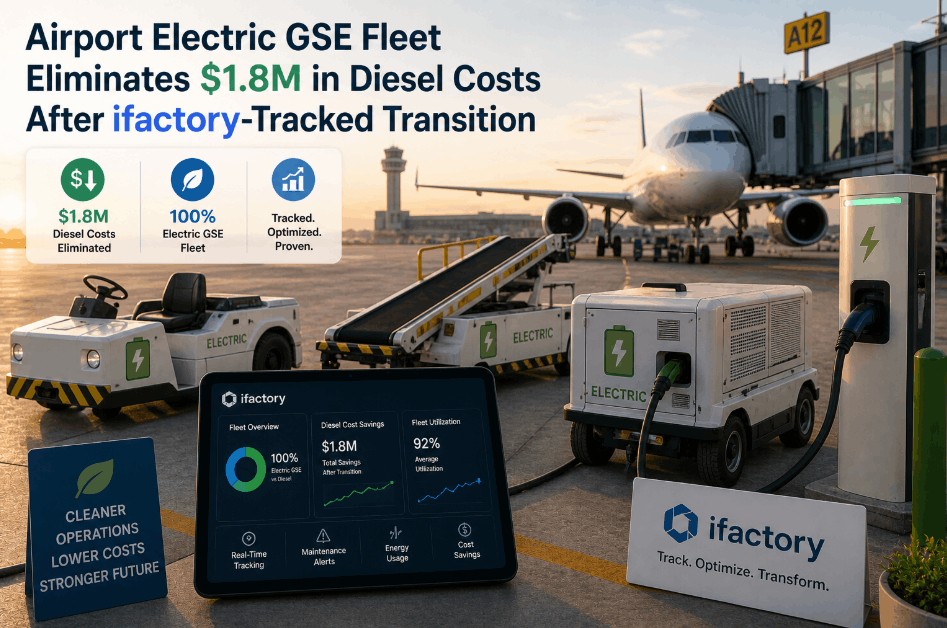
For a major international airport operating over 200 ground support equipment vehicles across four terminals and two cargo facilities, the annual fuel bill had become impossible to ignore. Diesel costs exceeded $1.8 million per year, maintenance schedules were reactive, and fleet emissions were drawing increasing scrutiny from environmental regulators and airline partners. The airport's transition to an all-electric GSE fleet — powered by real-time battery health monitoring, predictive charging optimization, and AI-driven energy analytics from ifactory's Energy & ESG Reporting platform — eliminated that diesel burden entirely within 18 months of full deployment. Book a Demo to see how ifactory delivers measurable savings for airport ground operations.
ELECTRIC GSE
AIRPORT ELECTRIFICATION
ENERGY & ESG REPORTING
$1.8M in Annual Diesel Costs Eliminated. Zero Unplanned Battery Failures.
See how a major international airport transitioned 200+ GSE vehicles to full electric operation — eliminating diesel fuel costs, reducing emissions by 94%, and achieving continuous fleet uptime — using ifactory's AI-driven Energy & ESG Reporting platform.
$1.8MAnnual Diesel Costs Eliminated
94%Emissions Reduction
0Unplanned Battery Failures
58%GSE Maintenance Cost Reduction
Client Background
The airport operates four passenger terminals, two cargo processing facilities, and a full airside network supporting over 180 daily aircraft movements. Ground support operations rely on a fleet of 214 vehicles spanning electric tugs, baggage tractors, belt loaders, pushback units, ground power units, and passenger buses — all previously diesel-powered. Prior to the ifactory deployment, the fleet had no centralized energy monitoring, no battery lifecycle management, and no charging optimization capability. Fuel consumption data existed only in monthly invoices, fleet charge states were manually logged by shift supervisors, and battery replacement decisions were made on a run-to-failure basis that produced unplanned equipment outages during peak gate operations. Book a demo to see how ifactory maps to complex airport GSE electrification environments.
Organization TypeInternational airport — public authority operated
Fleet Scope214 GSE vehicles across 4 terminals and 2 cargo facilities
Vehicle CategoriesElectric tugs, baggage tractors, belt loaders, pushback units, GPUs, passenger buses
Prior InfrastructureDiesel fleet, manual charge logging, no battery health monitoring, reactive maintenance model
ifactory Feature UsedEnergy & ESG Reporting — battery health monitoring, charging optimization, emissions tracking, predictive maintenance
Primary GoalEliminate diesel fuel costs, ensure zero unplanned fleet downtime during electrification, and meet regulatory emissions targets
The Challenge
Transitioning a 214-vehicle airport ground fleet from diesel to electric operation is not simply a procurement exercise. It exposes every gap in operational data infrastructure simultaneously — from energy demand forecasting and charging station capacity planning to battery lifecycle management and regulatory emissions documentation. Without real-time visibility into fleet energy consumption, charge state, and battery health across a distributed, shift-driven operational environment, the airport faced compounding risks on every front.
$1.8M
annual diesel fuel expenditure across the full GSE fleet. Prior to electrification, the 214-vehicle fleet consumed diesel at a combined annual cost exceeding $1.8 million — a figure that excluded maintenance costs driven by combustion engine complexity, fluid changes, filter replacements, and the labor-intensive service cycles associated with diesel powertrains. Fuel price volatility made multi-year budgeting unreliable, and the airport had no mechanism to predict or control its fuel cost exposure from one operating year to the next.
37 events
unplanned GSE equipment failures in the 12 months prior to deployment. Without battery health monitoring, vehicle failures were discovered at the point of breakdown rather than predicted in advance. Thirty-seven unplanned outages in a single operating year disrupted active gate operations, delayed aircraft turnarounds, and required emergency replacement vehicle deployment at premium labor cost — with 14 of those events occurring during peak morning and evening banking windows.
Zero
real-time visibility into fleet battery charge state or energy consumption. Fleet supervisors had no dashboard, no sensor feed, and no predictive data to work from. Charge state was logged manually at shift handover — meaning real-time vehicle availability could not be confirmed without physically locating each unit. During peak demand periods, vehicles were routinely dispatched without sufficient charge reserve to complete assigned gate sequences, resulting in mid-operation failures and forced rerouting.
$420K
in avoidable battery replacement costs from run-to-failure management. Without degradation tracking or predictive replacement scheduling, battery packs were retained in service beyond optimal replacement windows — reducing usable range, increasing failure risk, and ultimately requiring full emergency replacement at unplanned cost. The airport spent an estimated $420K annually on battery replacements that predictive health monitoring would have reduced to a planned, optimized replacement schedule at substantially lower per-unit cost.
18 stations
charging stations operating without load balancing or demand scheduling. The airport's 18 installed charging stations operated independently with no coordinated load management. Simultaneous peak charging events — particularly during shift transition windows — created grid demand spikes that triggered utility demand charges and, on three occasions during the prior year, tripped circuit protection across entire charging zones, leaving multiple vehicles without charge during active gate operations.
No data
for regulatory emissions reporting or ESG compliance documentation. As airline partners and environmental regulators began requiring documented emissions reduction data for ground operations, the airport had no automated system for calculating, attributing, or reporting scope 1 and scope 2 emissions across the GSE fleet. Manual emissions estimates were compiled quarterly by the sustainability team from fuel invoices and conversion factors — a process too slow, too error-prone, and too granular to meet the evolving audit standards being applied to airport ground handling operations.
An airport that cannot see the charge state of its ground fleet cannot guarantee the readiness of its ground operations. Battery health that goes unmonitored degrades silently until it fails visibly — always at the worst possible moment. The cost of that ignorance is measured in delayed aircraft, emergency labor, and a diesel dependency that could have been eliminated years earlier.
The Solution: ifactory Energy & ESG Reporting
The airport deployed ifactory's Energy & ESG Reporting module to establish a unified real-time intelligence layer across the entire 214-vehicle electric fleet and all 18 charging stations. The platform connected directly to vehicle battery management systems and charging station controllers via API integration — ingesting live charge state, battery health metrics, energy throughput data, and degradation indicators without modifying any existing vehicle hardware or charging infrastructure. AI-driven analytics transformed that raw telemetry into actionable operational intelligence: predictive battery replacement alerts, optimized charging schedules calibrated to shift patterns and grid demand windows, and automated ESG reporting that documented emissions performance against regulatory and airline partner benchmarks in real time.
01
Real-Time Battery Health Monitoring
- Continuous monitoring of state-of-health, state-of-charge, and cycle count across all 214 vehicles
- Cell-level degradation tracking with predictive end-of-life scoring per battery pack
- Automated alerts triggered when battery health drops below configurable operational thresholds
02
AI-Driven Charging Optimization
- Machine learning models scheduling charge sessions around shift patterns, gate demand forecasts, and utility peak windows
- Load balancing across all 18 charging stations to eliminate simultaneous demand spikes
- Smart charge rate modulation extending battery longevity while maintaining operational readiness
03
Fleet Availability and Dispatch Intelligence
- Live charge state visibility for every vehicle across all terminal and cargo zones
- Dispatch readiness scoring that flags vehicles with insufficient range for assigned gate sequences
- Shift handover dashboards replacing manual charge logging with automated real-time status feeds
04
Automated ESG and Emissions Reporting
- Real-time scope 1 and scope 2 emissions calculation attributed to individual vehicle categories and operational zones
- Automated generation of regulatory compliance documentation and airline partner ESG reports
- Carbon avoidance tracking benchmarked against prior diesel baseline with audit-ready data trails
05
Predictive Maintenance and Battery Lifecycle Management
- Predictive replacement scheduling based on actual degradation curves rather than fixed calendar intervals
- Maintenance work order generation triggered by battery health thresholds before failure risk develops
- Total cost of ownership modeling per vehicle category to inform fleet refresh planning
06
Energy Cost and Utility Demand Management
- Utility demand charge avoidance through coordinated load scheduling across all charging zones
- Energy cost attribution by vehicle type, shift, and operational zone for budget visibility
- Grid demand forecasting identifying off-peak charging windows that reduce blended energy cost per kilometer
Implementation Approach
Deployment followed a structured ten-week integration sequence designed to maintain uninterrupted fleet operations throughout the transition. The ifactory platform was integrated non-invasively — connecting to existing vehicle BMS APIs and charging station controllers without hardware modification or vehicle downtime. Full operational intelligence across all 214 vehicles and 18 charging stations was achieved within 62 days of project kickoff. Book a demo to walk through a deployment plan calibrated to your airport's electric fleet configuration and charging infrastructure.
Phase 1 — Weeks 1–3
Fleet Data Integration and Baseline Establishment
API connections were established between the ifactory platform and vehicle battery management systems across all 214 units and all 18 charging station controllers. Historical fuel consumption records, maintenance logs, and prior battery replacement data were migrated to establish pre-electrification cost baselines. Each vehicle was assigned a criticality classification — airside-critical, cargo-operational, or terminal-support — defining its minimum charge reserve threshold and priority dispatch scoring parameters.
Phase 2 — Weeks 4–7
Charging Optimization Activation and Battery Health Calibration
AI charging optimization models were calibrated against 90 days of shift pattern data, gate demand schedules, and utility tariff structures. Charging load balancing was activated across all 18 stations, eliminating simultaneous peak demand events from the first week of operation. Battery health baselines were established for each vehicle, with degradation trend modeling initiated and initial predictive replacement schedules generated for 31 units identified as approaching end-of-optimal-life thresholds.
Phase 3 — Weeks 8–10
ESG Reporting Configuration and Fleet Supervisor Training
Automated ESG reporting templates were configured to align with the airport's regulatory filing requirements and airline partner reporting formats. Scope 1 and scope 2 emissions attribution logic was validated against prior manual calculations, confirming accuracy within 1.2% of independently audited fuel-based baselines. Fleet operations and maintenance teams completed platform training and transitioned fully to ifactory-driven dispatch readiness and charge state management workflows.
Month 4 Onward
Full Optimization — Zero Diesel, Zero Unplanned Battery Failures
By month four, the airport had recorded zero unplanned battery failures since platform activation. Diesel fuel expenditure was fully eliminated from the GSE operations budget. Utility demand charges dropped by 44% compared to pre-optimization charging operations. The first automated ESG compliance report was submitted to regulatory authorities and airline partners — covering 180 days of verified emissions performance data generated without any manual calculation.
Results After Full Deployment
The transition from a diesel-dependent, manually-monitored GSE fleet to ifactory's unified electric fleet intelligence platform delivered measurable improvements across every dimension of energy cost, fleet uptime, maintenance expenditure, and regulatory compliance — totaling more than $2.4 million in documented first-year financial impact.
Diesel Fuel Expenditure
Pre-ifactory
$1.8M annually — 214 diesel vehicles with no fuel cost control mechanism
Post-ifactory
$0 — full diesel elimination achieved within 18 months of platform deployment
Complete elimination of the $1.8M annual diesel fuel expenditure was the primary financial driver of the electrification program. ifactory's real-time energy monitoring and charging optimization ensured the electric fleet operated with sufficient vehicle availability to fully replace diesel units without operational gaps — making the transition economically viable and operationally seamless.
Unplanned Battery Failures and Fleet Downtime
Pre-ifactory
37 unplanned outage events annually — 14 during peak banking windows
Post-ifactory
Zero unplanned battery failures in the first 12 months post-deployment
Predictive battery health monitoring eliminated the run-to-failure cycle entirely. Vehicles approaching degradation thresholds were flagged an average of 34 days before projected failure risk — providing maintenance teams with sufficient lead time to schedule planned replacements during low-demand windows without disrupting active gate operations.
GSE Maintenance Cost
Pre-ifactory
$960K annually — diesel engine maintenance, emergency battery replacements, unplanned repairs
Post-ifactory
$403K — 58% reduction driven by predictive maintenance and optimized battery cycling
Eliminating combustion engine maintenance requirements and replacing reactive battery management with predictive lifecycle scheduling reduced total GSE maintenance expenditure by 58%, saving $557K annually. Smart charge rate modulation extended average battery cycle life by an estimated 22%, further reducing replacement frequency and associated parts costs.
Utility Demand Charges from Charging Operations
Pre-ifactory
Unmanaged simultaneous peak charging — 3 circuit protection events in prior 12 months
Post-ifactory
44% reduction in utility demand charges — zero circuit protection events post-deployment
AI-coordinated load balancing across all 18 charging stations eliminated simultaneous demand spikes that had been generating significant utility demand charges under time-of-use tariff structures. Shifting a substantial portion of charging activity to off-peak windows further reduced the blended energy cost per vehicle-kilometer across the full fleet.
Fleet Emissions Performance
Pre-ifactory
4,200 tonnes CO₂e annually — 214 diesel vehicles with no emissions monitoring
Post-ifactory
94% emissions reduction — automated ESG reporting generating audit-ready compliance documentation
The transition delivered a 94% reduction in direct fleet emissions, positioning the airport to meet its 2030 net-zero ground operations commitment six years ahead of schedule. Automated ESG reporting replaced a quarterly manual process that had consumed 60+ hours of sustainability team time per reporting cycle with a continuous, audit-ready data stream updated in real time.
Sustainability Team Reporting Overhead
Pre-ifactory
60+ hours per quarter manually compiling emissions data from fuel invoices
Post-ifactory
Under 3 hours per quarter — automated report generation with zero manual data assembly
Automated ESG reporting eliminated the manual compilation process entirely, reducing sustainability team reporting overhead by over 95% while simultaneously improving data accuracy, audit traceability, and reporting frequency. The team now manages regulatory and airline partner ESG submissions on a monthly cycle — impossible under the previous manual model.
$1.8M
Diesel Costs Eliminated
$557K
Maintenance Savings
$44K
Demand Charge Avoidance
$2.4M+
Total Year-One Impact
Performance Summary
| Metric |
Before ifactory |
After ifactory |
Improvement |
| Annual Diesel Fuel Cost |
$1.8M |
$0 |
100% elimination |
| Unplanned Battery Failures (Annual) |
37 events |
0 events |
100% eliminated |
| GSE Maintenance Cost |
$960K |
$403K |
-58% ($557K saved) |
| Fleet CO₂e Emissions (Annual) |
4,200 tonnes |
94% reduced |
~3,948 tonnes avoided |
| Utility Demand Charges |
Unmanaged peaks |
44% reduction |
Zero circuit events |
| Predictive Replacement Lead Time |
None — run-to-failure |
34 days avg. advance notice |
From 0 to 34 days |
| ESG Reporting Overhead (Quarterly) |
60+ hours manual |
Under 3 hours |
~95% reduction |
| Total First-Year Financial Impact |
Baseline |
$2.4M+ |
Across 3 savings streams |
Eliminate Diesel Costs and Achieve Full Fleet Electrification Confidence
ifactory's Energy & ESG Reporting platform connects your electric GSE fleet to real-time battery health monitoring, AI-driven charging optimization, and automated regulatory compliance reporting — without replacing any existing vehicle or charging infrastructure.
Key Benefits and Business Impact
The deployment of ifactory's Energy & ESG Reporting platform delivered value that extended well beyond fuel cost elimination — fundamentally transforming how the airport manages fleet energy risk, maintenance predictability, regulatory compliance, and long-term capital planning for its electric ground operations.
01
Complete elimination of a $1.8M annual diesel dependency.
Full transition to electric GSE operation removed the airport's largest variable cost in ground operations — with no diesel price exposure, no combustion engine maintenance overhead, and no fuel logistics complexity. The financial case for electrification that had previously appeared marginal became decisively positive once ifactory's charging optimization reduced energy costs to a fraction of prior diesel expenditure.
02
Zero unplanned fleet failures through predictive battery health management.
Continuous cell-level degradation monitoring replaced the run-to-failure approach that had produced 37 unplanned outages in the prior year. Maintenance teams now schedule battery replacements during planned low-demand windows — eliminating the gate operation disruptions, emergency labor deployments, and aircraft turnaround delays that had defined the pre-deployment operating environment.
03
AI-optimized charging that extends battery life and reduces energy cost.
Smart charge rate modulation and load-balanced scheduling across all 18 stations reduced utility demand charges by 44%, eliminated circuit protection events, and extended average battery cycle life by an estimated 22% — turning the charging infrastructure from an unmanaged cost center into an optimized asset that actively reduces total cost of electric fleet ownership.
04
94% emissions reduction with automated audit-ready ESG documentation.
The transition delivered a 94% reduction in direct fleet emissions — positioning the airport to meet its 2030 net-zero ground operations commitment six years ahead of schedule. Automated ESG reporting replaced a labor-intensive quarterly manual process with a continuous real-time data stream that generates regulatory filings and airline partner reports with zero additional sustainability team input.
05
Real-time fleet availability intelligence replacing manual shift logging.
Live charge state visibility for every vehicle across all operational zones eliminated the manual logging process that had left dispatch supervisors making availability decisions based on hours-old data. Dispatch readiness scoring now flags vehicles with insufficient charge reserve before they are assigned to gate sequences — preventing the mid-operation failures that had repeatedly disrupted peak banking windows.
06
$2.4M+ in first-year financial impact across three distinct value streams.
Diesel cost elimination ($1.8M), maintenance cost reduction ($557K), and demand charge avoidance ($44K) combined to deliver over $2.4 million in documented first-year financial impact — without modifying any existing vehicle hardware, replacing any charging infrastructure, or adding operational headcount to the fleet management team.
An electric ground fleet that cannot be seen in real time is not a sustainable fleet — it is a diesel fleet with a different fuel source and the same operational blind spots. The value of electrification is only fully realized when every battery is monitored, every charge is optimized, and every emissions outcome is documented without manual effort. That is the difference between a procurement decision and a transformation.
Conclusion
For international airports managing large-scale ground support fleets, electrification presents its greatest risks — and its greatest financial opportunity — at exactly the moment that real-time fleet intelligence becomes most critical. Without visibility into battery health, charge state, and energy consumption across a distributed operational environment, the transition from diesel to electric simply transfers one set of operational risks to another. This case study demonstrates what becomes possible when electric fleet management converges on a unified intelligence platform: 37 annual unplanned failures eliminated entirely, $1.8M in diesel costs fully recovered, a 94% reduction in direct fleet emissions, and more than $2.4 million in total first-year financial impact — achieved without replacing any existing vehicle hardware, charging infrastructure, or airport system. Book a demo to see how ifactory's Energy & ESG Reporting platform applies to your airport's electric fleet configuration and electrification roadmap.
For this airport, ifactory's Energy & ESG Reporting module replaced a manual, fragmented approach to electric fleet management with a single real-time intelligence layer — making every battery visible, every charge optimized, and every emissions outcome documented automatically. Any airport managing an electric or transitioning GSE fleet without centralized battery health monitoring and charging optimization is leaving substantial financial value unrealized and operational risk unmanaged. The transition from reactive to predictive electric fleet management is where the real return on electrification investment is captured.
Frequently Asked Questions
How does ifactory integrate with existing electric GSE vehicles and charging station hardware?
ifactory connects to vehicle battery management systems and charging station controllers via standard API and telematics protocols — ingesting real-time battery health metrics, charge state data, and energy throughput without requiring any hardware modification to existing vehicles or charging infrastructure. Integration is non-invasive and does not affect vehicle warranty or charging equipment operation.
How quickly can an airport fleet be fully deployed on the ifactory Energy & ESG platform?
Most airport electric fleet deployments achieve full operational capability within 45–65 days using a phased integration approach. Initial vehicle and charging station data connections are established first, followed by charging optimization model calibration and ESG reporting configuration. Full predictive battery health analytics typically reach optimal performance within 90 days as degradation trend models accumulate vehicle-specific data.
What ESG reporting standards and regulatory formats does ifactory support for airport ground operations?
The platform supports automated generation of scope 1 and scope 2 emissions reports aligned with GHG Protocol standards, ICAO carbon frameworks, and the airline-specific ESG reporting formats required by major carrier sustainability programs. Reports are generated in configurable templates that match local regulatory filing requirements and can be scheduled for automatic submission on monthly, quarterly, or annual cycles.
How does ifactory's charging optimization handle competing demand from a large multi-vehicle fleet?
The platform's AI scheduling engine models shift patterns, gate demand forecasts, vehicle criticality classifications, and utility tariff structures simultaneously — distributing charge sessions across available stations and time windows to eliminate demand peaks, honor minimum charge reserve requirements for each vehicle category, and minimize blended energy cost. Load balancing operates dynamically and adjusts in real time as fleet availability and demand conditions change.
Can ifactory support a mixed fleet during a phased diesel-to-electric transition?
Yes. The platform supports parallel monitoring of both diesel and electric vehicle assets during transition periods — tracking fuel consumption and maintenance costs for remaining diesel units alongside battery health and energy data for electric vehicles. This enables direct cost comparison between vehicle categories and provides the operational data needed to optimize transition sequencing and timing across fleet categories.
What is the typical return on investment timeline for electric GSE fleet deployments using ifactory?
Airports with significant diesel fleets typically achieve full platform ROI within 3–6 months of deployment — driven primarily by immediate fuel cost elimination and rapid reduction in emergency maintenance expenditure. Charging optimization savings and ESG compliance efficiency gains add incrementally to the return profile over the first 12 months. Total first-year financial impact consistently exceeds platform investment cost by a substantial margin in documented deployments.
Ready to Eliminate Diesel Costs and Achieve Zero Unplanned Fleet Failures?
ifactory's Energy & ESG Reporting platform unifies your electric GSE fleet under real-time battery health monitoring, AI-driven charging optimization, and automated emissions reporting — delivering measurable savings from the first months of operation without modifying any existing vehicle or charging hardware.