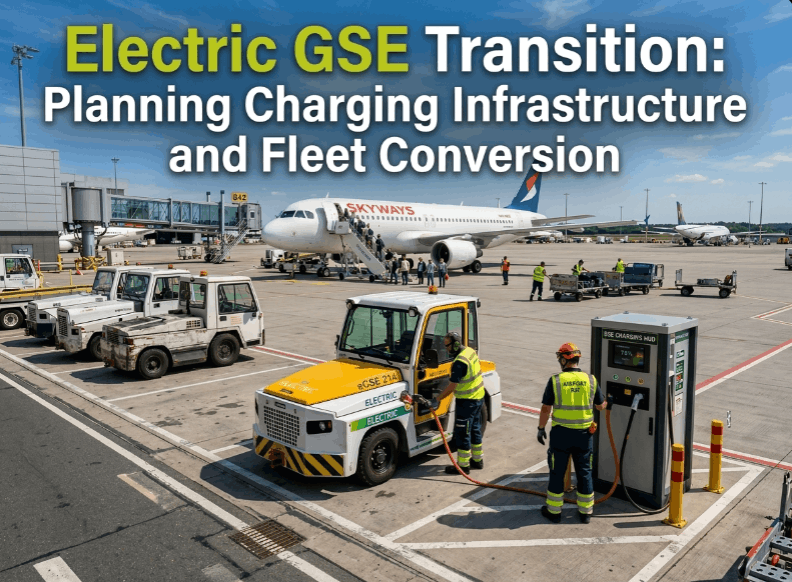
Airport ground operations are entering the most significant transformation in their history — the shift from diesel and gasoline-powered ground support equipment to a fully electric GSE fleet. The pressure is no longer hypothetical. Regulatory mandates from ICAO and national aviation authorities, airline sustainability commitments tied to SAF and Scope 3 reporting, rising diesel fuel costs, and tightening airport-level air quality requirements have made the electric GSE transition a board-level priority for airport operators worldwide. Yet most electrification programs stall not because the equipment is unavailable, but because the underlying charging infrastructure, fleet conversion sequencing, and battery management strategy were never engineered to operate at airport scale. In 2026, the airports leading on carbon reduction are not the ones that bought the most electric tugs — they are the ones that planned the electrification roadmap with the same rigor they apply to runway operations, gate scheduling, and capital construction. To see how iFactory supports airport electrification planning with AI-driven milestone tracking and ESG reporting, Book a Demo with our energy and ESG specialists today.
What the Electric GSE Transition Actually Requires
Understanding the Full Scope of Airport Electrification Beyond Vehicle Replacement
The electric GSE transition is often misunderstood as a procurement exercise — replacing diesel tugs, belt loaders, baggage tractors, ground power units, and pushback tractors with electric equivalents. In reality, airport electrification is a multi-system transformation that touches energy infrastructure, ramp operations, maintenance workflows, fleet scheduling, operator training, and ESG reporting simultaneously. A successful electric airport vehicles program must coordinate utility capacity upgrades, charging station siting, battery management protocols, operator certification, and conversion sequencing across hundreds of pieces of equipment without disrupting flight turnaround performance even once. The airports that have executed this transition successfully treat it as a structured, milestone-driven program with measurable carbon reduction targets, not as a series of independent equipment purchases driven by lease cycles.
The complexity multiplies further when airports operate across multiple terminals, cargo facilities, and remote stands — each with different electrical capacity, ramp geometry, and operational tempo. A successful GSE electrification roadmap must reconcile these site-specific constraints with corporate-level sustainability commitments, airline tenant expectations, and regulatory disclosure requirements. Most operators discover that the bottleneck is not capital availability or equipment supply — it is program orchestration. Without a unified data platform that connects equipment telemetry, charger commissioning records, utility coordination milestones, and ESG reporting, electrification programs fragment into disconnected workstreams that miss deadlines and underdeliver on carbon commitments. Airport operators evaluating their electrification roadmap can Book a Demo to see how iFactory structures GSE conversion programs from baseline assessment through final fleet cutover.
Charging Infrastructure Design for Airport-Scale Electrification
Engineering GSE Charging Networks That Match Ramp Operations Tempo
GSE charging infrastructure is the foundation of every successful electric airport vehicles program — and the most common failure point in electrification projects that stall mid-deployment. Unlike commercial EV charging networks designed for passenger vehicles, airport GSE charging must support intense industrial usage cycles where equipment may operate for 18–22 hours per day with brief charging windows between aircraft turns. Designing this infrastructure requires accurate ramp duty-cycle modeling, charger placement that matches gate operational patterns, electrical load balancing across multiple substations, and redundancy planning for peak operational banks when dozens of aircraft turn within the same 60-minute window.
Charging architecture must also accommodate multiple equipment classes operating concurrently — high-power DC fast chargers for tugs and pushback tractors, mid-power units for belt loaders and baggage tractors, and trickle charging zones for staged equipment held in reserve. The interaction between these charging tiers, the airport's electrical distribution system, and the operational tempo of the ramp creates a load profile that legacy facility power systems were never engineered to handle. Programs that deploy chargers without first modeling this aggregate load profile routinely encounter brownout events, breaker trips, and demand charge spikes that erode the operating economics of the entire electrification effort. Airport planners ready to model their charging network requirements can Book a Demo for a live walkthrough of iFactory's charging infrastructure planning framework.
GSE Fleet Conversion Sequencing: Which Equipment to Electrify First
A Risk-Adjusted Roadmap for Phasing Out Diesel Ground Support Equipment
Not every category of ground support equipment is equally suited for early electrification. Successful GSE fleet conversion programs sequence equipment replacement based on duty-cycle compatibility with available battery capacity, charging infrastructure readiness at each gate or stand, equipment market maturity across OEMs, and operational risk tolerance for that equipment class. Belt loaders, baggage tractors, and ground power units typically lead the conversion sequence because their duty cycles match available battery capacity and charging windows, their electric platforms have been commercially validated for over a decade, and operational disruption from equipment failures is contained within baggage handling rather than affecting aircraft movement.
Wide-body pushback tugs, high-lift catering trucks, lavatory service vehicles, and de-icing rigs typically follow in later conversion waves because their power demands, operational duty cycles, and weather exposure require either advanced battery chemistry, hybrid configurations, or second-generation electric platforms that are only now reaching commercial maturity. The conversion sequence must also account for equipment lease cycles, GSE maintenance contract expirations, OEM delivery lead times, and the readiness of the airport's own training and maintenance organization to support new electric platforms. Variables such as battery handling certifications, high-voltage maintenance capabilities, and electric drivetrain diagnostics can extend or compress the electrification timeline by 12–24 months independent of equipment availability. Airport operators ready to build a conversion sequence aligned with their fleet refresh windows can Book a Demo to review iFactory's sequencing methodology.
GSE Battery Management for Airport Electrification
Maximizing Battery Life, Availability, and Safety Across an Electric GSE Fleet
Battery management is the operational discipline that determines whether an electric GSE fleet delivers its promised total cost of ownership advantage — or becomes a maintenance and reliability liability that erodes the business case for electrification. Each battery in the fleet has a finite cycle life measured in thousands of charge-discharge events, a temperature-sensitive degradation curve influenced by ambient ramp conditions, and a state-of-health profile that drifts over the equipment's operational life. Without continuous battery telemetry, predictive degradation modeling, and proactive replacement planning, airports discover battery failures at the worst possible moment — during peak operational banks when every piece of equipment is committed to active turnarounds.
Modern GSE battery management combines onboard battery management system (BMS) data, charging cycle analytics, ambient temperature exposure tracking, depth-of-discharge profiles, and AI-driven health forecasting to predict end-of-life events months in advance of actual failure. This data also feeds warranty claim documentation, equipment insurance reporting, residual value assessments, and ESG disclosures that airlines and regulators increasingly require. Airports with mature battery management programs typically extend usable battery life by 18–28% compared to operators relying on reactive replacement, materially shifting the lifecycle economics of the entire electric fleet. Operations leaders ready to operationalize battery analytics across their electric fleet can Book a Demo to review iFactory's battery management dashboards in a live airport deployment.
Electrification Milestone Tracking with AI-Driven Analytics
How AI-Driven Tracking Keeps Airport Electrification Programs On Schedule and On Budget
Multi-year electrification programs involve hundreds of interdependent milestones — utility upgrades, charger procurement, equipment delivery, training certifications, decommissioning of legacy fuel infrastructure, ramp resurfacing for new charger installations, and quarterly emissions reporting checkpoints. Without an AI-driven tracking layer that connects all of these workstreams, milestones drift independently, dependencies break silently, and the carbon reduction commitments tied to the program slip past their reporting deadlines without anyone noticing until the annual sustainability report is being drafted.
iFactory's Energy & ESG Reporting platform applies AI-driven analytics to electrification programs by ingesting milestone data, equipment delivery schedules, charger commissioning records, utility coordination updates, and operational telemetry into a unified program intelligence layer. The system automatically flags at-risk milestones based on dependency analysis and historical schedule drift patterns, models the carbon impact of schedule slippage in real time, and produces audit-ready ESG reports that satisfy both regulatory requirements and airline sustainability disclosures. The result is a program management discipline that matches the rigor airports apply to capital construction projects — replacing weekly status meetings and reconciliation spreadsheets with continuous, data-driven program visibility.
| Electrification Program Metric | Manual Program Tracking | AI-Driven Tracking Platform | Improvement Factor |
|---|---|---|---|
| Milestone Status Visibility | Weekly status meetings | Real-time dashboards | Continuous visibility |
| Schedule Risk Detection | 3–6 weeks after slip | 7–14 days advance warning | 4–6× earlier intervention |
| Carbon Reduction Forecasting | Annual estimate | Live program-to-date forecast | Continuous accuracy |
| Charger Commissioning Tracking | Spreadsheet-based | Automated milestone capture | Eliminated manual entry |
| Battery Health Visibility | Reactive failures | Predictive degradation alerts | Proactive replacement |
| ESG Report Generation | 4–8 weeks per cycle | 2–4 days per cycle | 10–14× faster |
| Cross-Stakeholder Reporting | Custom decks per audience | Role-based live views | Unified data source |
Electric GSE Transition Roadmap: A Phased Implementation Plan
A Structured Path From Baseline Assessment to Full Fleet Electrification
Airport electrification programs succeed when they are sequenced as structured, milestone-driven initiatives rather than open-ended sustainability goals. The phased roadmap below reflects the implementation framework iFactory uses to guide airport operators from initial baseline assessment through full electric GSE fleet operations, with each phase delivering measurable outcomes that compound into the program's final carbon reduction targets.
Risk Factors That Derail Airport Electrification Programs
Common Failure Points and How AI-Driven Program Management Prevents Them
The airports that have struggled with their electric GSE transition usually encounter the same recurring failure modes — failures that are predictable, preventable, and almost always rooted in inadequate program visibility rather than technical limitations of the equipment itself. Understanding these risk factors before program kickoff allows airport operators to design controls into the electrification roadmap from day one, embedding mitigation strategies directly into the program's milestone structure rather than reacting to issues after they surface.
Frequently Asked Questions
How long does a complete electric GSE transition typically take at a major airport?
Most major airports complete full GSE electrification over a 5–8 year horizon, sequenced into 5–6 conversion waves aligned with equipment lease cycles, charging infrastructure readiness, and electric platform maturity for each equipment class. Early waves typically deliver 30–40% of the total emissions reduction within the first 24 months.
What is the most common reason electric GSE programs fall behind schedule?
Underestimated electrical capacity upgrades and utility coordination delays are the leading cause of slippage. Programs that engineer substation and charging infrastructure design before fleet procurement consistently outperform those that sequence the work in reverse and discover capacity constraints after equipment has already been ordered.
Which GSE equipment categories should be electrified first?
Belt loaders, baggage tractors, and narrow-body pushback tugs are typically the first conversion waves due to mature electric platforms, predictable duty cycles, and moderate charging demand that aligns with gate operational patterns. These categories also generate the fastest operational learning to inform later, higher-complexity conversion waves.
How does AI-driven tracking improve electrification program outcomes?
AI-driven program intelligence detects schedule slippage 4–6 weeks earlier than manual tracking, models the carbon impact of delays in real time, and generates audit-ready ESG reports in days rather than weeks — keeping programs aligned with sustainability commitments and providing leadership with continuous visibility into program health.
Can existing GSE charging infrastructure be expanded incrementally?
Yes — when the initial design includes substation headroom, modular charger architecture, and load-balancing controls. Programs that design for end-state capacity from day one avoid the costly rework that incremental retrofits typically require, often saving 20–35% on total infrastructure capital over the program lifecycle.
How does GSE battery management affect total cost of ownership?
Battery replacement is the largest variable cost in electric GSE lifecycle economics. Predictive battery analytics that extend cycle life and prevent premature failures can shift TCO outcomes by 15–25% over a 10-year operational horizon, often determining whether the electrification program meets or misses its financial business case.
Does electrification require replacing existing fleet management systems?
No. iFactory's Energy & ESG Reporting platform integrates with existing fleet management, maintenance, and ramp operations systems — adding charging telemetry, battery analytics, and milestone tracking without forcing a full systems replacement or disrupting current operational workflows.




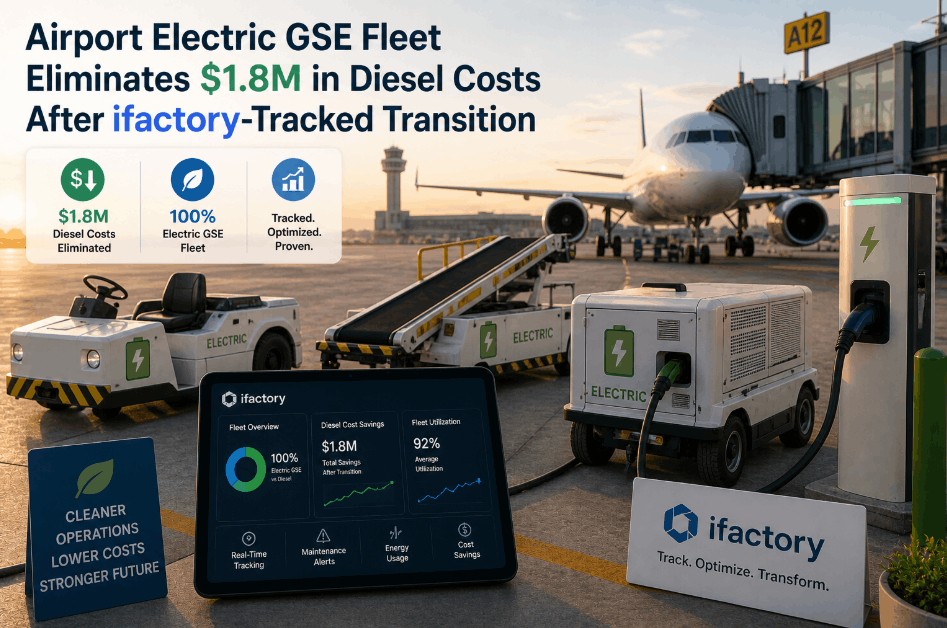


-fleet-management-electrification,-tracking,-and-predictive-pm.png)