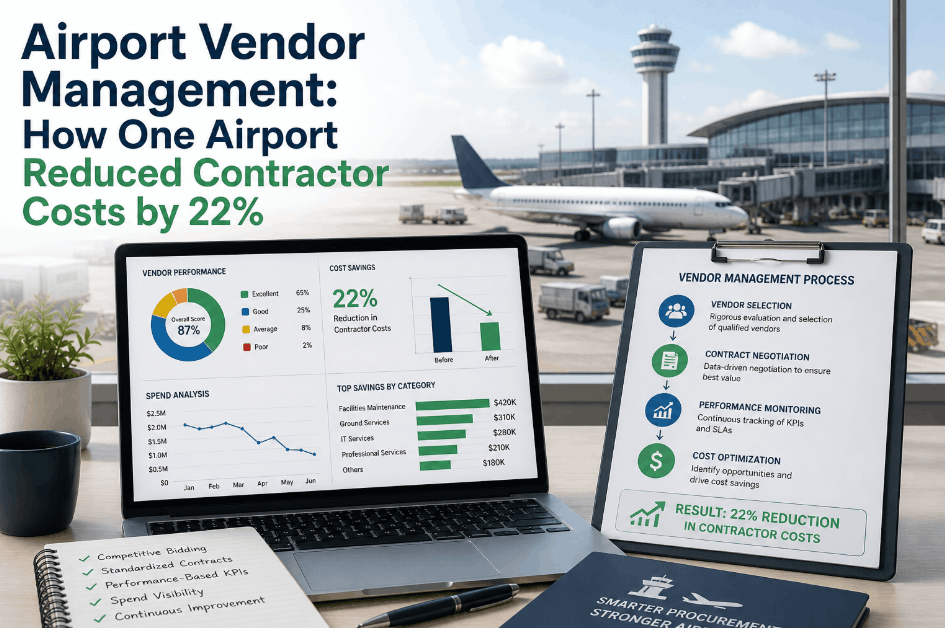
Managing a complex airport ecosystem means overseeing dozens of contractors simultaneously — each operating under separate SLAs, invoicing on different schedules, and performing at wildly different levels of accountability. For one mid-sized international airport processing over 11 million passengers annually, contractor sprawl had quietly become a significant financial liability. With 45 active vendors spanning ground handling, cleaning, maintenance, retail operations, and security services, the airport's procurement and operations teams were spending more time chasing paper trails than driving performance. By deploying iFactory's Vendor Management module, the airport achieved a verified 22% reduction in total contractor expenditure within 12 months — without reducing service scope or quality. Book a Demo to discover how iFactory can transform vendor accountability at your airport.
Client Background & Operational Profile
The airport in this case study operates two terminals, handling scheduled and charter services across 38 domestic and international routes. Its vendor portfolio spans the full breadth of airport operations — from airside ground handling and baggage services to terminal cleaning, retail concession management, infrastructure maintenance, and passenger security screening. Prior to the iFactory deployment, the airport's contract management function operated largely through manual processes: spreadsheet-tracked SLAs, email-based performance reports, and monthly invoice reconciliation conducted by a four-person procurement team.
The Challenge: Four Structural Failures in Vendor Oversight
Despite contractual obligations in place for all 45 vendors, the airport's operational leadership identified a persistent gap between contracted commitments and actual service delivery. Manual oversight simply could not keep pace with the complexity of real-time airport operations, where vendor performance directly affects passenger experience, regulatory compliance, and airside safety. Four structural failure modes were costing the airport millions annually.
The Solution: iFactory Vendor Management Module
iFactory's Vendor Management module was selected following a competitive evaluation process involving four shortlisted platforms. The decision centred on iFactory's ability to unify SLA tracking, real-time performance scorecarding, and automated invoice verification into a single operational layer — with native integration into the airport's existing CAFM (Computer-Aided Facilities Management) system and financial ERP. Rather than replacing existing vendor contracts, iFactory's deployment created a transparent accountability infrastructure that made contractual commitments enforceable in real time.
- Continuous monitoring of 380+ SLA parameters across all 45 vendors
- Automated breach detection with timestamped evidence capture
- Instant notifications to vendor relationship managers on SLA exceedance
- Automated penalty credit calculations applied directly to invoice reconciliation
- Dynamic monthly performance scores across 12 weighted KPI dimensions
- Cross-category benchmarking enabling objective vendor comparison
- Trend analysis identifying improving or declining vendor trajectories
- Procurement-ready performance reports generated automatically at renewal
- Line-by-line invoice reconciliation against verified service delivery records
- Flagging of anomalous charges, duplicate items, and unauthorised materials
- Integration with CAFM and operational logs for evidence-based dispute resolution
- Average invoice processing time reduced from 4.2 days to 6 hours
- Centralised repository for certifications, insurance, and regulatory documents
- Automated expiry alerts with vendor notification workflows
- Risk scoring based on compliance posture and performance history
- Audit-ready documentation trail for regulatory inspections
- Market benchmarking data integrated to support contract renegotiation
- Spend analytics by vendor, category, and terminal zone
- Scope creep detection and unauthorised variation tracking
- Data-driven renewal recommendations based on 12-month performance history
- Single-pane view of all vendor SLA statuses, scores, and open disputes
- Mobile-accessible alerts for procurement officers and operations managers
- Executive reporting suite with P&L impact summaries
- Escalation management workflows for critical SLA failures
Implementation Approach: 12-Month Phased Deployment
The iFactory deployment was structured in three phases, prioritising the highest-spend and highest-risk vendor categories in the first phase to generate demonstrable ROI within the first quarter. Full platform capability — including the automated invoice verification engine and procurement intelligence modules — was operational across all 45 vendors by month ten.
All 45 vendor contracts were ingested and digitised into iFactory's SLA configuration engine, with 380+ performance parameters mapped and weighted. Phase one focused on the ten highest-spend vendors — including ground handling, security, and terminal cleaning — representing 68% of total contractor expenditure. Real-time SLA monitoring went live on day 34. Within the first 90 days, $112,000 in previously unrecovered SLA penalty credits were automatically identified and applied to outstanding invoices.
The automated invoice verification engine was integrated with the airport's SAP ERP system and CAFM platform. Within the first full billing cycle, the system flagged 23% of vendor invoices for discrepancies — totalling $218,000 in disputed charges across 14 vendors. Performance scorecarding went live across all 45 vendors, delivering the airport's first objective cross-vendor benchmarking data. Three vendors in the bottom performance quartile received formal improvement notices backed by iFactory-generated evidence packages.
Armed with 8 months of verified performance data and spend analytics, the procurement team entered contract renewal negotiations for 12 vendors using iFactory's data-driven recommendations. Average rate reductions of 8–14% were achieved across the renewal cohort, with scope adjustments reflecting actual service utilisation data rather than contractor estimates. Vendor compliance documentation completeness reached 99.6% — reducing regulatory audit preparation time from 3 days to 4 hours.
Results: 22% Contractor Cost Reduction Across 45 Vendors
The iFactory deployment delivered verified, audited financial impact across every targeted cost category within the 12-month program period. Savings were independently reconciled against pre-deployment baselines using the airport's own financial records.
Performance Summary
| Operational Metric | Baseline (Pre-iFactory) | Current (Post-iFactory) | Improvement |
|---|---|---|---|
| SLA Compliance Rate (All Vendors) | 61% | 94% | +33 Percentage Points |
| Annual SLA Penalty Recovery | $68,000 (Partial Manual) | $612,000 (Automated) | +800% Recovery Improvement |
| Invoice Discrepancy Rate | 23% of All Invoices | Under 2% | -91% Reduction |
| Invoice Processing Time | 4.2 Days Average | 6 Hours Average | -94% Reduction |
| Invoice Dispute Resolution Time | 19 Days Average | 48 Hours Average | -87% Reduction |
| Compliance Document Completeness | 74% (Manual Tracking) | 99.6% (Automated Alerts) | +25.6 Percentage Points |
| Audit Preparation Time | 3 Days (Manual Compilation) | 4 Hours (Automated) | -94% Reduction |
| Procurement Admin Time (Per Officer) | 60% of Working Hours | 22% of Working Hours | -38 Percentage Points Freed |
Key Business Impact: Beyond Direct Cost Savings
The verified $1.8M in annual savings represents the directly quantifiable financial impact of the iFactory deployment. The platform also generated substantial strategic value that compounds over time across procurement, operations, compliance, and passenger experience dimensions.
The introduction of real-time, transparent performance scorecarding fundamentally changed how vendors engaged with the airport. With objective monthly scores shared with all 45 contractors, underperforming vendors proactively increased staffing and responsiveness rather than face contract penalties. Three vendors requested access to their own performance dashboards to drive internal improvement — a first in the airport's contracting history.
Freeing procurement officers from administrative burden — reducing administrative time from 60% to 22% of working hours — redirected significant strategic capacity back to the department. In the first year post-deployment, the team completed four competitive vendor retenders and negotiated two new contract structures with performance-linked incentive models that had previously been impossible to design without performance data.
Improved SLA compliance across cleaning, ground handling, and wayfinding services directly translated into measurable passenger experience improvements. The airport's quarterly passenger satisfaction scores increased by 11 points in the categories directly serviced by monitored vendors. Two terminal cleaning vendors, responding to real-time compliance alerts, reduced average restroom servicing intervals by 28%.
Centralised compliance documentation with automated expiry alerts brought vendor certification completeness from 74% to 99.6% — eliminating the compliance gaps that had previously generated regulatory notices during CAA and border agency inspections. The airport's most recent scheduled audit was completed in under a day, compared to a three-day preparation and review process under the previous manual system.
Conclusion: From Reactive Contract Administration to Strategic Vendor Intelligence
This case study demonstrates that the financial leakage embedded in unmanaged airport vendor portfolios is both substantial and recoverable. The 22% reduction in contractor costs achieved here was not the result of service cuts, vendor reductions, or renegotiation alone — it was the product of visibility. When an airport can monitor 380+ SLA parameters in real time, reconcile every invoice line against verified delivery data, and score 45 vendors on objective performance dimensions, it negotiates and manages from a position of evidence rather than assumption. iFactory's Vendor Management module delivered $1.8M in annual savings with a 3.1-month payback period — and the platform's intelligence compounds with every contract cycle, every renewal, and every performance trend it records. For airports managing complex multi-vendor ecosystems, the cost of operating without this visibility is no longer theoretical. Book a Demo to benchmark your vendor management maturity against these results.