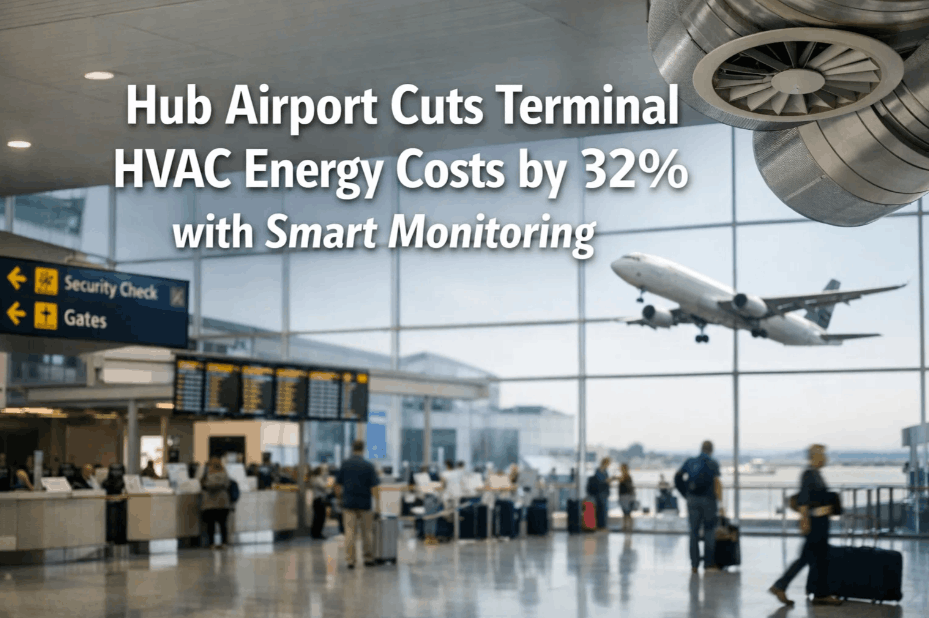
Airports are among the most energy-intensive facilities in the world, consuming millions of kilowatt-hours annually across terminal buildings, runway lighting, HVAC systems, and ground support equipment. As aviation faces mounting pressure from regulators, investors, and passengers, smart airport energy management has moved from a sustainability checkbox to a boardroom imperative. Airports that deploy AI-driven energy platforms today are slashing carbon emissions, cutting operational costs by up to 30%, and delivering verifiable ESG data that satisfies both government mandates and institutional investors — all while accelerating their path to net-zero aviation goals.
See AI-Driven Airport Energy Management in Action
iFactory's Energy & ESG Reporting module tracks HVAC consumption, optimizes terminal lighting, and generates audit-ready carbon reports for net-zero airport compliance.
The Energy Crisis Inside Modern Airports
Before exploring solutions, it's essential to understand why airport energy management is uniquely complex — and why traditional approaches are no longer adequate for net-zero commitments.
Staggering Energy Demand Across Every Operational Zone
A mid-size international airport typically consumes between 150,000 and 400,000 MWh of electricity annually. Terminal buildings alone account for nearly 60% of total energy consumption, with HVAC systems representing the single largest energy load — often 40–50% of total terminal energy use. Add runway lighting, jetbridge operations, baggage handling, and IT infrastructure, and you have an energy profile that rivals small cities.
Yet most airports still manage this sprawling consumption through fragmented building management systems (BMS), disconnected utility meters, and quarterly spreadsheet reports. This approach generates data that is always stale, never actionable, and impossible to present as credible ESG disclosure. To book a demo and see how real-time monitoring changes this entirely, airport teams are finding the investment pays back within 18 months.
Regulatory Pressure Is Intensifying
ICAO's CORSIA scheme now requires verified carbon reporting at the fleet and facility level. The EU's Fit for 55 package extends carbon pricing to aviation. ACI World's Airport Carbon Accreditation programme has seen a 40% increase in applicants since 2022 — signaling that airport carbon reduction is no longer voluntary. It is a competitive and regulatory necessity.
Airports unable to produce granular, real-time energy consumption data face accreditation delays, stranded capital in unverifiable offset purchases, and growing reputational risk with airline customers who themselves face Scope 3 emissions scrutiny.
4 Airport Energy Inefficiencies That Undermine Net-Zero Goals
The most common and costly energy management failure points found during airport energy audits — each addressable with AI-driven automation.
How Smart Airport Energy Management Platforms Work
Modern AI-driven energy management systems move beyond passive metering to deliver active optimization across every energy-consuming system in the airport ecosystem.
AI ingests flight schedules, occupancy sensors, and weather data to modulate HVAC setpoints zone by zone — delivering 18–28% energy savings without compromising passenger comfort.
Occupancy-aware lighting with daylight harvesting dims unoccupied gate areas automatically — reducing terminal lighting energy by 35–45% with zero staff intervention needed.
Circuit-level sub-metering tracks solar generation per terminal zone with time-stamped attribution — making renewable claims verifiable for ACI accreditation. Book a demo to see it live.
AI anomaly detection flags chiller, air handler, and escalator degradation weeks before scheduled maintenance — preventing silent energy waste and unplanned downtime.
Scope 1, 2 & 3 emissions tracked live using IPCC emission factors — every figure traceable to its source meter reading for fully audit-ready carbon accounting.
Unified dashboard across all terminals and concourses enables cross-facility benchmarking — identifying the highest-return efficiency investments across the airport portfolio. Book a demo.
Traditional Energy Management vs. AI-Driven Airport Energy Automation
The operational reality of net-zero airport management with legacy BMS systems compared to an integrated AI-driven energy and ESG platform.
| Airport Energy Function | Legacy BMS / Manual | iFactory AI-Driven |
|---|---|---|
| HVAC Optimization | Fixed schedules; no flight data integration | Real-time AI adjustment using flight & occupancy data |
| Terminal Lighting Control | Manual override; zone-level only | Occupancy-aware, daylight-harvesting automation |
| Carbon Footprint Tracking | Quarterly manual calculation; estimation-heavy | Real-time Scope 1, 2 & 3 dashboard with audit trail |
| Renewable Energy Attribution | Annual aggregate figures only | Circuit-level time-stamped attribution per terminal zone |
| ESG Report Generation | 40–80 hours of manual data compilation | Automated reports mapped to GRI, TCFD & ACI standards |
| Predictive Maintenance Alerts | Reactive; detected after efficiency loss occurs | AI anomaly detection flags degradation weeks early |
| Multi-Terminal Visibility | Siloed per building; no portfolio view | Unified dashboard across all terminals and concourses |
| Stakeholder ESG Reporting | Unverifiable; relies on estimates | Auditor-ready with source data linked to every metric |
Airport ESG Reporting: From Compliance Burden to Investor-Grade Disclosure
Airport ESG reporting has matured from voluntary sustainability narratives to verified, quantitative disclosure that institutional investors, airline customers, and regulators scrutinize with increasing rigor.
Automatically classifies energy into Scope 1, 2 & 3 emissions using live IPCC factors — every figure traceable to its source meter for fully audit-ready carbon accounting. Book a demo to see tenant sub-metering live.
Pre-mapped to all four ACI accreditation levels — Mapping through Neutrality. Automated evidence packages reduce accreditation preparation from weeks to hours, generated on demand.
Generates physical and transition risk scenario analyses for green bond issuance and ESG-linked debt — giving airport finance teams the climate narrative institutional investors require.
Produces airline-specific energy reports by gate, stand, and terminal zone — giving airline partners verifiable Scope 3 ground operations data for their own sustainability disclosures.
Building a Net-Zero Airport Operations Strategy: The 5-Stage Framework
Achieving net-zero airport operations requires a structured, data-driven roadmap — not isolated efficiency projects. Here is the framework that leading airports are deploying.
What Airports Achieve with Smart Energy Management Automation
The measurable outcomes airports experience after deploying AI-driven energy and ESG management platforms.
Average HVAC Energy Reduction
AI-driven HVAC scheduling delivers 18–28% reductions in terminal HVAC consumption within the first 12 months of deployment.
Terminal Lighting Savings
Occupancy-aware lighting automation with daylight harvesting cuts terminal lighting energy by 35–45% vs. fixed-schedule LED systems.
Faster ESG Report Generation
Automated carbon tracking reduces ESG disclosure preparation from weeks of manual compilation to hours of review and approval.
Full Platform Deployment
Full metering visibility and AI optimization live within 4–8 weeks — modular rollout, zero disruption. Book a demo for your timeline.
Is Your Airport's Energy Data Ready for Your Next ESG Audit or Carbon Accreditation Review?
iFactory's Energy & ESG Reporting module delivers real-time airport energy monitoring, HVAC optimization, renewable attribution, and automated carbon disclosure — all from a single audit-ready platform.
Which Airports Need Smart Energy Management Most Urgently
If your airport falls into any of these categories, legacy energy management systems are creating measurable financial, regulatory, and reputational risk.
Hub Airports with High Energy Intensity
Large international hubs with 24-hour operations and multi-terminal loads see immediate ROI — where even a 1% efficiency gain represents significant cost and carbon savings.
Airports Pursuing Carbon Accreditation
Facilities targeting ACI Level 3 Optimization or Level 4 Neutrality need verified, granular energy data that manual systems cannot produce — iFactory generates each accreditation evidence package automatically.
Airports with Renewable Energy Assets
Airports operating solar, wind, or battery storage need circuit-level attribution to make verifiable renewable claims in ESG disclosures — not just aggregate generation figures.
Multi-Airport Operators
Portfolio operators benefit from standardized ESG reporting across all sites and cross-facility benchmarking that identifies the highest-return efficiency investments across the entire group.
Airport Energy Management: Frequently Asked Questions
Your Net-Zero Deadline Is Getting Closer. Your Energy Data Shouldn't Be Getting Older.
iFactory's AI-driven Energy & ESG Reporting platform gives airport operators real-time energy visibility, HVAC and lighting optimization, renewable attribution, and audit-ready carbon disclosure — everything needed to deliver on net-zero commitments and satisfy institutional ESG scrutiny.

-integration-with-ai-driven.png)