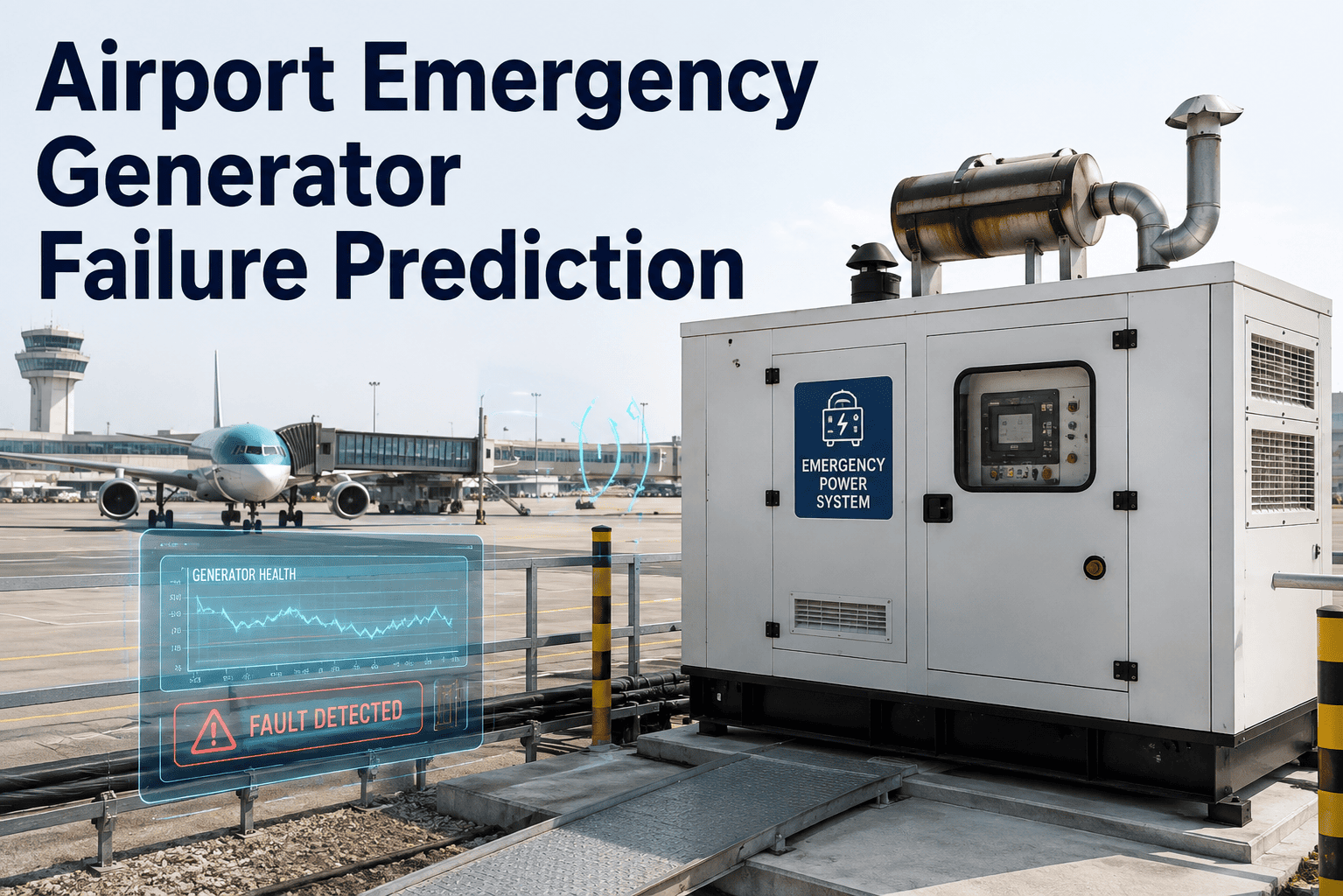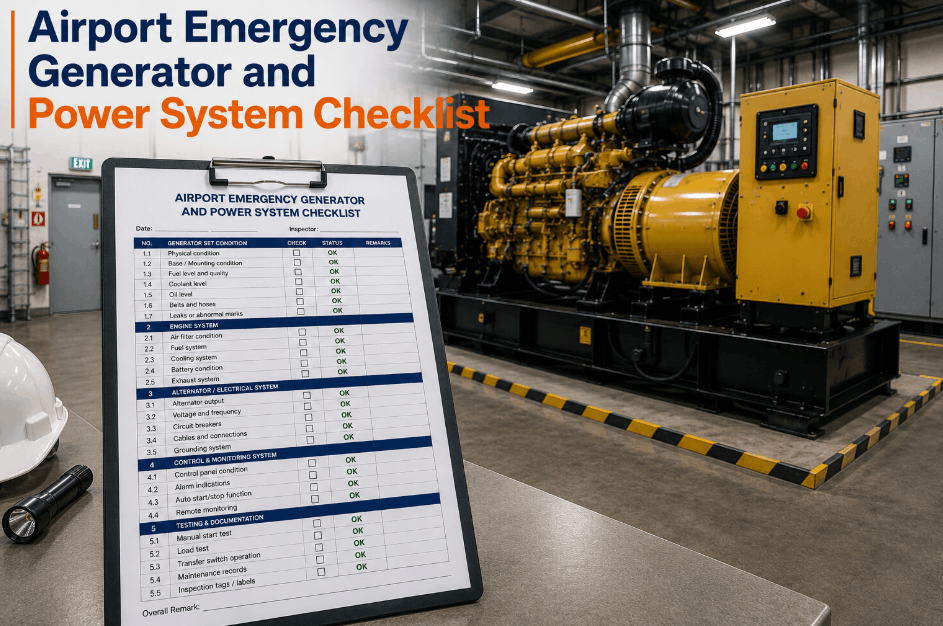
Airport emergency generator and UPS system analytics represent the last line of defense between normal operations and a safety-critical power failure that no airport director ever wants to explain. Emergency generators, uninterruptible power supplies, and automatic transfer switches are activated only when everything else has already failed — and at that moment, there is no second chance, no fallback, and no margin for equipment that was assumed to be ready but was not. AI-driven preventive analytics for airport emergency power systems converts this assumption into verifiable condition data — continuously monitoring generator engine health, UPS battery capacity, fuel system readiness, and automatic transfer switch performance so that standby power assets are genuinely ready when utility power fails, not just scheduled-tested and forgotten. To see how leading airport operations teams are transforming their emergency power reliability programs, Book a Demo and explore what condition-based generator and UPS analytics delivers for critical power continuity.
Ensure Your Airport Emergency Power Is Actually Ready — Not Just Scheduled-Tested
iFactory's preventive analytics platform delivers continuous generator health monitoring, UPS battery condition tracking, ATS performance analytics, and automated compliance documentation — purpose-built for airport critical power infrastructure reliability.
Why Airport Emergency Generator Analytics Is a Safety-Critical Infrastructure Priority
The fundamental challenge with airport emergency generator and UPS system maintenance is the gap between scheduled testing and actual readiness. A generator that passes its monthly 30-minute load test may still fail to start three weeks later due to a fuel system fault, battery degradation, or cooling system failure that developed between test cycles. Calendar-based testing creates a false confidence that condition-based analytics eliminates. Airport emergency generator analytics platforms deploy continuous monitoring across the health indicators that predict generator starting reliability and load-carrying capacity — coolant temperature trends, oil pressure baseline drift, battery voltage under load, fuel quality degradation, and cooling fan performance — detecting developing failure conditions weeks before they produce a no-start event during an actual utility outage. For airports where safety-critical loads include airfield lighting, ILS approach systems, security infrastructure, and emergency egress, the consequences of emergency power failure extend well beyond operational disruption into active safety risk. Airport power teams evaluating generator analytics programs can Book a Demo to walk through a monitoring configuration matched to their critical power infrastructure.
Diesel Generator Engine Condition and Starting Reliability Analytics
Continuous monitoring of coolant temperature, oil pressure, oil consumption rate, exhaust temperature, and vibration signatures detects engine wear progression, cooling system degradation, and lubrication system issues before they affect starting reliability. Engine condition scoring aggregates multiple health parameters into a single readiness metric that drives predictive maintenance scheduling across the airport generator fleet.
Fuel Quality, Tank Level, and Fuel System Integrity Monitoring
Diesel fuel degradation, water contamination, and microbial growth in storage tanks are among the most common causes of generator no-start events during actual utility outages. Continuous fuel quality monitoring, tank level trending, and fuel polishing system performance tracking ensure that generators have clean, properly conditioned fuel available at the moment utility power fails — not contaminated fuel that the engine cannot combust reliably.
Starting Battery Condition and Charge State Monitoring
Generator starting battery failure is the single most frequent cause of generator no-start events in airport standby power systems. Continuous battery voltage monitoring under load, cell impedance trending, and charge system performance tracking detect battery degradation before capacity falls below the threshold required for reliable engine cranking — enabling planned replacement before the battery fails in service.
Automated Load Bank Test Scheduling and Performance Trending
Generator load bank test results are tracked against performance acceptance thresholds, with trend analysis identifying generators whose load-carrying capacity or voltage regulation is degrading between test cycles. Automated test scheduling ensures compliance with NFPA 110 exercise requirements without manual calendar management, and test result documentation is generated automatically for regulatory record submission.
Airport UPS System Analytics: Battery Capacity and Runtime Assurance for Critical Loads
Uninterruptible power supplies at airports provide the bridge power that keeps safety-critical loads — ILS navigation systems, air traffic control feeds, security systems, flight information displays, and communications infrastructure — energized during the interval between utility power failure and emergency generator pickup. If UPS battery capacity has degraded below the rated runtime, safety-critical loads may lose power before the generator reaches stable voltage output — a failure mode that UPS systems were specifically designed to prevent. Airport UPS system analytics continuously monitors battery string condition, cell voltage balance, temperature, and discharge capacity against rated specifications — identifying strings approaching replacement thresholds before they fail to deliver rated runtime during an actual outage event. Airport teams managing critical power loads supported by UPS infrastructure can Book a Demo to see how UPS battery analytics is configured for their critical load profile.
UPS Battery String Capacity and Cell Balance Monitoring
Individual cell voltage monitoring, string impedance trending, and temperature-corrected capacity estimation track battery system health continuously between formal discharge tests — detecting cell imbalance, sulfation, and capacity degradation before they reduce system runtime below critical thresholds.
Available Runtime Calculation and Load-Adjusted Capacity Modeling
Dynamic runtime estimation accounts for actual battery capacity, current load, ambient temperature, and battery age — providing accurate remaining runtime predictions rather than nameplate ratings that assume new battery condition. Runtime alerts trigger when actual capacity falls below the airport's required transfer time margin for any critical load group.
UPS Room Environmental Monitoring and Battery Thermal Condition
UPS battery service life is highly sensitive to operating temperature — every 10°C above rated ambient temperature approximately halves battery life. Continuous battery room temperature monitoring, hot-spot detection in battery cabinets, and HVAC performance tracking protect battery investments and maintain rated capacity through the full expected service life.
UPS Power Module and Inverter Performance Analytics
UPS static bypass switch condition, rectifier performance, and inverter output quality monitoring detect power module degradation before it affects output voltage regulation or transfer switch response time — maintaining the power quality specifications that sensitive avionics and communications loads require during utility-to-battery-to-generator transition.
Automatic Transfer Switch Analytics: Ensuring Reliable Power Transition When It Matters Most
Automatic transfer switches are the electromechanical gatekeepers of airport emergency power systems — sensing utility power loss and commanding generator pickup within milliseconds, then transferring the connected load from utility to emergency power without operator intervention. An ATS that fails to transfer, transfers too slowly, or transfers back prematurely creates exactly the extended power interruption that the emergency power system was designed to prevent. Airport ATS analytics continuously monitors switch contact condition, mechanism operating time, transfer time performance against rated specifications, and exercise cycle history — detecting contact wear, spring mechanism fatigue, and control circuit degradation before they affect transfer reliability. Teams responsible for airport ATS reliability can Book a Demo to see how ATS monitoring integrates with their broader emergency power analytics program.
Emergency Power Analytics Deployment Roadmap for Airport Critical Power Infrastructure
Critical Power Asset Inventory and Baseline Condition Assessment
Analytics deployment begins with a structured inventory of all generator sets, UPS systems, ATS units, and associated fuel and battery infrastructure. Initial condition assessments establish health baselines and identify assets already operating outside acceptable parameters — closing the gap between the last scheduled test and current actual condition before the monitoring program goes live.
Continuous Health Monitoring and Early Warning Alert Configuration
Deployed sensors and integrated data feeds deliver continuous condition telemetry across generator engine, fuel system, battery, ATS, and UPS power module categories. Alert thresholds are calibrated to airport-specific criticality tiers — with differentiated notification urgency for assets supporting FAA-critical navigation loads versus lower-consequence facility circuits.
Predictive PM Scheduling and Load Test Program Optimization
Condition data drives predictive maintenance work order generation — replacing calendar-based PM intervals with condition-optimized schedules that intervene when equipment health indicators indicate actual maintenance need rather than scheduled date arrival. Load test frequency and load levels are optimized based on equipment condition trends to maximize test value while managing engine wear from frequent high-load cycling.
NFPA 110 and FAA Compliance Documentation Automation
Completed test records, maintenance documentation, fuel quality logs, and battery condition reports are automatically compiled into the structured packages required for NFPA 110 emergency power system compliance, FAA safety management system records, and airport certification maintenance program documentation — eliminating the manual record assembly that creates compliance exposure during regulatory audits.
Airport Emergency Power Infrastructure Maturity Benchmarking
Understanding where your airport emergency power program stands relative to industry capability benchmarks requires structured evaluation across monitoring coverage, testing discipline, fuel management rigor, and compliance documentation completeness. Airport operations teams ready to benchmark their current emergency power program posture can Book a Demo and complete a maturity gap assessment for their specific critical power infrastructure profile.
| Maturity Level | Generator Monitoring | UPS Management | ATS Testing | Compliance Documentation |
|---|---|---|---|---|
| Level 1 — Reactive | No monitoring; fault response only | Periodic manual checks | Manual exercise on schedule | Paper test logs |
| Level 2 — Scheduled | Monthly manual inspections | Annual battery tests | Quarterly ATS exercise | Spreadsheet tracking |
| Level 3 — Condition-Based | Continuous sensor monitoring | Continuous battery voltage tracking | Transfer time logging | Digital record systems |
| Level 4 — Predictive | AI engine health scoring | Capacity degradation modeling | Condition-based ATS PM | Automated compliance reports |
| Level 5 — Autonomous | Self-scheduling load tests | Predictive string replacement | Closed-loop transfer optimization | Real-time regulatory feeds |
NFPA 110 and FAA Compliance: How Analytics Strengthens Emergency Power Regulatory Posture
Airport emergency power systems operate under NFPA 110 Standard for Emergency and Standby Power Systems — which mandates specific testing frequencies, load levels, transfer time performance standards, and documentation requirements for standby generator systems. FAA Advisory Circular 150/5340-26 and 14 CFR Part 139 airport certification standards additionally require that airfield lighting and navigation aid emergency power systems be maintained and documented to defined reliability standards. Manually maintaining this compliance documentation across a fleet of generators, UPS systems, and ATS units distributed across an airport campus is administratively burdensome and frequently produces record gaps that create regulatory exposure during FAA inspections. Analytics platforms that automatically capture test results, maintenance records, fuel quality logs, and ATS performance data generate the compliance evidence base continuously — so that when NFPA or FAA documentation is requested, it is produced immediately rather than assembled under time pressure from incomplete records.
Frequently Asked Questions: Airport Emergency Generator and UPS System Analytics
What parameters does airport generator analytics continuously monitor?
Airport generator analytics platforms continuously monitor engine coolant temperature and pressure, oil pressure and temperature, fuel level and quality indicators, battery voltage and charge current, exhaust temperature, alternator output voltage and frequency, and cooling fan performance. These parameters are trended against baseline values, with AI anomaly detection generating early-warning alerts when developing failure conditions emerge between scheduled inspection events.
How does UPS battery analytics differ from scheduled capacity discharge testing?
Scheduled capacity discharge tests provide a point-in-time measurement of battery capacity at the test moment — but provide no information about what happens to battery condition between annual test cycles. UPS battery analytics provides continuous monitoring of cell voltage balance, string impedance, and temperature — identifying capacity degradation as it develops rather than discovering it only at the next annual test, by which time runtime may already be below the required threshold for the connected critical load.
Can airport generator analytics integrate with existing BMS and SCADA systems?
Yes. Modern airport generator analytics platforms support integration with building management systems, SCADA platforms, and power monitoring infrastructure through Modbus, BACnet, DNP3, and SNMP protocols. Generator controller data, ATS status, and UPS monitoring feeds can be aggregated into the analytics platform from existing monitoring infrastructure, reducing sensor deployment requirements and enriching condition data with operational context.
How does fuel management analytics reduce generator no-start risk from fuel degradation?
Diesel fuel in storage tanks begins to degrade within 6–12 months, with water accumulation, microbial growth, and oxidation byproduct formation progressively increasing filter-plugging risk and combustion instability. Fuel analytics platforms track tank water content, fuel sample test results, fuel polishing system runtime, and storage duration — generating alerts when fuel quality indicators approach thresholds that increase no-start risk, enabling planned fuel treatment or replacement before quality degradation affects engine starting reliability.
What is the typical ROI timeline for airport emergency power analytics investment?
For airports with multiple generator sets supporting safety-critical loads, a single prevented generator failure during a utility outage typically eliminates costs that exceed annual analytics program investment — including FAA notification obligations, flight diversion coordination, regulatory finding risk, and emergency repair premiums. Most airport emergency power analytics programs achieve payback within the first prevented failure event, which analytics-equipped airports typically experience within the first 12–18 months of program operation.
How are NFPA 110 compliance records generated through the analytics platform?
Analytics platforms automatically capture load test results, transfer time measurements, monthly exercise run data, fuel quality logs, and maintenance completion records in structured formats that map to NFPA 110 documentation requirements. Automated report generation produces NFPA-compliant test records immediately after each test event — eliminating the manual compilation that creates documentation gaps in paper-based compliance programs.
Build Airport Emergency Power Reliability You Can Verify, Not Just Assume
iFactory's preventive analytics platform equips airport power teams with continuous generator health scoring, UPS battery capacity tracking, ATS performance monitoring, and automated NFPA 110 compliance documentation — converting emergency power reliability from an assumption into a continuously verified operational fact.