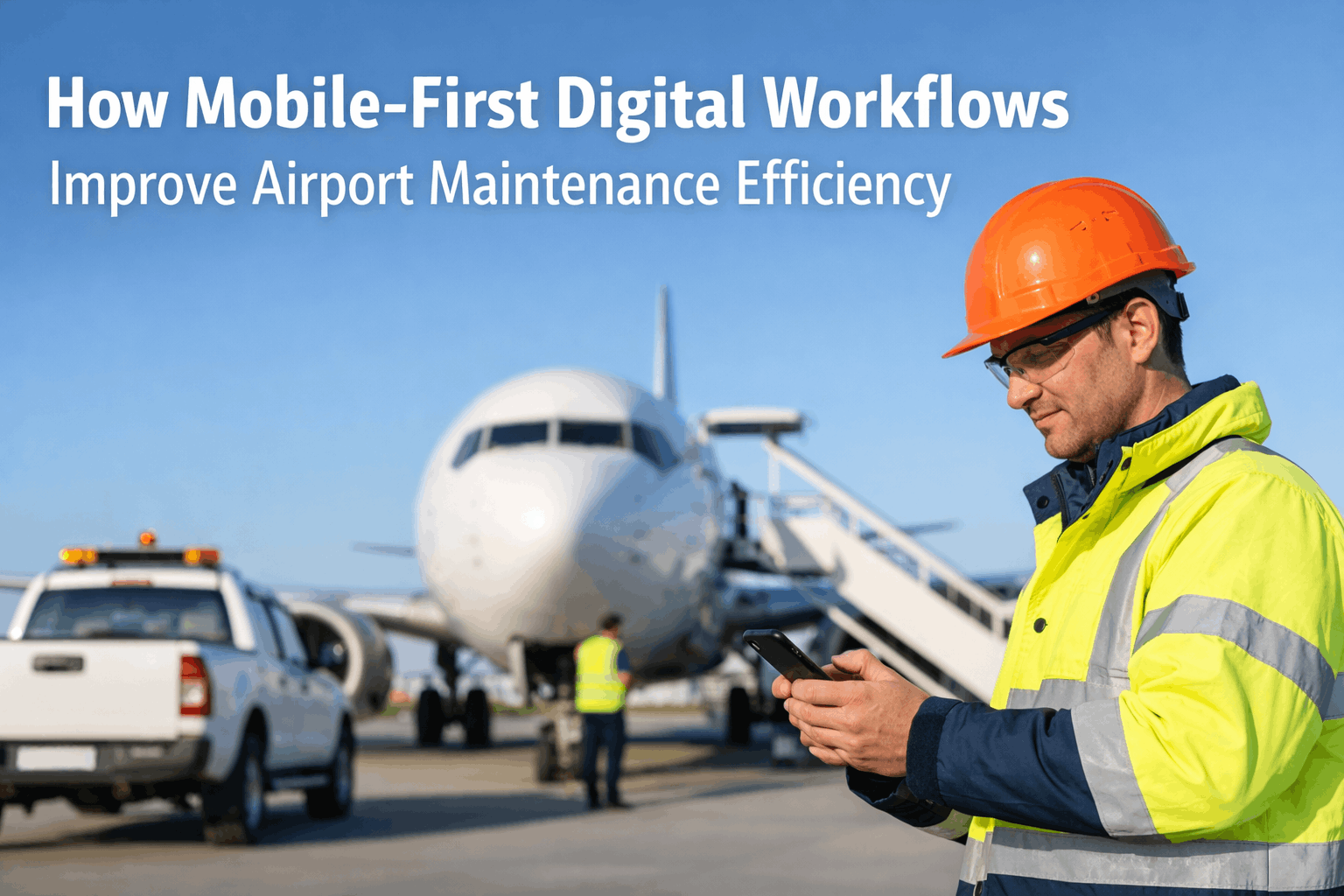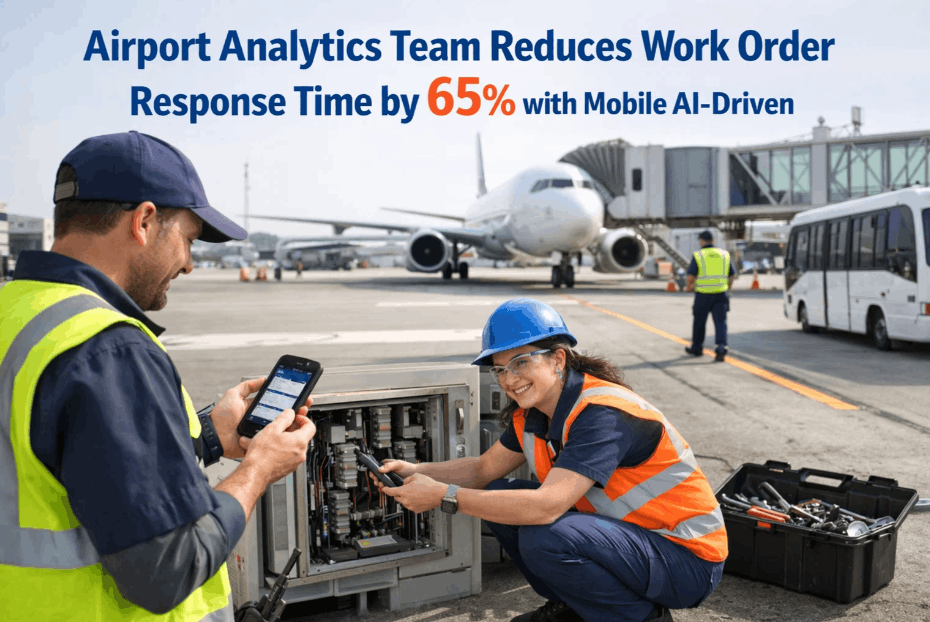
Maintaining operational continuity in complex airport environments requires instantaneous communication and rapid technical response. For a major international aviation hub, the transition from centralized dispatching to a decentralized mobile infrastructure proved transformative. By deploying ifactory's Mobile AI-driven application to 120 field technicians across terminals and airside operations, the facility reduced work order response times by 65%, ensuring critical assets return to service before passenger experience is impacted. Book a Demo to see how ifactory optimizes aviation field response.
Mobile AI-driven App
|
Airport Operations
|
65% Faster Response
Optimize Your Airport Technical Response with Mobile AI.
ifactory connects terminal technicians directly to real-time work order data, eliminating dispatch delays and streamlining communication between airside and landside operations.
01 / The Challenge
Fragmented Communication and Terminals Spanning Millions of Square Feet
The airport's maintenance department faced a persistent bottleneck centered on dispatch latency. Technicians relied on radio-based communication and paper work orders collected from a central office at the start of each shift. In an environment spanning three terminals and extensive airside ground handling facilities, the walking time back and forth to receive new assignments created a "response gap." Minor mechanical issues in passenger-facing areas often escalated into significant downtime simply because the nearest technician was unaware of the priority level or precise location of the fault. The lack of real-time asset history at the point of repair further extended repair durations as technicians frequently had to return to base for manuals or specialized tools.
42m
Avg. Initial Response
Pre-deployment response times averaged 42 minutes for terminal-side conveyor and HVAC issues, largely due to dispatch-to-technician notification lag.
120
Field Technicians
Managing a workforce across 24/7 shifts required a scalable solution that could handle terminal-specific zoning and high-density asset lists.
18%
Wait-Time Friction
Approximately 18% of technician time was consumed by travel related to obtaining work order updates and physical documentation retrieval.
$840k
Lost Productivity
Inefficient routing and manual data entry created an estimated $840,000 in annual productivity loss across terminal facilities.
"We were managing terminal assets with toolsets designed for a single building. When your workplace is several kilometers long, every minute spent searching for data is a minute the passenger experience is degrading."
02 / The Solution
iFactory Mobile AI-driven: Empowering the Edge of Maintenance Operations
The facility implemented ifactory's Mobile AI-driven application as the primary interface for 120 technicians, licensed operators, and airside ground handling staff. The solution moved the entire work order lifecycle to the technician's mobile device, enabling instant push notifications for critical alarms and direct digital access to asset health histories. By utilizing location-aware dispatching, the platform now automatically assigns work orders to the closest qualified technician based on their terminal zone. Book a Demo to explore the mobile interface.
Instant Digital Dispatching
Eliminated the paper-and-radio bottleneck. High-priority work orders are routed directly to mobile devices with precise terminal coordinates, asset IDs, and priority rankings, reducing the initial notification gap from minutes to seconds.
Point-of-Repair Intelligence
Technicians access historical repair data, PM checklists, and service manuals directly via QR code scanning on the asset. This reduced "diagnostic search time" and ensures first-time fix rates are optimized.
Zoned Resource Routing
AI-driven routing logic accounts for airport security checkpoints and terminal distances, ensuring the technician with the fastest physical access path receives the assignment.
Real-time Coordination
Integrated communication tools allow airside technicians to update terminal control centers on repair status instantly, providing accurate ETA data for gate management and passenger flow teams.
03 / Implementation
Strategic Rollout Across Terminal and Airside Hubs
Phase 1
Asset Digitization and QR Mapping
The team mapped over 4,500 critical assets across Terminal 1 and 2, including passenger boarding bridges, baggage handling motors, and HVAC air handling units. QR codes were applied to each asset to enable instant mobile identification.
→
Phase 2
Mobile Workflow Integration
Work order templates were customized for aviation-specific compliance requirements. The mobile app was integrated with the central maintenance database, ensuring bi-directional data flow between field and office.
→
Phase 3
Field Staff Training and Live Go-Live
120 technicians underwent terminal-specific training sessions focused on mobile navigation, digital signature capture, and airside safety protocols during mobile usage. Full live rollout completed within 60 days.
04 / Results
Data-Driven Transformation in Airport Asset Reliability
The adoption of ifactory's Mobile AI-driven platform resulted in an immediate and sustained improvement in response latency and workforce utilization. The most significant metric—average work order response time—dropped from 42 minutes to just 14.7 minutes within the first quarter of operations. These efficiency gains allowed the airport to resolve 30% more secondary work orders per shift without increasing headcount. Book a Demo to see these performance benchmarks.
| Performance Metric | Pre-Mobile Baseline | Post-Mobile Result | Overall Improvement |
|---|---|---|---|
| Work Order Response Time | 42 Minutes | 14.7 Minutes | 65% Reduction |
| Asset Diagnostic Time | 24 Minutes | 9 Minutes | 62% Reduction |
| First-Time Fix Rate | 74% | 91% | +17 Points |
| Baggage Handling Uptime | 94.2% | 98.8% | +4.6% Uptime |
| Technician Administrative Time | 55 Min / Shift | 12 Min / Shift | 78% Reduction |
| Annual Labor Capacity Recovered | N/A | 14,400 Hours | 120 Staff Scale |
65%
Response Speedup
14k+
Staff Hours Saved
91%
First Time Fix
120
Connected Techs
05 / Key Benefits and Business Impact
Beyond Efficiency: Enhancing the Passenger Journey
Passenger Experience Safeguarding
By reducing response times for escalators, elevators, and automated doors in high-traffic terminal zones, the airport successfully maintained seamless passenger flows even during peak seasonal travel loads.
Airside Operational Agility
Ground handling technicians can now respond to passenger boarding bridge issues in minutes, preventing flight delays and improving gate turnaround efficiency for airline partners.
Compliance and Safety Documentation
Digital timestamps and mobile photo evidence provide an immutable audit trail for FAA and safety inspections, ensuring all critical preventive maintenance is documented at the point of action.
Data-Driven Capital Planning
The mobile app captures high-resolution data on which terminal assets require the most emergency intervention, providing leadership with factual data for future equipment replacement budgets.
06 / Conclusion
Mobilizing the Future of Aviation Facility Management
The implementation at this international hub proves that the most effective way to manage millions of square feet of terminal space is to empower technicians with mobile intelligence. By eliminating the "walking gap" and providing instant access to asset data, the airport has moved from a reactive maintenance stance to a high-speed operational response model. The 65% reduction in response time is not just a statistical success; it is a critical component of the airport's commitment to terminal reliability and passenger satisfaction. Book a Demo to see how ifactory can mobilize your aviation maintenance team.
07 / FAQ
Frequently Asked Questions
How does the mobile app eliminate the "response gap"?
By bringing push notifications and work orders directly to a centralized mobile application, technicians no longer have to return to a central dispatch desk to receive assignments, significantly cutting down on transit time and ensuring the closest technician handles the fault immediately.
Does the application work within high-density airport environments?
Yes. The platform is designed specifically for complex environments and integrates real-time zoning intelligence so maintenance requests bypass traditional radios and alert the specific technician currently localized in that terminal area.
Can technicians access history without service manuals?
Absolutely. Technicians can scan QR codes placed on physical assets like baggage handling systems or passenger boarding bridges to instantly load the full repair history, required tool lists, and original equipment service manuals directly on their mobile screens.
How long does it take to implement across the entire terminal?
In this major hub, integrating the platform, digitizing over 4,500 assets, and rolling out mobile training to 120 technicians involved a complete live go-live in under 60 days.
How does the system handle preventive maintenance (PM) checklists?
PM checklists are fully digitized within the app. Technicians receive scheduled PM tasks directly on their device and can log completion metrics, submit compliance photos, and note secondary issues instantly.
Is the platform secure enough for aviation standards?
Yes. The system employs end-to-end encryption, role-based access control, and integrates seamlessly with existing airport IT infrastructure to ensure all maintenance and operational data remains strictly confidential and secure.
Mobile AI
|
Aviation Ready
|
Fast Deployment
Ready for 65% Faster Response Times?
Deploy ifactory's Mobile AI-driven platform for your airport operations team and empower your technicians with instant, real-time access to high-priority work orders and diagnostics.