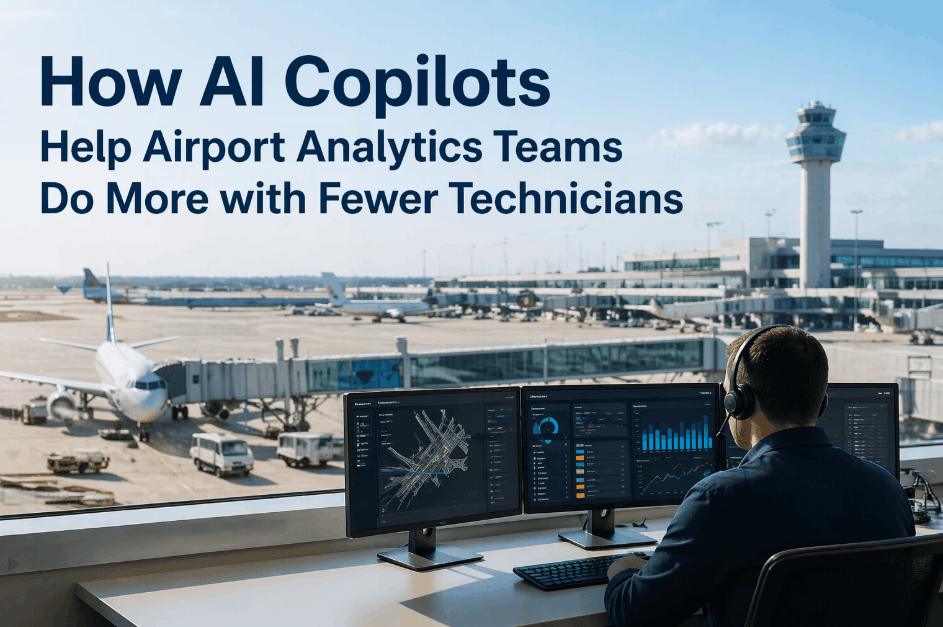
Airport analytics teams across North America and Europe are under mounting pressure in 2026 — not from technology gaps, but from a widening airport analytics staffing shortage that shows no sign of reversing. Aging workforces, elevated technician attrition rates, and surging passenger volumes have created a scenario where fewer skilled hands are responsible for more critical assets than ever before. The question facing every Director of Airport Operations is no longer whether to adopt AI — it is how quickly an AI copilot for airport analytics can be deployed to close the productivity gap before it becomes a safety and compliance liability. Book a Demo to see how iFactory's AI Copilot transforms what a lean analytics team can accomplish.
AI COPILOT
·
AIRPORT WORKFORCE OPTIMIZATION
·
PREDICTIVE TASK SCHEDULING
AI Copilot for Airport Analytics Teams — Do More with Fewer Technicians
iFactory's AI Copilot automates work order routing, predictive task scheduling, and intelligent parts forecasting — giving airport analytics teams the decision intelligence to operate at full capacity even when headcount is reduced.
The Airport Analytics Staffing Crisis Is Reshaping Operational Risk
Between 2022 and 2025, the aviation industry lost a disproportionate share of its most experienced analytics technicians to retirement, with replacement hire rates failing to keep pace across major hub and regional airports alike. According to workforce trend data tracked by aviation operations consultancies, the average airport analytics team is now managing 22% more assets per technician than it did five years ago — while simultaneously absorbing stricter regulatory documentation requirements from aviation safety authorities.
The result is a compounding risk environment. Overextended technicians miss early-stage equipment degradation signals. Work orders queue longer than asset health can tolerate. Reactive repair cycles replace proactive scheduling. And when a critical ground support asset or terminal system fails unexpectedly, the downstream impact on gate operations, passenger experience, and safety compliance is immediate and expensive. This is precisely the problem that AI copilot technology for airport operations is purpose-built to solve — not by replacing technicians, but by amplifying what each technician can see, prioritize, and act on every shift.
22%
More assets per airport technician managed in 2026 vs. five years prior
3x
Faster work order triage with AI-driven intelligent routing systems
40%
Reduction in unplanned asset failures after AI copilot deployment
60%
Less time spent on manual scheduling and work order administration per shift
Root Cause Analysis
Why Traditional Analytics Workforce Models Are Failing Airports in 2026
Understanding the structural reasons behind analytics team inefficiency is essential before deploying technology solutions. Airport analytics operations have historically relied on static scheduling frameworks, paper-based work orders, and technician expertise accumulated over decades. When experienced staff leave and headcount does not recover, these manual frameworks collapse under the weight of asset volume and compliance complexity. The problem is not effort — it is systemic information overload combined with a decision-making framework built for a different era of airport scale.
01
Manual Work Order Routing Bottlenecks
In facilities without intelligent routing, work orders are triaged by supervisors based on whatever information is available at the moment — often incomplete asset history and subjective urgency assessment. High-priority failures that match low-urgency symptom descriptions get deprioritized, while lower-risk tasks consume technician time that should be allocated to emerging critical failures.
02
Static Preventive Maintenance Schedules
Time-based PM schedules apply the same service intervals to every asset regardless of actual utilization intensity, operating environment, or observed condition data. In high-traffic airport environments where asset usage varies dramatically by season, gate assignment, and terminal load, static schedules routinely misallocate technician time — servicing assets that don't need intervention while missing those that do.
03
Reactive Parts Procurement Cycles
Without predictive failure intelligence, airport parts procurement runs on reactive cycles — parts are ordered after failure events create urgent demand. This produces the worst possible procurement outcome: premium emergency pricing, extended downtime while parts ship, and technician idle time that compounds the staffing efficiency problem during critical repair windows.
04
Knowledge Loss from Workforce Turnover
When an experienced airport technician leaves, they take with them years of institutional asset knowledge — failure patterns on specific equipment, vendor quirks, operational workarounds — that no paper logbook fully captures. Each personnel transition increases the probability of misdiagnosis, repeated failure events, and compliance documentation gaps that accumulate into audit risk.
05
No Real-Time Technician Workload Visibility
Supervisors managing analytics teams without real-time workload dashboards have no accurate picture of which technicians have capacity, which are overloaded, and which active work orders are approaching SLA breach. Resource allocation decisions made on incomplete information consistently produce both under-utilized technician capacity and critical task delays within the same shift.
06
Compliance Documentation Under Shift Pressure
Aviation regulatory compliance requires complete, accurate maintenance documentation regardless of shift pressure or staffing levels. When technicians are stretched across more assets than their documentation workflow can accommodate, compliance records become incomplete — creating audit exposure, corrective action requirements, and in severe cases, regulatory findings that ground assets or trigger formal investigations.
AI Copilot Capabilities
How an AI Copilot Transforms Airport Analytics Team Productivity
An AI copilot for airport analytics operations functions as an always-on intelligent assistant that processes asset condition data, work order history, technician availability, and parts inventory simultaneously — synthesizing this information into prioritized recommendations that help each technician focus their time on the highest-impact actions every shift. Unlike traditional CMMS platforms that require manual data interpretation, AI copilot systems deliver specific, contextual guidance that reduces the cognitive load on every member of a lean analytics team. Airport managers looking to understand how this translates to their specific operational environment can Book a Demo with the iFactory team and see the platform mapped to their asset portfolio.
01
Intelligent Work Order Routing and Priority Scoring
AI copilot systems analyze incoming work orders against real-time asset condition data, historical failure patterns, operational impact scores, and current technician workload — generating a dynamic priority queue that routes each task to the most appropriately skilled available technician. Automated work order routing eliminates the supervisor bottleneck that slows triage in manual environments, ensuring that safety-critical tasks reach qualified technicians within minutes rather than hours. Airport analytics teams using intelligent routing consistently report a 3x improvement in work order resolution speed without any increase in headcount.
02
Predictive Task Scheduling Based on Asset Health Data
Rather than scheduling analytics tasks on fixed calendar intervals, AI-driven predictive scheduling generates service recommendations based on actual equipment condition — combining IoT sensor data, usage intensity metrics, and historical failure signatures to identify the optimal intervention window for each asset. This means technicians are dispatched to perform analytics before failure occurs, but not before it is necessary — eliminating both reactive emergency calls and the wasted effort of servicing assets that have substantial remaining useful life. Predictive task scheduling is the single highest-impact capability for airport analytics automation because it restructures how technician time is allocated across an entire shift.
03
Intelligent Parts Forecasting and Inventory Optimization
AI copilot systems extend predictive intelligence beyond task scheduling into parts procurement — analyzing failure probability curves, service interval data, and lead time variability to generate automated parts replenishment recommendations before shortages create downtime. When an AI copilot predicts that a jet bridge drive motor is approaching end-of-life within the next 14 days, it simultaneously flags the required parts for procurement review — eliminating the emergency sourcing scenario that inflates repair costs and extends asset unavailability. Intelligent parts forecasting directly addresses one of the most expensive inefficiencies in airport analytics operations.
04
Real-Time Technician Workload Balancing
AI-powered workload visibility dashboards give analytics supervisors a live view of every open task, active technician location, skill certification matrix, and SLA timeline — enabling dynamic reallocation of resources as priorities shift during the shift. When a high-urgency failure emerges mid-shift, the AI copilot identifies which technician has the relevant certification and the nearest physical proximity, and generates a reassignment recommendation in seconds. This capability transforms shift management from reactive improvisation into proactive orchestration — a critical advantage when managing airport analytics staffing shortages with no buffer headcount available.
05
Automated Compliance Documentation and Audit Trail Capture
AI copilot platforms enforce complete documentation capture at the point of task completion — prompting technicians for required sign-offs, calibration records, and corrective action notes before a work order can be closed. Digital documentation workflows eliminate the end-of-shift paperwork scramble that characterizes manual analytics operations and ensure that every completed task generates a tamper-evident audit trail ready for regulatory inspection. For airports operating under FAA, EASA, or equivalent authority requirements, automated compliance documentation is not merely an efficiency gain — it is a regulatory risk management imperative.
Book a Demo to see how iFactory's compliance automation maps to your regulatory environment.
Airport Analytics Operations: Traditional Staffing vs. AI Copilot-Augmented Teams
Airports that have deployed AI copilot platforms report consistent, measurable improvements across every analytics performance dimension — with the same or reduced technician headcount.
AI Copilot Impact: Airport Analytics Team Performance Comparison
Implementation Roadmap
Deploying an AI Copilot Across Your Airport Analytics Operation
Implementing AI-powered airport analytics automation does not require a multi-year digital transformation program. The most operationally resilient airports in 2026 are those that connected their highest-criticality assets first, generating immediate AI-driven intelligence on the equipment most likely to cause operational disruption, then expanded systematically. Airports that want to understand deployment timelines specific to their facility size and asset portfolio can Book a Demo and receive a phased implementation plan within the first consultation.
1
Asset Criticality Mapping and Risk Prioritization
Begin with a structured inventory of airport assets ranked by their operational criticality and failure consequence. Jet bridges, baggage handling systems, ground power units, passenger boarding equipment, and HVAC infrastructure each carry different failure impact profiles. This criticality mapping determines which assets receive AI monitoring first — maximizing the productivity impact of every implementation dollar and ensuring the AI copilot delivers value from day one of deployment.
Outcome: Prioritized AI deployment roadmap
2
IoT Connectivity and Real-Time Asset Data Integration
Industrial IoT sensors connect to existing airport equipment — capturing vibration, temperature, pressure, current draw, and operational cycle data continuously. For assets without direct sensor interfaces, technician-facing digital forms on mobile devices enforce structured data capture during every inspection and repair event. The iFactory AI Copilot platform ingests this combined data stream and immediately begins building the equipment performance baselines required for accurate predictive analytics.
Outcome: Live asset monitoring from day one
3
AI Model Training and Intelligent Alert Configuration
AI machine learning models are trained on your specific airport equipment performance data — identifying the unique sensor signatures that precede failure events on your asset types in your operational environment. Alert thresholds are configured to notify technicians, supervisors, and operations leadership when health indicators cross into elevated risk territory, with sufficient lead time to schedule intervention before operational impact occurs. Model accuracy improves continuously as operational history accumulates.
Outcome: Predictive failure alerts with airport-specific precision
4
Workforce Optimization and AI Copilot Full Deployment
With asset intelligence established, the AI Copilot's workforce optimization layer activates — integrating technician certification data, shift schedules, real-time location, and active workload into the intelligent routing and task prioritization engine. Supervisors gain a single operational dashboard connecting asset health, open work orders, technician capacity, and parts availability — replacing the fragmented information environment that characterizes traditional airport analytics management with unified, AI-synthesized decision support.
Outcome: Full AI copilot productivity across the analytics team
Strategic Insights
What High-Performing Airport Analytics Teams Are Doing Differently
The airports recording the strongest analytics performance outcomes in 2026 — lowest unplanned asset downtime, fastest work order resolution, cleanest regulatory audit records — share a set of strategic commitments that separate them from facilities still managing technician productivity with legacy tools. These patterns are not theoretical; they are documented operational behaviors emerging from airports that have already deployed AI copilot platforms and are measuring the results.
They Treat AI as a Force Multiplier, Not a Replacement
Leading airport analytics teams have reframed the AI copilot deployment question entirely. Rather than asking whether AI can replace technicians, they ask how AI can multiply the output of every technician on the team. The result is a workforce model where each technician operates with the situational awareness of an entire analytics department — with AI processing the data volume that no individual could manage manually while the technician applies human judgment to physical intervention.
They Prioritize Predictive Over Reactive at Every Level
High-performing airport analytics operations have systematically eliminated reactive maintenance as an accepted operational mode. Every available technology investment — sensor connectivity, AI analytics, predictive scheduling — is directed at extending the window between symptom emergence and failure event, giving the analytics team time to plan, resource, and execute intervention without operational disruption. Airports that complete this shift report dramatic reductions in both emergency repair costs and asset availability failures.
They Connect Parts Intelligence to Asset Intelligence
The airports with the highest first-time fix rates have unified their predictive maintenance platforms with their parts inventory systems — creating a closed-loop intelligence environment where failure predictions automatically trigger parts procurement recommendations. When the AI identifies that a specific asset is approaching failure, the required parts are already staged before the technician is dispatched. This integration eliminates the extended downtime windows that occur when diagnosis outpaces parts availability.
They Use Documentation Automation as a Compliance Strategy
Rather than treating compliance documentation as an administrative burden layered on top of analytics work, top-performing airport facilities have integrated documentation capture directly into the technician workflow — ensuring that every task completion generates a complete, structured, and searchable audit record automatically. This approach eliminates the compliance gap risk that manual documentation creates under shift pressure and positions the analytics team for clean regulatory inspections regardless of operational conditions.
Frequently Asked Questions — AI Copilot for Airport Analytics Teams
How quickly does the AI Copilot improve technician productivity?
Most airport analytics teams report measurable productivity gains within the first 30–60 days of deployment. Intelligent work order routing and automated scheduling deliver immediate efficiency improvements even before predictive AI models accumulate full training data.
Can the AI Copilot integrate with existing CMMS systems?
Yes. iFactory integrates with existing CMMS, ERP, and asset management platforms through standard API connectivity — layering AI-driven predictive intelligence on top of current infrastructure without replacing existing technology investments or requiring duplicate data entry.
Does it support multi-terminal or multi-airport environments?
The platform scales from single-terminal facilities to complex multi-airport enterprise deployments. Cross-facility asset benchmarking and centralized compliance reporting are available for airport operators managing analytics across multiple locations.
How does the AI handle asset types it has not seen before?
The AI Copilot builds asset-specific performance baselines from the first days of sensor data collection. While models improve in accuracy as operational history accumulates, the platform begins generating useful routing and scheduling intelligence immediately upon connectivity.
What is the typical ROI timeline for airport deployments?
Airport analytics operations typically achieve positive ROI within 6–9 months, driven primarily by reductions in emergency repair costs, unplanned asset downtime, and technician overtime required to manage reactive failure events across the facility.
How does the AI Copilot support regulatory compliance?
Automated documentation workflows enforce complete record capture at every task completion event — generating tamper-evident maintenance records, calibration logs, and corrective action trails that satisfy FAA, EASA, and airport authority regulatory requirements without manual post-task documentation effort.
Build a Resilient Airport Analytics Operation
iFactory AI Copilot — Airport Analytics Workforce Optimization for 2026 and Beyond
The airport analytics staffing shortage is not a temporary disruption — it is a structural reality that every airport operator will navigate for the foreseeable future. The facilities that will maintain the highest asset availability, the cleanest compliance records, and the lowest operational costs are those deploying AI copilot platforms that transform what a lean analytics team can accomplish every single shift.
Intelligent work order routing with AI-driven priority scoring
Predictive task scheduling based on real-time asset health data
AI-powered parts forecasting and inventory optimization
Real-time technician workload balancing and shift optimization
Automated compliance documentation and audit trail capture
Scalable from single-terminal to multi-airport enterprise deployments