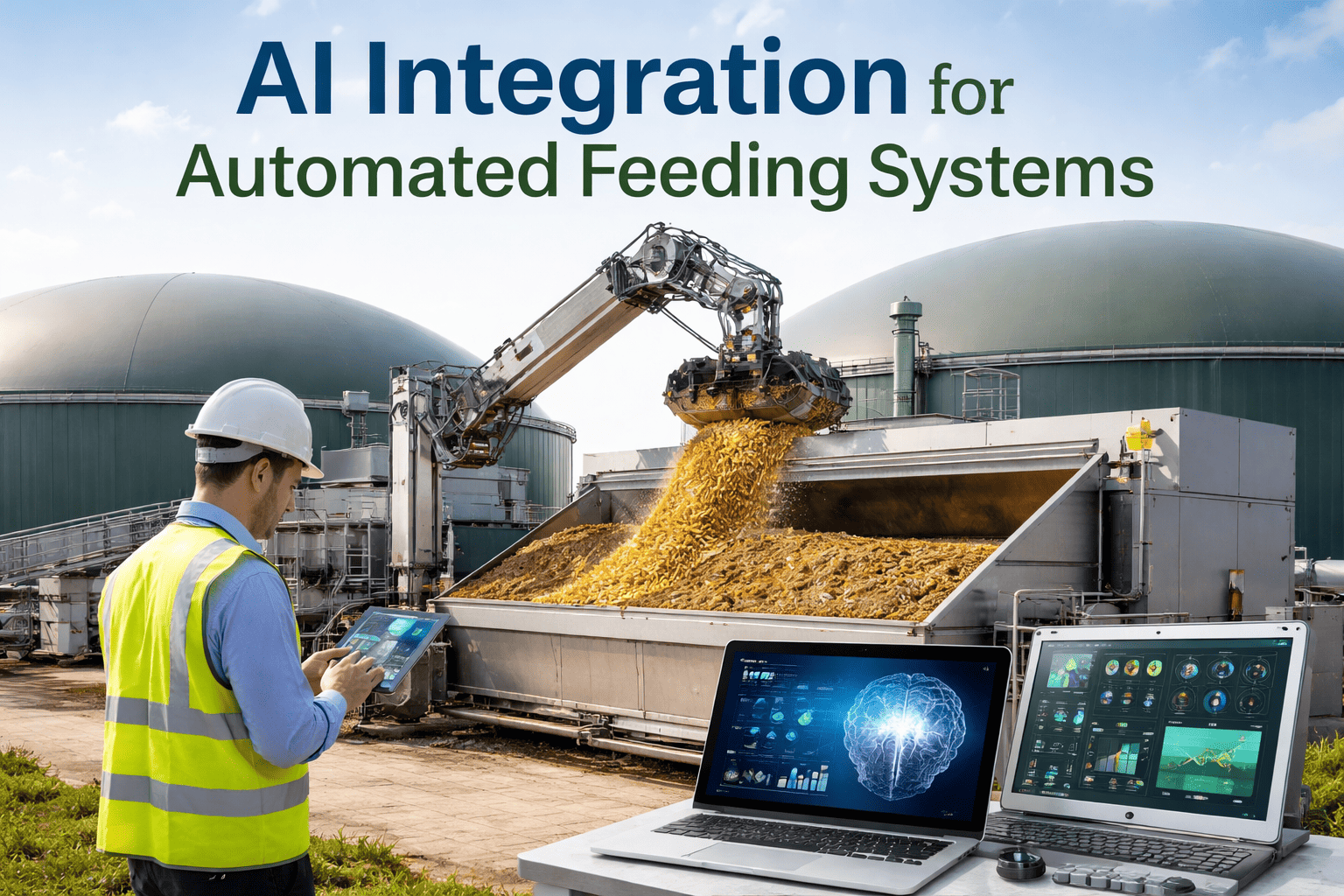
An automated feeding system that dumps 12 metric tons of maize silage into a digester at 6:00 AM every day — regardless of yesterday's VFA accumulation, current alkalinity status or biological loading capacity — isn't automation, it's programmed negligence. Traditional feeding automation executes fixed schedules and preset tonnages without biological feedback, forcing operators to manually override the system during process instability and defeating the purpose of automation entirely. The result: either conservative underfeeding that sacrifices 15-20% potential gas yield to maintain safety margins, or aggressive preset schedules that trigger process upsets requiring emergency intervention. iFactory's AI-integrated feeding system closes the control loop — continuously analyzing VFA trends, alkalinity buffer capacity, gas yield response, and methanogen health to calculate optimal loading rates in real-time, then automatically adjusting hopper discharge rates, pump speeds, and feeding intervals without human intervention. The feeding system that was blind to biological state now responds dynamically to digester capacity, maximizing yield while maintaining process stability through autonomous OLR optimization. Book a demo to see AI feeding control applied to your automation hardware.
Quick Answer
iFactory integrates directly with automated feeding hardware — hoppers, augers, liquid pumps, conveyors — via PLC communication or direct actuator control to adjust feeding rates based on real-time biological state analysis. Machine learning models calculate optimal OLR targets from current VFA concentration, alkalinity buffer status, gas yield trends, and substrate composition, then translate those targets into hardware-specific control signals (hopper discharge duration, pump speed setpoints, conveyor run times) updated every 15 minutes. Average result: 18% increase in gas yield from optimized loading vs fixed schedules, 76% reduction in process upsets caused by overfeeding, zero manual feeding override interventions in 12-month validation period.
How AI Transforms Feeding Automation from Scheduled to Adaptive
The transformation below shows the five-stage evolution from traditional time-based feeding automation to closed-loop AI control — integrating biological monitoring, optimal OLR calculation, hardware command generation, execution verification, and continuous learning from outcome feedback.
AI Feeding Control Architecture — Five-Layer Integration
The pipeline below shows the complete AI feeding control stack — from biological monitoring sensors through optimal OLR calculation, hardware abstraction layer, actuator control, and outcome-based model retraining.
Continuous ingestion of VFA concentration, alkalinity, pH, temperature, gas yield, gas composition (CH₄%, CO₂, H₂S), and substrate composition data from digester sensors and lab analysis. Data updated every 1-60 minutes depending on sensor type and biological response time.
Current state: VFA 2,340 mg/L (↑ 80 mg/L in 24h), Alkalinity 8,200 mg/L (stable), pH 7.81, CH₄ 62.1%, Gas yield 3.18 m³/kg VS
Machine learning model trained on 18 months of feeding history calculates maximum safe OLR from current biological state, substrate composition, and historical response patterns. Considers VFA accumulation rate, alkalinity buffer capacity, methanogen loading capacity, and substrate biodegradability to determine loading ceiling with 95% confidence interval.
Current capacity:
3.6 kg VS/m³/d
95% confidence range:
3.4 - 3.8 kg VS/m³/d
Conservative target:
3.5 kg VS/m³/d
AI translates OLR target (3.5 kg VS/m³/d) into substrate masses accounting for VS content per feedstock: maize silage (32% VS), cattle slurry (6% VS), food waste (22% VS). Then converts masses to hardware-specific commands: hopper discharge duration (seconds), pump speed (Hz for VFD-controlled pumps), conveyor run time (minutes).
Maize hopper: Discharge 13.2 tons → 78 sec @ 10 ton/min rate
Slurry pump: Deliver 8.4 m³ → 42 min @ 12 m³/h (32 Hz VFD)
Food waste auger: Convey 2.1 tons → 14 min @ 9 ton/h
iFactory sends control signals to feeding equipment via Modbus TCP, OPC UA, or discrete I/O depending on hardware configuration. Monitors execution feedback — hopper weight sensors confirm discharge mass, pump flow meters verify delivered volume, conveyor load cells track conveyed tonnage. Flags execution errors (pump cavitation, hopper jam, auger blockage) and initiates retry or alerts operator if hardware intervention required.
✓ Maize hopper: 13.18 tons delivered (target 13.2)
✓ Slurry pump: 8.39 m³ delivered (target 8.4)
✓ Food waste auger: 2.09 tons delivered (target 2.1)
System monitors biological response to feeding adjustments over 24-72 hours — did VFA stabilize as predicted? Did gas yield increase? Was alkalinity buffer maintained? Outcome data feeds back into ML model to improve future OLR predictions. Model accuracy improves continuously — typical path: 78% prediction accuracy at deployment → 92% after 90 days → 96% after 12 months of learning.
Today's feeding outcome (24h post-execution): VFA decreased to 2,180 mg/L (predicted: 2,150-2,250), gas yield increased 4.2% (predicted: 3-5%), alkalinity stable at 8,150 mg/L — feeding target validated, model confidence increased.
AI Feeding Integration
Stop Programming Feeding Schedules — Let Biology Set the Loading Rate
See how iFactory integrates with your automated feeding hardware to adjust loading rates based on real-time biological capacity — maximizing yield while preventing overfeeding upsets.
Problems with Traditional Feeding Automation
Every card below represents a failure mode in time-based or tonnage-based feeding automation that AI-integrated control eliminates through biological feedback and adaptive adjustment.
Fixed Schedules Ignore Biological Variability
Problem: Feeding automation programmed to deliver 12 tons maize silage daily cannot adapt when substrate batch quality varies (28% VS vs 34% VS), methanogen population is stressed (recent temperature shock), or alkalinity buffer is depleted (recent VFA accumulation). Operator must manually override automation 2-3 times per week to prevent upsets — defeating labor-saving purpose of automation.
AI solution: System calculates daily OLR target based on current biological capacity, then adjusts tonnage to deliver consistent organic loading regardless of substrate VS content variation. During biological stress periods, automatically reduces loading to safe levels without operator intervention. Operator overrides: zero in 12-month validation.
Conservative Underfeeding Sacrifices Yield
Problem: Operators set feeding schedules conservatively (OLR 2.8 kg VS/m³/d) to maintain safety margin against process upsets. Digester biological capacity supports 3.6 kg VS/m³/d loading, but without real-time feedback, operators maintain conservative schedule — sacrificing 22% potential gas yield to avoid upset risk.
AI solution: Continuously monitors biological headroom (gap between current loading and upset threshold). When VFA stable, alkalinity adequate, and gas yield strong, system incrementally increases OLR in 0.1 kg VS/m³/d steps every 3-5 days until optimal loading identified. Typical result: 15-20% yield increase from capacity utilization without upset events.
No Response to Substrate Composition Changes
Problem: Substrate batch changes (maize silage harvested from different field with 26% VS instead of usual 32%) but feeding automation continues delivering same 12-ton daily schedule. Actual OLR drops from 3.4 to 2.8 kg VS/m³/d — 18% yield loss for duration of low-VS batch (4-6 weeks) because automation didn't adjust tonnage to compensate.
AI solution: Integrates substrate lab analysis (VS content, C:N ratio, biodegradability) updated weekly or per batch. Automatically adjusts feeding tonnage to maintain target OLR despite substrate quality variation — delivers 14.6 tons of 26% VS maize to achieve same 3.4 kg VS/m³/d loading as 12 tons of 32% VS substrate.
Pump Speed Set Manually — Slurry Viscosity Ignored
Problem: Liquid feeding pumps operate at fixed speed (42 Hz VFD setpoint, 12 m³/h flow). When slurry viscosity increases (higher total solids concentration), actual delivered volume drops to 9.8 m³/h but automation doesn't compensate — resulting in 18% OLR reduction and corresponding gas yield loss. Operator notices yield drop 5 days later, manually increases pump speed, overcorrects, triggers VFA accumulation.
AI solution: Monitors pump flow meter in real-time, detects flow rate deviation from target. Automatically adjusts VFD speed to maintain target volumetric delivery regardless of slurry viscosity variation. If viscosity exceeds pump capacity (flow cannot reach target even at max speed), system alerts operator and temporarily reduces OLR target to match achievable delivery rate.
Multi-Substrate Feeding Lacks Ratio Optimization
Problem: Plant feeds 60% maize silage / 40% cattle slurry (by mass) based on operator rule of thumb. Ratio never adjusted based on biological response, substrate availability, or C:N optimization. During periods of ammonia accumulation (high-protein batch), maintaining fixed ratio worsens ammonia stress instead of adapting substrate mix.
AI solution: Optimizes substrate ratio based on biological feedback and nutrient balance requirements. When ammonia rises above safe threshold, automatically increases maize proportion (high C:N) and decreases slurry proportion (high protein) to restore nitrogen balance. Typical adjustment: 60/40 ratio shifts to 72/28 for 10-14 days until ammonia stabilizes, then gradually returns to optimal yield-maximizing ratio.
No Learning from Historical Performance
Problem: Traditional automation executes same feeding schedule year after year regardless of whether it produces optimal results. No mechanism to learn from successful feeding strategies, seasonal patterns, or substrate-specific responses. Knowledge exists only in operator experience — lost when experienced staff leave.
AI solution: Machine learning model continuously improves from outcome feedback. After 12 months operation, model learns plant-specific patterns: maize silage from Field A supports 3.8 kg VS/m³/d loading, Field B only 3.2 kg VS/m³/d (lower biodegradability). Winter substrate batches require 0.3 kg VS/m³/d lower OLR than summer (temperature-related microbial activity variation). Institutional knowledge embedded in model, accessible to all operators.
Supported Feeding Hardware — Integration Examples
Gravimetric hoppers with load cells, volumetric discharge screws, belt conveyors. iFactory reads hopper weight sensors, calculates required discharge mass, sends start/stop signals to discharge motors with duration control. Supports major brands: Vogelsang, BVL, Wasserbauer, Mayer, custom installations.
Control method: Discrete output to motor contactor (on/off + timer), or analog output for variable-speed auger control (4-20mA or 0-10V)
Progressive cavity pumps, centrifugal slurry pumps, diaphragm pumps — VFD-controlled or fixed-speed with on/off cycling. iFactory monitors flow meters (magnetic, ultrasonic, or Coriolis), adjusts VFD frequency or run duration to deliver target volume. Handles viscosity compensation automatically.
Control method: Modbus RTU/TCP to VFD for speed control, or discrete output with calculated run time for fixed-speed pumps
Automated substrate mixing stations that combine multiple feedstocks (maize, grass silage, manure, food waste) before digester feeding. iFactory controls recipe ratios, discharge sequences, and mixing duration based on biological feedback and nutrient balance requirements.
Control method: PLC integration via OPC UA or Modbus TCP, sending recipe modifications and discharge commands per component
Measured Outcomes Across Deployed Plants
18%
Average Gas Yield Increase
From optimal OLR utilization vs conservative fixed schedules
76%
Reduction in Overfeeding Upsets
AI prevents loading beyond biological capacity
Zero
Manual Override Interventions
In 12-month validation period — full autonomous operation
92%
OLR Prediction Accuracy
After 90 days of learning (starts at 78%, improves to 96% at 12 months)
34%
Reduction in Operator Time
Spent on feeding schedule adjustments and manual overrides
$142K
Avg Annual Revenue Increase
Per 1 MW plant from yield optimization (gas sales at $0.045/kWh)
Autonomous Feeding Intelligence
Your Feeding Automation Executes Schedules — AI Executes Biology
iFactory closes the control loop between biological monitoring and feeding hardware — automatically adjusting loading rates to maximize yield while preventing process upsets.
From the Field
"We installed automated feeding hoppers and pumps in 2022 — great for labor savings, but we still had to manually adjust the daily tonnages 2-3 times per week when VFA started rising or substrate quality changed. The automation executed whatever schedule we programmed, but it couldn't tell us what schedule was optimal. After integrating iFactory AI in Q2 2024, the system has been fully autonomous for 11 months — zero manual feeding adjustments. Gas yield increased 16% from optimal loading utilization, and we haven't had a single overfeeding upset. The AI adjusts daily tonnages automatically based on current biological capacity, compensates for substrate VS variation, and even optimizes the maize-to-slurry ratio when ammonia starts trending upward. Feeding automation finally works the way we thought it would when we bought the hardware."
Plant Manager
2.2 MW Biogas Plant — Agricultural Feedstock — Iowa, USA
Frequently Asked Questions
QWhat happens if the AI calculates an unsafe OLR increase and the operator disagrees?
Operators always have override authority. The system operates in three modes: (1) Fully autonomous — AI adjusts feeding without approval (default after 90-day validation period), (2) Approval required — AI recommends adjustments, operator approves before execution (default during initial 90 days), (3) Manual — operator sets feeding schedule, AI monitors but doesn't control. Mode selection per plant preference. Override history is logged and reviewed — if operators frequently override AI recommendations in same direction (e.g., always reducing proposed OLR), this indicates model calibration issue and triggers engineering review.
Discuss control authority configuration in a demo.
QHow does the system handle feeding hardware failures or communication loss?
If iFactory loses communication with feeding hardware (network failure, PLC offline) or detects execution error (pump cavitation, hopper jam, conveyor overload), the system immediately alerts the operator via mobile notification and falls back to last-known-good feeding schedule stored locally in the PLC. Hardware continues operating on safe fallback schedule until communication restored or operator intervenes manually. All hardware control systems include hardwired emergency stop and local manual override independent of iFactory — ensuring feeding can always be controlled locally regardless of AI system status.
QCan the AI optimize feeding timing (when to feed) in addition to tonnage (how much to feed)?
Yes. The system can optimize both daily tonnage and feeding interval timing based on biological response patterns learned from historical data. For instance, if analysis shows gas yield peaks 8-12 hours after feeding and remains elevated for 18 hours, the system may recommend splitting daily feeding into two batches (morning + evening) instead of single daily feeding to maintain more consistent gas production. Timing optimization is optional — many plants prefer maintaining fixed feeding times for operational convenience (coordinated with labor shifts, substrate delivery schedules). Tonnage optimization alone typically captures 80-90% of available yield improvement.
QWhat substrate composition data does the AI require and how often must it be updated?
Minimum required: VS content (% volatile solids) per substrate type, updated weekly or per batch change. Enhanced performance with: total solids (TS), C:N ratio, crude protein content, biodegradability index (from BMP test if available). Substrate data can be entered manually from lab analysis, imported from LIMS system, or auto-populated if plant has online NIR (near-infrared) analyzer. If substrate composition data is stale (>14 days old), AI operates conservatively with wider safety margins until fresh analysis available. Typical workflow: weekly lab sampling during stable operation, daily sampling during substrate batch transitions.
Discuss substrate analysis integration in a scoping call.
Continue Reading
Close the Loop — Let Biology Control Feeding, Not Schedules.
iFactory's AI integrates directly with your automated feeding hardware to adjust loading rates based on real-time biological capacity — maximizing gas yield while preventing overfeeding upsets through fully autonomous control.
Autonomous OLR Optimization
Hardware Integration (Hoppers/Pumps)
Substrate Composition Adaptation
Zero Manual Overrides
18% Yield Improvement