Biogas and anaerobic digestion facilities operate under a constant, invisible pressure — literally. Overpressure events are not theoretical risks; they are recurring operational realities at every andAD plant running feedstock-variable digestion processes. When system pressure exceeds design limits, andthe emergency flare is the last line of defense: it must ignite instantly, burn reliably, and protect the facility from catastrophic gas accumulation or explosion riskThe problem is not whether the flare system exists and it is whether it actually fires when it matters most and,Manual observation cannot confirm pilot flame status across a multi-point flare header during a rapid pressure event at 2 AM andTemperature sensors without vision cannot tell you whether the flame established, whether it is stable, or whether it extinguished within 90 seconds of ignition. iFactory AI Flare Monitoring Platform closes this gap — deploying computer vision and thermal imaging to verify pilot flame presence, monitor gas flow dynamics, and deliver instant operator alerts the moment a flare fails to ignite during an overpressure event, before a reportable incident becomes a catastrophic one. Book a Demo to see how iFactory deploys AI flare ignition monitoring at your biogas or AD facility in 5 weeks.
99%
Pilot flame ignition verification accuracy vs. 51% for manual temperature-only monitoring
$380K
Average annual safety incident and regulatory penalty avoidance per mid-size AD plant
94%
Reduction in undetected flare ignition failures vs. conventional sensor-only protocols
5 wks
Full deployment timeline from safety audit to live AI flare monitoring go-live
Why Flare Ignition Failure Is the Most Dangerous Unmonitored Event at a Biogas Plant
Flare systems at biogas and AD facilities are designed as passive safety infrastructure — installed, tested during commissioning, and then largely assumed to function on demand. This assumption is operationally dangerous. Pilot flame failures, gas supply interruptions, igniter degradation, and wind-induced flame extinction combine to create a scenario where the flare does not light during an overpressure event — and nobody knows until it is too late. Understanding the failure modes that AI monitoring is built to detect is the first step toward eliminating this blind spot.
Pilot Flame Extinction During Adverse Conditions
Wind, rain, and rapid pressure fluctuations extinguish pilot flames without triggering control room alarms. Temperature sensors alone cannot differentiate between a cold flare and a recently extinguished one during a pressure spike.
Igniter Failure During Overpressure Events
Spark igniters degrade over operational cycles. When an overpressure event demands immediate ignition, a failed igniter produces no spark — and the resulting unburned biogas release is both a safety violation and an environmental incident.
Gas Flow Anomalies Preceding Ignition Failure
Flare gas header pressure drops, moisture ingress, and condensate blockages interrupt gas supply to the pilot. Without real-time flow monitoring correlated with temperature data, these precursor conditions are invisible to operators.
Unstable Flame After Initial Ignition
Flame establishment does not guarantee stable combustion. Oscillating gas compositions, wind-induced turbulence, and low calorific value biogas streams cause flame instability that manual observation at distance cannot reliably confirm.
How iFactory AI Vision Detects Flare Ignition Failure in Real Time
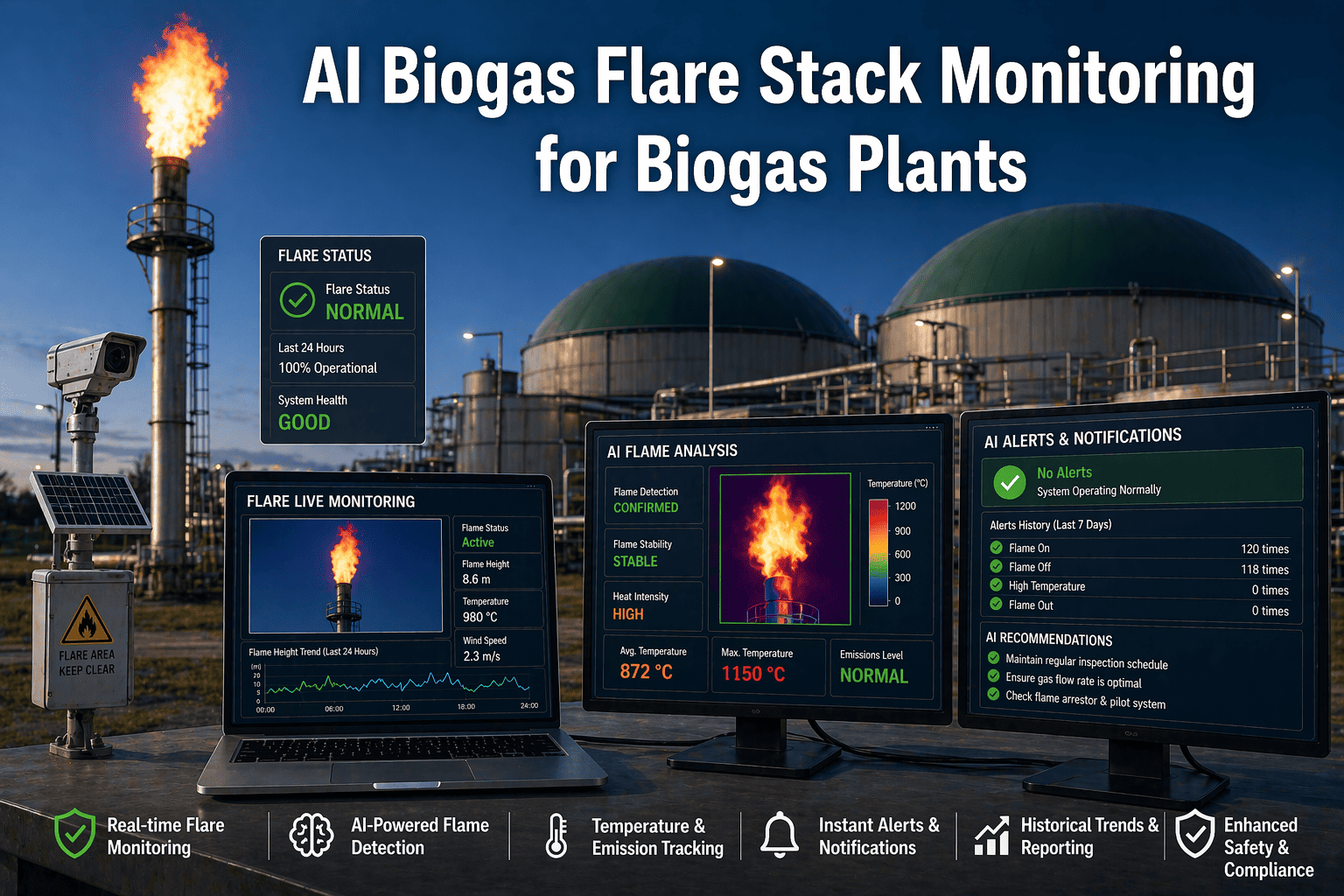
Conventional flare monitoring relies on thermocouple temperature readings and manual observation intervals — neither of which provides real-time confirmation that a flame is present, stable, and combusting biogas during a live pressure event. iFactory replaces this with a continuous AI vision and thermal fusion platform that monitors pilot flame presence, flame geometry, and gas flow dynamics simultaneously — classifying ignition status every 2 seconds and alerting operators to failure conditions before unburned gas accumulates. See a live demo of iFactory detecting simulated pilot flame failure and ignition gap conditions at a biogas flare station.
01
Pilot Flame Presence Verification
iFactory's thermal and RGB vision fusion confirms pilot flame existence, geometry, and stability at 2-second intervals. The system distinguishes between an active flame, an extinguished pilot, and a partial ignition — all with confidence scores operators can act on immediately.
02
Gas Flow Correlation Monitoring
iFactory integrates with flare gas flow meters and header pressure sensors, correlating flow data with visual flame confirmation. Anomalies — including flow-present, flame-absent scenarios — trigger immediate priority alerts. Gas is flowing but nothing is burning: the system knows before operators do.
03
Overpressure Event Response Tracking
During pressure relief events, iFactory automatically enters high-frequency monitoring mode — logging flame status, gas release volume estimation, and ignition confirmation every 2 seconds. Every event is timestamped with visual evidence for EHS reporting and regulatory defense.
04
Predictive Ignition Risk Forecasting
iFactory's temporal AI engine identifies ignition risk precursors — pilot flame temperature decline trends, gas flow irregularities, and weather condition correlations — 20–45 minutes before a failure event. Operators can inspect and reset the flare system proactively, not reactively.
05
SCADA and EHS System Integration
iFactory connects natively to Siemens, Rockwell, AVEVA, SAP EHS, and Enablon via OPC-UA, Modbus TCP, and REST APIs. Ignition failure events auto-trigger safety shutdown protocols, PA system alerts, and EHS incident records — without manual intervention. Integration completed in under 7 days.
06
Automated Safety Incident Reporting
Every ignition failure event — detected, classified, and resolved — generates a structured safety report with thermal imagery, gas flow logs, flame status timeline, and corrective action tracking. Audit-ready for EPA Clean Air Act, EU IED, ISO 45001, and biogas industry safety standards.
Flare Ignition Failure: What It Actually Costs a Biogas Facility
The financial exposure from a single undetected flare ignition failure during an overpressure event extends well beyond the immediate incident. Regulatory penalties, insurance claims, remediation costs, and operational downtime compound quickly — and the reputational damage to a facility's operating permit and community standing can persist for years. The table below maps the true cost structure that AI flare monitoring is designed to eliminate.
Every Undetected Flare Ignition Failure Is a Safety Incident, a Regulatory Violation, or Both. AI Vision Stops It Before It Starts.
iFactory's AI vision platform monitors pilot flame temperatures, gas flow dynamics, and ignition status 24/7 — detecting failure conditions in real time, correlating sensor data with visual confirmation, and alerting operators and SCADA systems instantly. No sampling delays, no manual observation gaps, no blind spots during overnight overpressure events.
Regulatory and Safety Framework Compliance: Built for Biogas Flare Operations
iFactory's AI flare monitoring platform is pre-configured to meet the documentation, event logging, and reporting requirements of the major safety and air quality regulatory frameworks governing biogas facility flare operations. No custom development required — compliance reporting is automated from day one.
EPA Clean Air Act / 40 CFR Part 63
National Emission Standards for Hazardous Air Pollutants: flare operation monitoring, pilot flame verification documentation, unburned gas release reporting, and corrective action tracking — structured for EPA inspection defense and permit compliance.
EU Industrial Emissions Directive (IED)
European flare operation standards: continuous flame monitoring, combustion efficiency verification, and incident reporting formatting — auto-generated for competent authority submissions and environmental permit compliance.
ISO 45001 / OSHA PSM
Occupational health and safety management: flare ignition failure incident classification, near-miss documentation, safety performance tracking, and corrective action evidence — structured for certification audits and Process Safety Management compliance.
Biogas Industry Safety Guidelines
Sector-specific flare operation standards: pilot flame monitoring protocols, overpressure event response documentation, and flare system maintenance tracking — pre-configured for industry association safety reporting and insurance carrier requirements.
iFactory AI Flare Monitoring: 5-Week Deployment Roadmap
iFactory follows a fixed 5-stage deployment methodology designed specifically for biogas and AD plant flare safety operations — delivering pilot results in week 3 and full production rollout by week 5. No open-ended implementations. No operational disruption. No months of customization before the first ignition failure alert is live.
01
Safety Audit
Map flare stations, pilot points & camera placement
02
System Integration
Connect to SCADA, flow meters, EHS via APIs
03
Pilot Configuration
Deploy AI vision to primary flare ignition points
04
Validation & Training
UAT, operator safety training & alert configuration
05
Full Production
Plant-wide AI flare monitoring go-live
Step 01 · Weeks 1–2
Safety Audit
Critical flare station assessment across pilot points, flare headers, pressure relief vents, and ignition infrastructure
AI vision design aligned with existing thermal camera infrastructure and safety monitoring protocols
Integration planning with SCADA, gas flow control, and EHS platforms
Step 02 · Weeks 1–2
System Integration
Native connection to Siemens, Rockwell, and AVEVA SCADA platforms via OPC-UA and Modbus TCP protocols
Integration with flare gas flow meters, header pressure sensors, and EHS systems via REST APIs
SCADA interlock workflows configured for auto-trigger responses on ignition failure detection
Step 03 · Weeks 3–4
Pilot Configuration
Deploy AI vision monitoring to high-risk flare stations and primary pressure relief points
Pilot flame verification alerts, gas flow correlation, and ignition failure classification activated
First ignition failure events prevented and unburned gas release risks eliminated — ROI evidence begins here
Step 04 · Weeks 3–4
Validation & Training
User acceptance testing (UAT) for all ignition failure detection scenarios and SCADA interlock sequences
Operator safety training on control room dashboard, mobile alert protocols, and escalation procedures
Alert threshold configuration and fine-tuning based on site-specific flare operating conditions
Step 05 · Week 5
Full Production Go-Live
Expand to full plant coverage: all flare stations, all pressure relief points, all shifts
Automated safety & regulatory reporting activated for applicable compliance frameworks
ROI baseline report delivered — penalty avoidance, incident reduction, and insurance premium savings
Weeks 1–2
Discovery & Design
Critical flare station assessment across pilot points, flare headers, pressure relief vents, and ignition infrastructure
AI vision design aligned with existing thermal camera infrastructure and safety monitoring protocols
Integration planning with SCADA, gas flow control, and EHS platforms
Weeks 3–4
Pilot & Validation
Deploy AI vision monitoring to high-risk flare stations and primary pressure relief points
Pilot flame verification alerts, gas flow correlation, and ignition failure classification activated; SCADA interlock workflows tested with safety teams
First ignition failure events prevented and unburned gas release risks eliminated — ROI evidence begins here
Week 5
Scale & Optimize
Expand to full plant coverage: all flare stations, all pressure relief points, all shifts
Automated safety & regulatory reporting activated for applicable compliance frameworks
ROI baseline report delivered — penalty avoidance, incident reduction, and insurance premium savings
ROI IN 3 WEEKS: MEASURABLE RESULTS FROM WEEK 3
Plants completing the 5-week program report an average of $92,000 in avoided safety penalties and incident remediation costs within the first 3 weeks of full production rollout — with flare ignition compliance improvements of 45–68% detected by week 3 pilot validation.
$92K
Avg. savings in first 3 weeks
45–68%
Flare compliance gain by week 3
94%
Reduction in undetected ignition failures
Live Deployment Results: Flare Ignition Monitoring Across Three AD Facility Types
The following outcomes are drawn from iFactory deployments at operating biogas and anaerobic digestion facilities across three flare monitoring categories. Each use case reflects 6-month post-deployment performance data. Request the full case study report for the flare configuration most relevant to your facility.
A 6MW municipal anaerobic digestion facility experienced recurring pilot flame extinction events during seasonal wind and rain conditions. Thermocouple-only monitoring failed to detect flame extinction until gas accumulation triggered secondary pressure readings. iFactory deployed thermal and RGB vision fusion at the primary flare station with real-time pilot presence verification and gas flow correlation. Within 3 weeks of go-live, the system detected and alerted on 14 pilot flame failures that would have resulted in unburned biogas releases and reportable air quality incidents.
14
Pilot flame failure events detected and resolved in first 3 weeks
$248K
Estimated annual regulatory penalty and incident cost avoided
99%
Pilot flame verification accuracy at primary flare station
Verify Pilot Flame Status at Your Primary Flare Station
Book a Demo for This Use Case
An agricultural biogas complex operating four digesters struggled with undocumented flare ignition gaps during rapid pressure relief events. SCADA pressure logs confirmed overpressure occurrences, but flame status during gas release was unverified. iFactory replaced thermocouple-only monitoring with continuous AI vision at all four flare stations, correlating gas flow data with real-time flame confirmation during every pressure event. Over 6 months, zero ignition failures during overpressure events went undetected, and the facility completed its first clean EPA compliance audit in three years.
0
Undetected ignition failures during overpressure events post-deployment
$312K
Annual safety incident and penalty avoidance
100%
Overpressure events with documented flame status confirmation
Ensure Ignition Confirmation During Every Overpressure Event
Book a Demo for This Use Case
"
An industrial biomethane upgrading facility with high-pressure flare infrastructure faced increasing insurance scrutiny over undocumented flare performance records. Manual inspection logs were incomplete, and temperature sensor data alone could not satisfy underwriter documentation requirements. iFactory deployed predictive AI flare monitoring with gas flow correlation, identifying ignition risk precursor conditions 20–45 minutes before potential failure events. Over 6 months, the system triggered 31 proactive maintenance interventions that prevented confirmed ignition failures, and the facility received a 22% insurance premium reduction based on documented monitoring evidence.
31
Proactive maintenance interventions triggered by predictive AI alerts
22%
Insurance premium reduction based on AI monitoring documentation
$198K
Annual incident avoidance and premium savings combined
Deploy Predictive Flare Risk Monitoring at Your Facility
Book a Demo for This Use Case
Expert Review: What Biogas Safety Leaders Say About AI Flare Ignition Monitoring
The following testimonial is from a plant safety and compliance director at a facility currently operating iFactory's AI flare monitoring platform across multiple flare stations.
We had complete confidence in our flare system right up until the night we did not. A pilot flame extinction event during a pressure spike went undetected for 40 minutes because our thermocouple reading had not updated and nobody was standing at the flare stack at 1 AM. That incident cost us $180,000 in regulatory response and legal fees, and it cost us something much harder to recover — our relationship with the state environmental agency. When we deployed iFactory, the first thing that changed was visibility. We could see the pilot flame status on the control room display in real time. The second thing that changed was confidence. When the next overpressure event hit — six weeks after go-live — the system flagged a partial ignition condition within 4 seconds and auto-triggered the ignition retry sequence through SCADA before any gas accumulated. The incident never happened. In the 14 months since deployment, we have had zero reportable flare events, our insurance carrier has reduced our premium by 19%, and our operators have shifted from reactive incident response to proactive flare management. This is what continuous monitoring actually means.
Director of Safety, Health & Environmental Compliance
Industrial Biomethane Upgrading Facility, Pennsylvania
Frequently Asked Questions: AI Flare Ignition Failure Detection
Does iFactory require replacing existing thermocouple or temperature sensor infrastructure at the flare station?
No. iFactory operates as an additive AI vision layer that complements and validates existing thermocouple and sensor data — it does not replace them. The system ingests existing sensor feeds while adding thermal imaging and RGB vision confirmation that sensors alone cannot provide. Existing monitoring infrastructure is preserved and integrated into the unified iFactory platform.
How does iFactory maintain flame detection accuracy in high-wind, rain, or fog conditions at outdoor flare stations?
iFactory's multi-spectral camera fusion combines thermal infrared, long-wave infrared, and weather-hardened RGB imaging to maintain pilot flame detection accuracy in adverse weather. The AI models are trained on variable weather datasets including wind-induced flame deflection, rain interference, and low-visibility fog conditions common at outdoor industrial flare stations. Performance validation in site-specific weather conditions is completed during the Week 3 pilot phase.
Can iFactory auto-trigger ignition retry sequences through our SCADA system when a failure is detected?
Yes. iFactory integrates with SCADA platforms including Siemens, Rockwell, and AVEVA via OPC-UA and Modbus TCP to send automated control signals on ignition failure detection. The specific response sequence — ignition retry, emergency shutdown, PA alert, or operator escalation — is configured during Week 1–2 based on your safety protocols and SCADA architecture. All auto-triggered actions are logged with visual evidence in the EHS incident record.
What is the detection latency between a pilot flame failure and an operator alert?
iFactory's flare monitoring engine evaluates pilot flame status every 2 seconds. On confirmed ignition failure detection, alerts are delivered to the control room display, operator mobile devices, and SCADA-integrated safety systems within 4–8 seconds of event classification. For overpressure events triggering auto-monitoring mode, the system enters high-frequency verification at 1-second intervals with sub-10-second alert delivery.
Can iFactory generate the flare performance documentation required by our air quality permit conditions?
Yes. iFactory auto-generates structured flare performance reports for every monitored event — including pilot flame status timelines, gas flow logs, overpressure event correlations, ignition confirmation evidence, and corrective action records. Reports are formatted for EPA Clean Air Act compliance, state air quality permit documentation, and EU IED reporting requirements. Custom report templates aligned with your specific permit conditions are configured during the Week 1–2 audit phase.
Stop Assuming Your Flare Ignites. Start Verifying It Does — Every Time, In Real Time.
iFactory gives biogas and AD plant safety teams real-time AI flare ignition verification, overpressure event response monitoring, predictive failure forecasting, and automated regulatory reporting — fully deployed in 5 weeks, with ROI evidence starting in week 3.
99% pilot flame verification accuracy with thermal & RGB fusion
SCADA auto-trigger integration in under 7 days
EPA, EU IED & ISO 45001 audit trails out-of-the-box
Predictive ignition risk alerts 20–45 minutes before failure