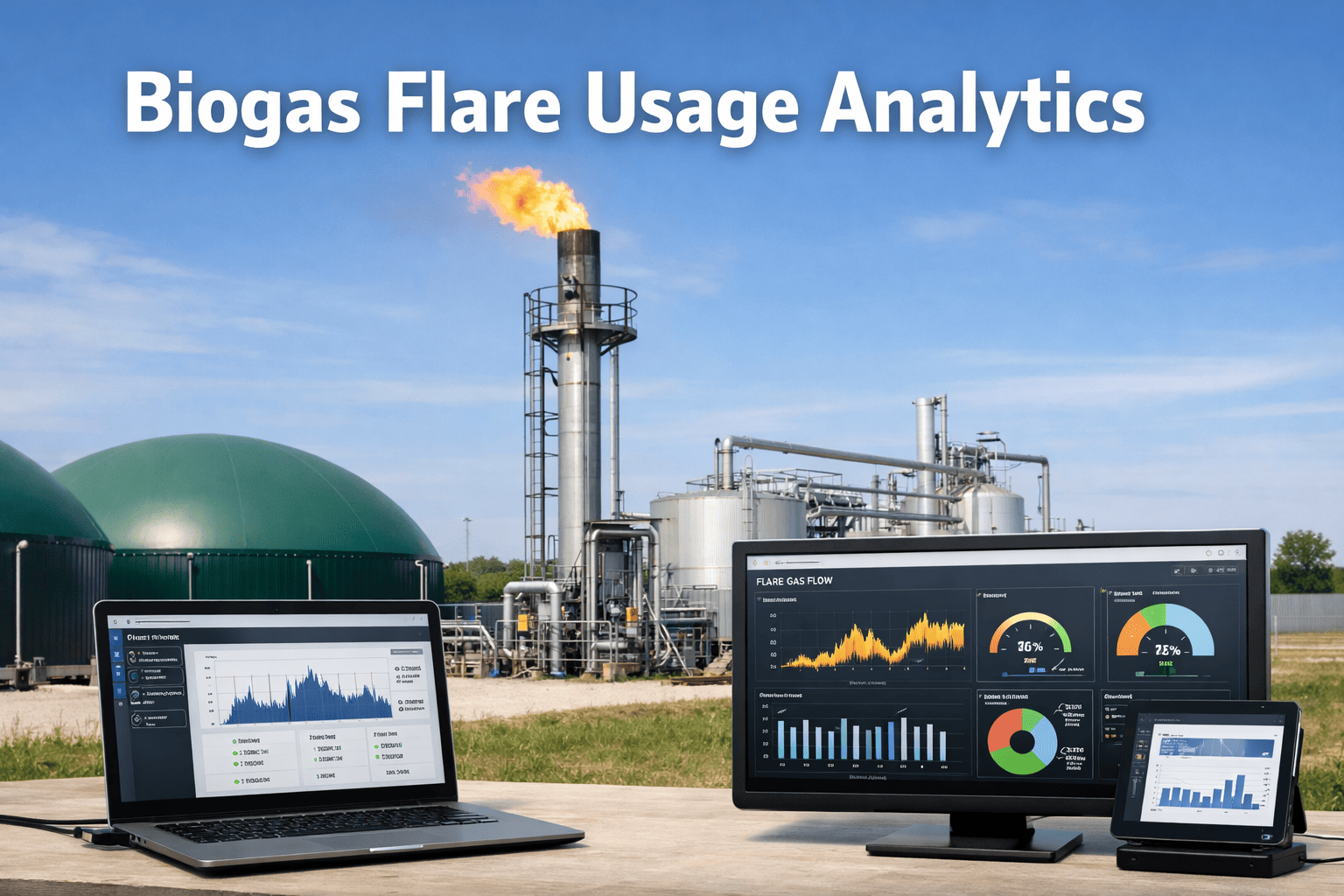
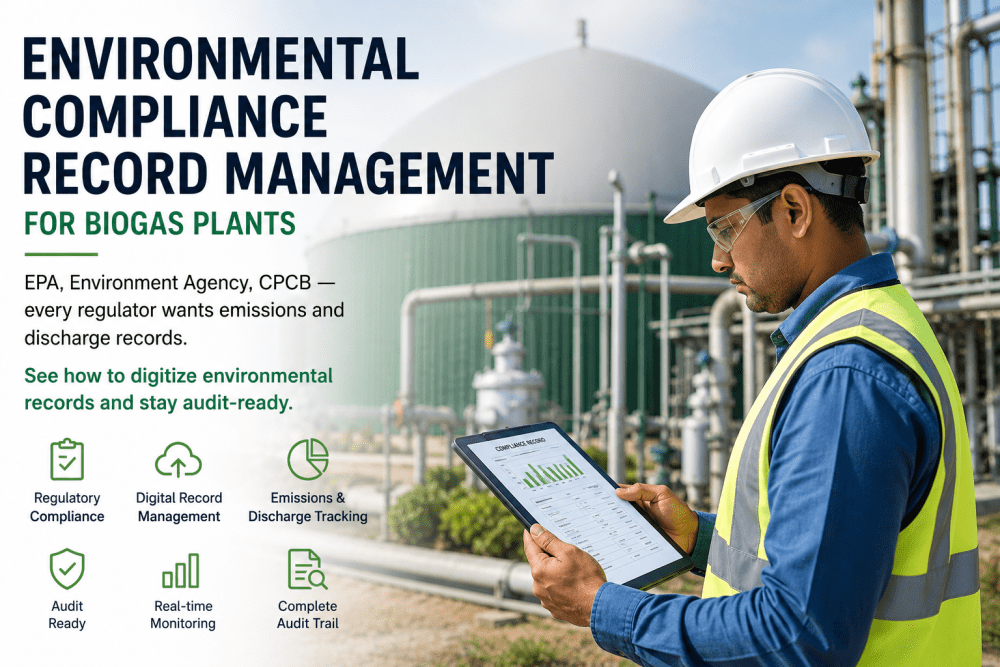
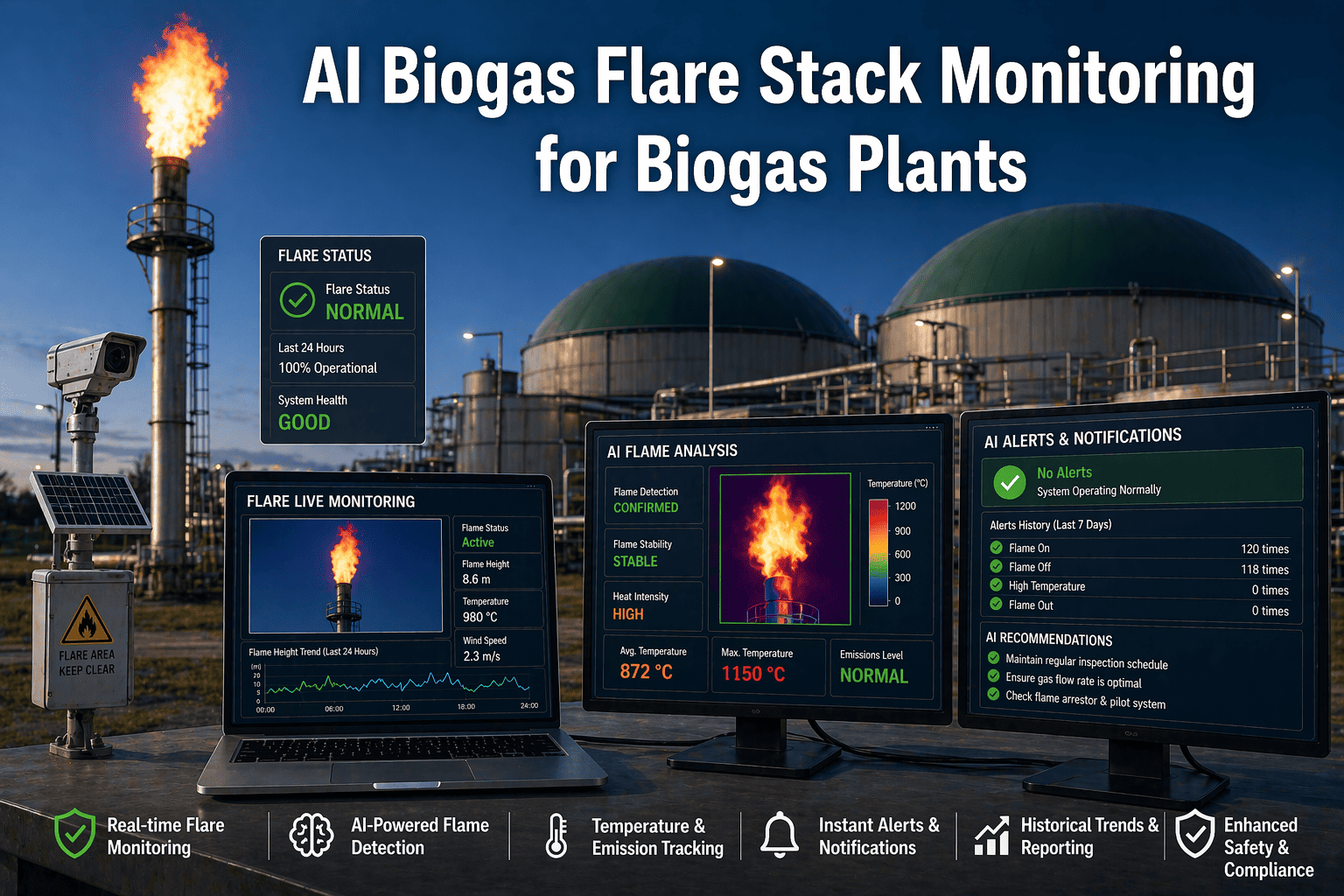
Every cubic metre of biogas that passes through your emergency flare instead of your CHP engine represents lost revenue, wasted renewable energy, and an environmental compliance risk that regulators are increasingly scrutinising. A 500 kW biogas plant flaring at 8% of total gas production loses $85,000–$140,000 in annual energy revenue while simultaneously generating emissions records that can trigger permit review, community complaints, and renewable energy subsidy audits. Most operators have no precise picture of when their flare activates, why it activates, or what the cumulative financial and compliance cost of their flaring pattern actually is — because standard SCADA systems log flare events as binary on/off signals without correlating them to biological process state, CHP operational status, gas storage capacity, or grid demand patterns. iFactory's biogas flare usage analytics platform monitors every flare activation event with microsecond precision — correlating flare usage to upstream biological process performance, CHP engine health, gas storage buffer management, and grid connectivity — delivering the data intelligence required to systematically reduce flaring events, maximise CHP runtime, and produce audit-ready compliance reports for environmental permitting. Book a demo to see flare analytics applied to your plant's gas management configuration.
Quick Answer
iFactory's flare analytics platform tracks every flare activation with timestamp, duration, gas volume flared, estimated revenue lost, root cause classification (CHP downtime, gas overproduction, storage capacity breach, grid export limit, biological process instability, emergency safety event), and environmental compliance data — enabling operators to reduce preventable flaring events by 73% within 12 months through targeted intervention on the specific root causes driving their plant's flaring pattern. Audit-ready compliance reports are generated automatically for environmental permit requirements and renewable energy subsidy declarations.
═══════════════════════════════════════════
SECTION: FLARE COST DASHBOARD — HERO STATS
════════════════════════════════════════════
The Real Cost of Unmanaged Flaring — What Your Plant Is Losing Right Now
Before operators deploy iFactory's flare analytics, most cannot answer three basic questions about their flaring pattern: How many hours did the flare run last month? What percentage of total gas production was flared? What was the combined revenue and compliance cost? The answers, when analytics are applied for the first time, are consistently worse than operators estimated.
$112,000
Annual Energy Revenue Lost
Based on 8.4% flare rate, $0.14/kWh electricity value
847 hrs
Annual Flare Runtime
9.7% of total annual operating hours — significantly above industry best practice of <3%
214,000 m³
Biogas Flared Annually
Equivalent to 128,000 m³ CH4 — 62% of which was preventable based on root cause analysis
3 events
Regulatory Threshold Breaches
Flaring duration events exceeding permit thresholds — triggering compliance reporting obligations
═══════════════════════════════════════════
SECTION: ROOT CAUSE CLASSIFICATION WHEEL
════════════════════════════════════════════
Why Your Flare Activates — The 6 Root Cause Categories iFactory Identifies
Flare activation is always a symptom of an upstream condition — not a random event. iFactory's root cause classification engine correlates every flare event with the operational and biological state of the plant at the moment of activation, assigning each event to one of six root cause categories that require fundamentally different interventions to prevent. Understanding your plant's root cause distribution is the prerequisite for any systematic flaring reduction programme.
CHP Engine Downtime — Planned & Unplanned
The largest single cause of flaring across most plants. When the CHP engine is offline for maintenance, emergency repair, or grid disconnection, gas production continues while the primary consumption route is unavailable. Plants without gas storage buffer management flare within 2–4 hours of CHP shutdown. iFactory detects planned and unplanned CHP downtime, calculates the time until gas storage capacity is reached, and recommends OLR reduction to match gas production to available consumption — minimising flare activation duration during engine downtime periods.
Preventable: 65% with OLR management
Avg duration: 4.2 hrs per event
Avg revenue loss: $580 per event
Gas Storage Capacity Breach — Buffer Management Failure
Gas storage pressure vessels or membrane stores reach maximum capacity faster than expected due to production surges, reduced CHP demand, or inadequate buffer sizing relative to OLR variability. Storage breach triggers automatic safety flaring. iFactory monitors gas storage fill rate in real time — detecting trajectory toward capacity breach 60–180 minutes before activation and recommending CHP load increase or OLR reduction to prevent storage overflow without flaring.
Preventable: 82% with predictive buffer management
Avg duration: 2.8 hrs per event
Avg revenue loss: $390 per event
Grid Export Limit & Feed-In Tariff Constraint
Grid operator curtailment instructions, maximum export capacity limits, or feed-in tariff generation hour caps force CHP de-rating or shutdown at times of maximum gas production — creating surplus gas that storage cannot absorb. Particularly acute at night when heat demand is low and grid curtailment is most frequent. iFactory integrates with grid operator dispatch signals and export metering — pre-adjusting OLR to reduce gas production during forecast curtailment periods.
Preventable: 71% with dispatch-integrated OLR control
Avg duration: 3.6 hrs per event
Avg revenue loss: $500 per event
Biological Overproduction — OLR Surge Events
High-BMP substrate batches or OLR increases generate more gas than forecast — overwhelming CHP capacity and storage buffer simultaneously. Common after introduction of high-energy food waste batches, following trace element correction (methanogenic activity recovery surge), or during warm weather periods when mesophilic digester activity increases. iFactory monitors gas production rate vs CHP consumption in real time, detecting surplus production trajectory before storage approaches capacity.
Preventable: 78% with production rate monitoring
Avg duration: 1.9 hrs per event
Avg revenue loss: $260 per event
Gas Quality Deviation — CHP Engine Protection Trip
CHP engine protection systems trip the engine offline when gas quality parameters (CH4 percentage below minimum, H2S above maximum, moisture content breach) fall outside safe operating thresholds — leaving the plant with gas production and no consumption route. H2S spikes from sulphate-rich substrate batches are a common cause. iFactory monitors gas quality continuously, alerting to developing gas quality deterioration before it triggers CHP trip — enabling scrubbing system intervention or OLR reduction ahead of the protective shutdown.
Preventable: 68% with gas quality early warning
Avg duration: 5.8 hrs per event
Avg revenue loss: $800 per event
Safety & Emergency Flaring — Non-Preventable Events
Genuine safety-driven flare activation — pressure relief events, gas handling system faults, emergency plant shutdown protocols — represents a small but critical category that must be distinguished from preventable operational flaring in compliance reporting. iFactory's classification system separates safety flaring from operational flaring in all reports, ensuring that environmental permit compliance calculations accurately reflect controllable vs unavoidable flare usage.
Non-preventable — Safety critical
Compliance documentation: Automatic
Flare Analytics Intelligence
Know Exactly Why Your Flare Activates — Then Stop It
iFactory classifies every flare event by root cause, calculates the revenue lost, and delivers the specific operational recommendation to prevent the same cause from triggering the next event.
73%
Reduction in Preventable Flare Events
$98K
Avg Annual Revenue Recovered
6
Root Cause Categories Classified
100%
Audit-Ready Compliance Coverage
═══════════════════════════════════════════
SECTION: ANALYTICS FEATURE BENTO GRID
════════════════════════════════════════════
What iFactory Flare Analytics Tracks — Full Platform Capability
iFactory's flare analytics layer sits across the full gas management stack — from biological gas production through storage buffer management to CHP engine consumption and grid export metering — tracking every variable that influences when and why the flare activates. Talk to an expert about your plant's gas management configuration.
Real-Time Flare Event Logging
Every flare activation logged with microsecond-precision timestamp, duration, gas flow rate, total volume flared, estimated methane content, revenue equivalent, and root cause classification. Event log available in real-time on dashboard and mobile app, with instant alert to operations team on activation. Historical event database searchable by date, duration, root cause, and financial impact.
Microsecond precision
Instant mobile alert
Root cause auto-classified
Gas Storage Buffer Trajectory Monitoring
Real-time gas storage fill level tracking with trajectory forecasting — calculating time-to-capacity based on current production rate vs consumption rate. Alerts when storage will reach capacity in less than 90 minutes without intervention, enabling OLR reduction or CHP load increase before the flare activates.
90-min advance warning
Trajectory forecasting
CHP Runtime vs Flare Correlation Dashboard
Side-by-side visualisation of CHP operational hours, maintenance downtime windows, and flare activation periods — revealing the direct relationship between engine availability and flaring frequency. Identifies whether maintenance scheduling is creating avoidable flare peaks and quantifies the revenue cost of each downtime window.
Downtime correlation
Revenue per downtime
Environmental Compliance Report Generation
Automated generation of permit-compliant flare usage reports — total volume flared, event frequency, safety vs operational event classification, CH4 emission equivalent, and comparison against permit thresholds. Available in formats matching EA (UK), EPA (US), and EU environmental permitting requirements.
Permit-ready format
CH4 emission calculation
Flare Reduction Opportunity Ranking — Prioritised Action List
AI model analyses the last 12 months of flare event data, root cause distribution, and operational patterns to generate a prioritised list of flare reduction opportunities — ranked by annual revenue impact and implementation effort. Operators receive a clear action plan: which root cause to address first, what operational change is required, and what the predicted annual flare reduction will be. Typical output: "Address CHP maintenance scheduling to reduce planned downtime flaring — estimated 34% reduction in total annual flare hours, $38,000 annual revenue recovery."
AI-ranked priority list
Revenue impact per action
Implementation effort scoring
Renewable Subsidy Revenue Protection
Tracks gas volumes and energy generation against feed-in tariff, Renewable Heat Incentive, or biomethane injection payment schemes — flagging flaring events that may affect subsidy declarations and ensuring compliance data is complete for payment claims. Identifies subsidy revenue at risk from flaring patterns before claim submission.
FiT / RHI / RNG tracking
Subsidy risk flagging
Gas Quality Impact on Flare Frequency
Correlates gas quality parameters (CH4%, H2S, CO2, moisture) with CHP trip events and subsequent flare activation — identifying gas quality deterioration patterns that precede engine protection shutdowns. Enables H2S scrubber performance monitoring, gas drying system effectiveness tracking, and early warning of gas quality deviation before engine trip occurs.
H2S trip prediction
Scrubber performance
═══════════════════════════════════════════
SECTION: COMPLIANCE FRAMEWORK — 3-COL
════════════════════════════════════════════
Flare Compliance Reporting — Meeting Environmental Permit Requirements
Environmental permits for biogas plants universally require flare usage reporting — but the specific data requirements, reporting intervals, and compliance thresholds vary significantly by jurisdiction and permit class. iFactory generates the right report format for your regulatory environment automatically, with all data derived from continuous sensor monitoring rather than manual estimation.
??
United Kingdom — EA Permit
Environment Agency environmental permits for biogas plants require annual reporting of total flare hours, estimated CH4 emissions from flaring, and classification of safety vs operational flaring events. iFactory generates EA-compatible annual reports with event-level detail, supporting H4 permit conditions and Bespoke Permit compliance. H2S concentration in flare gas and destruction efficiency assumptions included where permit conditions specify.
H4 Standard Rules
Bespoke Permit
Annual Return Ready
??
European Union — IED / National Permits
EU Industrial Emissions Directive and national implementing regulations require biogas plant operators to document all flaring events, volumes, and durations as part of emissions monitoring compliance. iFactory generates event logs in formats compatible with German BImSchG, French ICPE, Dutch Activiteitenbesluit, and other national frameworks — with CH4 emission factor calculations aligned to national guidance documents.
IED Compliance
Multi-jurisdiction
CH4 Emission Calc
??
United States — EPA / State Permits
EPA Subpart W (Methane Emissions) requires quantification of biogas flaring events and volumes for greenhouse gas inventory reporting. State air quality permits commonly impose flare operational time limits and emission thresholds. iFactory generates EPA Subpart W compatible data exports, state Title V permit compliance documentation, and RNG production pathway records for Renewable Fuel Standard (RFS2) compliance.
EPA Subpart W
RFS2 / RNG Records
State Title V Support
═══════════════════════════════════════════
SECTION: PERFORMANCE TABLE
════════════════════════════════════════════
Flare Reduction Performance — 12-Month Measured Results
The table below compares flaring metrics between plants operating without analytics vs. plants using iFactory flare analytics and gas management optimisation — measured across 40+ biogas facilities over 12 months of continuous monitoring.
| Flare Performance Metric |
Without Analytics — Industry Average |
iFactory Analytics — 12-Month Average |
Improvement |
Annual Value |
| Annual flare rate (% of total gas production) |
7.8–11.4% avg |
2.1–3.6% avg |
–73% |
$85K–$140K recovered |
| Annual flare runtime (hrs) |
680–1,100 hrs |
180–340 hrs |
–71% |
500+ hrs CHP runtime gained |
| Preventable flare events per year |
38–62 events avg |
8–14 events avg |
–78% |
— |
| CHP annual availability |
86.1% avg |
95.4% avg |
+9.3 pp |
$55K–$90K energy revenue |
| Gas storage capacity breaches |
18–34 events/yr |
2–4 events/yr |
–89% |
— |
| Compliance reporting time (hrs/yr) |
28–64 hrs manual |
2–4 hrs review only |
–93% |
Staff time recovered |
| Total Annual Revenue Impact |
Baseline |
iFactory Optimised |
–73% flare rate |
$98K–$210K/yr |
═══════════════════════════════════════════
SECTION: COMPETITOR TABLE
════════════════════════════════════════════
Platform Comparison — Flare Analytics Capability
Basic SCADA systems log flare on/off states. Advanced monitoring platforms add duration and volume tracking. iFactory goes further — root cause classification, revenue quantification, predictive buffer management, and automated compliance reporting in a single integrated platform. Book a comparison demo.
| Capability |
iFactory |
Generic SCADA |
EnviTec Monitoring |
Standard BMS |
| Event Tracking |
| Flare event logging with root cause |
6 categories, ML-classified |
On/off only |
Duration only |
On/off only |
| Revenue loss per flare event |
Calculated per event |
Not available |
Not available |
Not available |
| Predictive buffer breach warning |
90-min advance alert |
At breach only |
At 95% capacity |
At breach only |
| Compliance & Reporting |
| Automated compliance report generation |
EA / EPA / EU formats |
Manual only |
Basic event log export |
Manual only |
| Safety vs operational event classification |
Automatic, audit-ready |
Not available |
Not available |
Not available |
| Renewable subsidy compliance data |
FiT / RHI / RFS2 ready |
Not available |
Not available |
Not available |
| Optimisation Intelligence |
| Flare reduction opportunity ranking |
AI-prioritised action list |
Not available |
Not available |
Not available |
| OLR adjustment to prevent flaring |
Automated recommendation |
Not available |
Not available |
Not available |
Based on publicly available product documentation as of Q1 2025. Verify current capabilities with each vendor before procurement decisions.
═══════════════════════════════════════════
SECTION: RESULTS METRICS ROW
════════════════════════════════════════════
Measured Results Across Flare Analytics Deployments
73%
Reduction in Preventable Flare Events
$98K
Average Annual Revenue Recovered per Plant
89%
Storage Capacity Breach Reduction
93%
Less Time on Compliance Reporting
═══════════════════════════════════════════
SECTION: TESTIMONIAL
════════════════════════════════════════════
From the Field
"
We had no idea how much we were flaring until iFactory produced our first 90-day analytics report. We were running at 9.2% flare rate — nearly $130,000 in annual revenue going up in smoke. The root cause breakdown was the revelation: 41% of our flare hours were directly linked to planned CHP maintenance downtime. We'd been scheduling engine services without any adjustment to feeding rates — so every 48-hour service window was followed by a 6-hour flare event as gas storage filled up. iFactory's recommendation was simple: reduce OLR by 18% 12 hours before any planned maintenance window and restore gradually over 36 hours post-restart. We implemented that protocol in month four and our maintenance-related flaring dropped by 88% immediately. Total annual flaring is now at 2.7% — we've recovered approximately $95,000 per year in energy revenue from that one operational change alone.
Plant General Manager
1.8 MW Agricultural & Food Waste Biogas Plant — United States
═══════════════════════════════════════════
SECTION: FAQ
════════════════════════════════════════════
Frequently Asked Questions
QWhat sensors does iFactory require to deliver flare analytics?
Minimum requirement: a digital output signal from the flare control system (on/off state), a gas flow meter on the flare line (for volume calculation), and a connection to your SCADA or PLC system for plant operational state data (CHP status, gas storage level, OLR data). Most plants with existing SCADA instrumentation have sufficient data for full flare analytics from day one. Enhanced capability with: gas chromatograph (CH4% for revenue and emission calculations), gas storage pressure/level sensor (for buffer trajectory monitoring), and CHP output metering (for correlation analysis). iFactory engineers conduct a data availability assessment before deployment to confirm analytics scope.
Discuss your instrumentation in a scoping call.
QHow does iFactory distinguish between safety-critical and operational flaring in compliance reports?
iFactory's root cause classification engine analyses plant operational state at the moment of flare activation — if the flare activates following a pressure relief event, emergency shutdown signal, or safety interlock trigger, the event is classified as safety-critical. If the flare activates following gas storage capacity approach, CHP downtime, or OLR surge without concurrent safety system activation, the event is classified as operational. Classification rules are configured during deployment to match your plant's specific safety system architecture and permit definitions of safety vs operational flaring. All classification logic is documented and audit-traceable for regulator review.
QCan iFactory help reduce flaring caused by night-time grid curtailment or export limit constraints?
Yes — grid export curtailment is one of the most common causes of overnight flaring and one of the most addressable through OLR management. iFactory integrates with grid operator dispatch signals or electricity export metering to detect when CHP output is being curtailed, and calculates the OLR reduction required to bring gas production into balance with available consumption capacity during the curtailment period. For plants with gas storage, the system also manages storage buffer strategy ahead of forecast curtailment windows — reducing OLR pre-curtailment to create storage headroom that absorbs production during the curtailment without reaching capacity. Grid curtailment flaring is typically reducible by 65–80% through this approach without any hardware changes.
QDoes iFactory's flare analytics cover biomethane injection plants as well as CHP plants?
Yes. For biomethane injection plants, iFactory tracks flare events against grid injection flow rates, upgrading unit performance (pressure swing adsorption, water scrubbing, or membrane unit availability), and grid pressure constraints — classifying flare events by whether the root cause was upgrading unit downtime, gas quality below injection specification, grid pressure curtailment, or production surplus beyond injection capacity. Revenue loss calculations for biomethane plants use gas-to-grid tariff values rather than electricity generation rates. Compliance reporting covers gas injection metering requirements for biomethane certification schemes.
See biomethane-specific flare analytics in a demo.
═══════════════════════════════════════════
SECTION: READ MORE GRID
════════════════════════════════════════════
Continue Reading
═══════════════════════════════════════════
SECTION: FINAL CTA — HORIZONTAL STRIP
════════════════════════════════════════════
Stop Burning Revenue. Start Tracking Every Flare Event With Root Cause Intelligence.
iFactory's flare analytics platform tells you exactly when your flare activated, why it activated, how much revenue it cost, and what operational change will prevent the next event — with automated compliance reports for every environmental permit requirement.