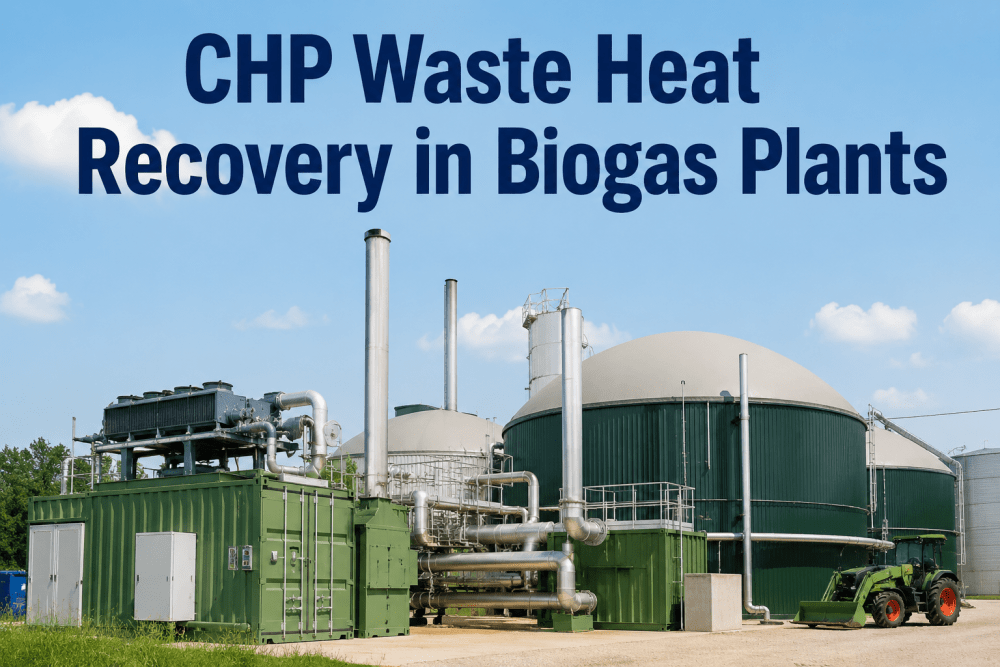
Combined heat and power waste heat is the single largest untapped energy resource in U.S. biogas plant operations — and it is routinely the cheapest energy available to any facility that captures it. A typical CHP unit converting biogas to electricity at 40–42% electrical efficiency rejects 48–55% of the fuel energy as heat: approximately 25–30% through the jacket water cooling system at 80–90°C, 18–22% through the exhaust gas stream at 350–500°C,Book a demo
Stop Discarding 50–70% of Your CHP Thermal Output. iFactory Captures and Monetizes It.
iFactory's CHP heat recovery platform monitors every capture circuit, heat exchanger, and thermal load in real time — optimizing heat distribution across digester heating, feedstock preheating, hygienization, and district heating offtake to maximize the value of every MMBtu your CHP produces.
CHP Waste Heat Sources: Temperature, Availability, and Recovery Potential
Every CHP installation produces heat at multiple temperature levels through different circuits — and the recovery strategy for each circuit is different because the temperature determines what the heat can be used for. Book a demo to receive a facility-specific CHP heat recovery assessment.
| Heat Source Circuit | Temperature Range | % of Total CHP Heat | Primary Recovery Method | Best End-Use Applications |
|---|---|---|---|---|
| Exhaust gas — post-turbocharger | 350–500°C | 18–22% | Shell-and-tube or finned-tube heat exchanger | Hygienization, thermal hydrolysis, high-temp digester heating, steam generation |
| Jacket water — engine cooling circuit | 80–90°C | 25–30% | Plate heat exchanger (closed loop to process loop) | Digester heating, building heating, feedstock preheating, district heating |
| Lubricating oil cooling circuit | 60–80°C | 3–5% | Plate heat exchanger (oil-to-water + water-to-process) | Low-temp digester heating, building pre-heat, floor heating |
| Charge air intercooler | 40–60°C | 2–4% | Plate heat exchanger (intercooler loop recovery) | Feedstock preheating, building ventilation pre-heat, digestate drying |
| Generator cooling / alternator air | 40–50°C | 1–2% | Air-to-water or air-to-air recovery | Building ventilation pre-heat, low-temp process |
CHP Heat Recovery System Architecture: From Capture to Utilization
An effective CHP heat recovery system is not a single heat exchanger — it is a coordinated network of capture circuits, thermal storage, distribution piping, and end-use delivery systems that must be managed as an integrated thermal network. iFactory's heat recovery optimization platform monitors every node in this network simultaneously, identifying the highest-value heat destination for every thermal unit recovered at every moment in time. The workflow below shows the five stages of the optimized heat recovery architecture.
CHP Heat Recovery Applications: Matching Temperature to End Use
The economic value of recovered CHP heat depends entirely on matching the temperature of each heat source to the temperature requirement of the end-use application. Exhaust gas at 400°C should not be used for low-temperature building heating — it should be cascaded through progressively lower-temperature applications, extracting the maximum thermal value at each temperature stage before the remaining heat is rejected. .
Digester heating is the highest-value application for recovered CHP jacket water heat because it replaces purchased natural gas or grid electricity that would otherwise be used for heating. The jacket water circuit at 80–90°C is an ideal match for the 70–80°C heating loop supply temperature required for typical mesophilic digester heating — no temperature lift is needed, and the heat exchanger approach temperature is achievable with standard plate heat exchanger design.
Feedstock preheating is a natural secondary application for recovered CHP heat because it requires temperatures in the 40–60°C range — achievable with heat that has already passed through higher-temperature applications and still retains useful thermal value. The primary source for feedstock preheating is typically the intercooler heat recovery circuit (40–60°C) supplemented by low-grade heat recovered from digestate cooling.
Hygienization — heating digestate to 70°C for 60 minutes to meet EU Animal By-Products Regulation and emerging U.S. biosolids pathogen reduction requirements — requires high-temperature heat that cannot be supplied by jacket water alone. CHP exhaust gas at 350–500°C is the ideal heat source for hygienization, providing the temperature differential needed to achieve 70°C process temperature efficiently. iFactory's hygienization heat recovery module integrates an exhaust gas heat recovery heat exchanger with the hygienization batch process — preheating digestate during the fill phase using recovered exhaust heat and maintaining temperature during the hold phase using a thermal storage buffer charged by exhaust gas recovery.\. Book a demo
When CHP heat recovery exceeds the plant's internal thermal demand — which occurs during warmer months when digester heating demand is lowest — the excess heat can be exported to a district heating network or adjacent industrial or agricultural facility as a revenue-generating heat offtake. District heating offtake typically requires supply temperatures of 70–90°C and return temperatures of 35–50°C, which is a direct match for the CHP jacket water circuit temperature range. iFactory's district heating offtake module manages the interface between the biogas plant's thermal system and the district heating network
CHP Heat Recovery Implementation: From Assessment to Full Optimization
Implementing CHP heat recovery is a structured engineering process that progresses from thermal audit through system design, installation, commissioning, and continuous optimization. iFactory's deployment methodology follows a four-stage roadmap that has been validated across biogas facilities ranging from 500 kW to 3 MW CHP installations. Book a demo to discuss your plant's CHP heat recovery project scope and receive a phased implementation plan with projected ROI.
Phase 1: Thermal Audit and Heat Recovery Potential Assessment
iFactory engineers conduct a comprehensive thermal audit of the CHP installation — measuring actual heat rejection rates on every circuit, establishing baseline thermal power output versus manufacturer specifications, and identifying the specific recovery configuration that maximizes capture efficiency for the plant's temperature requirements and end-use profile.
Phase 2: Heat Recovery System Design and Integration Planning
Based on the thermal audit findings, iFactory's engineering team designs the heat recovery system — specifying heat exchanger types and sizes, thermal storage capacity, distribution piping, control valves, and instrumentation. The design integrates with existing plant heating systems and accommodates future expansion for district heating offtake or additional end uses.
Phase 3: Equipment Installation and System Commissioning
Heat recovery heat exchangers, thermal storage tank, piping, valves, pumps, and instrumentation installed by qualified contractors working to iFactory's design specification. Commissioning includes flow balancing, temperature verification, control loop tuning, and safety system validation before the system is placed into live operation. Book a demo
Phase 4: iFactory Optimization Platform Commissioning and Continuous Improvement
iFactory's thermal optimization platform connected to all heat recovery instrumentation — monitoring capture efficiency, thermal storage status, distribution network performance, and end-use utilization. The platform's economic optimization engine begins managing heat destination allocation automatically, identifying further optimization opportunities as operating data accumulates.
Integrated vs. Fragmented Heat Recovery: The Real Cost of Discarded Thermal Energy
Most biogas plants that have installed CHP heat recovery equipment do not achieve the heat capture rates that the system was designed for — because the recovery system is managed as a fixed installation rather than an optimized operating asset. Heat exchanger fouling reduces capture efficiency. Thermal storage is charged and discharged without optimization. Heat is sent to low-value end uses when higher-value applications are available. iFactory's integrated heat recovery optimization platform addresses each of these failure modes.
Every MMBtu of CHP Heat You Are Not Recovering Is Revenue You Are Leaving on the Table
iFactory's CHP heat recovery optimization platform monitors every capture circuit, heat exchanger, thermal storage tank, and end-use heat consumer in your biogas plant — maximizing recovered heat value through real-time economic optimization.
CHP Waste Heat Is Not an Inefficiency — It Is an Uncaptured Revenue Stream
The thermal energy rejected by a biogas plant's CHP unit is not a thermodynamic inevitability that must be accepted — it is a recoverable resource whose value depends entirely on the infrastructure and intelligence applied to capture and utilize it. The 48–55% of biogas fuel energy that leaves the CHP as heat is produced at the same fuel cost as the electrical output, and every MMBtu of it that is recovered and used displaces purchased energy that would otherwise be consumed at market prices.
locations. Book a demo to receive a facility-specific CHP heat recovery optimization assessment with projected capture improvement and ROI based on your plant's current operating data.
CHP Waste Heat Recovery in Biogas Plants — Frequently Asked Questions
Transform Your CHP from an Electricity Generator into a Full-Spectrum Energy Asset
iFactory's CHP heat recovery optimization platform captures, monitors, and economically optimizes every MMBtu of thermal energy your CHP produces — turning waste heat into revenue and reducing your plant's purchased energy cost by 40–60%.